
THE ADVOCATE INVESTIGATES: One Month With No Cell Phones – Analyzing Student Survey Responses About The New Phone Policy
 By Ella Hopkins-Gianotti & Morgan Cappock – Social Media Editors
Jonathan Law students have been back in school for just over a month and the effects of the school’s phone ban are beginning to take shape.
To find out how the policy has affected students’ school experiences, The Advocate created an anonymous Google Form survey.
In total, 244 students across all grades participated in the survey during English class. The questions focused on classroom concentration, social interactions, anxiety about being separated from their cellphones, and students’ opinions on the policy.
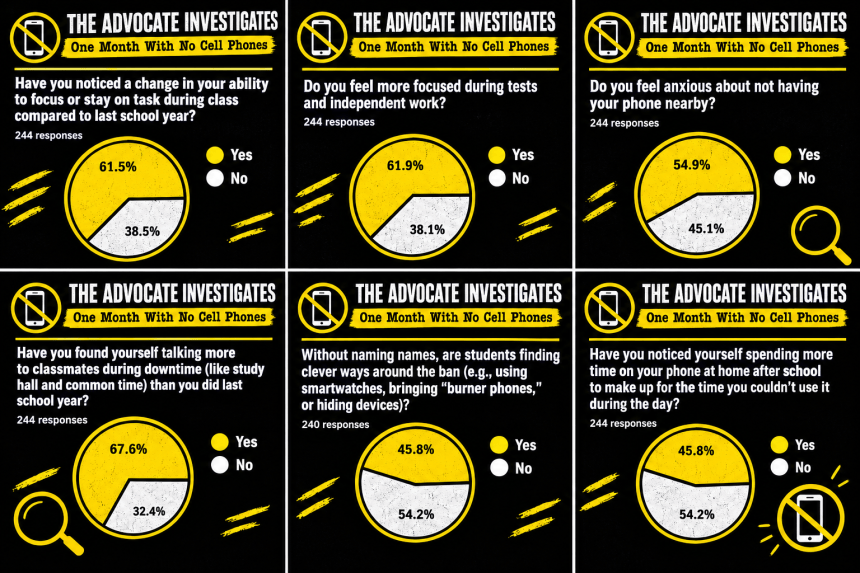
When asked whether they have noticed a change in their ability to focus or stay on task compared to last school year, 61% of the students reported no change. This suggests that, for many students, the phone van has not noticeably changed their perception of their classroom focus during its first month.
The other 39% of students voted that they have noticed a change in their ability to pay attention. Some wrote that the phone ban had decreased their attention and has made it more difficult for them to focus in class.
While most students reported no change in their focus, social interactions appear to be secretly telling a different story.
Approximately two-thirds of respondents said they have not been talking to classmates more during downtime than they did last school year. This suggests that removing phones doesn’t automatically lead to increased face-to-face interaction between classmates.
Some students may have already been socializing regularly, while others may prefer to spend their downtime doing other things like studying, completing assignments, or enjoying a quieter environment.
However, a lack of increased social interaction during class time doesn’t necessarily mean that phones are needed during each period.
During instructional time, phone notifications and messages can be distracting students from learning, regardless of whether the ban has changed their social habits.
Students were also asked whether they had noticed classmates finding clever ways around the policy, including using smartwatches, bringing additional phones, or hiding devices. Because this question was not optional, some students choose to not answer.
Among the responses, the opinions of the students were split nearly evenly (45.9% answered no while 54.1% answered yes.)
While the phone ban limits phone use during the school day, its effects may be extended beyond the classroom. According to the survey, half of the students who replied reported spending more time on their phones at home to make up for the time they could have been using their phones at school.
Though this policy cannot change how long our students spend on their phone, the data suggests that it may be shifting when the students use their phones rather than reducing their overall phone usage.
While the survey asked about students’ experiences with the policy, their written responses also revealed a range of opinions about how they think the policy should work.
When asked to answer the prompt, “If you could propose one realistic tweak to the policy, what would it be and why?,” one student replied how the administration could make changes regarding how the cell phone policy affects the use of headphones.
“The change I would make would be being able to wear headphones, and listen to music with our phones still in the lockbox,” the student wrote. “For some students like myself it is much easier to focus and get work done with it.”
One student replied how allowing phones during common time would get a positive response from students.
“I would make a tweak in allowing phones during common time because students are motivated to go on their phones during class to make up the notifications they haven’t answered,” the student wrote.
Some students want more flexibility during less structured parts of the school day, particularly study hall. Under the new policy, only upperclassmen are allowed to use their phones in during study hall.
“I would allow students to be on their phones during study and Advisory,” one student wrote. “Most of the time, I have nothing to do during these classes and I am forced to stare at the wall for an hour.”
Many students are in agreement with this change in the policy. Others believe that students should have more responsibility for managing their own phone use.
“It’s unfair that those who didn’t have issues with having their phones before the ban now have to have it locked away because others can’t handle them in school settings,” one student wrote. “If one person is using their phone and making a bad decision, mature people will not copy the behavior. A sense of trust should be reinstalled.”
Several students suggested an alternative in which phones are stored in students’ backpacks and not in cell phone lockers.
“Keeping the phones in our bags is a great alternative,” one student wrote. “Phones are useful in many classes if they are used responsibly. Students should be given the opportunity to use their phones responsibly.”
One student had a unique perspective on the new policy – and those who disapprove of it.

