 Most of the articles written by The Advocate staff each month focus on Law’s extracurricular activities, sports teams, and student achievements outside of the classroom. But what about the lessons that students are learning in the classroom from 7:20 a.m.-1:58 p.m. every day? This special series – compiled by the Journalism 1, 2, 3, and 4 classes – takes our readers inside the classroom and answers the age-old dinner table question: “What did you do at school today?”
Thank you to all of the teachers who participated.
(Photo by Addy Barber)
AP HUMAN GEOGRAPHY WITH MR. ROUMELES
By Addy Barber – Staff Reporter
AP Human Geography is an engaging course where students learn about different elements of society in different parts of the world.
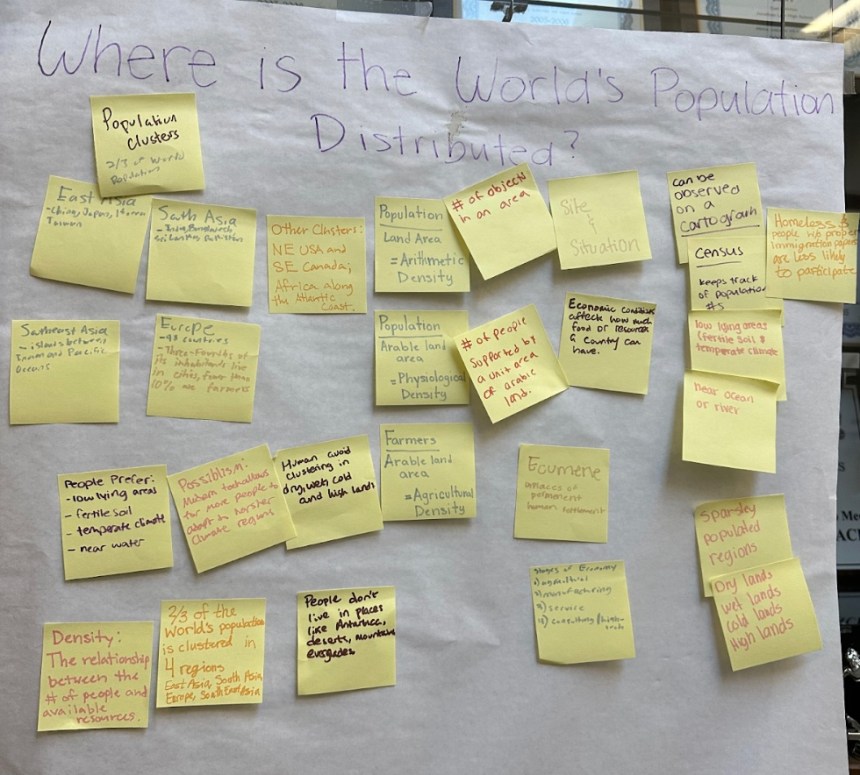
In preparation of each Chapter Test, Mr Roumeles has students “concept map” out the four Key Issues answered in the chapter. Students separate into four groups, and use their chapter notes to put as many sticky notes on the Key Issue poster as they can. Each group rotates after about five minutes until each group has contributed to each Key Issue.
This is a very helpful exercise that allows students to collaborate and makes sure they have something to study off of before their test.
“Concept mapping is a great way for students to collaborate instead of just individually studying,” Roumeles said. “It’s a good way to visually see the thought process of each student themselves and their peers and then bind it all together into a cohesive study guide that they can use to study later.”
Concept mapping also helps students catch any information they might have missed.
“It fills in all the gaps in my understanding and shows me what I need to focus on before the test,” junior Gabby Hyatt said.
This also allows students to take a break from the daily note heavy class periods.
“I like how we can work with others and share ideas in order to help further prepare for the tests,” junior Paige Kantor said. “It is also a fun activity where we get to take a break from just sitting at a desk.”
(Photo by Gabriella Coffin)
ORCHESTRA WITH MR. PELAGGI
By Gabriella Coffin – Staff Reporter
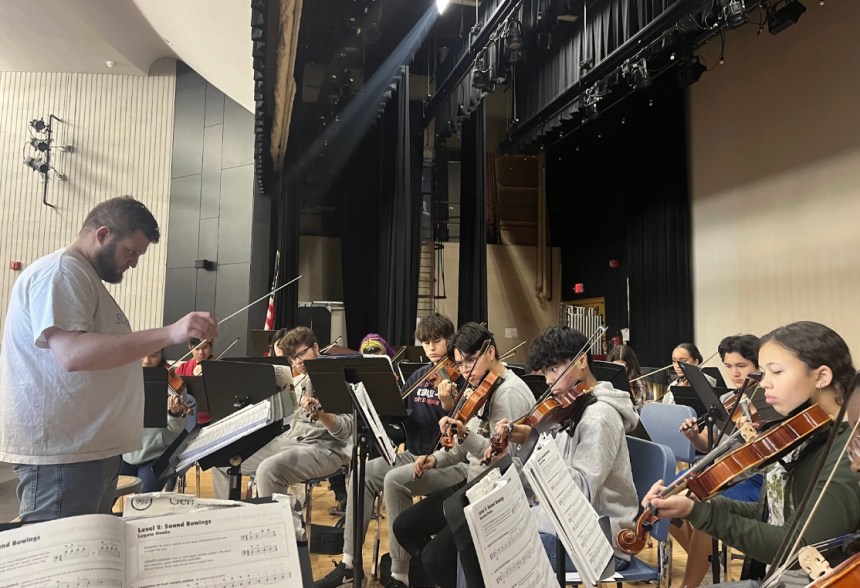
Mr. Pelaggi is working with his Orchestra students to prepare for the upcoming Winter Concert that will be held on December 14.
The pieces that the Orchestra will be playing and performing during this upcoming Winter Concert are “Enigma,” “Basiles Galop,” “Op. 9,” and “Thunder Snow.” During the class, the ensemble work with instrument sections that include violin, viola, and cello. Students continue to work on listening to their sections and constantly “finding their trio.”
“We went through a few of our pieces in full reps, working on refining interpretation, fine tuning intonation, and defining how we are interpreting the composer’s intent,” Pelaggi said. “At this point in the semester, we are doing fine tuning to our full performances.”
Pelaggi is working with his students on different types of notes, such as sound hooks and staccato. Staccato is performed when each note is sharply played differently from each other. The ensemble is continuously working on intonation within music as well as working together as a group.
“We’re working on slurring staccatos and going over parts in our concert pieces that needed work,” senior Section Leader Christina Ayala said. “I think we did pretty good.”
During class, students worked on dynamics within their pieces by identifying which parts of the music are supposed to be piano (quiet) and forte (loud). Although many in the ensemble may have been tired, everyone worked hard.
“We practiced dynamics and intonation by going through our practice books and reviewing a difficult passage thoroughly,” junior Section Leader Isabella Vancho said. “No matter how tired everyone gets from their classes, we always put our best effort into creating great music.”
(Photo by Ella Franzman)
JOURNALISM 2/3/4 WITH MR. KULENYCH
By Ella Franzman – Editor-In-Chief
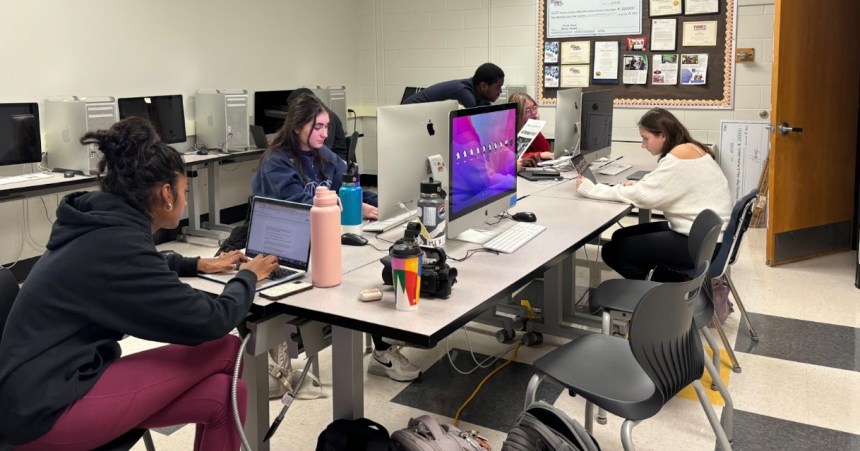
Law’s Journalism 2/3/4 class has been working hard in class producing a variety of different content.
Some students have been working on articles, podcasts, Instagram takeovers and videos asking the Law community topical questions. So far, The Advocate Online (jlawadvocate.com) has amassed 16,000 views in the first three months of the school year.
“The most exciting part of Journalism 2/3/4 this year has been the variety and the quality of the content that the editors have produced,” Journalism teacher Mr. Kulenych said. “We have an extremely creative group of editors this year and each week they are creating fun, informative, and entertaining content – print and otherwise – that students and staff have responded to very positively.”
Each Advocate article is required to have a minimum number of quotes from students and teachers relating to the article.
“I’ve really enjoyed creating podcasts this year,” sophomore News Editor Harshitha Kothapalli. “We started a podcast called The Court Report and it allows us to speak up on different topics around the school.”
Kothapalli is in Journalism 2 and has been working alongside Kayla Markowitz and Gemard Guery to create these podcasts, they are currently working on Episode 5.
“The Court Report has been a great place to address student concerns,” Guery said. “It’s allowed us to vocalize some things students have been wondering about, but also help inform students about what’s going on in the Law community. It has become one of my favorite parts of journalism.”
(Photo by Alexa Rosati)
HUMAN ANATOMY AND PHYSIOLOGY WITH MS. DOOLAN
By Alexa Rosati – Staff Reporter
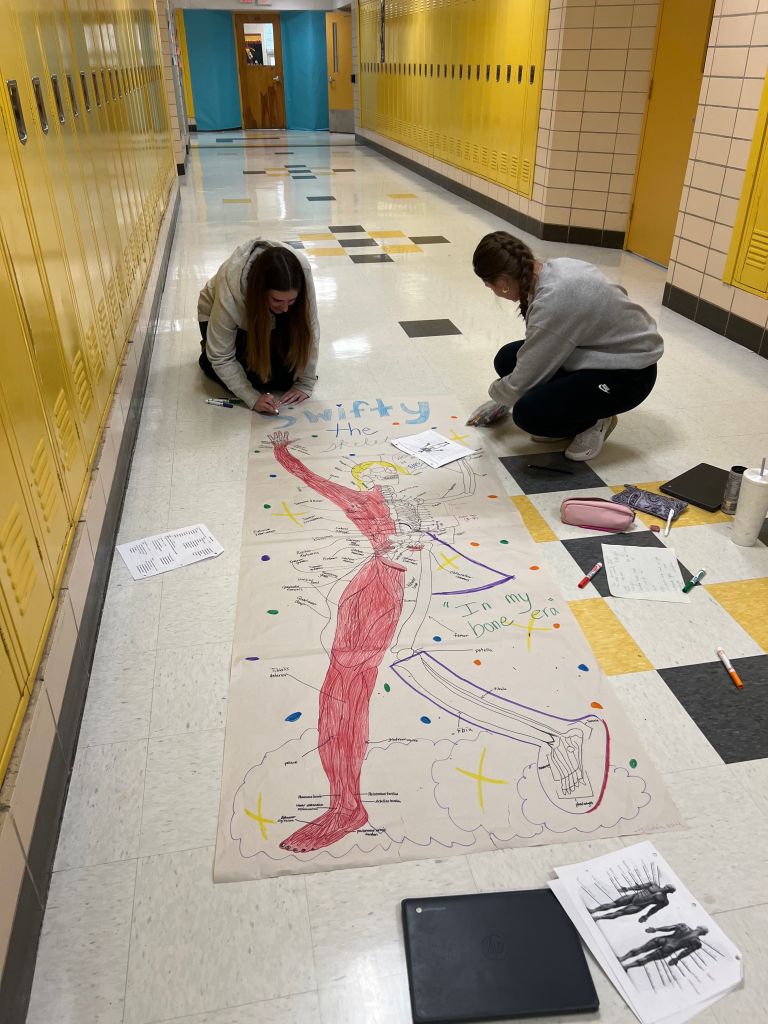
Ms. Doolan recently had students start their musculoskeletal posters for human anatomy and physiology.
Students were put into groups and asked to trace a classmate. After tracing, the students had to divide the drawing down the middle and make one side the muscular system and the other side skeletal. Students were allowed to pick a theme for their skeleton.
“My favorite part about the project is the creativity that comes with it,” Doolan said. “By having each group choose a theme, they are able to create a unique position for the skeleton and add a lot of detail to their poster so a lot of the end results are unique and look amazing.”
The goal of the project was to learn the different muscles and bones inside the body.
“I liked labeling the different parts because you get to learn more about the body,” junior Diya Patel said.
At the end of the project, Doolan will pick the best poster and the winning students will receive extra credit.
“I liked collaborating with my partners because it was fun to combine our ideas to make a really cool project,” sophomore Siya Patil said.
(Photo by Layla Alogna)
CHEMISTRY AND THE EARTH SYSTEM WITH MS. TURCOTTE
By Layla Alogna – Staff Reporter
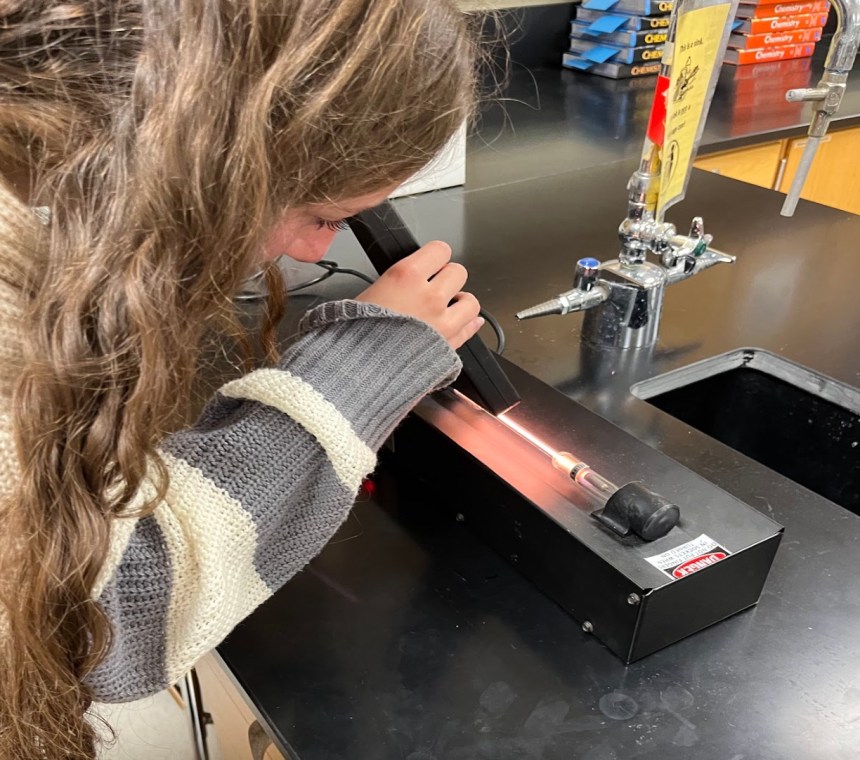
Students in Ms. Turcotte’s Chemistry class recently conducted an observational lab on Spectral Analysis.
Students used handheld spectrometers to observe the wavelengths of the unknown gas spectrum tubes and the wavelengths of the natural light from the sun.
“In the spectral analysis lab, students observe the line emission spectrum of three gases, which is like a chemical fingerprint, and then use it to identify each substance,” Turcotte said. “This lab also introduces students to the wavelength, frequency, and the visible spectrum. An understanding of the properties of light is important for the understanding of electronic structure and the quantum mechanical model of the atom.”
The students were able to view the colorful emission spectra with their own two eyes instead of simply watching a video about it or doing a worksheet. Looking through the spectrometer at the gas spectrum tubes, students were able to see a wavelength of colors ranging from red to violet.
“My favorite part about the lab was the hands-on aspect because it made it more engaging because we got a firsthand experience on how it actually looked,” sophomore Natalie Pank said. “I learned how to identify patterns and interpret spectral data.”
By seeing the individual emission spectra, they were able to identify which element was in the gas spectrum tubes based on where the bright lines were located on the wavelength spectrum.
“My favorite part of the lab was being able to work with my classmates and learn something new about the waves of visible light,” junior Sana Joshi said. “I learned about how different types of light emit different wavelengths and colors.”
(Photo by Kayla Markowitz)
AP GOVERNMENT AND POLITICS WITH MR. ZURAW
By Kayla Markowitz – News Editor
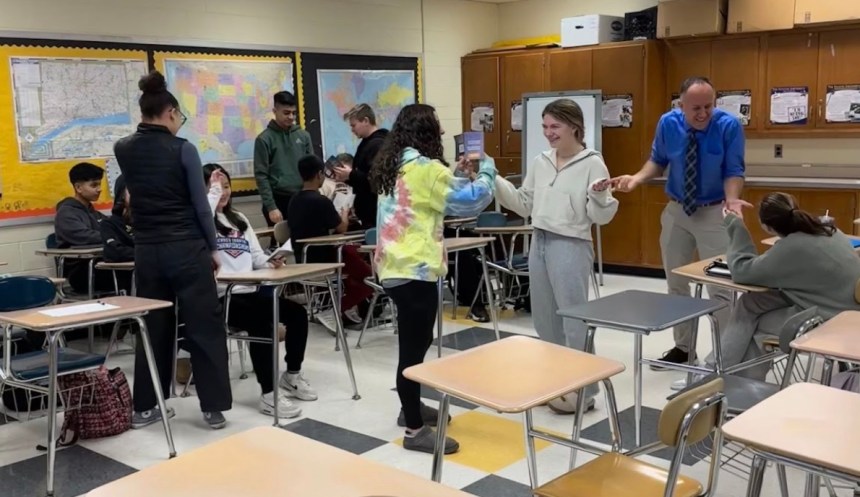
Students in Mr. Zuraw’s AP U.S. Government and Politics class recently took on the role of a Congressman to write and propose bills to the class.
The assignment – “You Are The Congressman” – encouraged students to create bills that they believe are important and debate them with their fellow classmates… a.k.a Congress members. As a class, they picked members from the House of Representatives and taught them to write a bill that their representative would most likely support.
“This experience was meant to truly immerse my students in the process of how a bill becomes a law,” Zuraw said. “By having to propose bills to their classmates and debate over the pros and cons of putting it into place, they were able to grasp how it goes down in real life.”
Students had to not only argue for their proposed bills, but also debate with other students using tactics commonly found in Senate and House debates
“Getting to see and hear the class actually go through the process of debating a bill definitely cleared up my confusions and uncertainty,” sophomore Lily Pleinman said. “It was cool because we had heard terms like logrolling and filibustering but understanding how they are implemented in real life dates was helpful.”
Students learned about law-making as well as the pros and cons of the law-making process by putting themselves in the shoes of a Congress member.
“I like interactive assignments like this because it’s much more engaging than simply reading about or listening to someone talk about something,” sophomore Sophia Scarpa said. “The class definitely went back and forth and really captured why less than 1% of bills get to become a law.”
(Photo by Fiorella Gargiulo)
LATIN 2 WITH MS. FURST
By Fiorella Gargiulo – Staff Reporter
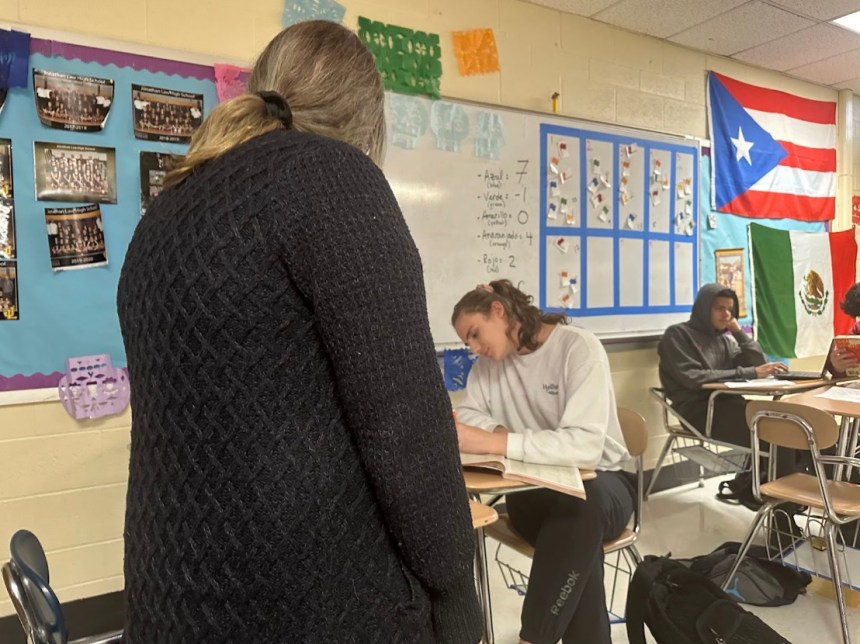
Recently in Latin 2, Ms. Furst led her students to focus their attention on the final stage of Unit One – the destruction of Pompeii.
The unit narrates a tale about a family living in ancient Rome and their everyday encounters. In the book, there are stages containing translations, passages, and lessons. In Stage 12, most of the family experiences the volcano, and most of them die. Before translating “ad villam,” which means towards the house, a documentary was shown, filling in most of the aftermath details.
“Translation is helpful to compare our own language with a foreign language and how they are similar and different,” Furst said. “It is also exciting and fun to read an ancient author in their original language.”
Overall, translations are a big part of the language and they teach students how to properly use certain tenses and sentence structures.
“Latin translations have made me more proficient in Portuguese and furthered my composition in English,” sophomore Ben White said. “The translations have not only done that, but have benefited my ability in Latin to comprehend, read, and write.”
With this translation wrapping up the unit, it was bittersweet for students to move on from subjects they started last year.
“I’m excited to learn more about the Latin subject and be able to have more knowledge about the language,” junior Brayden Dollar said. “But I’m also sad to see the old subject go, as we’ve spent over a year with the fictional family.”
(Photo by Molly Lynch)
UNITED STATES HISTORY WITH MR. LUI
By Molly Lynch – Staff Reporter
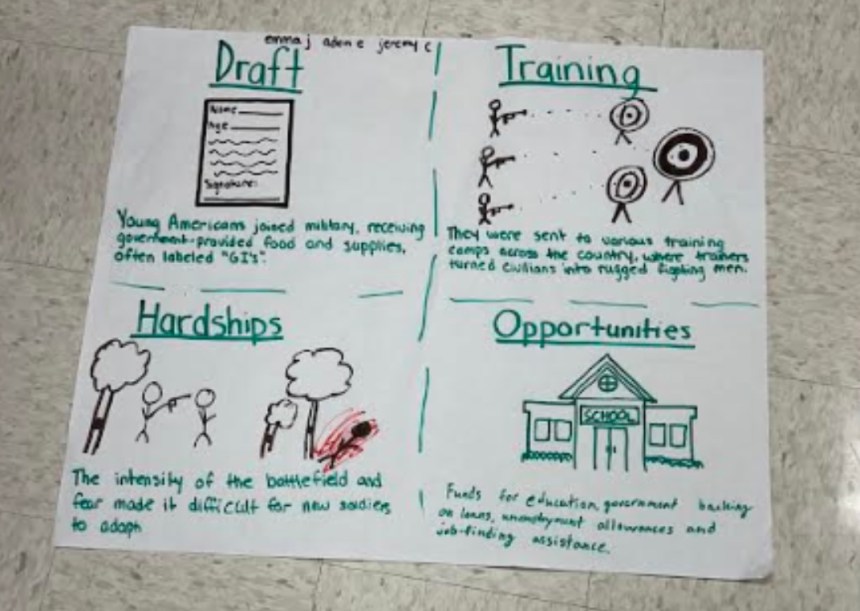
Mr. Lui recently had students in his U.S. History class create a group “storyline” poster on how different groups of Americans were impacted by World War II.
Students had to research these groups of Americans and create a “storyline” poster on how these groups were impacted by World War II. The posters had to follow the idea of a storyline so each picture that they drew connected to the next.
The American groups students researched were Japanese Americans, American women, African Americans, Mexican Americans, Jewish Americans, and soldiers.
“I enjoyed this assignment because we got to learn about different groups in World War II while coloring and making a storyboard, which was more engaging and interesting,” sophomore Sunny Scarpa said.
Lui allowed students to work in groups on this assignment which allowed them to collaborate with peers and engage more in the assignment.
“I enjoyed the lesson because I was able to explore deep into how my personal group African Americans were inspected by World War II and learned how women soldiers, Jewish, and Mexican Americans were impacted,” sophomore Brian Gonzalez said.
Students learned a lot from this assignment in part due to the groups that they worked with.
“This assignment teaches students how to communicate without words which benefits visual learners,” Lui said. “I also think it helps students connect images to certain vocabulary which they will remember when being assessed.”
(Photo by Aislyn McKernan)
INTRO TO ART WITH MS. JESSELL
By Aislyn McKernan – Staff Reporter
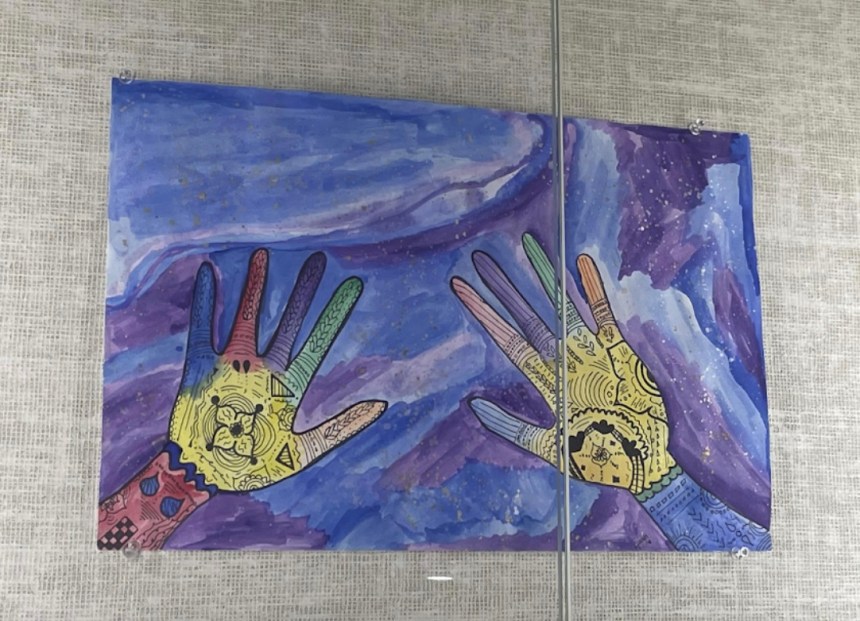
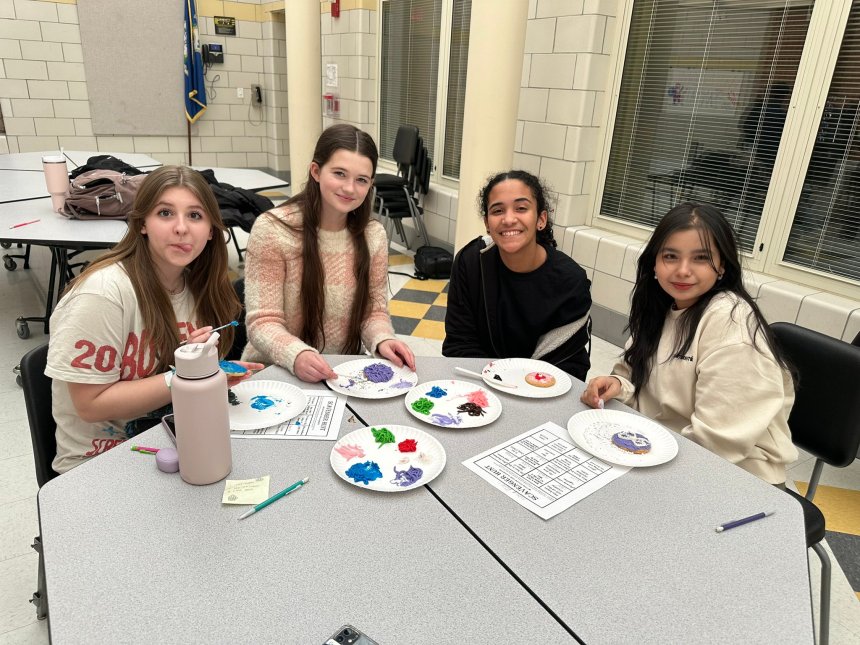
Ms. Jessell recently created a fun way for her Intro to Art students to create a colorful piece of art and learn about different cultures.
In this lesson, students created a watercolor painting with a henna design overtop. Students learned about the history behind henna and the different designs of henna.
“Although we did not use actual henna paste that is applied to the skin, we did create two-dimensional designs with watercolor and permanent ink on mixed-media paper,” Jessell said. “Students were able to focus on not only line, shape, and space, but also pattern, movement, balance, and color as well.”
During this lesson, not only did students learn how to do different designs and get creative freedom with colors and drawing, they also learned about henna itself and where it came from. They learned that it is a part of many cultures.
“I liked how intricate I could be with the designs,” freshman Avery Oliviera said. “It was a fun way to learn about lines and henna.”
Students also shared their own experiences with henna. Jessell shared that she used henna once and other kids shared that they did as well. With this project, students didn’t just learn about lines and henna, they also used different ways to color our project.
“I liked how we got to experiment with water colors,” freshman Ipek Nil Yalcin said. “Students got to use watercolor to paint their projects. We learned about how you can do different strokes when watercoloring to make it look unique.”
This project showed students different ways to create art and connect with cultures.
(Photo courtesy nytimes.org)
ENGLISH 1 WITH MRS. EVANS
By Sophie Kalagher – Staff Reporter
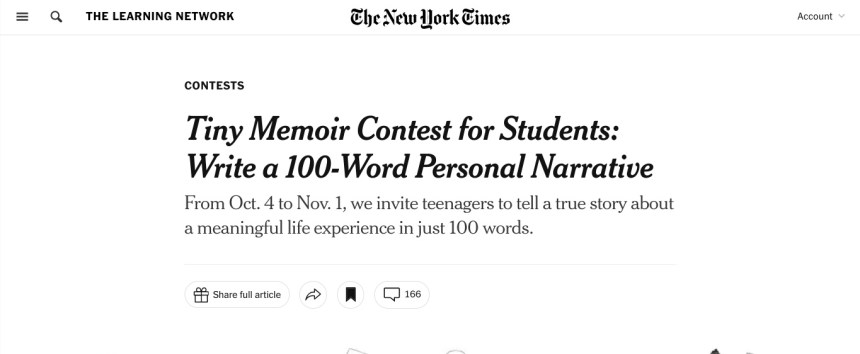
In Mrs. Evans’ freshman Level 1 English class, she created a recent lesson around the submission of a 100 word essay to The New York Times.
The essay is 100 words about anything in the student’s life that has made a significant impact on them or is of interest to them. The essay was intended to create a small window into the minds of her students. Evans showed many examples of essays and went around to each student to help support and give them ideas on their essay (encouraging them to submit).
“This lesson confirmed the writing abilities of 14 year olds,” Evans said. “I haven’t taught freshman in eight years and, come to find out my expectations were not too high after all.”
Evans is a first-year teacher at Jonathan Law and most recently taught in the town of Oxford. She is very passionate about her classes being involved with The New York Times competitions and is famous for basing many lessons on them.
“I liked it – it was a challenging assignment, but I was able to be creative with it,” freshman Emily Vella said. “I like how it was a skill that I could use in the real world.”
This essay assignment created a lot of buzz throughout the classroom between students sharing topics or comparing essays. Many students entered the contest (which was optional) after being so engaged and inspired by the way Evans introduced them to this assignment.
“I thought it was cool that Mrs. Evans included a project that we could enter,” freshman Sadie Timeny said.
(Photo by Yeiden Nieves)
SPANISH 2 WITH MRS. TROMBETTA
By Yeiden Nieves – Staff Reporter
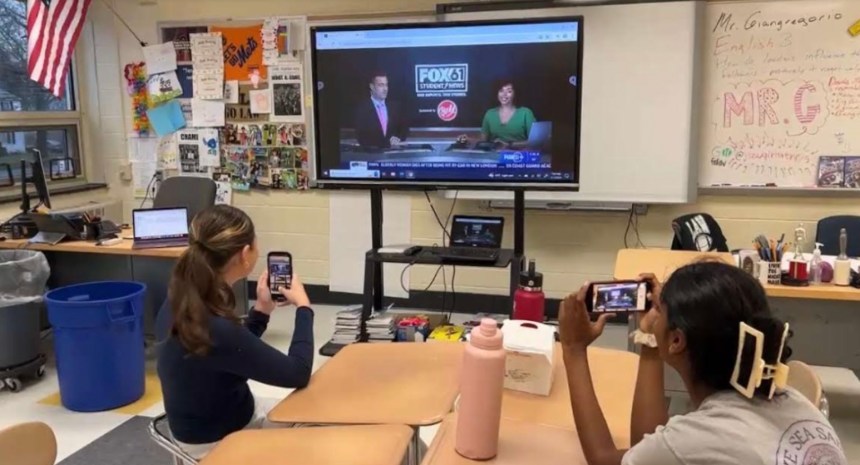
Mrs. Trombetta recently came up with a fun assignment to help her students be more comfortable with speaking the Spanish language.
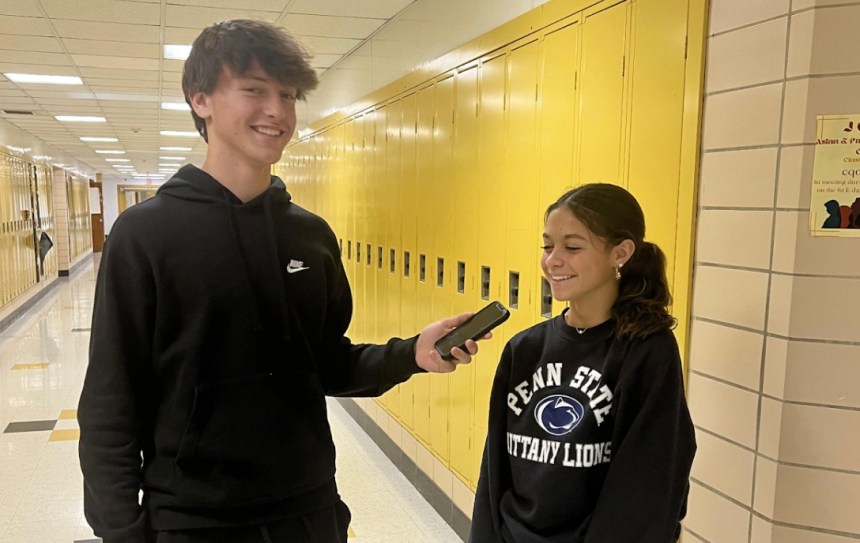
Inspired by The Morning Briefing morning news show interviews, Trombetta came up with the idea to have her students do something similar. She had her students come up with 10 questions in Spanish and go around the Jonathan Law community and interview their peers and have them answer in Spanish.
“The purpose of the assignment is for students to increase proficiency in their skills by having them speak more Spanish with their community,” Trombetta said. “Another objective is to make Spanish more visible within our community.”
The activity was a great way of using students’ knowledge of Spanish and strengthening their skills in a fun way.
“The project we are doing is helping me be more comfortable speaking Spanish to others and gain knowledge on the language,” sophomore Avery Moulton said. “It helps with memorization when needing to interview others and it has really helped me with speaking Spanish to my peers.”
Trombetta’s goal with her assignments is to help her students acquire the Spanish language. One of the most important factors in learning a language is learning how to structure sentences.
“This assignment helped me with structuring my sentences to get my point across while interviewing peers.” freshman Matthew Witteman said.
(Photo courtesy Julia Ryan)
PHARMACEUTICAL CHEMISTRY WITH MS. DOOLAN
By Julia Ryan – Staff Reporter
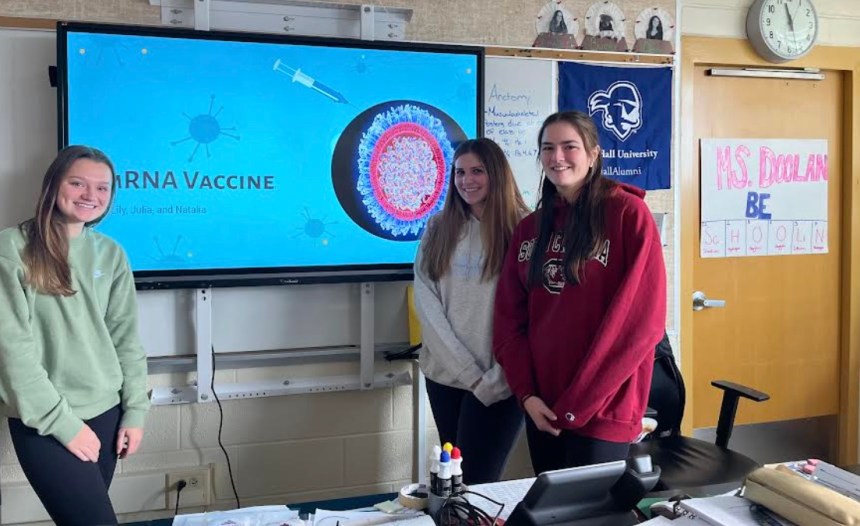
Ms. Doolan recently assigned a project in Pharmaceutical Chemistry to help students understand types of vaccines and how they work.
Learning how a vaccine works is important for Pharmaceutical Chemistry students to understand because vaccines play a crucial role in preventing the spread of disease and protecting health. In this specific project, students work with one another to understand the body’s response.
“I enjoyed this project because it is important for students to understand vaccines in the world we live in today,” Doolan said. “This was part of our unit in which we’ve been investigating the spread and control of pathogens and it’s very prevalent, especially at this time of year, when we see an increase in COVID and the flu.”
Doolan loved watching students present everything they learned from this project.
“The project further enhanced our knowledge on the topic of various vaccines and their impact on the body,” junior Lily Baird said. “The presentations were a fun way to learn and it seemed like everyone was able to gain a lot from them.”
Working in groups gave each student an opportunity to learn from each other.
“This project had lots of benefits because I was able to learn about various vaccines while also getting to collaborate and discuss with my group,” junior Natalia Michnik said.
(Photo courtesy Mr. Healy)
ADVANCED CREATIVE WRITING WITH MR. HEALY
By Taylor Batterton- Staff Reporter
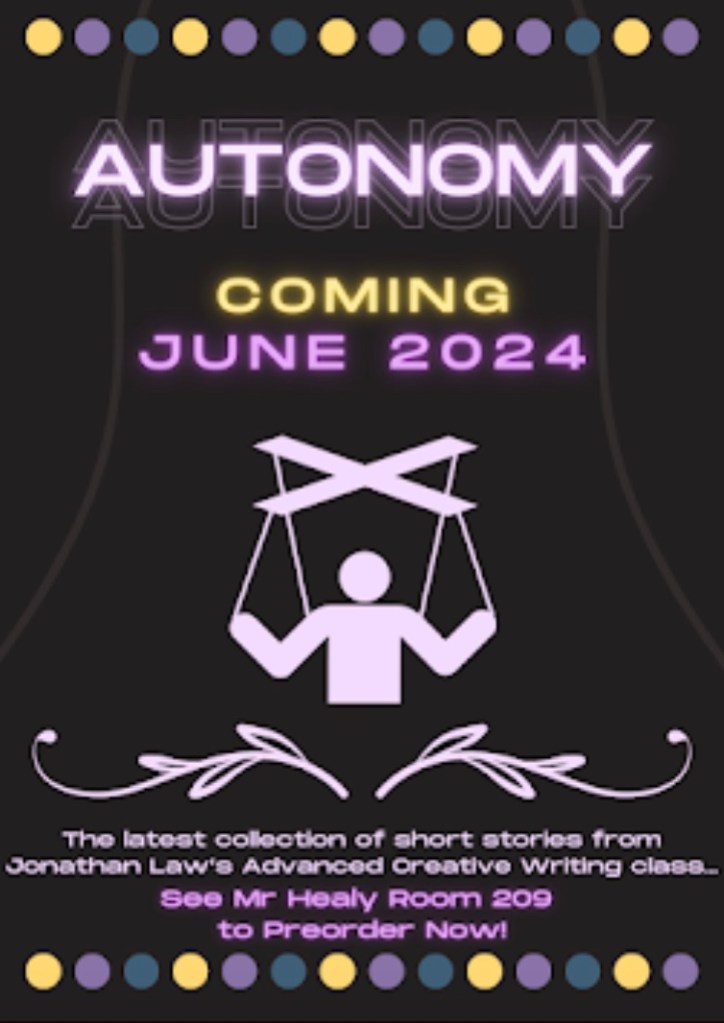
Law’s Advanced Creative Writing Class is diving into marketing for the book they will publish by May of 2024.
The class was inspired by other Jonathan Law clubs to create a TikTok and Instagram account to spread awareness to their upcoming book. Mr. Healy works with students to design the outline for the cover of the book and the goals of the class to achieve by the end of the year.
“Our marketing will be fueled mainly by word of mouth, but we’re really hoping for social media engagement to really spread the word as well,” Advanced Creative Writing teacher Mr. Healy said. “It’s a new tactic for the class, so I’m excited to see how it goes.”
The class discusses content they should make with the goal of getting onto BookTok and reaching more audiences.
“I feel that by making content on TikTok will have a great impact on increasing our marking. The content I will start to produce and create will relate to the BookTok side of TikTok,” senior Macy Tiche said. “By having our videos reach these audiences it will get people excited about teenagers in this generation producing novels and having their opinions heard.”
The book is called “Autonomy,” which means making one’s own rules and being free from external control or influence. Senior Faith Santiago came up with this idea in order to encapsulate everyone’s ideas.
“We talked a lot about wanting the creative control to write about whatever topics we want, so I thought of the word autonomy,” Santiago said. “Our book connects to the word autonomy because of the vast amount of topics everyone covers. We are given a lot of creative freedom in regards to what we write our stories about, so we have the autonomy to follow where our ideas take us and write something that we are passionate about.”

(Photo by Charlotte Rascoll)
PHYSICS WITH MR. STANTON
By Charlotte Rascoll – Staff Reporter
Students in Mr. Stanton’s Physics class recently participated in a lab experiment that involved driving little electric cars down the hallway.
Students were put into groups where they then set out long sheets of paper in the hallway and drew lines on it to mark time intervals. They then drove their cars down the sheets of paper and timed how long it took the car to cross each line.
The lab itself measured the velocity of the car and whether or not it remained constant. Velocity is one of the many factors of kinematics that the students have been studying for the past week.
“Students had to use ideas from classwork about distance, time and speed (velocity); they also had to use things they already knew about measuring,” Stanton said. “Every time I run a lab like this, someone does something outside the box and it is great to watch them think on their feet.
Students were also asked to write a procedure before they conducted the experiment. The procedure could include as many steps as needed, and really required students to think about what they were going to be participating in.
“The experiment showed us that the environment and being precise with the procedure are factors to be taken into consideration if accurate data is wanted,” junior Lily Baird said. “It was a fun way to learn more about our unit and working together in groups helped enhance our problem solving capabilities.”
The lab was an entertaining and interesting way to allow the students to be more interactive in their studies. They had full control over everything in the experiment, and it was up to them to work together to gather their results.
“I enjoyed being able to move around and use tools to make the lesson easier to understand,” junior Taylor Coretti said. “Being able to talk to people and work with others also made the topic more enjoyable.”
In the end, students were asked to find the average of each time interval, and graph their results in Google Sheets so that they could see the trendline of their date.
(Photo by Madi Black)
WORLD HISTORY WITH MS. HEALY
By Madi Black – Staff Reporter
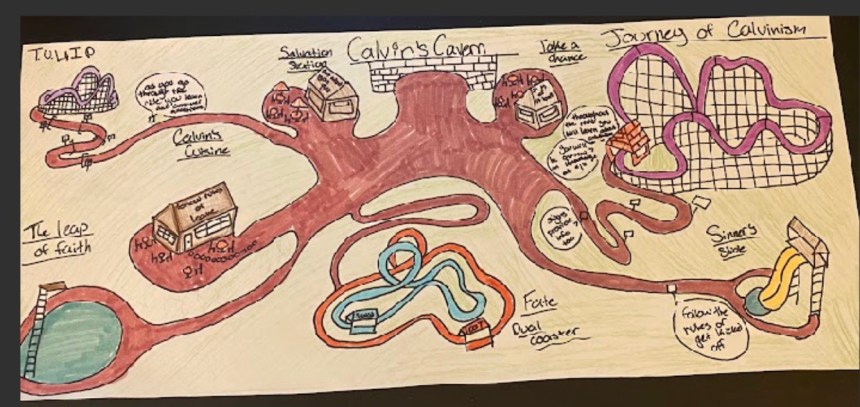
Ms. Healy’s World History class recently completed a Theme Park project to recap what they did in their Protestant Reformation unit.
This lesson helps students understand the unit they went over is a fun way.
“For the Theme Park Project students were asked to create mini amusement parks based on a branch of Christianity that began during the Protestant Reformation,” Healy said. “There had to be big rides, small rides, a restaurant and concession stands that all had to relate in some way to the branch they chose. That could mean they could base attractions on leaders, sacraments, major events in that branch, the history of it, or the region it was popular in. Each group then had to combine their parks into one large park, the way that Disney has Animal Kingdom, Magic Kingdom, and Epcot, with a big landmark that ties them all together. There is also a written component to the project where students have to provide reasoning behind their attractions and how they relate to their chosen branch.”
Students came up with many different, creative ideas on how to complete this project.
“I liked the theme park project a lot,” freshman Sadie Timeny said. “I thought it was a super creative way to end our unit. My favorite part about the project was the space for creative naming and making rides. This was a fun way to incorporate a thinking out of the box idea. I would do this project because again it was fun and very easy to understand. I think this would be a good project idea you could use other themes – like movie theater, museum, a school, instead of an amusement park.”
Healy thought that everyone did well on this assignment and she can’t wait to do it again next year.
“I thought it was a fun project and I learned a lot from it,” freshman Matthew Witteman said. “My favorite part of the project was the designing part because I got to get creative with the names of the rides and how they looked. I would do it again and I could do it on anything and just make it the theme. I had to do some work outside of class so the only thing I would’ve changed is have more time to do it.”
(Photo by Courtney Russo)
LIVING EARTH WITH MR. MORAZZINI
By Courtney Russo – Staff Reporter
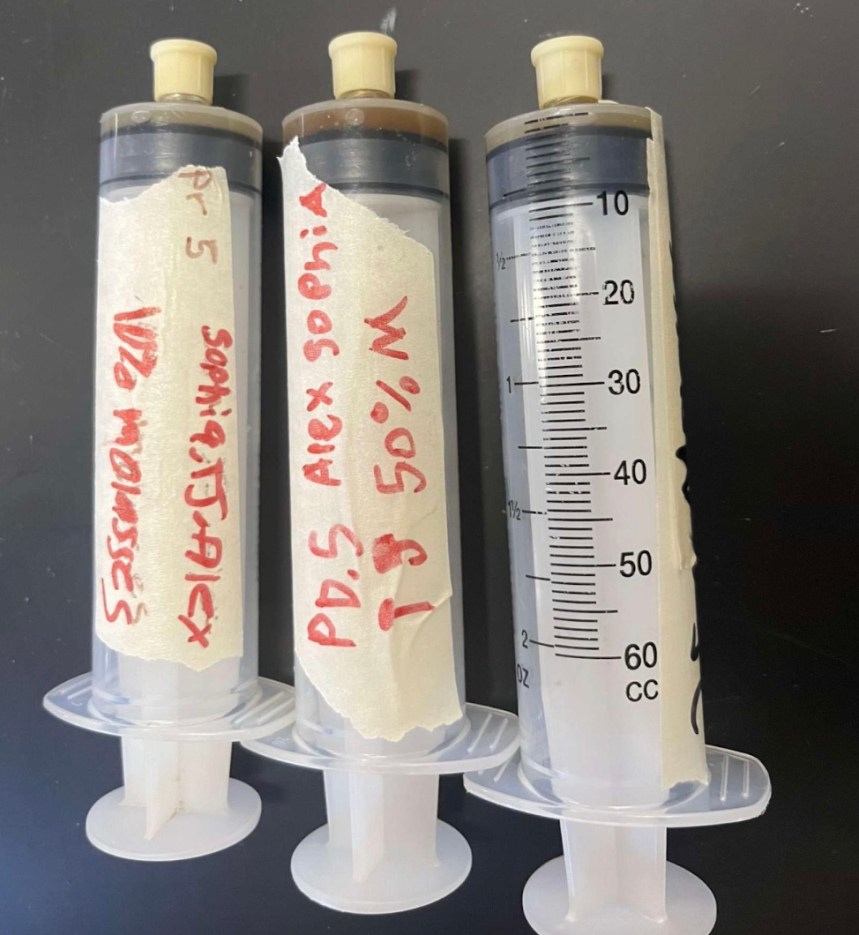
In Mr. Morazzini’s Living Earth class, students recently completed a lab that showed them how yeast and molasses create CO2.
First, students started off using a packet to identify the variables and the testable question. Once Mr. Morazzini checked them off, and they were able to write their procedure.
“I think the lab went well, students overall are improving in designing their own investigations in science considering all the work we’ve done so far this year on this skill,” Morazzini said. “With that being said, some students are still struggling with figuring out the variables in their experiments.”
Students left their experiments at school overnight and the next morning came back to class with amazing results.
“I really wasn’t expecting the results we got,” freshman Maddy Bonanno said. “I was expecting change but I wasn’t prepared for how much we saw.”
Each group had different independent variables that were different in every syringe which caused different results for everyone.
Some of the groups that students could pick from were molasses, concentration, light, and temperature.
“I like that we got to pick the topic we were most interested in,” freshman Abby Merenda said. “My group picked light and I liked how we got to see the difference in how light can affect the volume of CO2 in yeast and molasses in different places with light and no light.”
Each one of Morazzini’s Living Earth classes completed the lab and students have seemed to really enjoy it.

(Photo courtesy reellibrarians.com)
JOURNALISM 1 WITH MR. KULENYCH
By Chloe Edmonds- Staff Reporter
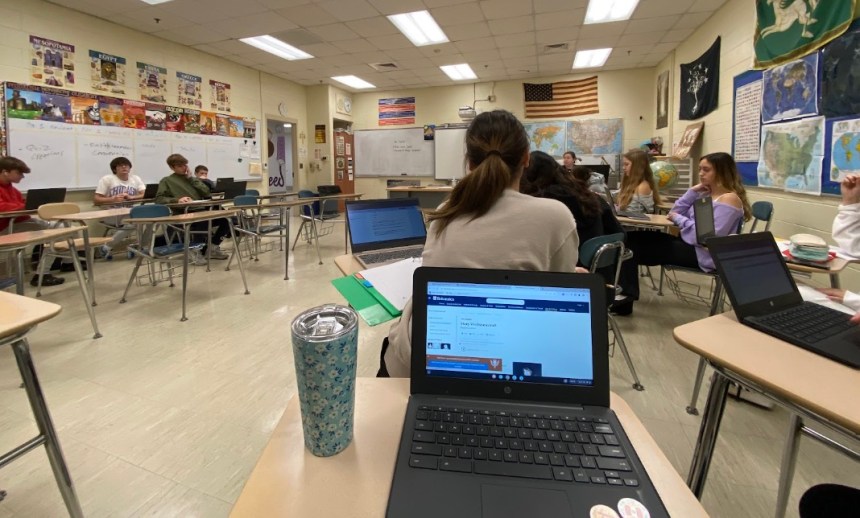
Mr. Kulenych’s Journalism 1 class has recently been studying “All The Presidents Men,” a movie based on the Watergate scandal.
The Watergate scandal was a major political scandal involving former President Nixon. “All The Presidents Men’s” details the investigative journalism work of Washington Post reporters Bob Woodward and Carl Bernstein as they uncovered the scandal and Nixon’s role in it – which eventually ended in his resignation.
“It’s extremely important that beginning journalists understand the power and responsibility of the press and no case shows that more than the Watergate scandal,” Kulenych said. “Woodward and Bernstein were tireless in their reporting and in the end that work was powerful enough to bring down the President of the United States.”
Aside from the movie, students also read a New York Times article on Mark Felt, the secret FBI informant that famously helped Woodward and Bernstein in their reporting of the story.
“I really enjoyed watching the movie in class,” freshman Logan Mullarkey said. “it was extremely interesting and insightful. It took about three classes and was overall super interesting to learn about.”
The movie was an inside look into the Watergate scandal and showed the behind-the-scenes work of the case and how journalism played a massive part in uncovering it.
“I really enjoyed learning about ‘All The President’s Men’ because I thought the Watergate scandal was really interesting and how a big political figure like Nixon could get into a scandal like that,” freshman Aislyn McKernan said. “You don’t see a lot of primary political figures like presidents get held accountable for their actions.”
(Photo by Ava Grippo)
WORLD HISTORY WITH MR. ROUMELES
By Ava Grippo – Staff Reporter
Mr. Roumeles’ freshman World History class has just begun working on a new project.
The class has just started their new unit on The Enlightenment. The students have recently learned about several figures that were important during this era with each student being assigned an individual to research.
“The reason for the project is that we want students to be aware of not only what the Enlightenment era philosophers thought government, religion, the role of women in society and all those other important elements,” Roumeles said. “We want students to be able to take the role of those philosophical figures to better get to know them.”
For each individual, students have to research the person’s beliefs in government, religion, education, rights and property.
“I worked on researching Denis Diderot who was one of the many Enlightenment thinkers during the Enlightenment era,” freshman Jackie Rivera said. “I researched his views on government, structure, religion, education, rights, and property.”
The reason for researching these questions is to see the different opinions that people had during The Enlightenment and how they are similar and different from others.
“The project is so we can see the different points of views with thinkers from the Enlightenment to show their point of view from the government and rights and religion and more,” freshman Anna Bludevich said.
(Photo by Michael Smith)
SPANISH 4 WITH MR. RODRIGUEZ
By Michael Smith – Staff Reporter
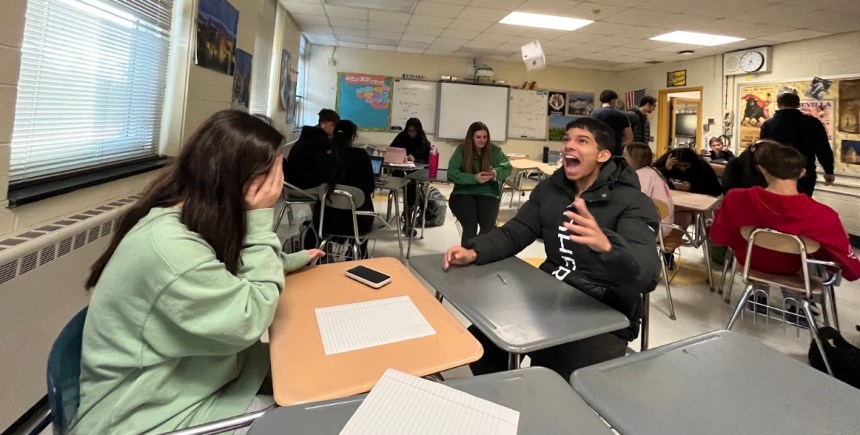
Mr. Rodriguez recently came up with a game for students to be interactive in class and to learn more about how to use preterite verbs in Spanish.
Preterite verbs are used for actions that took place in the past tense for example last night, last month, etc. Rodriguez encourages students to interact in the activity to get their Spanish speaking better and to flow more naturally when being used.
“Students will roll dice to get random words and phrases to be able to put it all together into a sentence and properly conjugate the verb,” Rodriguez said.
Students enjoy using games to learn in school because it makes learning fun.
“I like the activity because we talk a lot more to classmates and we are also learning as we play,” junior Katherine Cepetelli said.
The students have played the game the past teo classes and enjoy doing activities like these.
“It’s a fun way to learn a new subject in Spanish while also playing a game with other classmates,” junior Tim Firla said.
(Photo by Alex Rodriguez)
AP MACROECONOMICS WITH MS. HEALY
By Alex Rodriguez – Staff Reporter
Ms. Healy has recently come up with a fun and unique activity for her AP Macroeconomics class to help better prepare her students for their upcoming Unit 2 test.
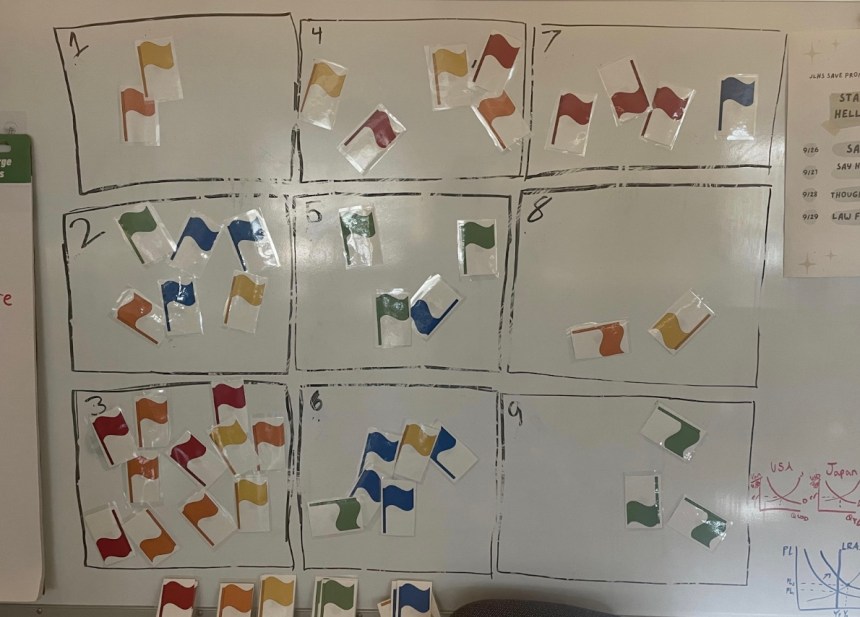
Prior to every test students play a game called “Capture the Flag.” When the class plays Capture the Flag everyone is split into their teams, and each team starts with one of each flag in their square. Everyone gets a review or practice packet and teams work to complete problems together.
“It’s been a great way to do a review in a fun way that puts it totally on the students,” Healy said. “The element of competition also keeps everyone super engaged because they want to capture more flags.”
Each color flag has a different of amount of points which the class does not know until the end. Whichever team has the most points at the end of the class wins.
“I think it’s a great game to play,” senior Jack Bretthauer said. “Not only is it fun but we all get really great review work in and we all get very competitive with each other.”
Students have given great feedback on this review game. The game continues to grow and add new elements every time.
“I think the capture the flag game is great,” junior Tyler Davis said. “Really fun way to learn and review as well as classroom bonding.”
(Photo by Analiyah Velez)
CHORUS WITH MS. JONES
By Analiyah Velez – Staff Reporter
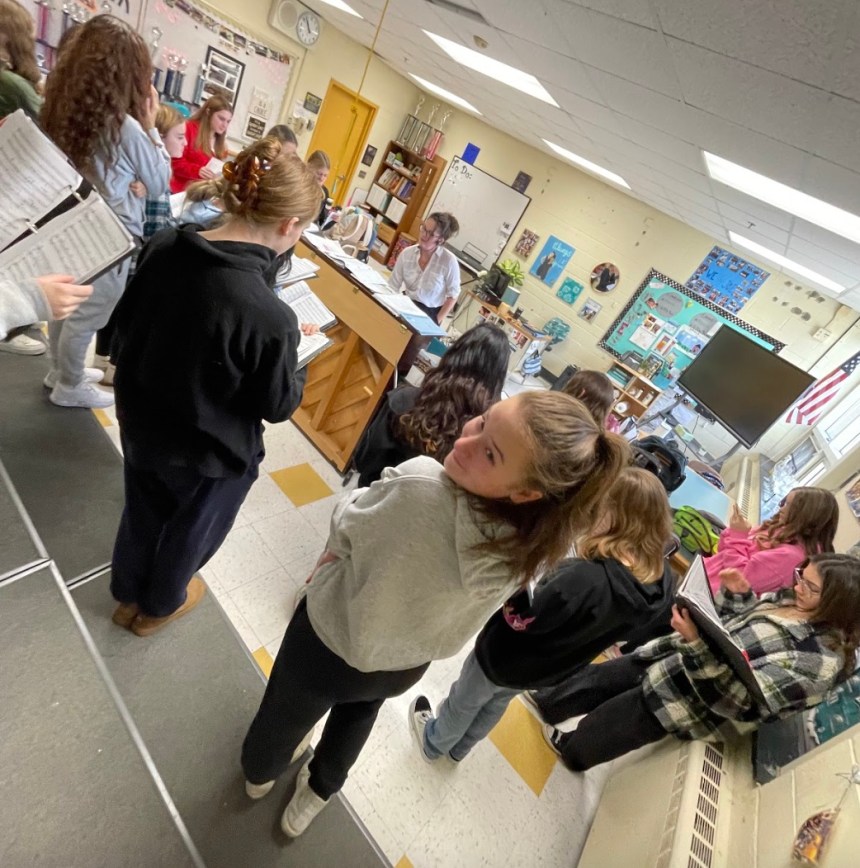
Jonathan’s Law Choir teacher Ms. Jones is creating rehearsals that are fun and engaging for the upcoming Choir concert.
Each Chorus class starts off with student-held warm-ups to create leadership, then the Choir reviews upcoming fundraisers and activities. Jones creates ways for the students to learn songs while building up the Choir’s music skills.
“There is a lot of nuance to decide what needs to be done because I have many specific techniques and literacy goals and objectives for each class but also the pressure of ‘this has to be ready to be performed so the students can be proud,'” Jones said. “So, it’s all a balancing act. Through that we also learn skills on how to continue through performances even if mistakes are made, which is a great and necessary quality to have as a musician.”
Jones chooses two students a day to lead warmups as a way to build up leadership music skills.
“In our Freshmen Chorus and Concert Choir classes we learn most of our songs in class with Ms. Jones,” senior Board Member Dani Matist said. “We work every class going over parts and really trying to nail the notes. It’s all about repetition.”
After going through the parts, students split up into alto, soprano, or tenor depending on the song, having the students give feedback to boost the skill sets of the Choir.
Typically, during the annual Winter Choir Concert, the Choir sings five to six songs, while Advance Vocal Ensemble (AVE) sings roughly seven to eight songs.
“My favorite song is ‘White Winter Hymnal’ because I feel confident while singing it,” freshman Ashlyn Smithauser said.
Jones makes rehearsals fun and light while constantly working hard. Several girls from AVE have joined the Freshman Choir class so freshmen have an example.
“I really enjoy being in the freshmen class, it’s a great group to be around,” Matist said. “When we have really stressful days in AVE, I love being able to have fun with the freshmen who are more relaxed.”
(Photo by Logan Mullarkey)
HEALTH AND SAFETY 1 WITH MR. MAURUTIS
By Logan Mullarkey – Staff Reporter
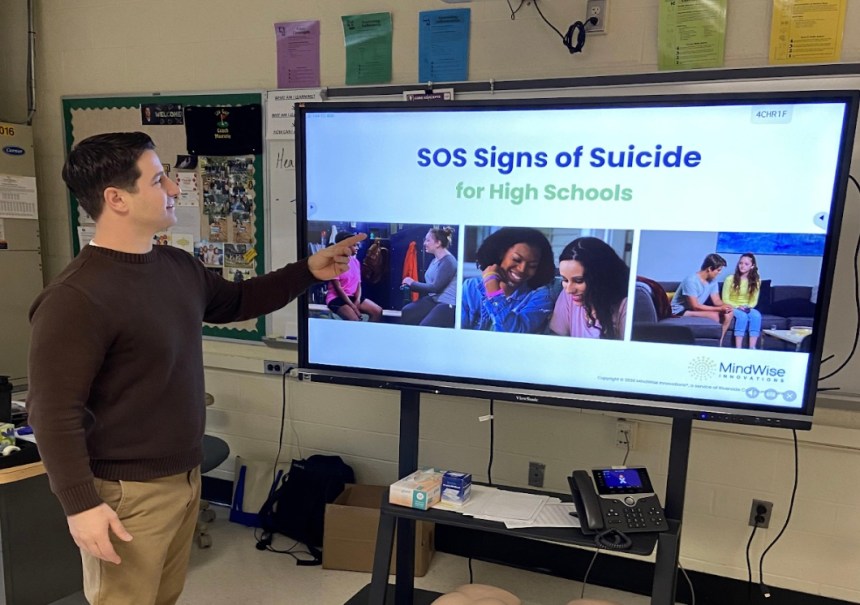
Health teacher Mr. Maurutis recently went over a lesson including suicide prevention and helped the students understand how to help people in need.
Students used the knowledge they already had about the subject and answered questions. The class also watched videos based on real-life scenarios about what to do – and what not to do – when in a suicide-related situation and explored different options that were available.
“I really enjoy talking about other topics and units such as nutrition, healthy habits, and stress management, however the lesson of suicide prevention is so important,” Maurutis said. “The ability to connect with students and give them information around warning signs, expressing care, and telling a trusted adult is powerful to help those that may be struggling.”
The goal of the lesson was for the students to realize how important it is to express care and to help those who have struggles.
“It’s a very important lesson that I knew was going to be brought up sooner or later and I felt it should be known by all students and teachers,” freshman Elijah Oliver-Fernandez said.
The subject of suicide prevention is a big topic to handle but it is very important for all people to know how to stop suicide and to help those in need.
“I thought it was a subject that everyone should know,” freshman Tamaree Ortiz said. “I learned how to acknowledge the signs given to me and what to do with them to give care and find help.”
(Photo by Ryan Nobles)
AP UNITED STATES HISTORY CLASS WITH MR. LUI
By Ryan Nobles – Staff Reporter
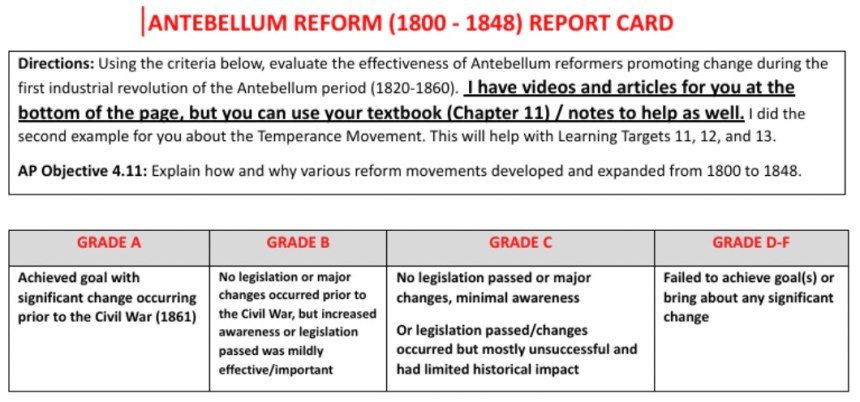
Mr. Lui’s AP United States History class recently completed an activity where students made a report card for Antebellum Reform.
The five categories that were graded were the Second Great Awakening, Temperance, Utopianism, Women’s Rights, and Abolition. Students had to grade each category based on whether or not the main goal was achieved with significant change before the Civil War of 1861.
Students could could also give partial grades like a B if the goal was only partially achieved.
“Students needed to evaluate the effectiveness of Antebellum reformers promoting change during the First Industrial Revolution,” Lui said.
The lowest grade given during this assignment was Utopianism which was given an F grade because the majority of the “movements” had failed. The highest grade that was given was on Abolition. It received an A+ because slavery became illegal and slaves were freed.
“I liked this assignment because it taught us about the Antebellum Reform while still making it fun to work in groups and the report card format made it fun rather than just taking notes,” sophomore William Soda said.
Two categories were given a B+ – Temperance and Women’s Rights. Temperance was given a B+ because the 18th Amendment went into effect which slowed down the sale of alcohol. Women’s Rights were given a B+ because women were finally given the right to vote in 1920.
“This assignment helped teach me about Abolition and understand how slavery had ended and when and why it got abolished,” sophomore Surya Gautham said.
(Photo courtesy gophersport.com)
PHYSICAL EDUCATION 4 WITH MR. ASMUSSEN
Brian Goglia – Staff Reporter
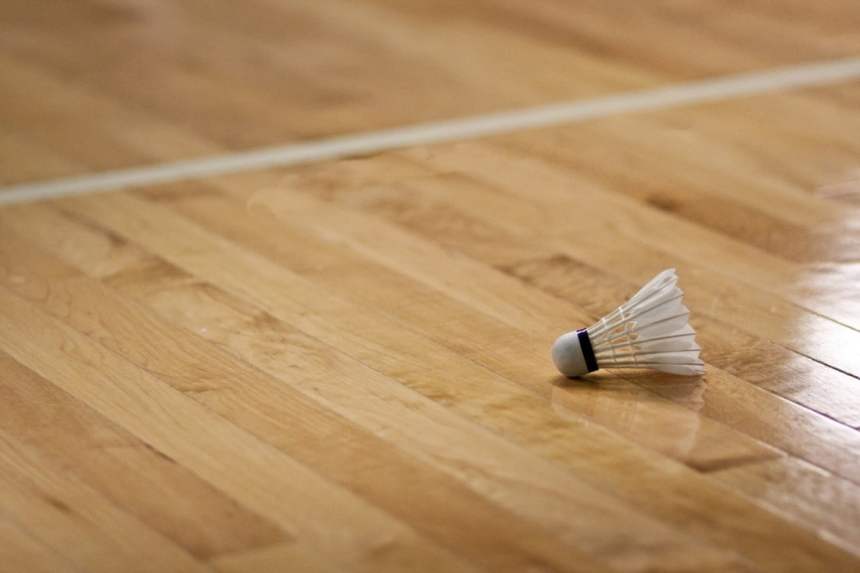
Mr. Asmussen recently introduced his Physical Education 4 classes to a new, fun activity – badminton.
Students said that badminton is one of the best activities in gym class because of how back and forth it is and how it keeps everyone moving. For this lesson, Asmussen made a tournament bracket and put everyone in teams of two.
“We play badminton because it’s popular as well as a sport working on hand eye coordination,” Asmussen said. “It’s a good sport to learn in high school because you could play this as an adult outside of a school setting.”
Not only does Asmussen likes teaching badminton, but all of the students enjoy the game. They like how it is run like a “King of the Court” style and how it keeps them on their toes because of the fast pace. Even though there isn’t a prize for the winner of the tournament, everyone is still very competitive.
“I love it,” senior Dylan Wargo said. “Everyone seems like they are having a good time, and it’s good to play competitive with people you see everyday in school but you don’t really talk to throughout the day.”
Asmussen loves to make everyone involved and competitive. He loves group games so students can work together and use these skills for later in life.
“I enjoy all of the activities we do in gym class,” Asmussen said. “Onside I like badminton or our volleyball unit, particularly triples. Triples is very interactive for the teacher as I serve the ball to the teams in a ‘King of the Court’ format keeping the game going quickly with good energy. My favorite outdoor activity so far this year has been pickleball. It’s becoming more of a popular lifetime sport for all and most of our freshmen seemed to enjoy it Quarter 1.”
(Photo by Cindy Bone)
BAKE SHOP WITH MRS. RYAN
By Cindy Bone – Staff Reporter
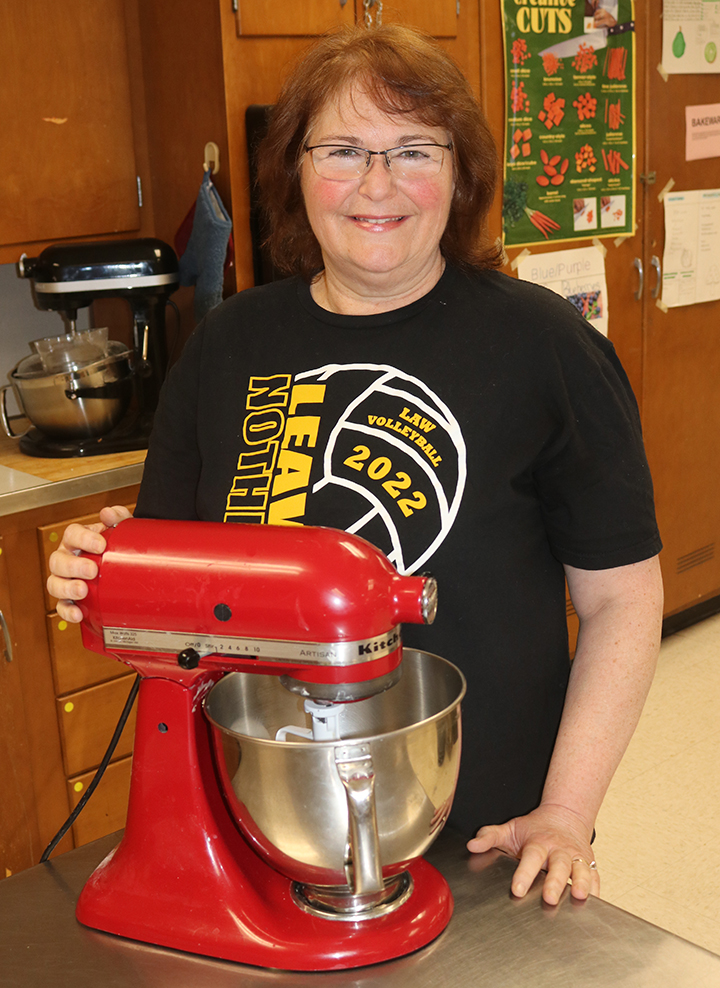
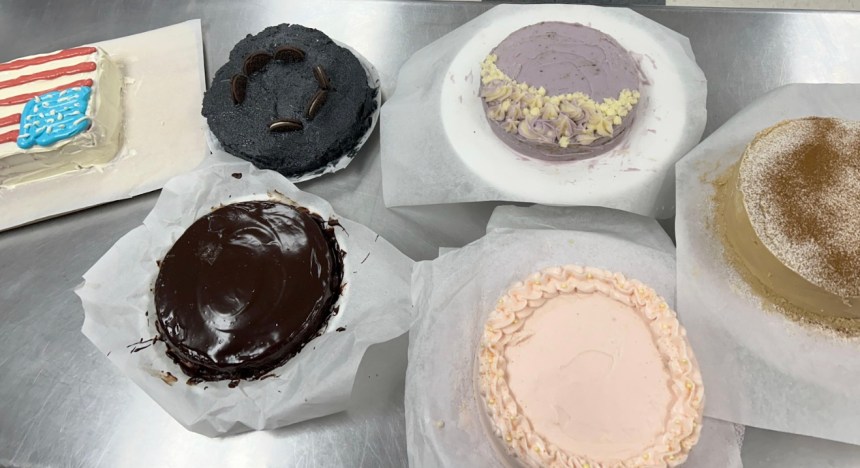
Bake Shop is a course where students learn new techniques and food cultures that revolve around pastry and baking.
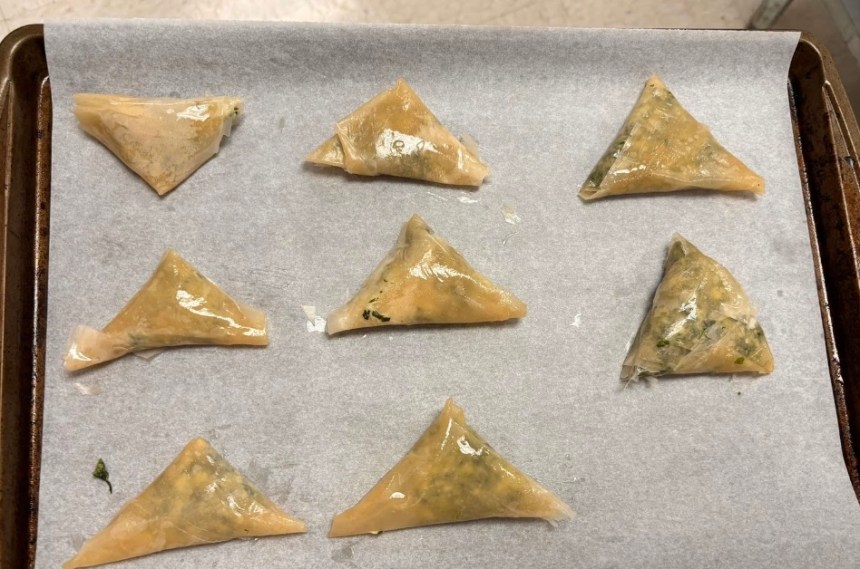
Students recently made Spanakopita, a traditional Greek savory pie that teaches students how to apply the techniques they have learned throughout the semester and their knowledge about the ingredients’ interactions.
“We bake so many sweet products in Bake Shop,” Culinary teacher Mrs. Ryan said. “I wanted to throw a savory dish to try, while keeping with the curriculum. Students here at Law like to try cuisines from different cultures, so I thought this recipe would be a good fit.”
Spanakopita is a simple dish but can require some patience as one of the main ingredients, phyllo dough, can be difficult to work with since it becomes more brittle the more it touches oxygen.
“I am glad I was able to learn new techniques with how to make phyllo dough and I was happy with the final product because the Pastry dish came out perfect,” sophomore Lilly Olmstead said.
Many students found doing this pastry dish as a nice break from the heavy sweet things we have been making.
“Spanakopita in my opinion was a fun dish and I really enjoyed making it,” junior Padriac Long said. “My favorite part was when we had to fold the dough into triangles.”
Ryan said the lesson was a good way to bring in new flavors and teach students techniques.
(Photo courtesy Mr. Ruzbarsky)
STATISTICS AND PROBABILITY WITH MR. RUZBARSKY
By Dylan Wargo – Staff Reporter
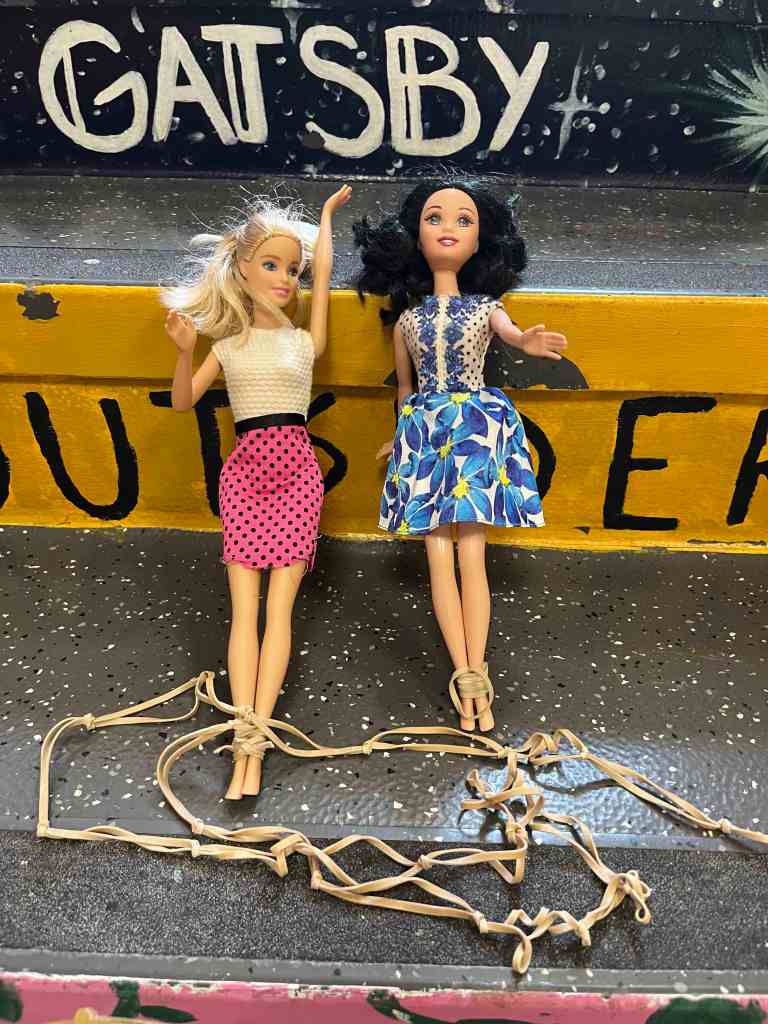
Mr. Ruzbarsky’s Statistics and Probability classes recently used statistical data to predict the number of rubber bands it would take to safely bungee jump a Barbie from the top of the stairwell.
Earlier in the year, students took data on a small scale dropping Barbies from the tops of lockers. They used this data in order to form an equation allowing them to find out the number of rubber bands correlated with the distance the Barbie would fall.
Before dropping the Barbie off the stairwell, they calculated the number of bands needed for her to fall a safe distance using statistical analysis-based data.
“One of my favorite activities every year because it’s fun, interactive, and we get to talk about math,” Ruzbarsky said.
When using data, exponential increase affects the estimates made on a larger scale, causing the predictions students made on a small scale to be wrong on the final drop.
“I did enjoy the Barbie assignment,” senior Michael Neider said. “It was a group, hands-on activity and those types of assignments are always enjoyable.”
Senior Brian Goglia also enjoyed how interactive the assignment was.
“I thought it was very interactive with your group partners when dropping the barbie from the stairs,” senior Goglia said. “Overall, a really good assignment.”
(Photo courtesy Harshitha Kothapalli)
INTRO TO PHOTOGRAPHY WITH MS. ROMANOWSKI
By: Harshitha Kothapalli – News Editor
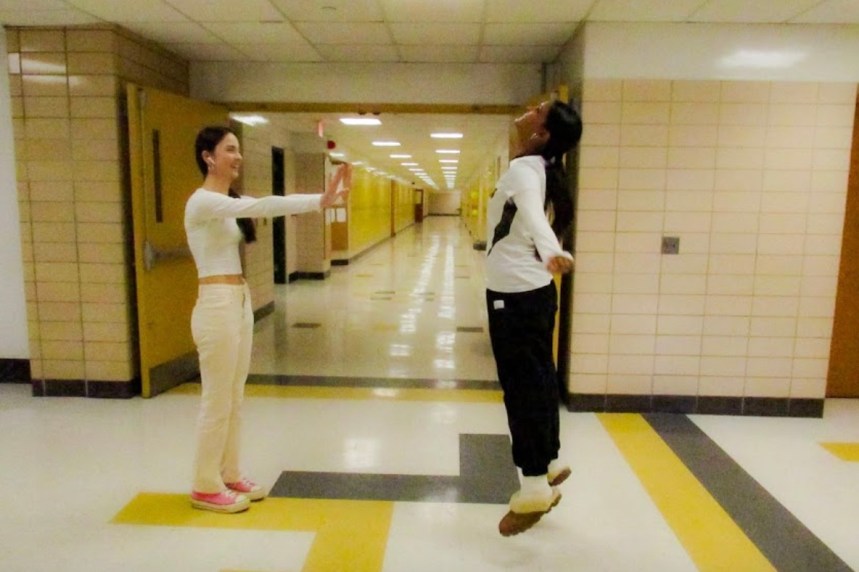
Ms. Romanowski’s Intro to Photography class participates in the class’ first project, the Levitation Project.
But first, Romanowski likes to start off the period with a unique tradition.
“The period starts off with me saying ‘Hello’ to each and every one of my students with a big smile and an enthusiastic wave,” Ms. Romanowski said. “Sometimes, I will ask my students fun questions or tell a quick story.”
The Levitation Project allows students to learn how to capture a picture without motion blur.
“The objective of the project was to choose a subject which was a student in our class and we had them jump for us to be able to capture a picture and make it look like they were ‘levitating’,” junior Tessa Piselli said.
Students were able to use their imagination and artistic skills to create they’re own levitating photo.
“I really liked how we were given creative liberty when it came to how we wanted our pictures to look,” junior Olivia Pisacane said.
Students were given many class periods to test and retake pictures using the feedback they received in class.
“We would take half a class period to go over a class feedback review where we would go through our classmates photos and give them ideas and provide constructive criticism,” Piselli said.
(Photo by Gemard Guery)
AP ENGLISH LITERATURE AND COMPOSITION WITH MRS. ROUMELES
By Gemard Guery – Editor-In-Chief and Editorial Editor
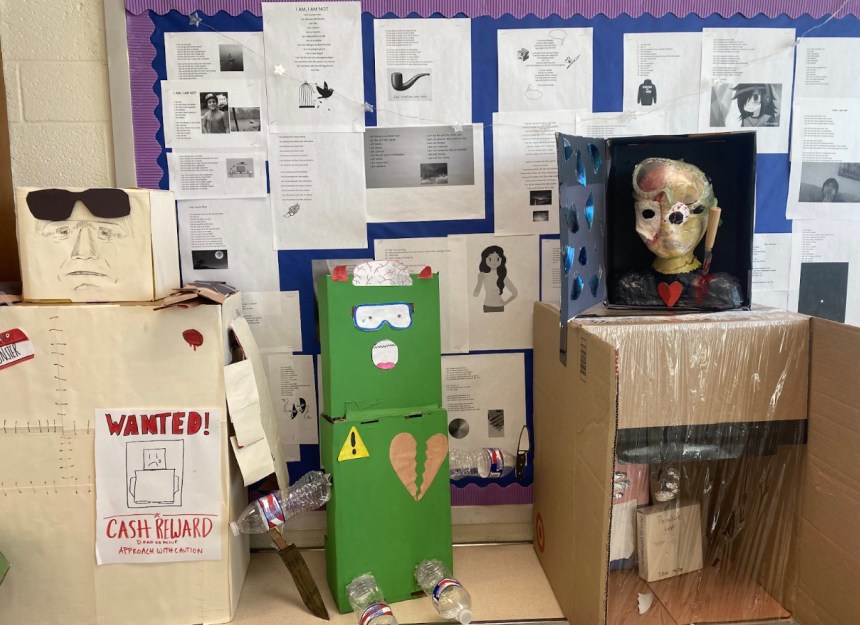
Mrs. Roumeles’ AP English Literature and Composition classes recently completed a group monster project.
Students were split into groups and used recycled materials to create a unique version of the monster from “Frankenstein”. The monster had to incorporate specific thematic concepts that were exemplified by the monster in the book.
“I do the project because it brings creativity to the class and it’s very different from just reading and writing. It’s more interactive which makes it fun,” Roumeles said. “I like the hands-on aspect of it because we are always on computers nowadays. It’s great because instead of an essay, you can examine the topics in a more enjoyable way.”
Students then had to present their monster, how it represents the thematic concepts, and how the book and our world represents specific thematic concepts more in depth.
“It made the book more interesting and allowed me to see the text in a different light,” senior Sara Moshirzadeh said. “We were able to connect it to the real world, which made the whole book tie together.”
The project also served as an amazing class team-building opportunity.
“It was one of our first projects of the year so it allowed for more collaboration in a class that tends to focus more on the individual,” senior Moulika Sivalenka said.
(Photo by Zack Sulkis)
YEARBOOK WITH MS. JESSELL
By Zack Sulkis – Social Media Editor-In-Chief
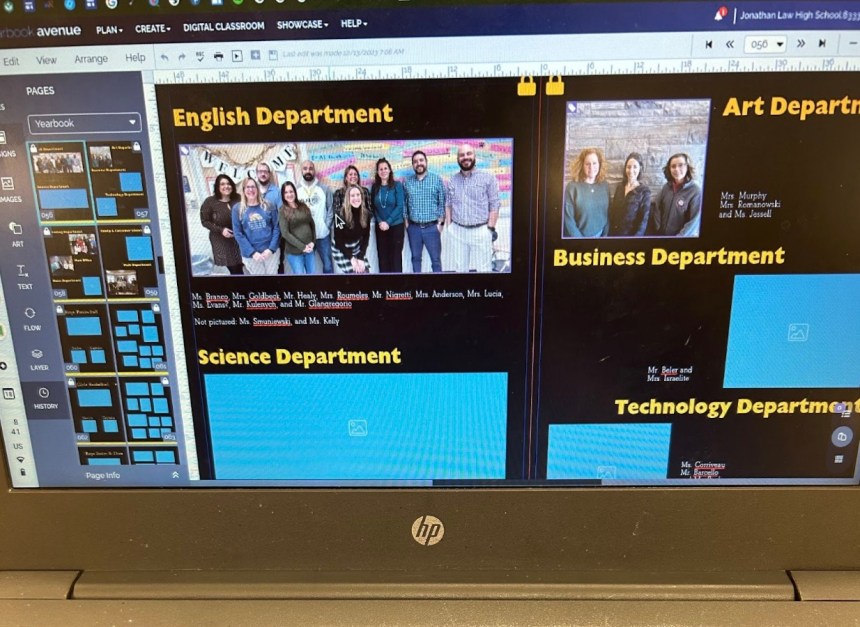
In Ms. Jessell’s Yearbook class, students have been hard at work organizing the faculty pages for the 2024 Yearbook.
Every year, the Jonathan Law Yearbook features multiple pages that show off all the faculty departments and familiar adults inside the building.
Yearbook students have to take time out of their study halls or class periods to go to faculty department meetings with a time coordinated by the department head to take the perfect photograph of the department. After the photo is taken, students then have to upload the photo to the Image Library on the Jostens Yearbook Avenue software used for creating the Yearbook.
“Getting the department photos isn’t necessarily difficult, it just can be a bit time consuming,” senior Ben Gomez said. “Taking the actual photos is simple but it’s the coordinating the perfect time for both you and the department, scheduling the appointments on the E-pass, the emailing the photos and uploading them to Yearbook Avenue that makes it a longer process then most students would think.”
This section of the Yearbook is a staple at Law and has to get done.
“The faculty pages are a tradition,” Jessell said. “As with our students, our faculty are another important component to the learning process. These pages add to the yearbook as both a keepsake and as a way to document the school year.”
(Photos courtesy Ms. Burns)
AP PSYCHOLOGY WITH MS. BURNS
By Maya Markowitz- Social Media Editor
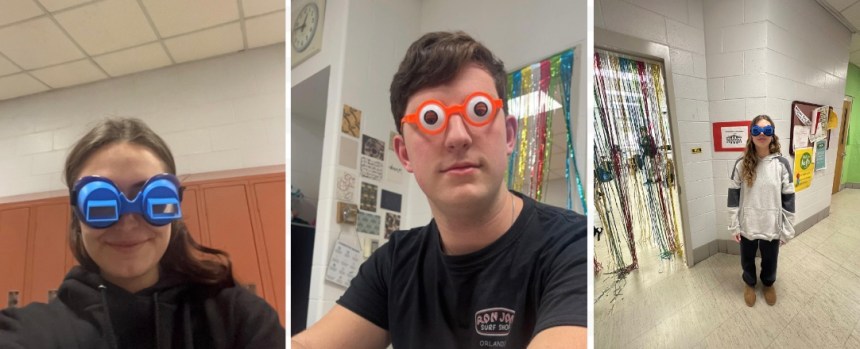
Ms. Burns’ AP Psychology classes recently held a “Sensation and Perception Carnival.”
There were different stations each representing different senses and ways that humans naturally perceive the world.
Students had the opportunity to explore sight, hearing, vision, and touch with a series of challenges. One of them consisted of spinning around a bat ten times, then attempting to balance on one leg.
“It showed me a real example of how the vestibular sense works and showed me how important balance was,” senior Maddy Gaillard said.
In addition to those experiences, the activity also focused on bottom-up processing.
“It was nice to see these vocab words in real life,” senior Soham Shah said. “Vocab can be challenging to learn, so this was a nice way to come up with connections for the words.”
The goal of this activity was to help students understand and remember the ability to detect senses like touch, pain, vision, or the movement and positioning of the body.
“I hope students can internalize and conceptualize what they have learned,” Burns said. “I really hope that if a question comes up on the test about bottom up processing, students remember the object box, or if there was a question on vestibular sense, the kids remember what it felt like to spin around the bat and then try to stand.”
(Photo courtesy Mr. McPartland)
SPANISH 3 WITH MR. MCPARTLAND
By Michael Merchant – Staff Reporter
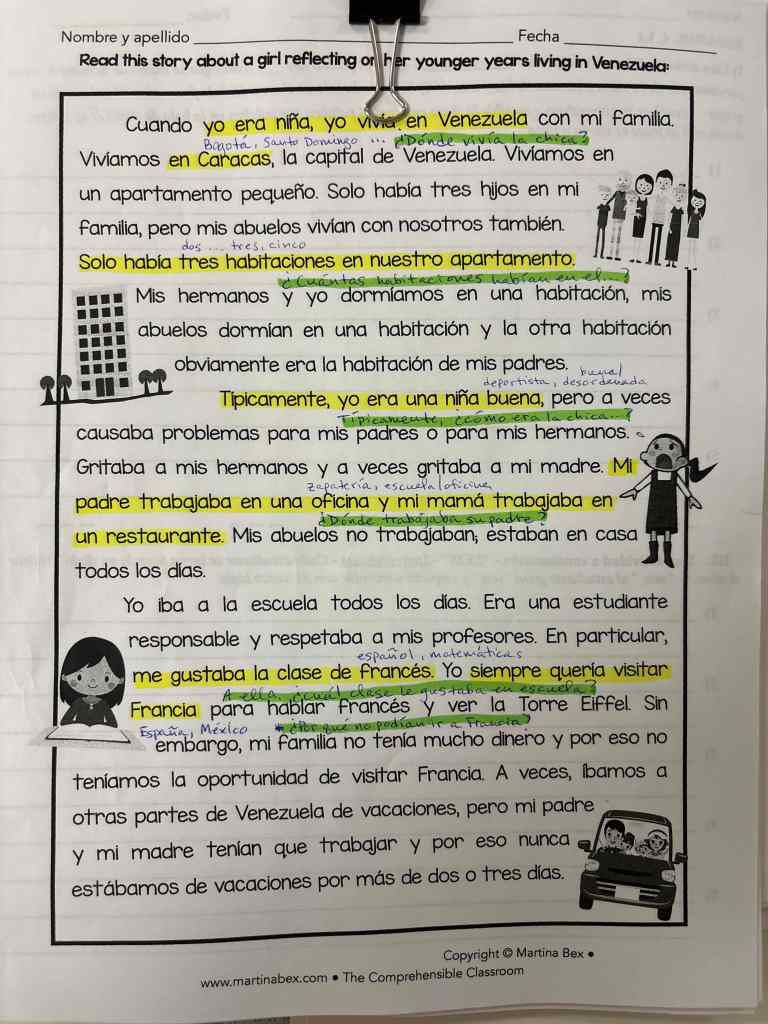
Mr. McPartland recently had students read a story about a girl from Venezuela who overcame obstacles in her daily life.
Students were told to read the story alone first and “skim and scan” it and think of any key words that come to mind. Students then read the story together as loud as a class and then try and find more key words and events and circle words they didn’t understand.
“Reading is so important when it comes to learning a language, especially a second language,” McPartland said. “Asking basic, yes or no, true or false questions initially is a great way to show comprehension. Asking students to draw allows for different ways for students to show they understood.”
The goal of this assignment was also to have students know the struggles that people face in other cultures and backgrounds.
“I like this subject because Spanish is different from what I am used to and I learn how life in some Spanish-speaking countries is different,” junior Cameron Upchurch said.
After the class read the story, McPartland had students go into the hallway, write down five phrases that they came up with, and try and figure out as a group if it was true or false.
“I really like working with groups and this activity was fun because it involved everybody and really made people work together to do this,” junior Dean O’Donnell said.

(Photo by Avery Moulton)
PERSONAL FINANCE WITH MR. BELER
By Avery Moulton – Staff Reporter
Business teacher Mr. Beler has recently used an online game called Bummer to help students get a better understanding of insurance.
Insurance is an arrangement where the company or government provides payment for loss, damage, or illness which leads to a return for payment of a premium. Students learn about the different types of insurance and how it can help them in the future.
“Bummer is an interactive game that gives students real life choices that they will face in the future,” Beler said. “I believe interactive simulations give the most real life experience for the students and face results of their decisions.”
The class views the game as a helpful source of information to learn about while also having fun.
“The interactive Bummer game we played really did a good job providing us with real life challenges and factors that you have to think about when choosing insurance,” sophomore Kayla Markowitz said. “It definitely made me analyze the consequences of my insurance and how that would affect me later in the game along with being actually fun and engaging.”
The Bummer game brought many surprises. The concept of the game is to spin a wheel and see what would happen to your property.
“Some hard stuff was thinking about what I had to put money on with add ons or additional coverage,” sophomore Brian Gonzalez said. “I enjoyed the game because it gave me a better understanding of buying insurance in case anything happens to me or my stuff in real life.”

(Photo courtesy Mr. Kulenych)
HUMANITIES WITH MS. KELLY AND MR. EVANKO
By Reinaldo Decarvalho – Staff Reporter
Ms. Kelly’s and Mr. Evanko’s Humanities classes have recently been working on a Documentary Project which explores subcultures at Jonathan Law.
For this project, students picked a subculture at Law (sports teams, clubs, etc.) to examine. One group is doing their documentary on the expectations of being on the Law football team and how being on the football team affects students in and out of school.
This project takes the whole month of December to finish with a minimum length of five minutes. Students have to write a script, film interviews, and film additional B-roll footage to complete the project.
Senior JT Nelly enjoyed this project because he likes editing video.
“I enjoy this project because we have the whole month to do it and the project itself is actually fun to work on,” Nelly said.
Senior Jackson Smith has enjoyed interviewing students for his documentary.
“I like this project because we have access to go around the school and interview people in the Podcast Studio which i feel is very fun,” Smith said.
Mr. Kulenych’s and Mr. Zuraw’s Humanities classes are also working on this project.
In their class, senior Lana Hanania in enjoying the project and said she likes walking around interviewing people. She is doing her documentary on the Law Powderpuff team.
“The thing I enjoy the most about this documentary is interviewing my friends on the Powderpuff team and also going in the Mac Lab and editing the videos,” Hanania said.

(Photo by Cesar Mendez)
PRE-CALCULUS WITH MR. RUZBARSKY
By Cesar Mendez – Sports Editor
Mr. Ruzbarsky’s Pre-Calculus class has a Unit Test before Christmas break, so this week, students played Trashketball to review for it.
Ruzbarsky gave all the students problems about exponential functions and construction of exponential models. Every time a student got a question right, they were allowed to shoot a paper ball into trash cans.
“Today we reviewed for the Unit 4 test with a Trashketball review game,” Ruzbarsky said. “It’s a fun activity where students are able to build confidence with their math concepts for the unit and be able to use up some energy at the same time.”
Students enjoyed being able to review for the test while also having a good time.
“I really liked this activity because it allowed students to be able to understand the material but also have an incentive to learn and have fun,” sophomore Harshitha Kothapalli said.
The winners won candy from Ruzbarsky’s big bag he got from his kids on Halloween.
“It was unfortunate that we did not win the game, but it was fun to be able to shoot around and it was productive,” junior Ryan Nastasia said. “I probably learned the most I have all year today.”
(Photo by Ava Vercellone)
ENGLISH 2 WITH MR. HEALY
By Ava Vercellone – Staff Reporter
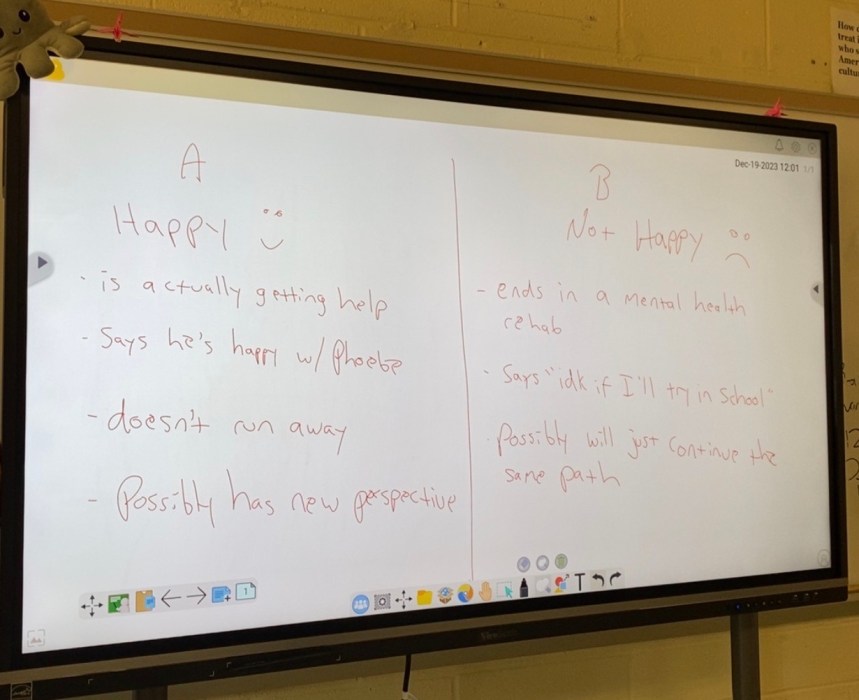
Mr. Healy recently taught his English 2 students how to win any argument when debating.
The class just finished reading “The Catcher in the Rye” and Healy had students debate whether or not the ending of the book was happy or unhappy. The students couldn’t choose what they thought the ending of the book was. They were given a side by Healy and had to argue for that side.
“By examining the ending, we can break down the themes we’ve seen developing throughout the book, and see where we think they end up.” Healy said. “Then we ended with a discussion of these themes and generated ideas for one of the culminating assignments which is to write about them in your one-page responses.”
Students worked on debating strategies, including not backing down from their argument and trying to not be overly emotional.
“I thought doing the debate was helpful because I saw both sides of the argument,” sophomore Audrey Delillo said
After the class debate, students discussed the themes of the book and what ideas to write about in the one-page responses
“I thought the lesson was helpful because I learned how to debate,” sophomore Andrea Crump said.
(Photo by Quinn Willett)
MODEL U.N. WITH MR. EVANKO
By Quinn Willett – Social Media Editor
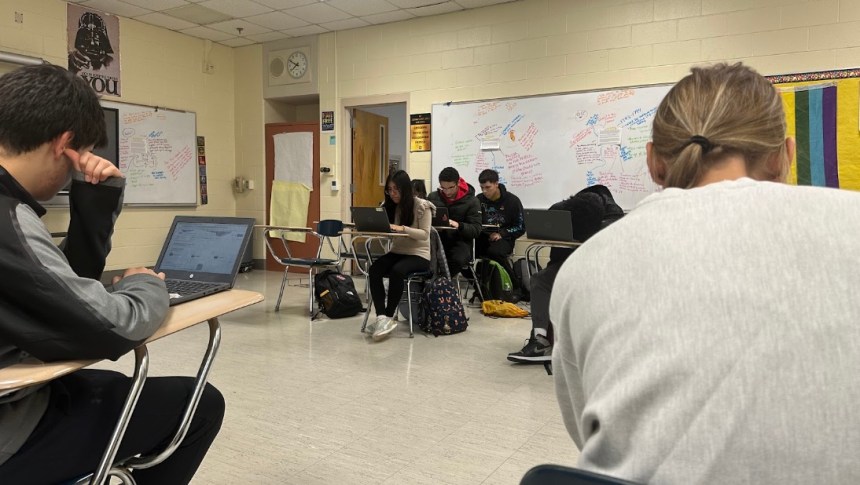
Mr. Evanko recently assigned his Model U.N. students countries and topics to write their position papers for the Milford Model U.N. Conference.
These position papers are the final exams for the class and will be presented on January 4. Each student is assigned a different committee and represents a country.
“Right now, the class is preparing for our final conference, which will be conducted at the Parsons building here in Milford,” Evanko said. “One of things that I love about this part of the semester is the variety: students are working in three different committees and topics, so I get to advise and guide them through subjects as varied as how to stop armed conflict, or how to improve global literacy skills.”
Students like creating new ideas and coming up with solutions to real world problems.
“The class makes me more aware of what is or has gone on in the world,” junior Gina Lombardi said. “And it puts things in perspective on how countries communicate in crisis.”
Students were assigned to the Security Council or the General Assembly. They were then assigned a country and a topic to research for a position paper where they must look at an issue through their country’s perspective.
“I really enjoy Model U.N., especially going to our conferences,” junior Alex Rodriguez said. “Model U.N. has very much helped me with public speaking in my other classes, as well as my research skills.”
(Photo courtesy Isla Concepcion)
ENGLISH 2 WITH MS. SMUNIEWSKI
By Isla Concepcion – Staff Reporter
The students in Ms. Smuniewski’s English 2 class were recently given new books to lead them right into midterms.
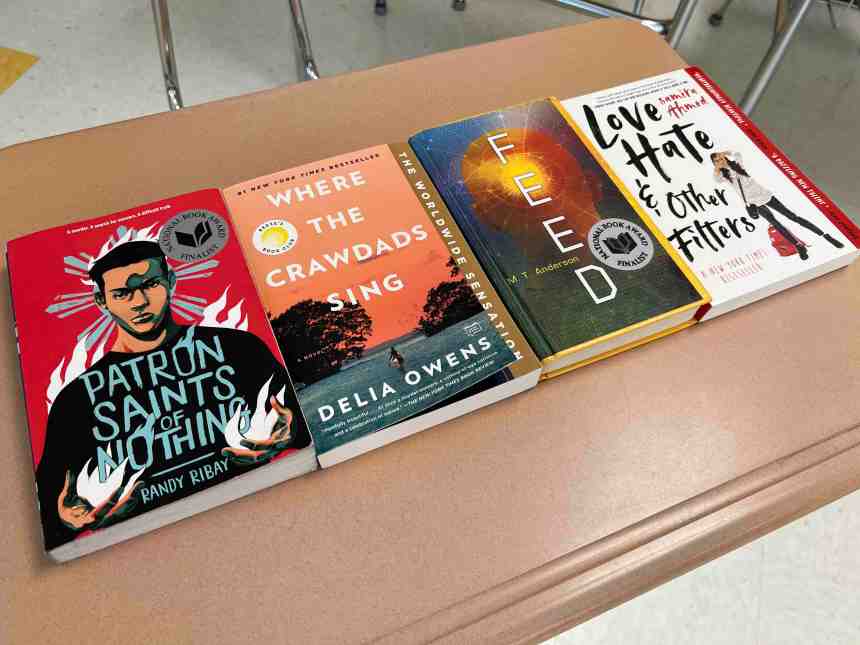
Smuniewski’s students were given many options for Book Club books, including “When Dimple Met Rishi” by Sandhya Menon, “Love Hate & Other Filters” by Samira Ahmed, “Patron Saints of Nothing” by Randy Ribay, “Where the Crawdads Sing” by Delia Owens, “Feed” by M. T. Anderson, and “The Absolutely True Diary of a Part-Time Indian” by Sherman Alexie.
Smuniewski put the class into Book Clubs based on what book they chose.
“Because the Book Club books are more modern than our full-class text and fall under the young adult genre, I think that my students will be more inherently engaged with what they are reading and therefore actually read the book,” Smuniewski said. “Reading the book from cover to cover will allow students to follow a character’s journey throughout a story, notice symbols and themes, make connections to their own lives, and hopefully learn to love reading.”
In their small Book Club groups, students talked about their books
“What I look forward to in these books is learning and reading about new stuff that I haven’t read about,” sophomore Carlin Skowronski said “What I hope to learn about in these books are how the characters, and plots change to see if there was a difference from the start to ending.”
The class is constantly learning about new elements of their books every day.
“I hope to learn (from my book) how and when to speak up for yourself,” sophomore Lexi Velez said.

(Photo courtesy Mrs. Gagnon)
FORENSIC SCIENCE WITH MRS. GAGNON
By Tim Firla – Entertainment Editor
Students in Mrs. Gagnon’s Forensic Science recently learned about what goes on behind the scenes of criminal cases.
“In Forensic Science students do activities, projects, and labs to explore the different types of evidence processing that can be used in civil proceedings, or criminal cases,” Gagnon said.
Students learn about different careers in the forensic science field, fingerprinting, handwriting and questioned documents, blood spatter analysis, DNA analysis, how time of death can be determined, and how a crime scene is processed and searched for evidence.
“Then they use all of this information to solve a mock crime starting with a crime scene and testing any evidence to put all the clues together,” Gagnon said.
Senior Rui Rocha said he enjoys the crime-solving activities in the class.
“My favorite part of forensics is learning about the different ways to figure out crimes,” Rocha said. “I enjoy that we get to figure out crimes in class so we know what it’s like to solve and learn them.”
(Photo courtesy Mrs. Israelite)
BUSINESS MANAGEMENT WITH MRS. ISRAELITE
By Haley Stroffolino – Social Media Editor
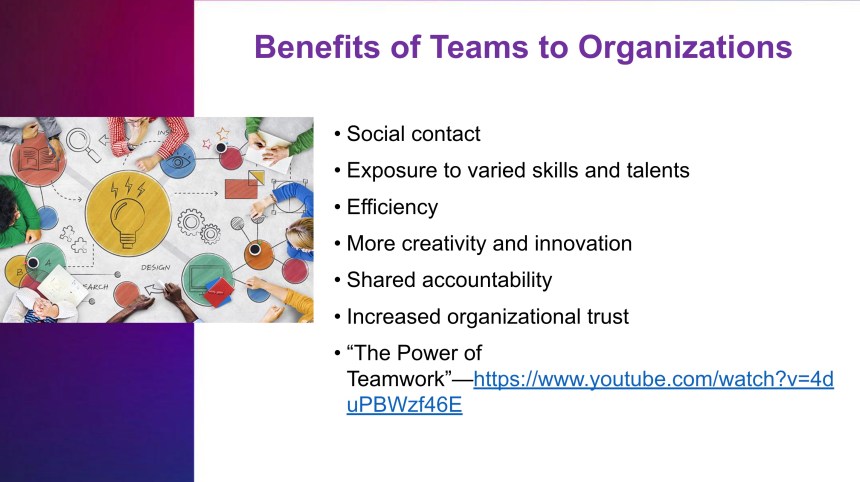
In Mrs. Israelite’s Business Management class students were recently given the opportunity to explore various teamwork scenarios and analyze what it takes to be a good team member in each situation.
Israelite wanted students to face different scenarios, so they would develop critical thinking and decision making abilities.
“Simulated scenarios allow students to apply leadership skills in a controlled environment, giving them practical experience before entering the real world,” Israelite said.
This activity was not only fun but also beneficial for students in preparing them for the future.
“I enjoyed the activity because it gave me experience that will be helpful for me in the real world,” junior Eshanika Shee said.
By analyzing different scenarios, students gain a better understanding of how to deal with certain situations.
“This activity made me recognize my strengths and areas for improvement,” junior Christian Mead said.














 The Advocate Online