
5 QUESTIONS WITH…History Teacher Mrs. Bradford About Her Year, Moving To Australia
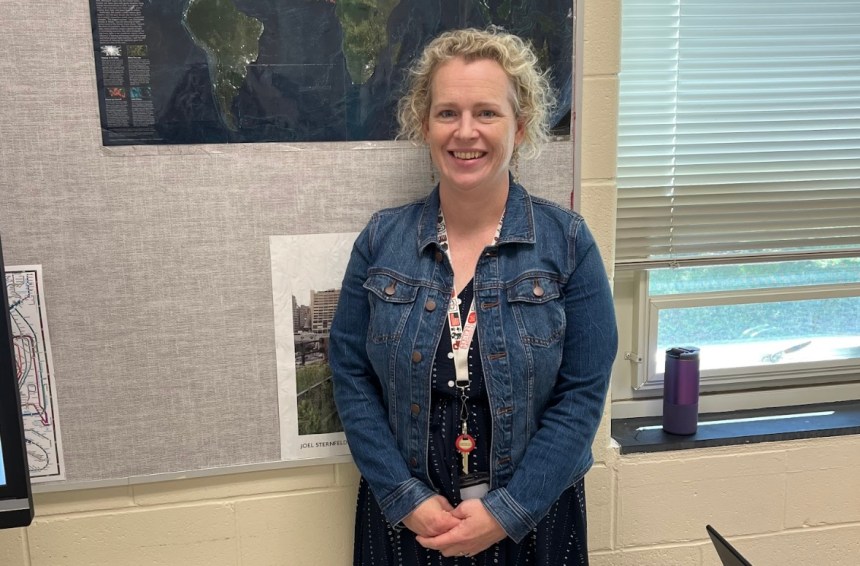
World History and AP Macroeconomics teacher Mrs. Bradford (Photo courtesy Sarah Hammad)
By Sarah Hammad – Staff Reporter
Mrs. Bradford is a World History and AP Macroeconomics teacher at Jonathan Law. Advocate Staff Reporter Sarah Hammad interviewed Bradford about the year overall and her transition to teaching next year in a new country.
Sarah Hammad: Reflecting on your first year, what would you say were the most significant challenges you encountered and how did you navigate them?
Mrs. Bradford: So, being in a new building, I didn’t know many of the other teachers other than people in the social studies department, so trying to learn people’s names, trying to learn my way around the school, you know, just some different, I guess, just different ways of conducting business at school. Each school has its own way of doing things, you know. The announcements are a little bit different here than they were at Foran. I’m not saying one is better than the other. They’re just different. And so, just getting to know the building and how the school runs and how administration, you know, wants things to be run. So that, you know, there’s always a transition period, to learn, a new place when you’re in a new place.
SH: Can you share any particularly rewarding moments or experiences from this past year that solidified your passion for teaching social studies?
MB: I always enjoy learning from my students and their experiences, and I felt like this year, I had a lot of different students who’ve taught me some things that I didn’t know or made me aware of, their cultures or their backgrounds. Their lived experiences, and their families experiences that broaden my horizons, and, you know, help me become a better teacher and help me understand the curriculum better. So I always like that. I really love learning from my students and having them. I mean, I love, I’m passionate about teaching, and I love teaching, but I also love learning from my students, because they have a lot to teach me. Yeah, it’s always nice to hear from someone who’s experienced something.
SH: How has your understanding of student engagement and effective teaching strategies evolved throughout the first year here?
MB: So I think, you know, I, one of the things that’s kind of an ongoing debate in education right now is, the use of cell phones, and, and their distractibility in class. For the most part, I thought students were really respectful in putting their phones away and not having them out. I didn’t have many challenging moments, and I tried to make light of them when students did have them out and get my phone jail out, and, you know, have a sort of laugh about it. But I really hope that, you know, going forward, that students are very mindful of how distracting phones can be, and so, I just, I kind of want to make… I just want to emphasize that, and that I really have enjoyed the moments when students haven’t had their phones out, and I’ve had time for, not for cutting casual conversations, too, not just conversations about the class, but interact with each other, because I feel like even I’m guilty of spending too much on my phone and focusing too much time on my phone instead of interacting and having conversations with real humans, ’cause I think that’s that human connection is important.
SH: Looking ahead, what are your primary goals or aspirations as you move to Australia next year?
MB: So, I’m hoping to take my experience, obviously, from Law. Every school I’ve worked at, I’ve learned new things. new content, new skills, but also from how the school conducts events from, like, the spring fling to the social emotional things, like the mingle, jingle, I always like to think about, could I, could I bring this to another school or bring this idea to another school? So, I always try to take my experience with me, but also learn from that school and how they do things. So I’m hoping to continue teaching in Australia. It’s a slightly different school year and different curriculum. So I don’t know if I’ll get a job right away, since we’re moving right in the middle of their school year, but I hope that I can continue my teaching career there as well.
SH: Beyond the curriculum, what has been your most valuable lesson learned about building relationships with students and colleagues in your first year at t:aw?
MB: So I think that’s the primary part of being an educator. I think the curriculum and content are secondary, because if you don’t have good relations with your students, you can’t, it’s very hard to build trust in each other and build a great learning environment. So I think what I’ve learned at Law is that, relationships between faculty and between students and faculty are really strong here, and, and, as Mr. Darcy always says in his emails, and, as I hear, multiple times throughout the year, this is, like, a family and the Law family, and I think that that’s something that Law has really gotten right and really does well, that people feel like they are part of a cohesive group here. And so I think that I would probably take that forward in continuing to develop relations with my students and also my colleagues, because that’s why we’re here. That’s why we do this.
 The Advocate Online