Category Archives: Opinion

EDITORIAL: Netflix’s Proposed Acquisition Of Warner Bros. Could Concentrate Power, Harm Movie Theaters

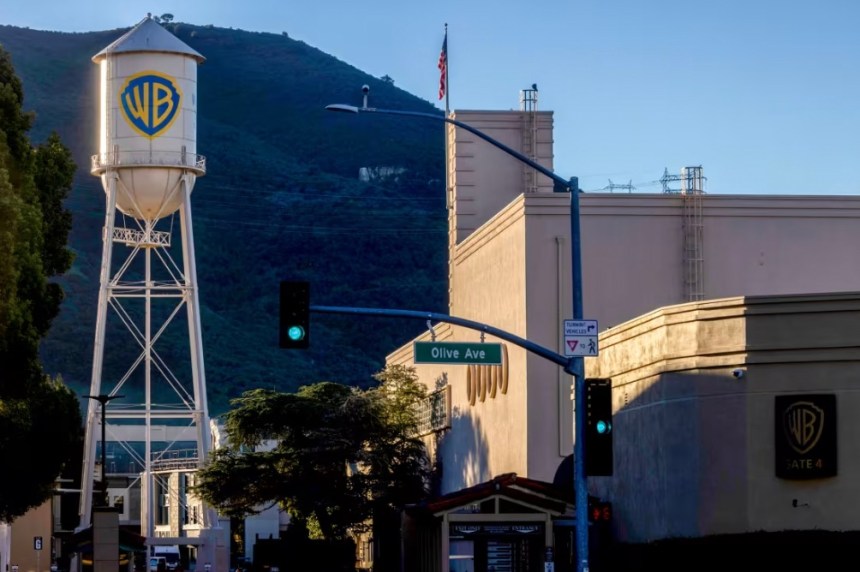
(Photo courtesy nbcnews.com)

By Tyler Lilly – Staff Reporter

Warner Bros. is a very recognizable name in Hollywood. They have created many movies, own numerous IPs, and are a giant in the film industry. The company itself, Warner Bros. Discovery, has been looking to make changes since it is billions of dollars in debt as a result of splitting from AT&T and merging with Discovery, Inc. in 2022. David Zaslav, the CEO of Warner Bros. Discovery, has proposed splitting the company in two to separate the less profitable television networks from the movies and streaming divisions. Recently, Netflix and Paramount Skydance have been bidding to acquire Warner Bros. Paramount bidded for the whole company, while Netflix only bid for the company’s streaming and studios. 

In the end, Netflix won the bidding war, and is currently in talks with Warner Bros. Discovery to acquire the Warner Bros. part of the company for $82.7 billion. With the deal set to be finalized by late 2026, there is absolutely no good that will come out of this. Warner Bros. owns many highly profitable properties; DC Comics (which includes Batman, Superman, the Justice League, etc), Harry Potter movies and TV shows, classic cartoons such as Looney Tunes and Scooby-Doo, and perhaps the most alarming asset being acquired by Netflix is the streaming service HBO Max. Netflix is already a streaming giant, so having two streaming services under its belt, along with many huge IPs is an enormous concentration of power. While this is not the first time a company has acquired a major streaming service, another example being Disney buying out all of the shares of Hulu, Warner Bros. has much more to offer Netflix in terms of new properties. The combined power of both companies could conflict with antitrust laws and create a monopoly. 

The CEO of Netflix, Ted Sarandos, has made controversial statements about movie theaters. Traditionally, movies stay in theaters for a 45-day window before moving to digital platforms. That theatre-exclusive window has been decreasing over the past few years, but theaters are still a huge part of the film industry. Sarandos believes otherwise, as he has gone on record saying that movie theaters are “outdated” and that consumers prefer to watch movies at home. Following the announcement of the deal, Sarandos has adjusted his stance, stating that theatrical releases for Warner Bros. films will continue. Even though Netflix will still release movies in theaters, it could potentially keep movies in theaters for less time, further diminishing the theater business. 

Instead of doing a corporate merger, the solution to all of this is to simply go with David Zaslav’s original plan of splitting Warner Bros. Discovery into two separate companies again. Unlike the Netflix deal, it won’t change the landscape of the film industry, will not concentrate power under a single company, and won’t harm the movie theatre business.

While the idea of a Netflix and Warner Bros. merger is quite intriguing, the effects of such a deal will outweigh any good it can possibly bring, if any. Unfortunately, it seems quite likely that the deal will go through, although it still needs government approval. But as it stands, this deal could bring about a gross concentration of power under one entity, and it should, quite frankly, not be approved at all.

EDITORIAL: Schools Should Increase Amount Of Retakes Per Quarter 

(Photo courtesy weareteachers.com)

By Alexandra Oliveira – Staff Reporter

Currently, students at Jonathan Law High School are limited to two retakes per quarter. This policy is meant to give students a chance to improve their grades on assessments like quizzes, tests, and papers. High school classes become more challenging every year, however, and many students need more than just two opportunities to show they understand the material. To better support student success, the number of retakes should be increased.

The number of retakes per quarter should be increased to three or four. This change would give students a more realistic chance to learn from their mistakes and demonstrate that they truly understand the content. Learning does not always happen perfectly the first time, and school policies should reflect that.

More retakes help students learn better. When students have more chances to try again after reviewing feedback, they are more likely to understand and remember the material. Interviews with several Law students showed that when students were allowed to retake tests, they generally felt better about how well they understood the material, how much control they had over their learning, and their grades. Retakes give them the opportunity to correct errors, revisit difficult concepts, and improve their skills. This leads to stronger long-term understanding, not just a temporary grade boost.

In addition, more retakes can lower stress about grades. Many sources suggest retakes have a positive impact on high schoolers’ anxiety levels. Students often feel pressure to do well the first time, which makes it harder to learn. More retakes can ease this pressure, helping students focus better. 

Some may worry that more retakes will give teachers too much work. However, this can be managed by limiting retakes to certain assignments or offering them at specific times. This way, teachers won’t be overwhelmed. Allowing three to four retakes per quarter is a good balance. It gives students enough chances to improve without causing too much extra work for the teachers.

Increasing the amount of retakes to three to four per quarter would create a better learning environment for students. By giving students more chances to learn, lowering stress, and helping them understand the material, Law can help its students do better in school.

EDITORIAL: Milford Mayor Rich Smith’s Victory Reflects A Broader Democratic Shift

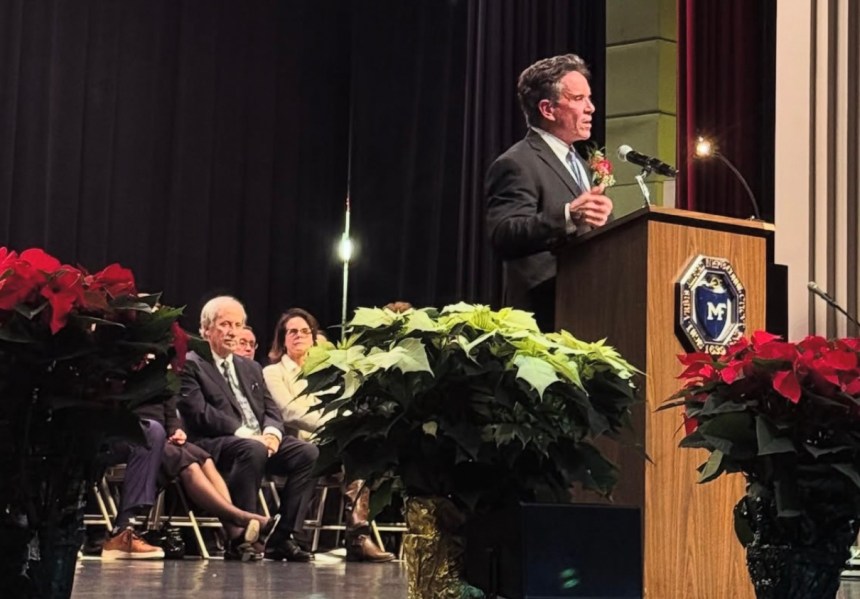
New Milford Mayor Rich Smith (Photo courtesy Rich Smith)

By Tyler Lilly – Staff Reporter

Election Day was on November 4, and Milford was among the many areas to be electing new government officials. The mayoral race was between Tony Giannattasio and Rich Smith. Rich Smith won the election by almost 2,000 votes, which doesn’t sound like much, but there were only about 18,000 total votes. Smith was inaugurated on November 17, and became the mayor of Milford. An interesting note is that this was just one of many victories for Democrats across the country, and that Democrats seemed to dominate this municipal election. Regardless of voting in other towns and states, Milford is under new leadership, and is going from a Republican mayor to a Democratic mayor. 

The previous mayor, Giannattasio, is a Republican, and was mayor from 2023 to 2025. Milford has never been purely a Republican town, although there have been more Republican mayors than Democratic mayors. The mayor before Giannattasio, Benjamin Blake, was a Democrat and was mayor from 2011 to 2023. According to voter data from 2020, Milford has 9,247 Republican voters, 12,543 Democratic voters, and 19,065 unaffiliated voters. This means that an election can tip in any direction, as there are many voters who do not associate with any particular party. Of course, one election being in favor of Democrats does not indicate a shift towards that party, but there are many other factors at play that make Rich Smith’s victory unsurprising. 

One thing that is key to a successful election is a good campaign. Giannattasio’s campaign focused on how the Democratic Aldermen voted to raise taxes, and that voters should vote Republican. The Board of Aldermen is a key part of the Milford government, and serves as a legislative body. What Giannattasio was trying to tell voters is that voting Republican, and thus, for him, would help fight the Democrats’ attempts to raise taxes. This messaging was a bit convoluted. There are likely thousands of people who saw Giannattasio’s signs around Milford and had no clue what he was talking about. Part of good political messaging is being able to relate issues for the average voter, which Smith did a much better job at. Smith’s campaign also focused on lower taxes, with the key difference being that his messaging was a lot simpler. Smith’s main slogan was “Lower Taxes, Stronger Milford.” Smith’s campaign gets right to the point, and is much less complicated than Giannattasio’s. One thing the citizens of Milford can expect are lower taxes, reducing economic strain on people.

Some people might say that Giannattasio’s re-election campaign was good enough. And while the campaign wasn’t bad by any means, it just wasn’t perfect. While a good campaign with sincere promises and efficient messaging is a big part of winning an election, it isn’t the only thing that goes into it. Even if Giannattasio had a significantly better campaign than Smith, there’s still one more thing that needs to be addressed – President Donald Trump. While there are many people who like Trump’s policies, as evident by him winning the popular vote last year, there are as many people who hate him and his administration. Trump has had many controversies that impact the whole country, especially tariffs, which put even more economic strain on people. Trump is a Republican, and Smith is a Democrat. Smith being on the opposite party as the highly divisive President, along with offering some economic relief with lower taxes, apparently pushed many undecided voters over the edge to vote for him. And this is not just in Milford, but many elections around the country. Smith’s victory is not just indicative of the direction Milford is heading in, but the direction the entire country is heading in.

EDITORIAL: Schools Should Continue Shift Toward Less Homework

(Photo Courtesy onlineclasseshub.com)

By Sarah Hammad and Mihika Dabhade – Staff Reporters 

In recent years, more schools across the United States have started to change the way they handle homework. Many districts in places like California, Oregon, New York, and Florida have created “less homework” or even “no homework” policies, especially for younger students. These changes are meant to help students feel less stressed, stay healthy, and have a better balance between school and home life.

One of the main reasons schools are cutting back on homework is research. Studies from Stanford University and Duke University show that homework in the early grades does not really improve learning. In fact, when students have too much homework, their motivation can drop and their grades can even get worse. Because of this, schools decided it made more sense to reduce homework and focus on what actually helps students learn.

Mental health has also played a big role in this shift. Teachers and principals have noticed that students today face higher levels of stress, anxiety, and lack of sleep. Many kids reported staying up late to finish assignments or arguing with their families about schoolwork. By giving students less homework, schools hope to improve their well-being and help them feel more supported.

Another goal of these homework changes is to give students more free time. Schools want kids to have time for clubs, sports, reading for fun, spending time with family, or simply resting. Educators believe that when students are not overwhelmed, they are more ready to learn during the school day.

Teachers are also focusing more on what happens inside the classroom. Some students may not have internet access, a quiet space to work, or help at home, which can make homework feel unfair. To fix this, many teachers now give more classwork, group activities, and guided practice so students can get support directly from the teacher. This helps make learning more equal for everyone.

Instead of assigning lots of worksheets, some schools now follow a “quality over quantity” rule. This means teachers give shorter, more meaningful tasks, such as small projects or real-world activities that help students understand how the lessons apply to everyday life. These assignments are designed to be useful, not just time-consuming.

Parents have also influenced homework changes. For years, many families have said that homework caused stress at home and took too long to finish each night. Some children were staying up far too late, which affected their sleep and overall health. Listening to this feedback, schools realized they needed to make a change.

As more schools adopt these new homework policies, the focus is shifting toward balance, mental health, and effective learning. Supporters hope that by reducing homework, students will feel more relaxed, more motivated, and more connected with their families and school communities. Many educators believe this approach will help students grow not only academically but also emotionally and socially, making school a safer and more positive place for everyone.

EDITORIAL: Harsh Truths With Harshi – Government Shutdown, Sudan War vs. Media Silence, “Drill, Baby, Drill” 

By Harshitha Kothapalli – Editor-in-Chief

“Harsh Truths with Harshi” is a new Advocate column written by Editor-in-Chief Harshitha Kothapalli. Kothapalli will break down top news events while also sharing her own insights, aiming to promote civic knowledge, discussion, and engagement. This week’s topics are: The End of the Government Shutdown, Sudan War vs. Media Silence, and “Drill, Baby, Drill.” 

TOPIC 1: The End of the Government Shutdown

The United States federal government recently reopened after a partial shutdown that lasted 43 days, the longest in history. During the shutdown, approximately 670,000 federal employees were furloughed and many more worked without pay. The Supplemental Nutrition Assistance Program (SNAP), which in the fiscal year of 2024 provided benefits to an average of 41.7 million people each month was announced to freeze on November 1st. Meanwhile, agencies such as the Federal Aviation Administration (FAA) faced serious operational strain, with reports of flight reductions up to 10% at over 40 airports. 

The budget deadlock in Congress stemmed from competing priorities: one party insisted on extending tax credits under the Affordable Care Act (ACA) while the other resisted or wanted those credits removed, and disagreements also centered on funding levels for domestic and defense programs. Congress passed a continuing resolution that temporarily funds most federal agencies through January 30, 2026. 

Harsh Truth:

Millions of Americans were deeply affected by the government shutdown, with hundreds and thousands of jobs being lost. Many blamed the democratic party for failing to compromise on the fiscal year budget. However, Democrats maintained that the proposed Republican funding bills were unacceptable because they did not include an extension of the expanded ACA tax credits. This issue became a “red line” for Democrats, who insisted the health subsidies be addressed in the legislation itself. As a result, the shutdown ended with a temporary resolution, but no long-term solution to this critical healthcare issue. The episode also revealed the lengths to which the President is willing to go to enforce priorities, including cutting essential programs, delaying benefits, and risking economic disruption to achieve political goals. Will Americans open their eyes as our country begins budgeting for a Deportation-Industrial Complex rather than healthcare affordability? 

TOPIC 2: Sudan War vs. Media Silence 

The conflict in Sudan began in April 2023 between the Sudanese Armed forces and the Rapid Support Forces (RSF), a powerful paramilitary group. Fighting has been concentrated in major cities such as Khartoum, leading to thousands of deaths and injuries and displacing millions of civilians. Hospitals, schools, and basic infrastructure have been destroyed, while humanitarian organizations report shortages of food, water, and medical care. Despite the scale of the crisis, international media coverage has been limited, leaving global awareness and public pressure relatively low. 

The war has continued without significant international intervention, partly because attention has been focused on other global crises. Humanitarian aid has been challenging to deliver due to ongoing conflict, bureaucratic hurdles, and limited resources.  

Harsh Truth:
Millions of Sudanese civilians are living in life-threatening conditions, yet the global media has largely overlooked their suffering. The lack of coverage makes it harder for international organizations and governments to mobilize aid or diplomatic pressure. The silence highlights how international priorities and media attention often fail to align with the severity of human crises, leaving vulnerable populations without a voice or timely assistance. We are constantly discussing the war in Gaza and the Russia-Ukraine War, which is undoubtedly important; however, this does not make the war in Sudan any less urgent. No crisis should be deemed more or less significant simply because it receives less attention; every human life deserves recognition and response.

TOPIC 3: “Drill, Baby, Drill” 

The United States continues to rely heavily on fossil fuel extraction despite repeated warnings from scientists about rising global temperatures. Politics promoting oil and gas drilling, often summarized, even by our own president, as “Drill, Baby, Drill”. In his 2025 inaugural address, Trump declared a “national energy emergency” and stated: “We will drill, baby, drill”, adding that the U.S. has the “largest amount of oil and has of any country on earth, and we are going to use it.” Continued fossil fuel use contributed to greenhouse gas emissions, which drive climate change and lead to more extreme weather events, rising sea levels, and environmental degradation. Experts warn that without significant reductions in emissions and increased investment in renewable energy, the U.S. will struggle to meet global climate goals and prevent long-term damage. 

Harsh Truth:

While scientists continuously warn us of irreversible climate consequences, policy continues to favor drilling and fossil fuel use. The U.S. is sending mixed signals: promoting energy independence while ignoring the environmental costs. Without decisive action, the nation is accelerating climate risks that will disproportionately affect vulnerable communities, future generations, and the planet as a whole. We preach paper straws, recycling, and electric cars, but we watch as the leaders and decision makers approve new oil and gas leases, roll back environmental protections, and double down on fossil fuels subsidies on our behalf. While everyday Americans are encouraged to make small personal changes, the policies driving the climate crisis remain unaddressed at the highest levels. 

EDITORIAL: Government Shutdown Did Unnecessary Damage To U.S. Citizens

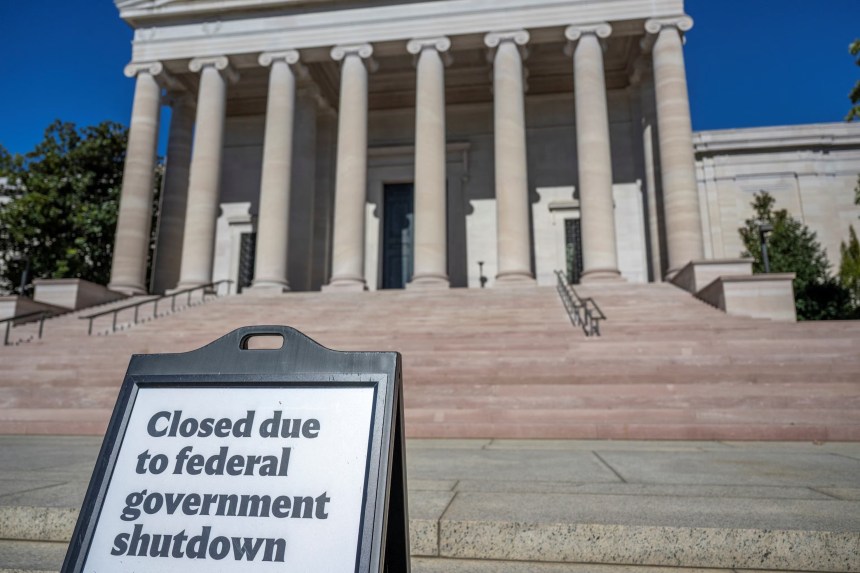
(Photo courtesy abcnews.com)

By Anwita Puttam – News Editor

On October 1, Congress failed to pass new spending bills as well as other short-term extensions. Because of this, many parts of the U.S. federal government shut down and people have been let go. All of this happened all because Congress wouldn’t pass a continuing resolution.

A continuing resolution, also known as a CR, is “a type of appropriations legislation, which allocates money to specific federal government departments, agencies, and programs. This money provides funding for different operations, personnel, equipment, and activities.

The issue with this is the constant controversy following the CR. The CR can attach political demands, delay government operations, and alter spending in ways which can negatively affect the political and economical state of the U.S. Continuing the CR can cause a major disruption in how the government functions; it pushes back other projects the Congress has and causes political corruption.

While Congress not passing the CR was the right thing, since Trump had no right or reason to even try and pass it, the Democrats shutting down the federal government was way too harsh.

The general purpose of the federal government is to make sure the nation has a functioning and stable government. It’s in charge of taxes, providing national defense, promoting general welfare, establishing justice, ensuring domestic tranquility, regulating commerce, and conducting foreign policy. All of these key aspects of running a functional government and nation are all a part of the federal government. It’s a key part of the U.S. as a whole.

While the federal government being unable to function is one thing, the biggest issue from this is how it is affecting the federal workers and the people of the U.S. The federal shutdown has caused so many to lose their jobs as well as working without any pay. Roughly 900,000 federal employees have been let go while another two million are working without pay. It’s been over seven weeks – seven weeks not knowing when they’ll get their next paycheck.

This quarrel between the parties is causing so many to suffer in their daily lives.

As well as that, many air flights have been shut down due to the fact that most pilots are either working without pay or have decided to rebel and not work. Since the shutdown began on October 1, more than 2,700 flights have been canceled per day across the entire nation. These people are unable to get to places they need to be; they can’t even see their families.

While, yes, Congress has now started coming up with a compromise for this issue, the damage is already done. The government had too much pride, neither side wanting to compromise on the situation, and what happened? It harmed the people in irreversible ways.

The government can’t give people the income they missed.

The government can’t give them back their jobs.

The government can’t help them get home.

Our government officials need to step up and remember who they are supposed to be serving. The people of the U.S. have suffered enough from the government’s actions, but they still have hope things will change. Don’t make them lose that hope.

EDITORIAL: School District Needs To Invest In Stronger Wifi For Students

(Photo courtesy netspot.com)

By Sarah Hammad – Staff Reporter

In most districts, the school wifi connection is extremely laggy. This internet lag occurs for several reasons: There are hundreds or even thousands of people sharing one internet source, which causes the internet to be slower. The layout, age, and construction materials that make up a school – especially at a school as old as Law – also make it difficult to maintain a strong wifi connection. In Milford, each time a new website is opened at school, it goes through Securely, a security system that checks if it is a school-friendly site. This process also takes time. Most sites and apps such as VPNs and Youtube are typically blocked to prevent students from getting distracted.

Despite these challenges, Milford needs to invest in a better internet system because the school wifi is so inconsistent that on several days this year, it has stopped working or been extremely slow for hours at time. When this happens, students are unable to do any work on their school-issued Chromebooks. They either don’t get any work done in class or they have to resort to using their cell devices to complete their assignments. 

Having a reliable and fast internet connection is something that all school, including Milford, need. Today, almost all school work is done online. When the internet slows down, Chromebooks get disconnected from the wifi and teachers and students have difficulty completing classroom assignments. If the internet goes down in the middle of the school day or the middle of a lesson, the work can’t be done on paper because the paper has to be printed using a device. That device won’t work if there is no internet.

Unfortunately, having a slow internet connection isn’t something that’s easy to fix because it requires a lot of money. Many public school districts do not have the money to invest in hi-speed wifi for all schools. It would take a lot of time and money to make sure that all building are compatible for hi-speed wifi. 

That said, through fundraising, grants, or other means, Milford should work towards getting a newer and faster wifi connection. This will make it easier for students to get their assignments done in school and ensure that all school technology works without interruption.

EDITORIAL: Harsh Truths With Harshi – Blue Wave, Proposition 50, & Tariffs

(Graphic courtesy Harshitha Kothapalli)

By Harshitha Kothapalli – Editor-in-Chief

“Harsh Truths with Harshi” is a new Advocate column written by Editor-in-Chief Harshitha Kothapalli. Kothapalli will break down top news events while also sharing her own insights, aiming to promote civic knowledge, discussion, and engagement. This week’s topics are: The Blue Wave, Proposition 50, and The Supreme Court vs. Trump Tariffs.

TOPIC 1: The Blue Wave 

The 2025 Election Day marked a new beginning in American politics, one that left some citizens hopeful and others uneasy about the nation’s direction. 

New York City Mayoral Election

Democratic Socialist Zohran Mamdani made history by defeating former Governor Andrew Cuomo in both the Democratic primary and the general election. 

Mamdani’s campaign priorities (according to nytimes.com)  included…

  1. Navigating President Trump’s attacks
  2. Universal free child care
  3. A rent freeze
  4. Mending fences with his critics
  5. Set a vision for the Police Department

Mamdani became New York’s first Muslim mayor, symbolizing a shift toward progressive leadership in one of America’s most influential cities. 

Virginia Governor Election

Former Representative and Democrat Abigail Spanberger was elected as Virginia’s first female governor and chief executive. According to CNN, she beat her opponent, Republican Winsome Earle-Sears, with a campaign focusing on affordability and addressing the concerns about “the impact of federal job cuts and the government shutdown on a state with more than 300,000 U.S. government employees.” 

New Jersey Governor Election

Democrat Mikie Sherrill was elected to serve as New Jersey’s 57th governor, defeating her opponent, Republican Jack Ciattarelli. Sherrill’s platform emphasized improving education and expanding access to academic opportunities regardless of income level. 

The Harsh Truth

As the nation continues to navigate a turbulent government shutdown, these elections offer a glimmer of hope amid uncertainty. Mamdani’s rent freeze could bring relief to countless New Yorkers struggling with affordable housing. Spanberger’s victory affirms Ruth Bader Ginsburg’s timeless words: “Women belong in all places where decisions are being made,” and Sherill’s education reforms have the potential to uplift students from every background. Together, these wins mark a significant step toward a government that more closely reflects the people it serves.

TOPIC 2: Proposition 50

Proposition 50, passed on November 4, 2025, changes how California’s congressional districts will be drawn for the rest of the decade. Instead of using maps from the state’s independent Citizens Redistricting Commission, Prop 50 authorizes new maps drawn by the state legislature for the 2026, 2028, and 2030 elections. After the 2030 Census, the independent commission will regain its authority and create the maps starting in 2032. 

Supporters, including Governor Gavin Newsom and several Democratic leaders, argued that the measure was necessary to counteract Republican-led redistricting in other states, such as Texas, that tilted U.S. House representation in their favor. Prop 50 was introduced as a defensive step to ensure fairer representation at the federal level. Opponents, however, saw the proposition as a partisan power grab designed to help Democrats gain up to five additional congressional seats. 

If fully implemented, the new maps could reshape California’s political landscape as soon as the 2026 midterms. Several lawsuits have already been filed challenging the measure’s constitutionality and its treatment of racial and community boundaries, meaning its future impact may depend on upcoming court decisions. 

The Harsh Truth

Prop. 50 reflects a complicated truth about modern politics that we are forced to face. It’s hard to ignore how gerrymandering in other states has tilted national representation altogether. California’s move to temporarily reclaim redistricting power isn’t about partisanship as much as it is about a step towards restoring balance, nationally. 

TOPIC 3: The Supreme Court vs. Trump Tariffs

The Supreme Court is taking on one of the most significant trade cases in decades, deciding whether President Trump exceeded his authority when he imposed broad tariffs using the International Emergency Economic Powers Act (IEEPA). The law allows presidents to act during national emergencies, but lower courts ruled that it doesn’t explicitly grant power to set tariffs, something the Constitution reserves for Congress. The justices’ decision will determine whether presidents can continue using emergency declarations to shape trade policy on their own. A ruling against Trump could force the government to refund billions in tariff revenue and limit future presidential power over the economy, and reinforce laissez-faire. 

The Harsh Truth

Trump’s recent tariffs have hit Americans where it hurts most, their wallets. According to abcnews.com, around 55% of Americans say tariffs hurt their own family’s financial situation, and about 60% believe tariffs worsen U.S. inflation. While these tariffs were meant to protect U.S. industries, in reality, everyday Americans have been heavily affected. Allowing one leader to control global trade decisions without congressional approval or even oversight sets a dangerous precedent. If the Supreme Court reins in that power, it would mark a necessary return to balance. 

EDITORIAL: Donald Trump’s $300 Million White House Ballroom A Bad Idea

(Photo courtesy abcnews.com)

By Tyler Lilly – Staff Reporter

The East Wing of the White House was demolished on October 20. A new building called the White House State Ballroom will eventually be built in its place. The new ballroom is not being funded with taxpayer money, but is instead being funded by many private donors, including companies and individual people. A few of these donors include Microsoft, Google, Apple, Amazon, and T-Mobile. It has not been stated how much the companies have donated, but they and many others contributed to funding the ballroom, which has yet to receive mandatory approval from the National Capital Planning Commission to begin construction. 

This planned White House State Ballroom addition is wrong for many reasons. It demolishes history, and encourages private companies and people to give the president money, essentially letting companies buy their way into the government, setting a dangerous precedent for the power of these companies.

To make room for the ballroom, the history of the East Wing was destroyed. There were two historically important magnolia trees in the East Wing; one for Warren G. Harding, and one for Franklin D. Roosevelt. The tree for former president Harding was planted in 1922 to commemorate him, and was replanted in 1947. The tree for former president Roosevelt was planted in 1942, and both trees were officially designated commemorative trees. Both of the trees were removed, and the White House staff have ignored any questions about the trees. President Trump had gone on record saying that the ballroom will “not interfere” with the current East Wing. The blatant disregard for history is concerning, and the trees should have been preserved somehow rather than destroyed.

The destruction of history is far from the most concerning part about the White House ballroom addition, because the project is being privately funded. While this might seem like a good thing because taxpayer money is not being spent, it is actually quite unsettling to think about. An entire list of donors has been released, and some of the biggest names are on there; Microsoft, Google, Amazon, Apple, and more. An outlier on this list is YouTube, which is a subsidiary of Google, and the largest video-sharing platform on the internet. Donald Trump’s YouTube account was suspended in 2021 following the January 6th United States Capitol Attack, which, in part, was started by Trump’s false claims of election fraud in the 2020 Election. President Trump recently sued YouTube for his suspension, and they were forced to contribute $22 million to the White House State Ballroom project, as per the terms of the settlement. This is only one of many lawsuits that President Trump has filed in the past year. With so many companies being targeted, one could argue that donating to the Ballroom’s construction is a way for companies to buy the trust of the government, which could lead to these companies and the elite rich having a greater influence over politics than they should.

Some might say that the new ballroom plan has benefits. One of the biggest reasons for the addition is because the current East Wing is too small to host large events, and the large capacity of about one thousand people will make hosting White House events far easier. While these points are undeniably true, it is the equivalent of taking a moldy, stale, inedible cake, and putting frosting on it. Sure, it looks nice at first glance, but once the cake is cut open and the inside is revealed, nobody will want to be within 10 feet of it. The removal of historic parts of the White House, and allowing companies to buy into the Trump administration are not worth having a new State Ballroom and renovated East Wing. Letting companies get involved in government affairs is a dangerous path to go down, and could lead to a consolidation of power.

Unfortunately, the East Wing was already demolished, and the donors’ money already went into a private fund. There is not much that can be done to solve this, but there should be restrictions on private donations to fund government projects. The Ballroom itself is not the worst plan ever, but it is unnecessary and is being funded in a way that is vulnerable to corruption. Between the disregard to historical parts of the East Wing, private funding, and being an unnecessary overhaul of an area that already did its job, the White House State Ballroom is a bad idea.

EDITORIAL: Is It Time To Get Rid Of Political Parties?

(Photo courtesy Stanford University)

By Anwita Puttam – News Editor

On January 6, 2021, there was a major attack on the U.S Capitol in Washington, D.C. On September 10, 2025, 31-year old Republican political activist Charlie Kirk was shot dead at a campus event at Utah Valley University by 22-year-old Tyler Robinson.

The cause of these events? Political division.

The creation of the two most well-known U.S. political parties, the Democratic Party and Republican Party, happened in 1792. In current politics, they are used as a way to express which ideologies a person might follow. People will declare they are a part of a certain party as a way to show which side they support during the election. During each election, ever since the 19th century, the two closest contestants have always been a Republican and a Democrat.

While the political parties have such a major impact on our election system, were they ever a good idea to begin with?

In 1796, during George Washington’s farewell speech, he talked about many of his concerns about the New Republic, one of them being political parties. He explained how he believed that causing a divide between the people through politics would only end badly. He feared that if political parties had a rise, corrupt men would use this as an opportunity to seize power from the people as well as create the trend of “spirited revenge.” Nonetheless the people of the U.S chose to ignore his warnings, which all led us to this.

In 2022, a study showed that 54% of Democrats and 62% of Republicans had a hatred towards the other party. Many also believed that the opposing side is “uneducated” and “immoral.” Multiple disputes have happened in person and online. People get harassed and berated just because of what side they associate with. The entire creation of these two parties was due to conflicts and disagreements. 

And it’s not only in the U.S.

The government in France is going through a major crisis. The president, Emmanuel Macron, has now fired his second Prime Minister in his two-year term and is looking for a new one. The reason behind this? The conflicts of political parties happening between the far right and far left. These two parties have banded together, all for the sake of bringing down Macron’s own political party. The country is now in a hectic state, being unable to please both sides of the parties.

What is the point of all this? What was the point of creating these parties that show such hatred and corrupt behavior to each other? Why did we choose to ignore the words of our founding fathers? What was the reason for these segregations? What was the point? 

The entire concept of dividing people because of their ideologies has caused outrage throughout society. People get harassed and attacked just because they have a different set of opinions. There has been zero public benefit; it only causes the people to argue, fight, or become violent.

We put our trust into things that cause us, as people, to fall apart. Creating this sense of separation has done nothing but hurt the people following it. People should be allowed to convey their opinions without feeling like they might get shot the next day. As people, we need to realize that we should settle for division just because of our own differences.

EDITORIAL: Charlie Kirk Coverage Highlights Dangerous Trend In Today’s Media

(Photo collage courtesy Harshitha Kothapalli)

By Harshitha Kothapalli – Editor-in-Chief 

On September 10, 2025, at 12:23 p.m., an American right-wing political activist, Charlie Kirk, was fatally shot while addressing an audience on the campus of Utah Valley University in Orem, Utah. On September 10, 2025, at around 12:24 p.m., local dispatch received a report of a school shooting taking place at Evergreen High School in Evergreen, Colorado, where three students were taken to the hospital in critical condition. On September 10, 2025, Chandra Mouli Nagamallaiah was attacked with a machete by his co-worker, eventually being beheaded in front of his wife and child, over an argument about a broken washing machine. On August 22, 2025, at 9:50 p.m., Iryna Zarutska was fatally stabbed, unprovoked, on a light rail train in Charlotte, North Carolina, where she was killed just moments after texting her boyfriend that she was on her way home. 

The following data has been roughly calculated by the Foundation for Civic Advocacy and Security (FCAS) about media coverage over various large news corporations such as CNN, Fox News, The New York Times, The Washington Post, and more. They found:

1,200 media posts for the Colorado school shooting.

300 media posts for the Ukrainian woman stabbing.

50 media posts for the Indian man beheaded. 

Over 26 million media posts for Charlie Kirk’s assassination. 

The question is, why? Why is there such a vast disparity in the media coverage between all of these tragedies? Why were the students at Evergreen overshadowed, although the events happened within a singular minute? Was Chandra not as eye-catching for the headlines? Iryna? What about the 900 students and faculty who said their goodbyes as they heard the 20 rounds being fired by their very own classmate? What about DeMartravion “Trey” Reed and Cory Zukatis, who were hanged to death in Mississippi? Would the racially-motivated violence imitating the Jim Crow era not generate enough hits?

Charlie Kirk’s assassination was an awful tragedy, and a rude awakening to the vast amount of gun and political violence in today’s world. But so were Melissa Hortman, a  Minnesota lawmaker, and her husband, Mark, who were shot in their homes on June 14, 2025. Chances are, the majority of you didn’t even know about the Hortmans. Before people even get the opportunity to become ignorant, the media is doing it for them. From the seizing of the White House press pool to defunding non-profit news organizations such as NPR and PBS to the suspension of Jimmy Kimmel Live, we’re slowly watching the biased corruption of every media source.

We are actively being failed as a society by the inaccurate media coverage that we witness daily, and most of us don’t even realize it. It is our duty to educate ourselves, to research, to read, to listen, to learn, but how can we do this when the correct resources aren’t even available to us?

EDITORIAL: The SAT Can’t Measure What Matters Most

(Photo courtesy collegeboard.org)

By Harshitha Kothapalli – Editor-in-Chief

For years, the SAT has been treated like the golden key to opportunity, the number that can open doors to scholarships, college acceptances, and even a sense of self-worth. One test, one morning, and suddenly your future feels like it’s boiled down to a three-digit score. 

But let’s be honest, the SAT doesn’t actually measure the things that matter most. 

It doesn’t measure your ability to lead a team, to speak with confidence, or to stand in front of a room and persuade people to believe in your vision. It doesn’t measure how well you build relationships, how you solve real-world problems, or how you adapt when things don’t go according to plan. It doesn’t see the student who works a part-time job, helps raise younger siblings, or organizes community projects on the weekends. It doesn’t see you. 

Studies have shown that a high school GPA is a far better predictor of college success than standardized test scores. That’s because GPA reflects consistency, discipline, and resilience: qualities that unfold over time, not under a three-hour time limit. The SAT offers a snapshot, but real potential is revealed through patterns, growth, and the ability to keep showing up even when things are difficult. 

And the real world doesn’t hand out multiple-choice questions. 

In real life, success depends on the things the SAT ignores: communication, emotional intelligence, leadership, and creativity. It won’t ask if you can mediate a disagreement, pitch an idea, or connect with people from different backgrounds. It won’t measure your ability to inspire others, collaborate on a team, or speak up when something feels wrong. Yet these are the exact skills that make someone stand out, not just in college, but in life. 

Recently, some colleges have started to walk back their test-optional policies, reintroducing SAT and ACT requirements into their admissions processes. The justification? A belief that standardized scores offer a “common measure” across diverse school systems. But let’s be clear, just because a number is easy to compare doesn’t mean it tells the whole story. 

And history proves it. Some of the most successful people in business, entertainment, and public service didn’t ace the SAT or didn’t even bother taking it. Oprah Winfrey reportedly scored below average. Joe Biden once admitted he didn’t perform well on standardized tests. Even former Supreme Court Justice Antonin Scalia said standardized exams didn’t capture his true strengths. Yet all of them built impactful, high-achieving careers, not because of a test score, but because of their own abilities. 

So take the test if you need to. Do your best. But remember that a score is just one part of a much bigger picture. You are not the sum of bubbled answers and test-day nerves. You are your work ethic, your perspective, your voice, and those will always matter more than any number ever could. 

EDITORIAL: Signing Off…

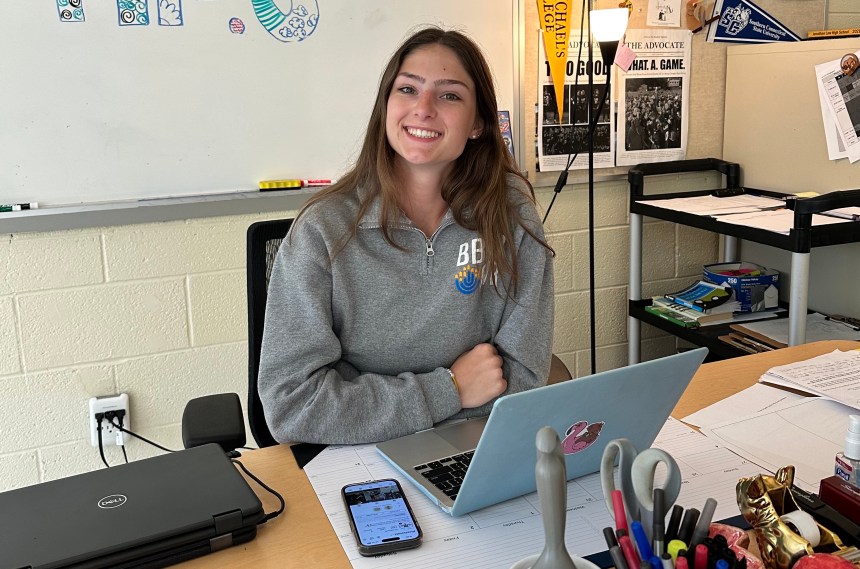
Advocate Editor-in-Chief Ella Franzman will be attending Syracuse University in the fall. (Photo courtesy Kayla Markowitz)

By Ella Franzman – Editor-in-Chief

As I get ready to say goodbye to Jonathan Law, I think the hardest thing to leave behind is The Advocate. From the very first class freshman year in Journalism 1, this elective became more than just a class. Over the years, I’ve had the honor of holding multiple positions and working with many different editors – from a Staff Reporter to Sports Editor and now my second year as an Editor-in-Chief. Each role taught me something different, challenged me and helped me grow, not just as a journalist but as a leader and a person. 

Being part of The Advocate has given me the opportunity to tell so many different stories and bring so many new ideas to the table. Being able to celebrate the people who make our school so special and to be a voice for our student body has just been an amazing experience. 

I want to give a huge thank you to Mr. Kulenych, better known as Mr. K. None of this would have been possible without all of your support. Mr. K. has been more than just The Advocate’s Advisor and teacher, but he has been an awesome mentor. His passion for Journalism and the endless support he has had for every Advocate editor is inspiring. I can’t even begin to think how my high school and future would have looked if I didn’t take that one Journalism class freshman year.

I also want to thank Mr. G. for allowing me to sit at his desk two periods a day. I feel like at this point I’m in Room 211 (or now Room 228) more than you are.  

To the future Staff Reporters of The Advocate, write what matters to you, meet your deadlines (as best you can) and always triple check your spelling. 

I am beyond excited to continue my career in Journalism at Syracuse University in the fall where I will be studying at the S.I School of Newhouse majoring in Broadcast and Digital Journalism. 

Leaving The Advocate is bittersweet but I’m so proud of everything we’ve accomplished and excited to see how the paper continues to grow in the future.

OPINION: Are Trump’s Executive Orders Really Making America Great Again?

(Photo courtesy npr.org)

By Harshitha Kothapalli – Editor-In-Chief

It has been less than a week since Donald Trump was inaugurated into office, and he has already begun to push forward on what he sees as “Making America Great Again.” But what have we really seen so far?

Trump’s campaign revolved around strengthening the economy by imposing tax cuts and securing the border by ending President Biden’s catch-and-release policy. Based on a recent Pew Research poll, the country’s pressing issues at the moment include the economy, the healthcare system, political divisions, and rising concerns about abortion rights and gun violence. 

President Trump has issued a number of executive orders during his first days in office, but many of them don’t seem to tackle or address the issues facing the country. 

Quickly after his inauguration he renamed The Gulf of Mexico as The Gulf of America and changed the name of Mount Denali to Mount McKinley. During a post-inaugural speech, he also pronounced that America will now only recognize two genders. 

While some may argue that these decisions are symbolic, they don’t directly address the real challenges facing Americans. Renaming geographical features or issuing statements on gender doesn’t exactly tackle issues like job growth, healthcare, or social equity: issues that Trump’s campaign promised to prioritize.

That being said, not all of Trump’s executive orders have resulted in entirely negative responses. For example, his 75-day extension on the trending app, TikTok, has newer generations hopeful for the future. 

However, when it comes to pulling out of the World Health Assembly (WHA) and the Paris Climate Accord, Trump’s actions are a step backward. Leaving the WHA, which coordinates global health efforts, could isolate the U.S. from collaborations on health issues, leaving the country vulnerable. 

Also, withdrawing from the Paris Climate Accord, a global agreement aimed at combating climate change, sends a dangerous message to the world. Climate change is one of the most pressing challenges of our time, and the U.S. stepping away from international efforts only weakens the global resolve to address it. 

As the world’s largest economy and one of its biggest emitters of greenhouse gases, America’s role in these agreements is crucial, not just for the planet’s future but also for maintaining diplomatic relationships.

Whether or not these decisions will lead to a better, “great” America remains unclear.

However, if Trump is serious about making America great again, he’ll need to focus more on the issues that truly matter to the average American. 

Pulling out of important global agreements and making symbolic moves may grab attention, but they won’t necessarily move the country forward.

OPINION: Live In The Moment, Not On Your Phone

(Photo courtesy freepik.com)

By Harshitha Kothapalli – Editor-In-Chief

On the night of Thursday, October 10, Milford witnessed the once-in-a-lifetime experience of the Northern Lights. However, my takeaway from the magical happening slightly differed from the regular reaction of awe. 

As I looked up into the sky to see the blend of colors, my automatic reflex was to grab my phone and quickly scramble to take a picture. But, at that moment, everything seemed too surreal. It didn’t seem like my iPhone with a TrueDepth, Ultra Wide, and Main camera could capture such a feeling. 

When I told my friend that I saw the Northern Lights but I didn’t take a picture, she couldn’t understand my reasoning. This made me think about just how dependent we are on technology as a society. It isn’t exactly our generation’s fault for growing up in such a fast-paced world with a rapid flow of new ideas and technology. However, it’s our obligation to make sure we don’t let it disconnect us from the authenticity of the moments unfolding around us. 

In our day-to-day lives, we are constantly in contact with electronic devices. We wake up and check our phones, we go to school and open our Chromebooks or stare at a Viewsonic, we go home and turn on the TV (while also scrolling on TikTok), and then we press repeat and do it all over again. 

The use of technology has been linked to the causes of various mental health disorders, including anxiety, depression, and sleep disorders. My belief is that the second we look up from these tiny screens, not only will we have a reduced amount of headaches, but we’ll actually start to observe and enjoy the natural world around us.  

I know it’s never that easy. This modern world is so reliant on technology that it is almost impossible to live in this imaginary dream where we can look out our window all day long. That is why,we as a generation must find a balance. To make sure our children don’t experience their first rainbow through Cocomelon. To make sure that we don’t reminisce on the past and remember nothing of actual substance.

So, the next time you look up into the sky and see a pretty sunset, don’t immediately take out your phone. Instead, take a minute to appreciate the beauty in front of you, and let it remind you that some moments are meant to be felt, not captured.

OPINION: Did Anyone Win The Presidential Debate?

(Photo courtesy whyy.org)

By Harshitha Kothapalli – Editor-in-Chief 

On September 10, Candidates Donald J. Trump and Kamala Harris took to the stage for their first Presidential Debate against one another. Many have argued that Harris won. Others have argued that Trump was the victor. Let’s dive in a little deeper. 

The Commission on Presidential Debates (CPD) is a nonprofit established for the benefit of all voters. According to the CPD, presidential debates were introduced “to ensure that the voting public has the opportunity to see the leading candidates debate during the general election campaign”. It is supposed to allow voters to be informed of critical policies and vital issues. 

However, in the 90-minute debate, 30 minutes and 16 seconds were spent attacking the opponent rather than answering the questions. Moderators David Muir and Lindsey Davis introduced questions about abortion, the economy, foreign policy, tax reform, global warfare and various other important topics. 

Despite these crucial issues, the debate fell short in providing voters with clear insights into the candidates’ policies and visions for the confused country. Instead of using the powerful platform to address the concerns of the people, both candidates veered off-topic, engaging in personal attacks and deflecting important questions. 

In a time where voters crave real substance, this debate left a lot up in the air. The constant interruptions, accusations, and off-script commentary overshadowed any meaningful discussion of policy. While every now and then plans were mentioned, neither candidate made significant headway in clarifying their positions, nor did they articulate clear plans for the future.

As a result, it’s difficult to declare a real “winner.” When the focus is more on undermining the opponent than offering solutions, the real losers are the voters, who were left without the information needed to make an informed decision.

OPINION: A Call To Action – Let’s Move One Stop Closer To Keeping Our Schools Safe

(Photo courtesy buzzfeednews.com)

A CALL TO ACTION: ONE STEP CLOSER TO KEEPING OUR SCHOOLS SAFE

By Kayla Markowitz – Editor-in-Chief 

For many students and staff, school is our home away from home. We expect to be safe in our own home. So, why should we leave our families every morning to attend school without a guarantee that we will come back?

The first school shooting in America dates all the way back to 1764, and since then, hundreds of schools have been the target of terrible massacres and so many lives have been taken. One of the worst high school massacres was the Columbine Shooting in Littleton, Colorado, which was the first time a brutal attack on a high school was covered live. According to the Washington Post, 417 schools have been the victim of this violence since Columbine.

So what should we do?

One step we should be taking to prevent school shootings is to limit the access of firearms kids are exposed to. The U.S. Secret Service analyzed nearly 40 years of school violence involving firearms, and found that an estimated three-quarters of school shooters’ guns came from their parents’ home or a nearby relative’s home. This tells us that by making guns less accessible to kids and teenagers, there is less risk that they will be used dangerously. 

Every household storing a gun should have a complete background check. Along with this, there should be increased education and enforcement on storing guns safely so that they are not accessible to anyone but whom the gun belongs to. 

If a child or teenager obtains their parent’s or relative’s gun because it was not securely locked up, the parent should be held responsible and face legal consequences. Laws like this will help deter parents from allowing kids access to their firearms. 

In the most recent firearm attack at Apalachee High School in Georgia, 14 year-old Colt Gray got a hold of an AR-15-style rifle. His father, Colin Gray is facing charges of two counts of second-degree murder, four counts of involuntary manslaughter, and eight counts of cruelty to children because he gave his son access to the firearm used. 

Every school district in America, including Milford, would benefit from providing families with educational resources about safe and secure gun storage. At the federal level, Congress needs to pass common sense gun laws that protect gun owners’ rights, but more importantly, protect kids’ lives.

EDITORIAL: Political Discourse Should Not Be This Polarizing

(Photo courtesy insperity.com)

By Harshitha Kothapalli – Editor-in-Chief

In 2008, The Advocate conducted a schoolwide poll to determine who the Jonathan Law community supported for President. In the October 2008 edition of the newspaper, Editor Mary-Elizabath Sabo wrote an editorial in support of Democratic candidate Barack Obama and Editor Joe Pellicano wrote an editorial in support of Obama’s opponent, Republican John McCain.

In 2012, The Advocate also published two editorials leading up to the Presidential Election: one endorsing Obama and the other endorsing Republican Mitt Romney.

In 2024, leading up to the Presidential Election, The Advocate has not endorsed either of the two candidates. 

In today’s world, both in and out of school, we have to tip-toe around big important political topics more than ever. It seems as if trying to make the world a better place by learning and growing is sacrificed for trying not to hurt people’s feelings, opinions, or emotions.

If we as teenagers aren’t able to get uncomfortable and talk about growing issues that will affect our lives today, and in the future, we will never be able to mature fully as adults. Being able to see where other people are coming from and realizing when someone else is right are critical skills that we just don’t have as a generation.

Shortly after the recent presidential debate between candidates Kamala Harris and Donald Trump, I wanted to write an editorial on my thoughts on the event. The reason this article is not on that topic is based on a simple question that came quickly after the idea: “Would the backlash be worth it?”

This “backlash” is the reason we’re being held back as a community and as a generation. Why is it that we’re not able to express political opinions without thinking about the consequences?

It’s understandable that people have become cautious about sharing their thoughts and opinions in today’s society. However, this hyper-sensitivity stems from the fact that these political conversations have become more polarized than ever. 

Rather than fostering discussions that allow for growth and understanding, we often witness arguments that leave no room for nuance. It’s easier to brush past urgent topics than to engage with those who disagree, especially when social media amplifies the consequences.

But we as students need to realize that in a world so interconnected and diverse, avoiding tough conversations will not protect us but just increase the challenges we face as a generation. We can’t expect to navigate the future if we can’t even begin the conversations that will shape it.

So how can we move forward? How do we create spaces where people feel safe to express their ideas without the threat of backlash, while also being able to hold one another accountable? How do we balance empathy with honesty?

The solution starts with a change in us. If we can commit to having difficult conversations with respect and genuine willingness to understand, we can easily change the way society engages with these issues. If we want to mature as adults, we must first learn to have these conversations as teenagers. 

EDITORIAL: Senior Parking Lot Traffic Pattern Needs To Be Altered

(Photo by Maya Markowitz)

By Maya Markowitz – Social Media Editor 

Jonathan Law has four parking lots available for the student population as well as for faculty and staff. One of the parking lots is dedicated to teachers and staff and one is meant to be for senior students, leaving two lots for general use. 

School policy states that in order to protect the cars of faculty and staff, students should not park in that lot; however, their other options are extremely limited. The main student parking lot, by the auditorium, becomes full before 7:15 a.m. and it takes up to 10 minutes to get out at the end of the day. Oftentimes, when the lot fills up, students park illegally of desperation. This leaves students eager to leave class on time and even early. Ultimately, the parking lot distracts students from completing their day as they anxiously await near the door come the end of class. 

The flow of traffic is particularly troublesome in the morning. Parents who drop students off before and after school will often pull into businesses nearby to avoid going near the parking lot and getting stuck in traffic during its peak. This disrupts the flow of traffic to these businesses and creates an overflow on to the adjacent streets. 

The student parking lot has seen several accidents both before and after school as students pull in or out in a rush to get to class or to their after school activities. Students even made an Instagram page featuring all of the parking mishaps in the lot which was a humorous way to shed light on the concern at hand. 

With a large number of new drivers, the school should have a way to make sure that everyone is safer at the end of the day. 

Some of the ways that Law could approach this is by expanding parking options to students, so they are not all concentrated in the same place at the same time. Another option would be to slightly change the traffic patterns so that the pick up line does not have to merge with the line already consisting of students from the senior, regular, and small top lots. 

These solutions are easier said than done, however, it is an investment that everyone will benefit from. 

EDITORIAL: Student Council Election Process Needs Some Changes

(Photo courtesy lolhs.org)

By Kayla Markowitz – Staff Reporter

The Jonathan Law Student Council is elected at the beginning of every school year through a process of selecting an office and then getting student and teacher signatures in order to run. Once students are in the running for a desired position, Election Day is held where students get to hear speeches from each candidate and vote on who they think is best to fill each role. 

While the current process is adequate, it is time for an upgrade. Instead of this process, students should run for the council and then once the top six students with the most votes are elected, the council and advisors decide on roles to give everyone. This process will eliminate the appeal of running only for titles like the president and vice president and would promote students running purely to help their class. Running for the council before filling certain roles will help guarantee that everyone will take their jobs and responsibilities seriously. This process also allows roles to be chosen after elections are done which ensures that people with different skills will get to fit their position. For example, someone who wants to be a treasurer and believes that it’s the right role for them can be elected treasurer once elected to the council. 

Some may argue that Law should keep the old process to practice how elections are run in real life. While this argument is understandable, one way to include both arguments is only freshman classes will go through elections with the updated process because they are new to the school and don’t know how much leadership or responsibility council members should have. 

Many times, students run for positions on the council only because they’re running unopposed or they win because no one else ran for that position. This system would eliminate that appeal because it focuses on electing students purely based on responsibility. 

If these changes were put in place it would guarantee a responsible and hard-working council while also decreasing the likelihood of students running only for titles.

EDITORIAL: Black History Should Be A Year-Round Celebration

By Gemard Guery – Editor-in-Chief and Editorial Editor

Black History Month is a yearly celebration of Black culture and history. It highlights many of the Black heroes and hidden figures that have helped change our world for the better.  

Over time, however, February has become the main – and sometimes only – time when people have acknowledged and celebrated the contributions made by Black people on society.  This really shouldn’t be the case.

The teaching and celebration of Black culture and history should  be happening throughout the school year and not just centralized in February. Oftentimes, Black history is ignored by popular culture until February hits. February becomes the time when we acknowledge Black History. 

The purpose of Black History Month when it was founded in 1970 was to make it more accessible to people.  It was intended as one way to show the contributions made by Black people at a time where people argued that Black people hadn’t contributed to society.  

However, by centralizing the learning and celebration of Black history and culture in February, we rob ourselves of so much history that could be learned. There are so many different movements, events, and people that often get overlooked because people don’t get to them in February. So why stop on February 28?

In order to stop centralizing Black history in February, there are a few steps that can be taken. Firstly, schools can stop waiting until February to begin teaching Black history.  Rather than preparing lessons and other events just for February, these can occur year-round.  

Another way is making Black history more engaging. While Black history can definitely be hard history, schools can discuss achievements and more positive aspects of Black history as well. There is so much more than slavery and segregation and lessons and activities should reflect that.

In order to make school a more equitable place, we shouldn’t be packing our bags because the calendar has flipped to March. A 28-day month simply isn’t enough to encapsulate all that Black people have contributed to history.

EDITORIAL: Class Rank System Does More Harm Than Good

(Photo courtesy tasseldepot.com)

By Gemard Guery – Editor-in-Chief & Editorial Editor

Class rank is a system that ranks students based on their cumulative grade point average.  Typically, it utilizes the weighted GPA that takes the difficulty of the classes into account in addition to the grade earned in the class.  This system is in use in schools all around the world.  However, in recent years, many schools have begun to change their class rank systems.

Class rank doesn’t truly benefit students and should be abolished or changed within high schools.  

High school is meant to be a time where students explore and discover interests they may have.  Class rank prevents students from exploring their interests.  Students often worry about how their rank will be affected if they take classes that they’re actually interested in so they take the hardest classes robbing themselves of the opportunity to learn more about what they like.  Rather than taking classes students may be interested in, they take classes that may raise their GPAs higher.

Additionally, more than half of all high schools have completely done away with class rank.  A lot of private and top-tier high schools have realized that class rank penalizes many students who have done amazingly during their high school career, but are unable to make it to the top 10% despite maintaining a phenomenal academic record.  

Class rank is also incredibly relative based on what school you attend.  Schools, curriculums, and grading scales are all different based on what school a student may attend.   Even the way class rank is calculated is different around the country and the world.  Some schools take personal qualities and school involvement into consideration in addition to GPA.  Some schools decide who gets the valedictorian honor based on whether you earned a certain GPA rather than if you had the highest.  The system is so different based on where a student goes to school and a student with amazing grades may be low at one school whilst a student with simply okay grades may be at the top of the class.

Even college admission officers all around the country (especially at selective schools) have realized that class rank may not be an important factor in admissions decisions.  Colleges already have so much information about a given student with GPA, their transcript, extracurriculars, and recommendations that class rank is becoming less important in admissions decisions. 

Class rank can also contribute to an incredibly toxic school culture.  Oftentimes, schools pride themselves on building a community and being part of a “family” within your school.  Class rank works against it as students want to have the  highest number possible.  School can easily become an unhealthy competition where a student may want to see their peers do worse than them or fail.   This competition also makes students who work really hard feel really bad about themselves because despite trying their best, they aren’t number one.

Class rank doesn’t take into account extenuating circumstances that may have affected a student’s academic performance.  It ranks you and has no regard for what a student may have gone through during the course or any moment within their high school career that may have resulted in their grade point average lowering.  Many students entered or experienced most of their high school careers in the midst of a pandemic.  Nothing about those school years during the pandemic were normal and a lot of students had personal, familial, mental, and physical issues that had an impact on their academic performance.  It’s truly unfair to those students and even if they get back on track, their GPA and therefore class rank will still be affected.

Some may argue that eliminating class rank is unfair to students who may be at the top of their class and want that honor to be included in their application.  This argument is wrong because students are honored for their commitment to academic excellence all the time.  Through honor societies, honor roll, awards ceremonies, and more, those students are given many opportunities to be recognized for their academic and personal achievements.  Eliminating class rank doesn’t stop those students from getting the recognition they deserve.

There are many solutions or routes that can be taken with class rank in addition to eliminating it as a whole.

One solution is to make rank optional.  Many schools around the country have made rank optional and given students the opportunity to decide whether or not their rank gets reported to colleges.  By giving students the option to omit their rank, students aren’t put at a disadvantage if they don’t like their rank because colleges won’t have to see it.

Another solution is changing our ranking system to the Latin honor society.  Rather than ranking by number, utilizing the Latin Honor Society and recognizing students by naming them Summa Cum Laude, Magna Cum Laude, and Cum Laude would still honor students who have maintained great standing in their high school career.  Students can be more focused on themselves and their performance rather than the performance of everyone else.

Schools can also simply rank until a certain point.  Some schools just rank until the top 10 or 25 percent of the class and everyone else simply goes unranked.  That way, those students aren’t put at a disadvantage in their college application process.

Class rank truly does more harm than good and serious discourse must be had about how it can be changed or eliminated in order to achieve school’s main purpose: ensuring every student reaches their fullest academic and personal potential.

EDITORIAL: Homework Policy Should Be Adjusted To Accommodate Religious Holidays

(Photo courtesy hrsimple.com)

By Gemard Guery- Editor-In-Chief and Editorial Editor

Holiday breaks are known as great days for students to catch up on school work. A great day to study, work on projects, and just get ahead in classes.  Since there’s no school, it’s just a day to  finish what you have to get done and prepare for school the next day.  

However, this has proven to be problematic for some students.  Some students actually have religious holidays that they celebrate during those days off from school.  Having tests, projects, and various other assignments to complete over those days may prevent them from experiencing a holiday incredibly important to them.

“It’s important to take into consideration other people’s cultures and how they celebrate them.  Schoolwork on holidays may interfere with how well they can partake in their specific holidays,” sophomore Ella Franzman said.  “It may stress them out and it’s important that students should be able to not be stressed out as they celebrate. “

Students should not have to worry about assignments over the course of those holiday days off.  The students who celebrate should be able to celebrate without worrying about the next big assignment the second they get back to school.  By scheduling so many tests and quizzes right after those days off, students are prevented from partaking in holidays important to them.

Instead of celebrating Yom Kippur which is considered the most important holiday in the Jewish faith, I had to worry about studying,” Franzman said.

Some people may argue that students who don’t celebrate will be able to take advantage of not having anything to do on days off.  However, that’s not necessarily a bad thing.  It rewards students who have been keeping up with school and allows them to take a break. Additionally, it gives students who may have been struggling with keeping up the opportunity to get caught up without falling behind further.

In order to ensure that students can freely celebrate their respect, Milford should have a policy in place to prevent tests, and projects from being due on days back from holiday breaks.  Rather than leaving it to a specific teacher’s discretion, a policy would guarantee that students have those days free to celebrate.

“It’s important to have this policy because I feel insensitive that I have to be worried about studying and homework while I’m supposed to be celebrating a holiday,”  Franzman said.

It’s important to recognize that teachers are not intentionally ignoring religious holidays. Sometimes, teachers are unaware of all the different religious holidays that students may celebrate.  Some students may also not be comfortable advocating for themselves in that manner.  Another way to solve this problem is to speak to students about what holidays are important to them (even if school is in session on those holidays) to work around that.  Asking earlier in the year through an anonymous form or a conversation would give the information needed to schedule assignments and be prepared for the year.

“There are not holidays every day so if you can speak to your students to find out what they’re comfortable with and potentially get a feel for which holidays are represented by your students would be great,” sophomore Sanna Joshi said.  “Keeping a calendar would also be a great way to ensure that your schedule doesn’t really interfere with student’s holidays.”

Students shouldn’t have to worry about schoolwork on days where they have religious and cultural commitments.  In order to ensure that, schools need to implement guidelines and policies that guarantee students can freely celebrate and communication between teachers and students is essential.  

EDITORIAL: New Mask Guideline A Step In The Right Direction And A Huge Milestone

(Photo courtesy tenneyschool.com)

By Gemard Guery – News & Editorial Editor

On March 13, 2020, our lives changed in a way no one could’ve anticipated. Students around the country – the world, even- found themselves stuck at home in quarantine taking online classes. Most students around the country had to finish the 2019-2020 school year at home.  

As the pandemic progressed, some schools gave students the option to come back in-person for the 2020-2021 school year.  While some students came back to school, other students like me decided to stay home.  

While COVID-19 is still very much a thing, these new mask guidelines are a great step towards a “normal” life again.

I came into high school with a very pessimistic attitude. The Class of 2024 hasn’t had a normal year since eighth grade which was taken away from us just before all the fun activities were supposed to happen. We came in thinking that a “normal” high school experience would be completely unheard and it’d be a miracle if we got an even somewhat normal senior year.

For me, staying online for the 2020-2021 school year was anything but fun. I did not want to be home, but I didn’t really have a choice because of safety reasons. This time last year was a terrible time because I truly did not enjoy school. I did not want to attend online classes and had never felt more disconnected from school and the content I was learning. There was nothing more I wanted to start in-person and have a normal pandemic-free school year.

Now, in just a year, the situation has changed significantly. I am now in-person with everyone else and we’ve reached a point where masks can be optional. To me, that’s nothing small.  It shows my normal high school experience is actually possible. I can enjoy all the fun events that the classes before me were able to enjoy and work hard, play hard.

The one I’ve heard so much about that has often been referred to as “the best four years of my life” would actually be happening – even if it did start a bit late.

OPINION: Slight Changes To Lunch Procedures Would Benefit Students, Cafeteria Staff Alike

(Photo by Isabella Gecaj)

By Isabella Gecaj – Staff Reporter

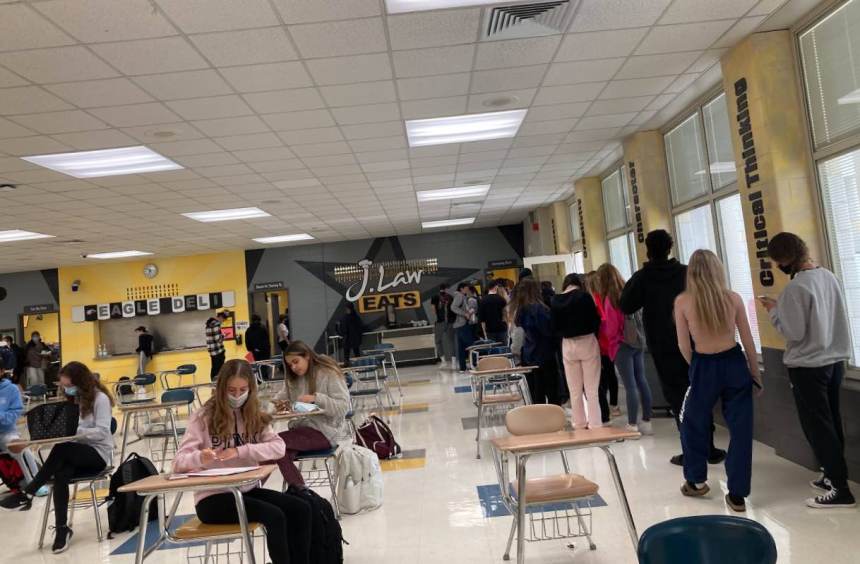
Jonathan Law High School has a 25-minute period for students to eat lunch. In this time students must leave their class and go to lunch from whatever area of the school they are in. Students primarily wait in two lines to buy food and then have the remaining time to eat lunch. Unfortunately, Law is unable to add simply time to the lunch period as it would affect the times of other classes and would be a districtwide decision. 

That said, lunch periods can and should be made more efficient. It takes a long time to buy lunch and students are left with little to no time to eat. This problem has especially been an issue the past two two years, since lunch is free and more and more students are buying lunch rather than bringing lunch to school. While the cafeteria staff has done an amazing job adjusting to more students buying lunch, wait times are still an issue on some days. Students who are coming from upstairs or the other side of school have to wait anywhere from 10-20 minutes, which gives them 5-10 minutes to eat. For some, the bell rings as soon as they get their food and they are given a late pass so they can get time to eat. The lines are very crowded, all because students are worried about whether they will be able to eat lunch or not. The current process is inefficient and stressful for both students and the cafeteria staff who are rushing to hand out lunch. The students who are not given enough time to eat often leave undernourished or have to miss class time to finish lunch.

By making lunch more efficient, this problem can be fixed. The school district could possibly make a mobile app so students can pre-order their lunch beforehand. Lunches could be pre-made and boxed individually to follow COVID protocols. Creating an app will likely take some time, so in the meantime, paper forms or a Google Form could be used to pre-order a boxed lunch that students could pick up at the start of their lunch wave.

School lunch can also be made more efficient by adding an additional lunch wave or two, especially during block periods where there is time in between waves. This way lunch waves have less people, decreasing the line and helping the lunch workers so they do not have to rush as much with packing lunch. This would help since the last lunch wave finishes at 12:34 p.m. on block days, so there could be another one or two waves added. A third lunch line would also be helpful. The return of the Deli Line this week will hopefully shorten the other two lunch lines and make for a more efficient lunch-buying process.

These changes are important because a short lunch wave can negatively impact students’ physical and mental health. Eating too fast can result in a series of complications. With it taking 5-10 minutes to get lunch, students do not have enough time to properly digest their food. Even the full 25 minutes is not long enough, but at least it is more time than having 15 minutes to eat.

Students who rush to eat their lunch are more prone to headaches and stomach aches. Consuming food too fast can lead to irritable bowel syndrome, arthritis, abdominal pains, and heart diseases. In turn, students have a harder time functioning in class due to their increased stress levels. The rapid changes and inconsistency of the digestive system can lead to constipation or multiple trips to the bathroom. It can also interrupt class time and cause students to miss class time. 

While this is not an everyday problem, current lunch procedures do affect many students on some days. Therefore, lunch can and should be made more efficient. Lunch is a time for students to destress, spend time with friends they do not normally see, and fill themselves with the proper nutrients. There are many ways this challenge can be handled. It will not be easy to instill and it will take time, but eventually a more efficient lunch period will benefit everyone.

(Some information courtesy Mrs. Attardo, thea-blast.org, edweek.org, kingcountry.ogov, goodtherapy.org, washington.edu, kqed.org, sutterhealth.org)

OPINION: Law’s Bathrooms Should Be Open More Often

(Photo by Sydney Simpson)

By Maddy Gaillard – Staff Reporter 

At Jonathan Law, many bathrooms have been closed during passing time as well as during all lunch waves. This is due to several incidents of vandalism at the beginning of the school year and multiple students staying in the bathroom for a profound amount of time. Only a few bathrooms are open at all times and the rest are locked. 

This bathroom situation is unfair to all of the students and it does not defeat the problem. Having the bathrooms locked just because of a handful of students harms the other hundreds of students that go to Jonathan Law. This also impacts the teachers and the students time to be in class because they are trying to find an open bathroom. While this is a good idea to try and stop this issue, the rest of the school has to pay for a few students’ mistakes. 

The bathroom situation is unfair to the majority of the students in the school. Each lunch wave is 25 minutes long so the bathrooms will be closed for about an hour. This is unfair to the students because they may have to go to different sides of the school to find an open bathroom. This can create conflicts between teachers and students because students may take too long to go to the bathrooms. This can also be difficult for the teachers because it is taking away from their lesson time. Therefore, this can be unfair to the students because they have to take more time to find a bathroom and it is unfair to the teachers because the students are taking too long. 

In addition, the students that are causing this problem are making the rest of the school pay. Instead of punishing the whole school, more options about controlling these problems should be made. Having the whole school face the consequences of a few students is unfair to the students, having to go around the school is very inefficient and frustrating to students and teachers. Therefore, this issue is not truly benefiting the rest of the students in the school and having the students try and find open bathrooms can be aggravating for students as well as teachers. 

A possible solution is having more people watch the lunch waves so more bathrooms can be open. Having the bathrooms closed during all of the lunch waves is the biggest issue so having them locked during passing periods is okay. Therefore, a solution could be to have more people watching the lunch waves or just not closing all of the bathrooms. 

Having the majority of the bathrooms locked may be beneficial at times but there are also many cons. Having the bathrooms locked for a certain period of time can lead to conflicts with students and teachers and it is unfair for the rest of the students in the school. The bottom line is that making sure the students are safe and preventing trouble is good but locking the bathrooms for a long period of time isn’t. 

OPINION: Law Seniors Put Together Amazing Outfits For Prom 2021

(Submitted photos. Collage by Tyanna Xavier)

By Tyanna Xavier – Social Media Editor

The seniors at Jonathan Law attended a prom like no other at Lake Quassy on May 12.

Members of the Class of 2021 were raving about how amazing prom was. While it was a very untraditional prom, students said this was the best prom they could have imagined.

This article isn’t about prom, though – it’s about prom fashion! The seniors at Jonathan Law put together some amazing outfits – and I’m here to recap it all! 

Senior Elma Radoncic wore a beautiful emerald green dress that was to die for.

“I chose this color because I felt like it complimented me in a good way,” Radoncic said. “When I first tried the dress on I instantly noticed the way it made my eyes stand out.”

Emerald green is a color that is not as popular as others prom dress colors, thus so Elma’s dress was a 10/10. Her earrings and her lace-up heels really pulled her whole look together and it looked stunning on her.

Senior Brian Felag showed out to prom with a stunning white blazer with black lining. White is a tricky color to wear to prom, however, if you can pull it off, it is never going to be a problem.

“I really liked my suit choice because since this was a senior prom I really wanted to try something different and stand out and having a white blazer in the springtime definitely felt like the right choice for me,” Felag said.

Senior Jordyn Wirth wore a turquoise prom dress that absolutely complimented her beautifully. The dress was a strapless with a silk texture and a slit down the leg. She wore the dress beautifully and had an amazing natural glow. 

“I chose this dress because I thought the color and the overall design of the dress was right up my alley,” Wirth said.

Always someone who loves a good fashion moment, senior Jefri Caballero’s suit was a great choice. Caballero wore a maroon suit with black accents and a small white pocket square.

“I loved my suit and felt very confident with it,” Caballero said. “For senior prom, I wanted to pull it out of the bag, since it’s our last school dance.”

Senior Umnia Rahman also showed up dressed to impress. As if she did not catch people’s eyes already, Umnia also had her date, Pardhip Nair, match her with hot pink accents. Umnia’s dress was hot pink with a criss-cross back, and rhinestones from the bottom to the top. She came to make a statement and was definitely a show-stopper. 

“Pink is one of my favorite colors and since this is the last school dance I’ll be going to, I wanted to stand out and wear a different color than most people,” Rahman said. “My favorite part of the dress was the criss-cross back.”

EDITORIAL: Poet Amanda Gorman Put My Feelings About America Into Words

(Photo courtesy variety.com)

By Gemard Guery – Staff Reporter

The 2021 Inauguration was both historical and stunning.

While the ceremony was wonderful, the moments from a young poet stood apart.

Amanda Gorman, a recent Harvard grad who studied sociology and first-ever National Youth Poet Laureate, was that young poet.

Her poem, “The Hill We Climb,” captivated the hearts of millions.

Gorman researched the speeches of Martin Luther King Jr. and Abraham Lincoln, she told CBS News, in her quest to create her masterpiece.

And then a pro-Trump mob attacked the U.S. Capitol.

That same day, Gorman told CBS, the poem “came to life.” She told the network that she wanted the poem “to be a message of hope and unity” but didn’t want to “turn a blind eye to the cracks that really need to be filled.”

After reciting the poem, Gorman’s fan base grew to include some of the most famous people in the world.

“I have never been prouder to see another woman rise! Brava Brava Amanda Gorman!” Oprah Winfrey posted on her Instagram account.  “Maya Angelou is cheering – and so am I.”

Gorman perfectly put into words some things that I have been feeling since the attack on the Capitol.

The attack was bothering me for some time because I never thought something like this could happen in 2021. But then Gorman said, “We learned that quiet isn’t always peace and the norms and notions of what just is isn’t always just-ice.”

That’s when I finally understood what was bothering me so much.

I believed we were all at peace.  I saw nothing about an attack and I only saw people arguing with the results because they were unable to accept the fact they lost.

I thought that just because I heard and saw nothing, nothing was going to happen.

Gorman’s poem allowed me to breathe a bit and know that days of true peace without fear could come.

I always thought that just because I was American, this could never happen.  I never saw anything like it, so I convinced myself that it could never happen.

But as the young poet perfectly said, “While once we asked, how could we possibly prevail over catastrophe? Now we assert, how could catastrophe possibly prevail over us?”

I always thought we would be strategizing to prevent catastrophe, but never thought catastrophe could win.

For months, I have been rethinking what being American has even meant, and with all the time covid has given, I have had a lot of time to think about it.

For so long, there was some kind of unexplainable joy that came from the word American. But it means so much more than it. It’s truly looking at what has happened in the past and learning how to fix it so it doesn’t happen again in the future because there is a lot of pain, grief, and sadness that comes with that word as well.

It was truly amazing to see how Gorman captured so many different feelings and thoughts in her poem.  It was a positive take on such a negative time in our country.

I believe history will remember how Gorman found light in so much darkness because as she said, “There is always light, if only we’re brave enough to see it.  If only we’re brave enough to be it.”

EDITORIAL: Social Distancing Rules Necessary, Important To Slowing Coronavirus Spread

(Photo courtesy houstonmethodist.org)

By Mia Cerrato – Editorial Editor

“Social Distancing” is the term given to community practices that are currently being recommended for the word to confront the COVID-19 coronavirus outbreak. Those recommendations are necessary and important. 

The restrictions vary from simple tips, such as hand washing, to more drastic things such as cancellation of schools, and advising to work from home. Those require a lot of planning, preparation and adjustment to everyday schedules. But these tips and tasks are necessary if people are to better contain and slow the virus’s spread. For those who are young and healthy, the chance of contracting the virus is minimal. On the other hand, for those who are over 65, have respiratory issues or with heart disease or diabetes. The slower the spread of the corona, the better it will be for hospitals or other medical establishments  to treat the people in need. These facilities would like to keep the amount of patients smaller than the amount of hospital beds. 

People have to isolate themselves, but everyone needs to maintain social connectedness. The community needs support from one another despite the fact that people must be secluded from each other. The community has to make conscious choices to reach out to others. Particularly for the elderly among friends, family and neighbors, make a call to see how they are. Make plans to talk on the phone, FaceTime, or Skype to keep them company during this time of self-isolation. 

While all this isolation is beneficial, it leads to lost hours of work and layoffs. The secludedness is putting a huge strain on the financial system. If no one has a job how will they pay for rent, food, and personal items? People who works in a restaurant, in entertainment, or in sports could be out of work. All of those establishments have help staff such as custodians, maintenance workers, waiters who will be out of work. The more we keep socially distant, the sooner these people will be able to get back to work.

The correct plan of action to combat the coronavirus is to remain in self-quarantine and to keep distance from others. It is beneficial for yourself and those around you. 

EDITORIAL: Key To Managing Coronavirus Stress Is Staying Positive

(Photo courtesy positivityblog.com)

By Alexis Broderick – News Editor

The coronavirus, also known as COVID-19, has changed many things. School is much harder now; the teachers are doing everything they can to help us, but nothing is like sitting in a classroom with a teacher and being 1:1. The students are struggling with these changes, but so are the teachers. Unfortunately, we all now don’t have a choice. There is one way of learning now and that change we have to make into a daily routine.

Not only has our education been affected, but we also can’t even see some of our family and friends. That’s a major change as well. During times like these I’ve spent time painting my house, learning how to navigate and use new technology, and watching new TV shows.

The goal is to stay positive and focus on what we do have. The internet can help us keep in touch with the people we usually talk to on a daily basis. It also plays a huge role in how students are being educated. If it wasn’t for the internet, we would be staying in school until the end of June. 

These are tough times and we will get through them together. Here are are some inspirational quotes that have helped me: 

  • “You must do the thing you think you cannot do.” – Eleanor Roosevelt


  •   “A problem is a chance for you to do your best.”– Duke Ellington
  • “Always remember you are braver than you believe, stronger than you seem, smarter than you think and twice as beautiful as you’ve ever imagined.” – Dr. Seuss
  • “Life isn’t about waiting for the storm to pass, it’s about learning how to dance in the rain.” – Vivian Greene
  • “Challenges are what make life interesting and overcoming them is what makes life meaningful.” – Joshua J. Marine


At the end of all of this, COVID-19 taught me to not take moments for granted. Hug your loved one tighter and live every moment like your last. 

EDITORIAL: There Will Be An End To These Crazy Times Soon

(Photo courtesy cnn.com)

By Addison Schwing – Editorial and News Editor

Julien Minnick is a junior at East Hampton High School. For the past seven months, he has been studying in France, in the city of Alés, France, when the COVID-19 pandemic first broke out in Wuhan, China. At first, he didn’t think too much of it, as viruses tend to go around quite frequently. But France soon began to descend into chaos as essential supplies dried up and people began to take precautions. In a matter of months, COVID-19 started to swallow the globe. Europe became the epicenter of the pandemic, with entire countries, including France, going on lockdown. Julien had to make the difficult decision to return home early, in fear of not being able to ever return to the United States. 

Julien is now back at home, undergoing isolation under orders from his local health department. He can’t even see his family, locked in his room with his meals dropped off outside his door. “The hardest part is just having to stay in my little area,” he said. “I just wanna go downstairs, get a bowl of cereal, and sit on the couch.” Now, many other American youths share Julien’s predicament, quarantined in their houses, burdened by distance learning and forced isolation. 

But how did all this happen? How did the world go from thriving to hiding under the table so quickly? And what even is COVID-19?

COVID-19 is a member of the Coronavirus family of illnesses. Other coronaviruses include Severe Acute Respiratory Syndrome (SARS), and Middle East Respiratory Syndrome (MERS), also known as the Camel Flu. Coronaviruses have been around since the 1960s, being traced back to chickens with respiratory diseases. The Coronavirus Disease 19 (COVID-19) is similar to the flu but is highly contagious. Common symptoms include fever, coughing, and shortness of breath, but it can result in pneumonia and organ failure if left untreated. 

The first cases of COVID-19 were reported in 2019 in Wuhan, the capital of the Hubei province in China. Health officials traced the origin of the disease to a live animal market in Wuhan, where it quickly spread within the city, to outlying provinces, and then to other countries and continents at lightning speed. 

As the virus began to spread, the price of domestic and international flights dropped exponentially. Young and overzealous travelers took to the skies, enjoying their spring break, until cases began to crop up in Europe, especially in Italy. Soon, Italy went into lockdown, forcing its residents to stay inside and banning unessential travel. Then followed France, Spain, Germany, and many more Schengen-zone countries. Then, cases cropped up in the United States, with New York seeing hundreds infected every day. State governments ordered schools closed and residents to shelter in place, threatening legal penalties for those defiant of state ordinances. Restaurants were forced to switch entirely to takeout, nonessential businesses closed their doors entirely, and millions of workers began filing for unemployment. 

COVID-19 has also changed the lives of Jonathan Law’s own students and staff. Law closed its doors on March 16, and Milford Public Schools quickly established a plan for distance learning. Junior Rachel Giers feels greatly decreased motivation from her Google Classroom filling up with assignments.

“It’s a lot easier to actually absorb material when you have teachers directly explaining it rather than just seeing ‘Do this work’ on Classroom,” she said.

Unfortunately, Giers will have to wait a good amount of time before things return to normal, as Connecticut Governor Ned Lamont has ordered schools closed until April 20 at the latest, with a great possibility of schools being closed for the year. With these closures comes the postponement of many highly anticipated school events, most notably the Senior cotillion. 

Our current predicament is frightening, yes. Our favorite restaurants and stores are closed. We can’t see our friends. We can’t live life like we used to. We’ve lost trips, school dances, and our prospects for the future are in serious danger. But through all of this, our Milford community is coming together to weather the coming storm. Local businesses are giving back to the community, and there is hope on the horizon; China and South Korea have seen exponential drops in confirmed COVID-19 cases with more recoveries every day, and trials are already starting for potential vaccines. 

So don’t give up hope. Stay healthy, wash your hands, and practice your social distancing. There will be an end to these crazy times soon.

EDITORIAL: Reflecting On Two Weeks Of Social Distancing

(Photo by Michael Loschiavo)

By Michael Loschiavo – Sports Editor

The new normal has been hard to get used to for me, but this past week I looked forward to getting outside, walking the boardwalk, running, and playing golf. These activities got my mind off the daily problem I was dealing with. I was facing sadness from the busy life I had before, whether it was going to school, track, work, or Police Explorers. This whole new life was different.

On Monday, I went out for a 13 mile run with Liam Fedigan while social distancing. Tuesday, I went out for a 9.5 mile run and on Wednesday, I walked the boardwalk with my mom. On Thursday, I stayed inside to stretch anything that was hurting and made sure I was prepared for my next run. And Friday, I enjoyed golfing at Orange Hills with the two Fedigan brothers and my friend Nick to get some fresh air and to enjoy the outside. I stayed a little productive with my mom and I cooked hamburgers and hot dogs on the grill on Saturday. However, Saturday night I was thinking to myself, “When is this ever going to be over?” Never in my lifetime was anything ever as bad as this coronavirus outbreak.

With every update that is on TV, whether it’s Governor Lamont or President Trump, the news never sounds pleasing. It sounds like it’s going to take a while until this virus goes away. I feel like I just need to keep busy and pretend like I have so much going or make a lot of work for me to do. Also, I will do my everyday routine which is to go outside everyday and get a nice long run in and will still walk the boardwalk and still continue to have a social life but practice social distancing. I hope sooner than later we will be able to get back to school so I can share the rest of my senior year memories with the people and teachers  I miss the most. Most of all, I just want to see the best class of all, The Class Of 2020.

EDITORIAL: The Only Way To Get Through This Coronavirus Crisis Is Together

(Photo courtesy abcnews.com)

By Stephanie Caron – Entertainment Editor

It is no secret that the Coronavirus has swept up, not only the United States, but the entire world. Our everyday life has been put on pause in order to keep everyone safe and healthy. In attempts to do just that, schools have shut down, businesses, and jobs. The Coronavirus has spiraled into a national outbreak faster than anyone would have expected. 

Schools are trying to find new ways to connect with their students to teach and enhance our classroom skills even though we are out of the classroom. There remains the possibility that all schools in Connecticut hold the rest of their school years online. This does not come as a shock, as the new virus is everywhere. It’s also everywhere we look – on commercials, ads, billboards, alerts on apps, and the news. So how do we continue everyday life while our new normal is so new to everyone? It is a question almost everyone is asking themselves – how to create a seemingly normal routine in a very un-normal experience. It is something we are all going through. Although it does not seem it, everyone’s life has been put on hold for the remaining future. 

Social distancing was the first main step. For us, it is now almost two weeks that we have tried to remain distant from everyone. It seems as if this could go on for more time than anyone was expecting. News sources have speculated this will go until August, some are saying June, and others think this will be over this in April. All of it is unknown, not only to us, but to those who are trying to find out more information on this dangerous virus. This is new territory. A territory we wish we were not in, but are. 

But where does this leave us? How do we get through this? What steps can we take to make sure we are safe? These are all questions we have found ourselves asking one another.  It is all in the air on how we will get through this, whether it takes two months or six months. All we can do is be there for one another. Reach out through text to a friend to make sure they are doing okay. Or if you find you are bored, try a new hobby. This is all so strange to all of us, but in every situation there is always a positive outlook to it. Together we will get through this. 

EDITORIAL: Vape Detectors, Enforced Sign-In Process Would Help Solve Law’s Bathroom Dilemma

(Photo by Eva Carroll)

By Eva Carroll – Staff Reporter

Two years ago, the administration at Jonathan Law made the decision to close off some of the school bathrooms. Currently, there are five student bathrooms at Law, but only two are being used by students. One of these bathrooms is near the new gym on the first floor and the other is upstairs. The reasoning behind this action was to minimize teen vaping at school and to stop the fighting and vandalism that was occurring in some bathrooms.

A sign-in sheet was set up for the bathrooms in which students are supposed to log in their name, time of entrance and exit, and where they came from. By keeping track of who uses the bathroom and for how long, it would be easier to identify vapers who have been reported by other students. By limiting the number of open bathrooms, they would become more concentrated with students. As a result, the chances of a staff member or a concerned student encountering and reporting teen vaping or other misbehaviors would increase.

In theory, this idea does seem effective; however, in practice it is not. While vaping has decreased, this system has failed to completely eliminate teen vaping and other misbehaviors and, over time, has actually created additional problems for students. Due to the inconvenient locations of these bathrooms, using the bathroom takes even longer for students. When students have to use the bathroom during class, more time is taken out of learning. Further, there is sometimes not enough time in between classes to use these bathrooms and still be on time for one’s next period class. 

One solution to modify the current bathroom system is to re-enforce the sign-in sheet. As of right now, the sign-in system has not been enforced properly. Even though teachers do monitor the bathrooms, students have not been giving accurate or complete information on the sign-in sheets. Students will put fake names or just scribble their names so it can not be read. Students also leave sections blank which is an issue because it is much more difficult to pinpoint teen vapers without the full sign-in complete. For example, students will write their names, but will leave the time section blank. It should be mandatory that all students are signing in and if they are not doing it properly, there should be consequences for the student. Maintaining a stricter sign-in sheet will make it easier to identify student vapers and it will also help to prevent students from camping out in the bathrooms as well. A lot of this responsibility lies on the students for not taking the sign-in sheets as seriously as they should. If students are caught not filling out the sign-in properly, there should be a consequence put in place. If a student is caught the first time, students should get a warning. If they are caught a second time, they should receive a more severe consequence. While many students enjoy complaining about the bathrooms, nothing will change if students can’t maturely handle something as simple as signing their name, time in, and time out to a piece of paper.

Another solution to modify the current bathroom system is to install vaping detectors in the opened bathrooms. Even though the bathroom system has decreased teen vaping at Jonathan Law, it has not eliminated it entirely. If administration were to install vaping detectors, the school would be directly notified every time the sensors detected vaping. Vape detectors have become increasingly popular in high schools all over the nation. These specialized detectors closely resemble standard smoke or carbon monoxide detectors. One popular smoke detector brand called Halo has designed its smoke detectors to pick up on smoke, vapor, and THC oil, a compound commonly found in marijuana products. Their sensors even pick up on abnormal and loud sounds such as gunshots, screaming, and aggressive speech. With the installation of these detectors, administration know when vaping takes place and it will be much easier for them to identify students that have been vaping in the bathrooms. Further, these sensors will also eliminate concerns of other bathroom misbehaviors such as fighting, bullying, and shootings. The school dministration can even link the notification from the sensors directly to the teachers who are monitoring the bathrooms so fast action can be taken.

Recently, Hargrave High School in Texas has installed Halo vape detectors in its school bathrooms. Hargrave High School Assistant Principal Robert Murray said, “We have actually had a high percentage of success rate with actually finding the vapes when we get the notification and are able to address it in a timely manner, I want a kid to make a conscientious decision, is this decision worth this? If I get discovered with this, is it truly worth it.” These sensors are the most promising method to secure bathroom safety at Law.

It is understandable to see why some individuals may be reluctant to make these solutions. Creating a stricter sign-in system will be more of a hassle enforce and will require more maintenance to deal with guilty students. Smoke detectors take a lot of money to purchase and install. However, these measures are necessary in ensuring the health and safety of students. The FDA has recently discovered that some lung injuries are associated with the use of vaping products. If putting in that extra mile to get those detectors or to change the sign-in system decreases the use of teen vaping than there is no greater reason not to take action. As a school, Jonathan Law must make sacrifices to ensure the well-being of students. Additionally, once students prove that they can handle to behave responsibly in the school bathrooms currently open, maybe the administration could consider reopening the closed bathrooms. This action will stop the inconveniences the current system has inflicted.

EDITORIAL: TLC Quiet Rooms Have Been Beneficial For All Students, But Have Opportunity To Be Even Better

(Photo courtesy Sydney Simpson)

By Sydney Simpson – Staff Reporter

This year, Jonathan Law High School debuted a new and improved Teaching and Learning Commons, complete with couches, tables, a presentation room, and quiet and collaboration rooms. The TLC in general was created to act as a resource for students, specifically with the peaceful atmospheres of both the quiet rooms and the collaboration rooms. The quiet rooms are places where students can go to get work done in a quiet and productive space, and the collaboration rooms are places where students can go to concentrate on group projects, work together, and be creative and productive. 

Both the quiet rooms and the collaboration rooms at Law have proved beneficial to the student body this year for many reasons, but there are also flaws hidden in their design. The pros of the quiet and collaboration rooms are that they are productive spaces for students to get work done, and they provide students with an escape from the crowded cafe during study halls. The cons, however, are that some students do not utilize the quiet and collaboration rooms for academic purposes, and the same students often use these rooms daily, not allowing for other students to get a chance to experience the benefits. Also, many students do not know the difference between the quiet rooms and the collaboration rooms, which can affect the experiences of other students trying to work.  

The specialized rooms in the TLC are beneficial to students for many reasons. They are productive spaces and can help students focus on their work. They are closed off from the rest of the TLC, providing a less crowded and noisy place for students. These rooms allow kids to work diligently without getting distracted by their surroundings, and with the popularity of the TLC and the amount of students there each period, it is easy to get distracted by noise and by people passing through. Some students have trouble working in noisy atmospheres, and the quiet and collaboration rooms can help these students to focus. The rooms also supply the kids at Law with an alternative to a crowded cafeteria study hall. Law’s cafeteria can get extremely crowded, especially when there are four study classes in there at once.

The quiet rooms in the TLC give students another option by offering an escape from the often noisy cafeteria. Study hall is a time for students to utilize and to get work done, and it should be used to its full potential by all students. It can be hard for kids to utilize their study periods in loud, crowded places; the quiet and collaboration rooms provide secluded and productive areas for kids to do their work. Although there are not enough quiet rooms for every student to go during their study every day, students can rotate between staying in the cafeteria during study and going to the TLC to let other kids have a chance to utilize these rooms. With at least some students visiting the TLC each day, cafeteria study halls will become less crowded, letting the remaining students have a more productive, quiet atmosphere as well. 

Although the quiet and collaboration rooms located in the TLC help Law students academically, there are some issues that still need to be addressed. First off, some students do not use these rooms for academic purposes, taking away the opportunity for students who are trying to utilize the quiet atmospheres to focus on school work. Many kids use these rooms to relax and take a break from their busy school days, which isn’t necessarily a bad thing, but there are many other places they could go to do this. For example, if coming from a cafeteria study, students can stay there to talk and socialize. They could also make a visit to the couches set up in the main area of the TLC, or the other cool new furniture that was installed. By doing this, other students could use the quiet rooms and the collaboration rooms more appropriately, for academic purposes rather than for socialization and Tik Tok dances. Secondly, the same students often use these rooms daily, not allowing for other kids to experience the benefits that the quiet and collaboration rooms have to offer. This could be fixed by having a sign-up sheet in the TLC for students who want to visit the rooms during their study periods. This way, quiet rooms can be previously reserved, and kids don’t have to rush to sign into their study and get to the TLC before all the rooms are taken. By only allowing kids to sign up for quiet rooms twice a letter cycle, it gives everyone an equal amount of time to use the quiet rooms if they want to. 

The intended differences between the quiet rooms and the collaboration rooms at Law are not widely known by the student body. Most students use all four rooms in the same way when they are meant to be utilized for different things. The two quiet rooms are supposed to be places for students to go where they can get individual work done fast and efficiently. Kids can work in silence to increase productivity and to have less distractions. The two collaboration rooms are creative spaces where students can work together on assignments or group projects and still get work done efficiently because there are no outside distractions. These rooms should be filled with students exchanging ideas and helping each other through academic assignments. If more students at Law knew the differences between the quiet rooms and the collaboration rooms and used them correctly, productivity in both rooms would increase.

The quiet and collaboration rooms at Law have both benefits and issues associated with them. These issues are easily fixable, and by the end of the quarter, these rooms could be better utilized by the student body.

EDITORIAL: More AP Courses Should Be Offered To Sophomores

(Photo courtesy collegeboard.org)

By Eva Carroll – Staff Reporter

College Board is a non-profit organization which aims to expand access to higher education. In opposition to standard prep courses, College Board offers college-level classes to high school students in what is known as Advanced Placement courses (AP courses). At Jonathan Law High School, AP courses are available to grades 10-12. Most of these courses require students to take prerequisite courses during their years as underclassmen. A total of four APs are offered to sophomores at Jonathan Law: AP Computer Science Principles, AP United States History, AP Spanish Language, and AP Government and Politics. 

More Advanced Placement courses should be made available to sophomores because they facilitate successful futures. AP European History, AP Environmental Science, and AP Biology are AP courses that should be added to sophomore course selections. These AP courses fit better in sophomore year because they branch off of topics taught in the Freshmen curriculum. AP courses improve chances of college acceptance as well. These courses may pave and build possible career paths for sophomores.

Some AP courses provided at Law make more sense to take during sophomore year, for they align with topics taught in the freshman curriculum. For example, sophomores could smoothly transition to AP European History (AP Euro) from World History taught in freshman year. College Board lists units taught in AP Euro, and among them are the European Renaissance and Reformation Era. Freshmen study both of these units in World History. In addition, World History dedicates two units to the World Wars and one unit to the Cold War, which are significant topics in AP European History as well. As one may note, lots of these units overlap, which will provide some prior knowledge for sophomores taking AP Euro. Consequently, sophomores would be aided in retaining the course material and succeeding in the class. This knowledge serves a greater advantage for sophomores than upperclassmen because upperclassmen may have forgotten important events and facts from Freshman year over time.  More examples of fitting AP courses are AP Environmental Science and AP Biology, which are stemmed from the basics taught during freshman year in The Living Earth course. 

Additional AP courses will increase the chances of students getting accepted into colleges. College admissions officers weigh AP courses highly on student transcripts. It proves that a student is capable of tackling challenging college curricula. AP courses are also weighted heavier than standard prep courses when calculating GPAs. The Milford Public School Program of Studies states that an A in an AP course is worth a 5.00 GPA, where as an A in a standard prep course is worth only a 4.25 GPA. Colleges are more likely to accept students with high GPA’s and AP’s help to facilitate this requirement. The average sophomore at Jonathan Law takes approximately 0-1 AP courses; only a handful of sophomores take more. If more AP courses were made available to sophomores, students would get more comfortable with the idea of taking college-level courses and as a result, will enroll in more AP courses in order to better their chances of getting into colleges that they apply for. For this reason, more AP courses should be added to sophomore course selections. 

AP courses are essential for paving career paths for students. At Jonathan Law, a high school career path is defined as, “a concentration in a particular field of study through a sequence of courses which lead to the development of a particular set of knowledge and skills aligned with career interests.” Not only are AP courses recommended to complete career paths, but they can direct students towards career paths that peak their interests. However, due to the limited AP courses provided to sophomores at Law, GPA driven students feel pressured to take an AP that they may not be interested in. AP courses in the subjects of social studies and foreign language are the only APs students can enroll in without taking any elective prerequisites. Not all students wish to go into those fields. More AP courses should be provided to sophomores, so that students can take AP’s that are related to their desired career paths. Moreover, if more AP courses are made available to sophomores, they can choose APs to see if they are interested in a subject and want to continue a career path within that subject. This is important to sophomores at Law because students will be more certain on their academic interests and course selections in years to come. 

Opponents of expanding AP selections for sophomores because they are afraid students will “bite off more than they can chew” in regards to taking more challenging classes as underclassmen. This argument makes sense because not all sophomores are ready for the responsibility required at the AP level. However, these APs are completely optional. If a student can not handle an AP course, they have the option to take an elective or study hall instead. Further, the discipline students are taught at the AP level can be beneficial for students because it will aid them later in their academic careers including the rest of high school.

High school is responsible for preparing and supporting students for success at higher levels of education. By providing sophomores with more AP selections, Jonathan Law is fulfilling this purpose. AP courses aid students in college acceptance and in finding their academic interests, which will only improve their college performance.

EDITORIAL: Jonathan Law Needs Longer Common Time Periods

By Sydney Simpson – Staff Reporter

Most high schools across the country incorporate an advisory period into their schedules in order to teach students moral values, and Jonathan Law High School is no exception. Every E and F day in the letter day cycle at Law contains an advisory or common time period that lasts for 33 minutes. Advisory is only held on the first block day of each month, and every block day after that has what is known at Law as common time, a free period for students to visit teachers, retake tests, or just to get work done in general. 

Both advisory and common time are very beneficial for all students, but 33 minutes is simply not enough time. Common time periods need to be longer due to students needing more time to get their work done and more time to visit teachers in order to get extra help, especially since a majority of students are student athletes or have other extracurricular activities that leave them with minimal after school time to get these things done.

Common time only comes around at Law twice every six school days, and for some students, this can be the only time that they have to get their work done, which is why it needs to be longer than 33 minutes. A majority of students at Law are student athletes, and practices for after school sports can be up to three hours long every day. These practices make kids tired, and the last thing they want to do when they get home is complete three or more hours of homework. If practice is located at Law and ends at 6 p.m., some students may not get home until 6:30 p.m. Once they get home, they have to take a shower, eat dinner, and spend time with their families in order to keep family relationships intact. Some students also have other home responsibilities such as chores that can take a considerable amount of time every day to do. Each student also has up to eight classes in which they need to maintain their grades in in order to be eligible to continue playing sports at Law or making honor roll at the end of each quarter.

According to a poll done by the University of Phoenix, high school students spend up to three and a half hours each night on homework. When you combine this with sports and attending school during the day, kids can often be awake until midnight on a school night, leaving them with only six hours of sleep and damage to their health.

If a longer common time during school was offered, it would give students the opportunity to get more of this work done during school so that they are not up all night trying to be prepared for class the next day. Some will say that a longer common time is not needed because some kids who are not student athletes have plenty of time after school to get work done, but just because kids do not participate in sports at Law, does not mean that they do not participate in any extracurricular activities or outside sports. There are various clubs and other after school activities offered at Law that take up a student’s free time after school such as Unified Sports, Key Club, and Model U.N.

Also, students may participate in outside sports that can take up a lot of their free time as well. For example, Sophomore Emma Nelly is a three sport athlete at Law, and on top of this, she practices gymnastics at Cartwheels for two or more hours every day. Even if she did not participate in Law sports, her schedule would still be full, leaving her with almost no time for homework. An extension of the common time period would be beneficial to Nelly along with all other students who participate in sports or extracurricular activities and have minimal time after school to get their homework done. 

Some students need extra academic help in order to keep good grades, and they can do this by staying after school with a teacher in order to ask questions and get help on assignments. The only problem is, some students are not able to stay after school due to other commitments, and some teachers also are not able to stay after school for too long to help students excel in their classes with this extra teaching time. Many kids play sports and participate in extracurricular activities which leaves them with no time to stay after school and get extra help. Also, some teachers coach sports and have to leave their classrooms right after the last bell rings in order to get ready for practice. This leaves common time as the only time that students at Law can go to visit their teachers and ask questions to help them understand a topic that they may be struggling to learn. The time provided for common time is not enough time for all students to get the help they need, because a teacher may be busy with one student for all of common time, while another student also might need help from that teacher.

People may argue that students have ample time to get extra help, and that they can utilize their study periods in order to talk to their teachers, but what these people fail to realize is that not every student has a study period in their schedule, and a lot of the time, teachers have other classes during a student’s study period and are unavailable to help because they are teaching. Common time periods should be extended to 58 minutes long, the same amount of time as a regular period. If this extension were to happen, six minutes would have to be taken away from each block period, which is not that drastic of a change. The block periods would still be significantly longer than regular periods, with 75 minutes rather than the standard 81. A longer common time period would benefit students who are struggling in school tremendously by allowing them enough time to get the help that they need.

Although common time is a great asset for students, it would be even more beneficial if the period dedicated to it were longer. It would help all students to get their work done and get the extra academic help they need to excel in school.

OPINION: Trump’s Immigration Plan Unfair, Dishonest

(Photo courtesy cbsnews.com)

(Photo courtesy cbsnews.com)

By Josh Weizel – Editorial Editor, Class of 2015

(Josh is a 2015 graduate of Jonathan Law. His political commentaries will be featured on The Advocate Online periodically during the school year.)

The process of selecting presidential candidates has always been a long one that starts with a hot summer in Iowa and New Hampshire where the candidates of the parties appeal to early primary voters and delegates. It is a democratic process that is not seated, but is instead open to different members of the party and different special interest groups with their own agendas and goals. The final part of this grueling process – vote both candidates and voters – is for the party to finally get enough delegates for nomination at the summer convection a few months before the November election.

What makes this year’s campaign even more absurd is Donald Trump’s entry into the race.

Trump is an embarrassment to the political system wand a mockery of American politics, open to strong ridicule at home and to the international community. What are his policy proposals? Does he even have any policy proposals? Oh, right, he has one: an immigration plan.

But let us examine his plan one step at a time.

Trump’s insane proposal would end birthright citizenship and build fence around the southern border of the United States and Mexico and it would deport tens of thousands of undocumented immigrants and children who were born in the United States. Trump may have a detailed plan, but it lacks in morals or humanity and could never even be carried out. It just plays on the worst fears of people’s odd hatred of immigrants.

It is inhumane to deport tens of thousands of illegal immigrants. It is inhumane to take children out of schools and raid the business of families when all they have ever known is America – a country of immigrants since the days when it was colonized, and later broke away to form a new nation.

More importantly, why have Republicans become so obsessed with securing the border? There are so many more important issues then securing the border, such as the national debt and tax reform. In a truly free society, a pure libertarian society, there would be open borders so individuals can freely associate with one another. The closing of borders violates the fundamental human right to movement and the fundamental human right to trade through mutual consent. If individuals are crossing the border internationally and are not harming individuals’ private property, there should be no restrictions.

Closed borders restricts the right of free trade because it prevents individuals from coming into this country who are willing to work, and it  prevents immigrants from coming here who can create new and lager business opportunities. Many of them already have.

Trump’s ideas represent a contraindication of liberty. Trump also avoids facts when presenting any of his ideas. He uses demagogy about immigrants invading this country, but his arguments are filled with lies. The facts are that there are fewer undocumented immigrants coming across the United States in recent years. Many immigrants aren’t even coming from Mexico, yet he continues to use the Mexican people as scapegoats.

Trump and his cult followers probably won’t even look at this information because they only want to see their own set of so-called “facts.” The Pew Research Center has estimated there were 11.2 undocumented immigrants in the United States in 2012. That is down from 12.2 million in 2007. There has been no substantial increase in undocumented immigrants since 2009.

Another contentious issue raised by Trump, which us untrue, is that immigrants commit more crime and violence than natural born Americans. This, again, plays on people’s worst fears. He claims these crimes and murders are being committed by undocumented immigrants, but the rhetoric is not true.

The reality is that native born citizens are more likely to commit violent crimes then undocumented immigrants and are more likely to be behind bars as well.  Between 1990 and 2013 those born in the United States increased from 7.9 percent to 13.1 percent. That same year the number of undocumented immigrants increased from 3.5 million to 11.2 million.  During that same period violent crime declined as a whole, according to data from the FBI, which says violent crime declined 48 percent. The propaganda about immigrants comes mostly from fear of the unknown.

According to the American Immigration Council there are 1.6 percent of immigrant males between the ages of 18 and 39 that are incarcerated, compared to 3.3 percent of native born Americans. Incarceration rates among Mexicans, Salvadorans, and Guatemalans without a high school diploma are lower than those among natives in the United States without a high school diploma. In 2010, less-educated native-born men 18 to 39 had an incarceration rate of 10.7 percent. This is more than triple the incarceration rate among foreign-born Mexicans, and five time times the incarceration rate among foreign born Salvadorans and Guatemalans

It’s time Trump acknowledged the actual numbers.

What about Trump’s idea for a massive wall? Who can be against building a massive wall to prevent illegal imagination and to protect the rule of law? The problem is that it is not as practical as Trump makes it out to be. He loves to talk about building a massive wall and calling it the “Trump Wall.”  The problem is that it makes no practical or economic sense. Not once does he put out a plan to pay for it. In fact, Trump does not even include a proposal of how he would enact his massive wall. Building such a wall would not be as cheap as Donald Trump would like have people believe. It would cost billions of dollars and Trump has not detailed where those funds would come from. This is also a very dangerous idea because the very same wall that can prevent people from freely moving into the country can also prevent individuals from freely moving out of the country as well.

Trump’s plain to end birthright citizenship for children of undocumented immigrants who have come here through no fault of their own is repugnant and unscrupulous. It not only shows a lack of morals on Trump’s part, but also a lack of common sense and practicality. This idea is unpractical because there is no plan on how Trump would end birthright citizenship, and how he would make up for the cost and lost revenues of the undocumented immigrants who are working and have businesses in the United States. With all of Donald Trump’s anger and rhetoric, can he really get this proposal to be taken seriously? Did it ever occur to Trump that he just might need a constitutional amendment since the fourteenth amendment makes very clear that, “All persons born or naturalized in the United States and subject to the jurisdiction thereof are citizens of the United States and of the States of where they reside.”

So what is Donald Trump’s “big idea” to make America great again? His big idea is to deport 11.5 million undocumented immigrants when the only flag they have known is the flag of the red, white, and blue. Trump can try all he wants to use the politics of fear and propaganda about immigrants being rapist and murders. The truth is these are the same individuals who look after our kids. These are our fellow students who have pledged allegiance to the flag of the United States their entire lives. These are our fellow neighbors and our friends and they are not drug dealers or murders, but are just Americans – and many of them are more patriotic then those on both extremes of the political spectrum.

(Some information courtesy fivethirtyeight.com, pewhispanic.org, americanimmigrationcouncil.org, and libertarianism.org)

OPINION: Social Security System Should Allow For Choices

(photo courtesy drhurd.com)

(photo courtesy drhurd.com)

By Josh Weizel – Editorial Editor

The Social Security program began in the 1935. The program originally had the intention of allowing retirees to live independently and with dignity. This public pensions program is funded by workers paying into it in payroll taxes with the promise of getting back that money during their retirement years.

There are various proposals of how best the U.S. can reform Social Security, which is running out of money and could one day go bankrupt. One of the proposals is partial privatization of the program, which would allow workers to put aside their benefits into private accounts. Supporters of partial privatization argue that it will give workers more choices to invest their money in the stock market, and reap the benefits of a greater return.

Critics of privatization argue that investing Social Security money in the stock market is risky because workers can lose their retirement safety net if the decisions they make in the market don’t work out.

Social Security is the largest single program that makes up the federal budget in the nation, of which there is high need and demand, especially with an increasing Baby Boomer population reaching retirement age. One argument for Social Security privatization is that it will give more choice to higher wage workers, while opponents insist it will put lower wage workers in particular at higher risk.

Every election year, politicians exploit the fears of seniors that their opponents are going to take away their Social Security benefits instead of talking about meaningful reforms to the system. There is a lack of honesty in our political system regarding Social Security. That’s because no political leader has been willing to be bold and telling people the truth in dealing with issues that are unpopular. Political leaders in both parties have ignored the hard reality that if Social Security continues on its current path the program will be physically unsustainable for future retirees. Unless there are serious reforms, Social Security will be unable to pay back the funds to the people who have earned and been promised that money during retirement.

This country was founded on the principle that men have ownership over the fruit of their own labor. This means that they have a choice about what they would like to do with their own income. What we have to realize is that in the present time the money we are putting into Social Security does not belong to hard working contributors. It is not the property of these workers because politicians are free to raid the Social Security trust fund, which they have often done. This makes it more of a tax than a real fund for retirees. There is no longer a set trust fund for Social Security but instead politicians are paying back contributors by taxation and also distortion of the monetary supply.

Our nation was the first distinguishing country on the earth founded on something extraordinarily different. Our country was founded on the individual creativity and inventiveness that comes from individual men. The current Social Security system is a contradiction of the very principles that this country was founded upon. Workers are forced to pay into the system and young workers do not have a choice of when they can take that income out to use it when they need the money at a younger age. The present system is more of a Ponzi scheme for the young generation. Young people pay more into Social Security then can ever hope to get out of the system.

Social Security should be a system where individuals work hard to get all the money they earned and to get higher rates of returns. As now constituted, Social Security is a program that redistributes from one group to give to another group.

Government redistribution programs discourage wealth creation, which affects economic growth and does more harm than good to the most vulnerable. The best thing as a society we can do for the most vulnerable is to maximize the opportunities and creativity of a free market system so workers can greatly increase their potential and create success for themselves, instead of promoting division and class warfare. If young workers were given a choice to invest in private accounts, it would provide them more control over their own income and more direction over their own lives. There should at least be partial privatization of Social Security because there is no guarantee that younger workers will get all the benefits they have contributed into the present system. It is only moral that young people be allowed to invest in private accounts because individuals must be trusted to use their money, instead of government bureaucracies. If Social Security was partially privatized, it would not endanger the traditional Social Security system for those already eligible for the program, and it would not endanger the system for those who choose to be part of it. It would give workers a choice of whether they want to be party of the private system or the government system, and would allow younger workers to choose if they want to have a higher rate of return in the stock market.

Young workers should be given a choice to invest in private accounts because the current Social Security system benefits for future workers are not guaranteed. The opposition against giving young workers a choice to invest in private accounts is strong and organized because critics want to protect the status-quo. Young workers should be given a choice because they have the most knowledge about how to make individuals decisions for their retirement. This is not some radically new idea, as some argue; this has already been done in countries like Sweden, which has partially privatized Social Security. In Sweden, it has led to great success because it provides for a level playing field and fairness for all workers, as they receive  income back when they retired based on how much they worked in the their life. These workers have a choice to put their money into government accounts or in private saving, where they receive a higher rate of return.

The government cannot just keep spending and printing money and expect no impact on the economy. Partial privatization of the Social Security system has made it stable in Sweden because it limits the amount the government can spend. It was calculated that in order for the old system to continue, the Swedish government would have had to have a payroll tax of 36 percent by 2025. The level of government spending and taxation would have negatively impacted the economy of Sweden. The United States should use Sweden as a model because it would give workers choice and direction over their own retirements, and it would be more fiscally responsible. The opposition argues that giving individuals a choice to invest in private accounts is too risky because some people could lose their investments in the stock market.

What these opponents fail to realize is that it does not have to be in private stock market accounts because individuals should do whatever they see fit with that income. The other argument against partial privatization of Social Security is that it will ruin our collective idea of helping others as a nation. The fundamental problem with this argument is that it fails to recognize that giving individuals a choice to invest in private accounts would maximize human potential and human creativity. Every dollar redistributed in the form of payroll taxes from Social Security is one less dollar the less disadvantaged can use in ways they see fit. After all, local communities are more efficient at helping the poor then big government bureaucrats. This has not only discouraged the idea of charity and philanthropy, but has also discouraged disadvantaged workers from being able to support their family by saving and investing money to give their children more opportunities that they did not have.

The enemies of freedom and liberty put these arguments into consideration. They don’t consider the possibility that if Social Security was not a forced redistribution program, there could be more maximized opportunity for the poor. This could happen in the form of philanthropy, since more money is left in the hands of individuals. Unfortunately, opponents believe the government spends the money of individuals better than individuals can in the free market. What opponents fail to understand is that individuals have more knowledge about how to invest their own resources than the government. In fact, the government program does not lead to the most amount of success in a free market society

The partial privatization of Social Security is not something that can happen overnight and current retirees and those approaching retirement should be granted their full benefits because they paid into the program for their years of dedicated work. Instead, the partial privatization of Social Security should go through a transition period and younger workers should be given a choice to make decisions about their own retirement. Younger workers should be able to choose if they want to put that money into government or into private accounts to gain a higher rate of return. America is a country that should not empower government bureaucratizes to run our lives and make decisions for us, but instead we should empower individuals to make decisions about how to run their own lives.

As a country we should empower young people to use their own knowledge for their own purposes in deciding what is best for their own personal retirement. This is more than just an issue about making Social Security solvent because this is also an issue about personal freedom and liberty. Individuals are more than just a Social Security number, but instead are people with unique traits and characteristics.

(Some information courtesy cbo.gov, econbrowser.com, socialsecurity.procon.org, heritage.org, classicprinciples.org)

OPINION: More Political, Social Changes Need To Be Made To Ensure Racial Equality

(Photo courtesy teamsters246.com)

(Photo courtesy teamsters246.com)

By Josh Weizel – Editorial Editor

On a warm day in August 1963, civil rights leader Martin Luther King, Jr. proclaimed that he envisioned a society where African Americans and whites would one day live in brotherhood and judge each other based on the content of their character and not the color of their skin. The Declaration of Independence begins with the words, “We hold these truths to be self-evident that all men are created equal and endowed with their creator with certain unalienable rights that include life, liberty and the pursuit of happiness.”

Unfortunately, our country has not lived up to this principle fully throughout its history. We have seen too many instances of white supremacy which has been embedded in our nation’s psyche and caused Jim Crow laws that prohibited African Americans from using public facilities, attending public schools and getting an equal education. African American children were not able to have access to equal education because they did not have access to educators who could teach in-depth about the subject and focus on individual student needs.

Our country has come a long way forward in the fight for equal rights. It is a disservice to the African Americans and whites who risked their lives and marched for freedom to say that we have made no progress since the year 1964. As President Obama pointed out perfectly at the recent 50th anniversary of the famous Selma march, “We do a disservice to the cause of justice by intimating that bias and discrimination are immutable and that racial division is inherit to America.” If you think nothing’s changed since the past 50 years ask somebody who lived through the Selma or Chicago or Los Angeles of the 1950s. Ask the female CEO who once might have been assigned to the sectorial pool if nothing had changed. This country has come a long way, but we are still a long way from being an equal country along lines of race.

This problem infiltrates politics even today. It is shameful that Republicans would not reauthorize the Voting Rights Act in 2012. The traditional roots of the Republican Party are not against civil rights. It is the party of Ronald Reagan that reauthorized the Voting Rights Act. Unfortunately, the current group of extremists on the right is proudly causing Ronald Reagan to roll over in his grave. These individuals on the extreme right are appealing to the worst parts that remain in American society. The argument against the Voting Rights Act is that it is outdated and obsolete, but the truth is racism still exists in the present time and separate states are already making it more bureaucratic for people to register to vote which disproportionally affects democratic voters and minorities. The right to vote should not be a partisan idea, but instead it should be bipartisan and both Republicans and Democrats should want to make it easier to register to vote. There is a new generation of Republicans leaders who have common sense ideas and more free market solution to problems instead of government takeovers. These are good ideas, but it is not morally right for Republicans to get elected by suppressing the vote of Democratic voters. Instead, they must convince traditional Democratic voters why they should vote for Republicans.

Martin Luther King Jr.’s assertion that there are two Americas is still evidently true in our modern society. It is shameful that drug crimes are equal among whites and blacks, but young people of color are far more likely to spend their life in prison for nonviolent drug crimes. The idea of two Americas is so obvious in our system when African Americans who make one nonviolent mistake at an early age can no longer vote because of a mistake they made when they were teenagers. Are we really living in a system of equal justice for all when one nonviolent felony can prohibit minorities from reaching their dreams and potential, and not getting an education and job to move out of poverty?

There should be common sense criminal justice reform in this country that limits minimum mandatory sentencing that currently gives nonviolent offenders no chance for parole. This is because it is unjust and undemocratic when a disproportionate amount of young people, which are minorities, can spend inflexible amounts of time in prison for nonviolent drug crimes. It is not only unjust but we physically cannot afford it as a country and it costs the United States an average of $30,000 a year to incarcerate each inmate, which is a burden on taxpayers. The most disturbing thing is that this is money that could be spent on educating these individuals about the effects of drugs instead of putting them in jail. It is not only the length of the prison term that is unjust, but it is also the opportunities that are taken away that are fundamental to a democratic society. Those who have been in prison and who have felons on their record are prohibited from voting and applying for certain jobs and gaining access to equal education. It is even more heinous that the powerful and elite in the business and political worlds can vote and gain an education and control and influence the system, while these opportunities are taken away from others.

There are also problems within the African American community that need to be addressed to help inequality. When 85% of African American children live in single households, it is much more likely for these children to live an endless cycle of poverty. Every American should want his or her fellow Americans to rise out of poverty and to have economic empowerment and succeed as far as they can. We should have policies towards these communities that target economic opportunity and economic empowerment. Republicans must lead the case most effectively of why conservative economic policies are best for the African American community. Economic conservatives must go speak in communities where they have never gone before and lead the case for reducing regulations and taxes on business in urban areas to create enterprise zones in the African American community. This is because we need to get the African American community involved in the free enterprise system and those in that community to become as successful as possible.

Economic conservatives should also lead the case for real education reform where more time is directed towards class time and student learning and not focused on one size fits all tests. They should also make the case strongly for school choice to give minority and poor parents the opportunity to send their children to a charter or voucher school that best meets their individual needs because the public cannot keep throwing money into falling public school systems.

Republican Senator Rand Paul and Democratic Senator Cory Booker provide a perfect example of how politicians in Washington should behave in a non-partisan manner. The two senators have come together to work on criminal justice reform It is time we had more of that in Washington. Even with our shameful history of slavery and Jim Crow, America is still the last hope for freedom and human rights in the world and it is time we come together and focus on issues that unite us as Americans instead of those that divide us.

(Some information courtesy washingtontimes.com, whitehouse.gov, and cnn.com)

OPINION: U.S. Needs Consistent Foreign Policy In Middle East

middle_east_pic

(Photo courtesy wilfpus.org)

By Josh Weizel – Editorial Editor

There have been conflicts in the Middle East for decades. With the rise of radical extremism and fundamentalism, Iran has been part of the regional conflict. By building up its ballistic nuclear weapons system it has endangered the region, and ultimately, the world. Israel was established for the Jewish people after the Holocaust and is the original homeland of the Jews. Israeli leaders are deeply concerned about Iran possessing nuclear weapons because it would threaten its security.

The history of 20th century foreign policy – from the Truman doctrine and to Ronald Reagan’s policy of sending arms to nations controlled by the Soviet Union – was a policy of engagement and diplomacy in our national interests. Throughout the Cold War, the United States had an organized strategy and consistent foreign policy to defeat the Soviet Union.  All presidents during the Cold War understood that military aggression would only make the conflict worse, but diplomacy had to be on our terms and in the interest of our nation.

So, it is sad and disappointing that we do not have a president or any political leader now that represents the national interests of our nation and its allies in the region. It’s time to have political leaders in foreign policy in both parties that represent our national interest in the world. President Obama has an extremely inconsistent foreign policy. His military intervention in Libya turned out to be a debacle. The presidency of George W. Bush was also inconsistent on foreign policy. For example, he did not have a multicultural, clear and defined mission or strategy in the war in Iraq. He also failed dramatically in preventing Iran from getting a nuclear weapon.

There will be those who argue that President Obama is being criticized unfairly and that he is only trying to use diplomacy to prevent war and further conflicts. These individuals make valid points, but what they fail to realize is that no one is against diplomacy – what they’re against is diplomacy that enriches and strengthens our enemies. Why would an American president agree to a deal that lifts energy sanctions on a government with no real restrictions on its nuclear program and would allow any restrictions on its nuclear program be time limited? Why would an American president appease a nation that is a state sponsor of terrorism and consistently denies the existence of the Holocaust? Why would an American president agree to a deal that undermines the security of our greatest ally – Israel?

Individuals against this diplomatic deal are not necessarily against diplomacy, as the Obama administration claims. The deal’s opponents are against a diplomatic deal that is against our national interests and allows Iran to continue enriching uranium so it can develop nuclear weapons. They believe that it is unacceptable to have any deal that just slows down Iran’s nuclear capabilities. Instead, there must be a deal that prevents Iran from having any capability at all to develop nuclear weapons. This is because it is unacceptable for a country that is a state sponsor of terrorism to even have the capability to develop nuclear weapons.  President Obama acts like he is a peacemaker and he charges his opponents as war mongers, but appeasing Iran will only force us into war in the future and will give us no choice but to use military action. If we have strong diplomacy that forces Iran to stop nuclear capabilities the world will be safer in the future.

There is middle ground on this issue and no one is arguing for World War III. We should keep the existing sanctions on Iranian oil and trade to isolate it from the world community. In fact, these sanctions should be increased. Sanctions have already worked in moving Iran in the gradual direction toward a more democratic country and have led to the overthrow of the extremist dictator Malamud Ahmadinejad, who was replaced by the more moderate Hassan Rouhani. This is because the public blamed the government for the crumbling Iranian economy caused by the sanctions, not the United States. There are those who will argue it is time to decrease the sanctions since there is now a more moderate leader in power, but the United States should not lessen the sanctions until Iran gets rid of its capacity to have a nuclear weapons and stops producing uranium.

The United States should at least keep current sanctions in place because there is a moral obligation to stand up for freedom and democracy around the world and Iran remains a nation that oppresses the rights of individuals and journalists to speak against the regime. The principles in the United States Declaration of Independence and Constitution are universal and apply to men and woman longing to be free and independent of tyranny everywhere. It is the responsibility of the United States to stand up for those who long to be free and enjoy liberty. The goal of those of all political persuasions should be to have a more peaceful world where there are no nuclear weapons, but peace cannot come from appeasement. It must come through policies of strength and standing up for human rights and values of western civilization. It’s time that the United States stand with Israel since it is the only nation in the Middle East with any values of democracy and human rights, and Israel represents the values of our nation. Israel must remain in existence because it is the only hope for democracy in the Middle East and stability in that region. When Democrats chose to boycott the speech of Israeli Prime Minister Benjamin Netanyahu, it was deplorable because when you are in a position of public service it is your responsibility to respect and hear what your allies have to say, no matter what your personal feelings are.

Extreme leftist Congressional Democrats are being insensitive to the thousands of Christians who are being seized from their homes and being forced to subject to Islamic rule. The Democrats are signaling that they don’t care about increasing anti-Semitism in Europe and don’t care if Jews cannot even feel safe in a French Kosher deli without being slaughtered. If the United States wants to confront the issue of anti-Semitism, then our political leaders must respect Israel and show respect for the Israeli prime minister who wants nothing but survival of his nation and the Jewish people. Individuals might see this as emotional collectivism because of the Holocaust, but it could not be farther from the truth because the threat of radical Islam is not only a threat to Israel and Jews everywhere, but also moderate Arab nations in the Middle East. Some may see this editorial as prejudice against Muslims because of the lack of political correctness because of the use of the words radical Islam but that could not be farther from the truth. The argument is against extreme Islam and not moderate Muslims because moderate Muslims reject this literal view of the Koran. We are in a battle of good against evils with the values of freedom of expression and religion of western civilization the and the values of a death cult which preaches taking away freedom of expression and freedom of religion and enforcing those values on all of us. We are in a fundamental battle that is equivalent to the evils of fascism and communism and it is our responsibility to stand up against evil.

History repeats itself and we study it to prevent past historical mistakes from occurring again. The same damaging historical mistakes that were made before World War II are being made now. Before that war there were political leaders in the U.S. Congress who did not want to fight the evils of Nazi Germany and Imperial Japan and there was a leader in Great Britain called Winston Churchill who warned about the evils of Nazi Germany. He challenged previous Great Britain Prime Minister Neville Chamberlain, who wanted to appease the Nazis. The dangerous Policy of Isolationism, during World War II, led to the Blitz invasion of Great Britain and the Pearl Harbor Attack on the United States by Japan. In the present time, Israeli Prime Minister Netanyahu is warning about the dangers of Islamic extremism and a nuclear Iran, while the current-day Neville Chamberlain, President Obama, is seeking appeasement with a thuggish and terrorist nation. What is frightening is that there are so many familiar trends. President Franklin Roosevelt’s refusal during World War II to meet with more than four hundred rabbis about the Nazi persecutions of Jews in Europe was just as shameful as President Obama’s refusing to meet with Netanyahu about the possibility of a modern day holocaust. If the current policy does not change and our political leaders do not wake up there will be a modern holocaust in the Middle East of great magnitude. Israel is the last hope for the survival of the Jewish race because it is the only Jewish nation to exist on the Earth since millions of European Jews died in the Holocaust. It’s important that we stand up to Islamic extremism because it is not only a threat to the survival of Israel, but also to the survival of Christianity in the Middle East and all those who value human freedom and dignity.

(Some information courtesy cnbc.com, wymanistitute.org, nationalreview.com, and gatesoneinstiute.com)

OPINION: Republicans Must Have More Passionate Tone On Immigration

immigration_info_lead_020413-thumb-640xauto-7574

(Photo courtesy colorlines.com)

By Josh Weizel – Editorial Editor

Immigration reform has perhaps caused the biggest divide in the Republican Party in a very long time.

Between immigration hawks like Steve King, who argue strongly against it, to Republicans who are very much open to reform like Jed Bush and Marco Rubio, the issue has caused tremendous debate in the party.

The Dream Act was a bipartisan idea by both Republicans and Democrats to give undocumented minors who have pledged allegiance to our flag and earned good grades, or have served in this country a chance to work and avoid deportation. This bill would also give these undocumented minors a path to citizenship by learning our history and culture. At the same time, the bill would strengthen border security for national security reasons. But the proposed bill has put Republicans in two groups: those who want to further anger the white working class base and Republicans who want to expand the base. This bill had the bipartisan support of Republicans like Rubio and John McCain and Democrats such as Dick Durbin.

This is such an important national issue that it requires a serious debate. Ever since the Pilgrims came here on the Mayflower, there has been a natural desire by most Americans that unite us, a belief that no matter our background or where we started off in life, we are united behind the idea of loving America the idea that if you start off impoverished, it does not have to determine your destiny and your entire life.

Americans support the idea that we can improve our conditions and that where we start of in life does not determine our future.  Just like the Pilgrims on the Mayflower were escaping tyranny and rule of the Monarch that created laws without the consent of the British people, immigrants today are escaping tyranny and countries that are against an ideology of reason.

Those on the Mayflower came seeking more opportunities. The new destination they were going to had been unknown by the European world. The individuals coming here did not know what they would find, but they were determined to come anyway to pursue their own happiness.  America was the first country where people could work for their own self-interest and it was the first country where individuals could improve their conditions in life. Immigrants who take the journey to come to the shining city on a hill today want the same opportunities that immigrants have always wanted — which is to improve their conditions and pursue their own happiness in the way they choose by working for their own rational self-interest. Immigrants today come to America to start new business and develop new ideas and innovations. This free enterprise system is what makes America great. The spread of fear and hatred from politicians and political leaders need to stop because immigrants who come here with new ideas do not destroy this country, but instead they add to it.

Unfortunately, demagogy has played a role in this debate. Those who are the strictest on immigration argue that immigrants who come here will take jobs from hardworking natives, but what they fail to understand is that it is not natives who built this country. We are a country of immigrants. Immigrants built this land into the superpower it is today. The undocumented dreamer who came here through no fault of their own could be the next Steve Jobs or the next big innovator or entrepreneur that will add to the joy of our nation. It is despicable and deplorable to advocate mass deportations of these dreamers because they are indeed our future and we should treat them with compassion.

There are some immigration opponents who have legitimate concerns about national security, which means we must strike a middle ground on the issue. We should have an immigration policy that abides by the rule of law by keeping out immigrants who want to do harm to our nation, but we should also have a compassionate immigration policy. Immigrants do not damage our country. Instead, they add to our country and to the greater American experience.

It is dangerous how political leaders on the far right and far left can become brilliant demagogues and spread hatred and fear. The most disgusting thing is that this demagoguery brings about little tolerance, and sparks hatred and racism.  In order to pass immigration reform, we need to combat this ideology of ignorance, intolerance and antiquated racial attitudes. It is the job of political leaders not to tell extremist constituents what they want to hear, but instead act like real leaders and not spread that hatred .The more our country is divided between left and right and the more politicians there are on both extremes of the political spectrum, the more we spread fear and hatred that will keep America ignorant on immigration.

OPINION: Republicans Must Communicate United, Conservative Message To Voters

(Photo courtesy libertywithoutapologies.com)

(Photo courtesy libertywithoutapologies.com)

By Josh Weizel – Editorial Editor

The year 1968 marked a transformative and new age in American politics and for the Democratic Party. The Vietnam War and the outcry of the civil rights movement lead to the rise of the New Left. The New Left distanced itself from the old Democratic Party in that they did not believe in gaining their support through labor unions and the working class, but instead they focused on the issue of civil rights and the Vietnam War. There were those in the New Left movement who went as far as being anarchist and believing that America was not an exceptional country. This New Left rise had caused the Democratic Party to lose major elections in 1972, 1984, and 1988 since those candidates were perceived as being at the fringe of the Democratic Party.

This all changed in 1992 with the rise of The New Democratic Coalition which was led by the governor from Arkansas, Bill Clinton. The main goal of the New Democratic Coalition was to hold on to the core progressive ideas of the Democratic Party of Franklin D. Roosevelt, such as advocating for more government action to protect workers and a safety net for those who cannot help themselves or have lost their job through no fault of their own, while at the same time strengthening foreign policy. The main goal of The New Democratic Coalition was to communicate their message to the working class and get their votes back. The strategy behind this was to explain and articulate to the working class why the Democratic Party was the party that stood for them.

The most misunderstood aspect about The New Democratic Coalition was that they were conservative Democrats when, in fact, the difference between The New Democratic Coalition and the new left wing of the Democratic Party was all about strategy because the more orthodox liberals wanted to continue only campaigning neighborhoods that would traditionally vote Democratic, but The New Democratic Coalition believed in also communicating their message to voters that would traditionally vote Democratic such as the working class and small business owners.

It is time for the Republican Party to use the same strategies of reaching out to nontraditional Republican voters to get elected and it is time for a transformative change in their strategy in getting elected. The Republican Party must stay steadfast to their ideas of economic conservatism.  The Republicans must stick true to the ideologies of Milton Friedman and Friedrich Hayek by standing up for individual liberty and small government and free markets.  They must stick to the core principles that the government does not know best how to determine human lives and that individuals know best in making decisions about issues that affect their own lives such as healthcare education and consumer choice and local control of issues like education instead of top down centralized control   They must remain true to the ideology of economic conservatism but they must communicate this message to larger audiences.

It is not enough for conservatives to talk rhetoric to their extreme and white working class base but instead they must communicate the ideas to African-Americans and Hispanics that government does not know best and that the policies of big government affect the most. They must communicate to these constituents an alternative which is the idea that if they are allowed to keep more of their own money they are more likely to succeed.

On the other hand, Republicans cannot claim to support small government when Republican administrations support widespread increases in government spending and regulation. George W. Bush expanded and spent more on the war on poverty more than Lyndon Johnson did.  The fact is George W. Bush increased the debt to trillions of dollars and broke away from the principles of fiscal sanity and cutting spending.  George Bush and Dick Cheney betrayed the constitutional, conservative ideas of giving all citizens equal due process to the law and rights to a fair and speedy trial even if they are accused of being terrorists and this shamed the Republican Party.

The worst betrayal of George W. Bush was the idea that education must be centralized and that mandating government testing is the way to go in education. The best solutions for education comes from the local level and there cannot be one-size-fits-all standardized assignments for every student in the United States because every student has their own unique differences and all students learn at different paces. The truth that progressive Democrats and unfortunately some Republicans don’t want to hear is the fact that the United States spends more on education than other industrialized country, but U.S. students lack many independent and critical thinking skills. During the last 40 years, the United States has spent $1.8 trillion on education, but the truth is there has been no significant outcome in student progress. These Republicans must learn that answer is not more spending but instead reforming existing programs and this cannot be done by the federal government but must be done by local communities and private individuals.

In order to have more diversity in their party, Republicans must also abandon orthodox conservative ideas about race relations and immigration reform. Republicans must learn that it is not just a left wing idea to support expanded voting rights to minorities. Despite the rhetoric about Frederic Douglas being a progressive, if he was alive today he was a traditional liberal and like Barry Goldwater he supported ideas of self-reliance and economic liberty and not demonizing successful individuals which are traditional ideas that are fundamental to the Republican Party. Douglas said, “He who does not think himself worth saving from poverty and ignorance by his own efforts will hardly be through worth the efforts of anybody else.” The Republican Party needs to stop the Southern strategy because they cannot get elected just on spreading fear and hatred and making white working class voters in the South angry. Instead they need to gain votes by expanding their base and using a unified message. It would be wrong to abandon working class white voters but the party should focus on making a unifying message to unify both the African American working class and the white working class against  big government controls and instead as a alternative for economic growth policies.

The Republicans also need to call out extremists in the conservative movement who have called President Obama a tyrant and a dictator. There is no moral sin against disagreeing with the president’s ideology and policies, but simply hating Obama will not grow the economic conservative movement. The Republicans must stand steadfast to small government ideology without holding on to tenacious strategies like using propaganda and demagogy and the power of fear to certain voters.  When the extremist in the Republican Party do this it is just as heinous as the left wing fringe which tries to tear down the wealthy. The Republicans must stand up for their ideas of wealth creation and against the ideas of wealth redistribution and punishing those who have been successful.  In order to win, they must state what they stand for instead of what they are against.  If they are against Obamacare, then they must offer real common sense solutions, such as letting individuals buy insurance across state lines which would reduce the price of health insurance.

Any true Republican would be against the Common Core mandates imposed on local communities, but they must stand for alternatives such as local control of education.  It is true that the poor and middle class are suffering in this country, but they must offer different solutions rather than spreading the wealth around. One idea for economic growth is tax cuts and growing the pie instead of spreading the wealth that is earned from the pie around.  They must believe and run on the fact that civil liberties and the freedom to decide what you want to do with your own life, like who you marry, is just as important as economic liberty.  If they want to get elected nationally again, they must understand that compromise is not a dirty word. The Republicans must understand that on foreign policy they can strike a middle ground and that they don’t have to stand for the extreme isolationism of the Ron Paul wing of the Republican Party or the extreme internationalist wing which includes those like Dick Cheney and John McCain.  They must understand that our country can remain firm against authoritarian countries that are against us while at the same time remaining vigilant and not sending our troops into harm’s way unless it is the only way to secure peace.

The Tea Party movement started after eight years of a Republican president who had increased the role of government and the rise of Barack Obama’s own big government agenda. This movement at first was a positive movement that stood against fiscal irresponsibility in Washington, but those behind the movement have distorted what the Tea Party real stands for when they refuse to legislate and say no to every proposal by the president without offering solutions. It is time for the Republican Party to not just stand against big government, but they must offer a positive and optimistic agenda against big government.

(Some information courtesy ncpa.org, fairimmigration.org, monadnock.net)

OPINION: Proponents Of Global Warming Remain Close-Minded

(Photo courtesy inhabitat.com)

(Photo courtesy inhabitat.com)

By Josh Weizel – Editorial Editor

Global warming has remained a controversy in the political world. This issue has caused debate because scientists argue that increased carbon pollution in the atmosphere is causing a greenhouse gas effect, which is causing the planet to heat up. But skeptics argue there is no substantial evidence that man’s actions are causing the temperature to increase. There is a debate in Washington D.C. about which policies the government should enact. There are those that argue that Cap and Trade, CO2 control, is necessary to set a limit on emissions and root out greenhouse gases in our system. Then there are those that argue that government should not interfere with the free market and if the free market is allowed to naturally progress our country will naturally develop alternative fuels.

This nation is under attack by individuals who are anti-reason when it comes to this issue. It is incomprehensible that those who even question the existence of man-made climate change are labeled anti-science. What seems to be missing from the argument is that science is always changing and there is not just one science and once-believed scientific views can be disproven.

Let’s take their arguments one step at a time. The proponents of man-made climate change argue that increased C02 emission is causing the planet to warm up, but what these individuals fail to realize is that 500 million years ago when C02 was much higher, modern forms of life still survived even with high temperatures on planet earth. The proponents of climate-change don’t understand that while the climate is changing naturally, as it is scientifically proven the climate is always changing and our planet has gone through many temperature patterns including the Medieval Warming Period and the Mini Ice Age.

Let’s get some facts straight. Despite what scientists argue about the earth getting warmer in the present time, during the 500 million years that life has existed on our planet, the climate has been warmer than it is in the present time. During the Cambrian period, which is the time period when most modern life forms like mammals emerged on this planet the temperature averaged 25-75 degrees Fahrenheit. The reader may believe that these statistics come from Rush Limbaugh or Glenn Beck, but the truth is they come from a Ecology Ph.D scientist named Patrick More.

There are many problems with those that argue that man-made climate change is real. One problem is that we have based our views on climate change on a computer model that is only a model and it can not say anything scientifically for certain. How can we base it solely on a computer model when we can barely even predict the correct weather or temperature for the next day? According Dr. Freeman Dyson of the Princeton Institute for Advanced Studies, “A computer model is not a crystal ball. We may think it sophisticated but we cannot predict the future with a computer model any more then we can make predictions with throwing bones or appealing to gods.” The truth is that people cannot simply say that the science behind man-made climate change is settled because to this day scientists still do not have the complete groundwork for theories like Newton’s law and Schrodinger’s equation.

What the other side does not realize is that just because there is a correlation between higher CO2 levels and higher temperatures does not prove causation. The other side will argue it from an emotional state instead of facts. They will argue that human actions and evil greed is causing extinction of the polar bears. What they fail to realize is that animal extinction even before human existence was a natural part of nature. It is scientific fact that certain species exist today because the earth went through a cooling period a few million years ago, and that since the polar bears are a separate species of brown bear they evolved as polar bears when the Arctic Ocean froze over for most of the past 2.5 million years. What the alarmist media won’t tell people is that there is no proof the polar bear population is decreasing because of man-made climate change and, in fact, its population is higher than it was 30 years ago. Although it is true that the polar bear population is gradually slowing down, there is no evidence that it is because of man-made climate change. In fact, it is because they are being trophy hunted and 20,000 to 35,000 bears have been shot, which is more than 700 shot every year by trophy hunters and natives.

The proponents of symbolically going back to the Dark Ages and who are anti-progress and reason will argue that that the science of man-made climate change is settled, but what those like President Obama, Al Gore, and Hillary Clinton fail to realize is that no science is settled and scientists are always finding new evidence about old scientific theories.

It is deplorable and shameful what the environmentalist movement has done. The dark and brutal history of the environmentalist movement is unimaginable. The environmentalist movement banned DDT as a pesticide but it eliminated the birds that carried malaria. According to the National Association of Science, elimination of the birds has prevented 500 million deaths. The environmentalist across the globe will argue that the ban of DDT was a necessary ban because it was harmful, but the reality is there is no evidence that the chemical DDT was harmful. The question is why they would do this when DDT was not a harmful chemical. Could they just have been stupid or could they have done it for a sinister reason like to slow down the earth’s population in the name of an earth where less resources are used?

The other side will argue that their real goal is to protect the world, but their real goal is to keep citizens under a state of fear, believing that man-made climate change is a reality. This is their real goal because their only true evidence is a computer model and not actual mathematical or scientific evidence. Their real goal is to ultimately control people not through a dictatorship of the mind and soul. These individuals would be willing to sacrifice anything even if it meant sacrificing our fundamental freedoms and constitutional rights as long as they had their perfect utopia.

Those on the other side of the argument also argue that our country should enact Cap and Trade and put a severe limit on carbon emissions. Those on the other side would like to put a limit on carbon emission by 80 percent or more. What the far left extremists who support Cap and Trade don’t realize is the simple reality. The reality is that it is not realistic to completely move away from fuels when it dominates so much of our economy. The truth is that would result in higher oil prices for consumers and less economic growth. The plain and simple facts are that four million Americans would lose their jobs from a Cap and Trade program which will lead to $4,022 to $6,752 loss in disposable incomes per household which will be a real life effect on working class families. It is ironic that the very people who advocate for Cap and Trade are the same people that always preach about how the poor are not being treated fairly in this country when in fact the Congressional Budget Office, which is a nonpartisan organization, has estimated that reducing carbon emissions would affect the poor. The reality is that even a 15 percent decrease in carbon emissions would cost the lowest income Americans 3.3 percent of their incomes but only 1.7 percent of the incomes of the higher brackets.

While it is a reasonable position to want to move to more alternative fuels and the proponents make valid points about moving to more alternative fuels what they fail to realize is that it does not have to be done in an arbitrary manner by taxation and regulation which will affect the poor and middle class and it can be done more effectively by the free market then by anti-free market policies. There are also modest things our country can do to protect our air and water because even if people are skeptical of man-made climate change, that should be bipartisan. It’s time to stand up for the truth. It’s time to stand up for reason.

(Some information courtesy epw.senate.gov, instituteforenergyresearch.org, discovermagazine.com, and The National Science Organization)

OPINION: NSA Continues To Violate American Civil Liberties

2000px-National_Security_Agency.svg

(Photo courtesy nsa.gov)

By Josh Weizel – Editorial Editor

The National Security Agency is an agency within the federal government that is responsible for collecting data on potential dangers to our national security. Between 2012 and 2013, there were huge leaks on the data the NSA was collecting. This has caused an enormous amount of controversy on how far as a society we should go in giving up our liberty for a little bit of security.

It’s time for American citizens to face the terrifying truth that we are living in a time period in which are leaders are indifferent to our constitutional rights and liberties. This can be shown as data is being collected on American citizens in violation of the Constitution. The hard truth is the National Security Agency is targeting many citizens without definite proof that these individuals are involved in terrorist activities and without a warrant to target them. According to an internal audit of the agency completed in 2012, there were 2,766 violations committed between 2011 and 2012. What does this mean? This means that every American, no matter if they are a terrorist threat or not, is being targeted illegally.

Most Americans don’t realize how serious it is that the National Security Agency is spying on us. What most Americans don’t realize is that in a time of great technological advance, our constitutional rights are becoming less respected. Proponents of NSA targeting will argue the agency only targets foreigners and Americans suspected of terrorist activity, but that statement is inaccurate. According to a four-month nonpartisan investigation by the Washington Post most of the data being collected is not from foreigners, and terrorists and most of the individuals being targeted are innocent American citizens. In fact 90 percent of the intercepted data is from ordinary American citizens. This is an outrageous abuse of our constitutional rights and liberties.  This is also an insult to every American soldier who has risked his life in the name of our constitutional rights and liberties. We are living in a technological age where it is easier for the government to violate our civil liberties because unlimited data can be looked up on any individual.

It’s time we ask ourselves if the NSA is really making us more secure. The truth is the National Security Agency is not making American citizens more secure because it is so focused on targeting individuals not involved in terrorist activity. According to a public policy group called The New American Foundation, the NSA is not only violating our sacred constitutional rights but is ineffective and does little in preventing terrorist attacks. NSA proponents make valid points that The National Security Agency is necessary in protecting our country from terrorist attacks, but what they fail to realize is there is no evidence that targeting by the NSA has made American citizens safer. What these individuals don’t realize is that The National Security Agency can target people in a more direct and transparent way so the Fourth Amendment rights of Americans are protected.

The most disturbing part about the NSA targeting is the agency does not even have to alert citizens about when they are collecting data. Is it unreasonable to expect that the National Security Agency alert citizens when they’re collecting data on them? What many individuals don’t realize is the fact that the founding fathers wrote the Bills of Rights to protect us from a tyrannical government that would abuse its power. The Fourth Amendment states that Americans shall be protected against unreasonable searches and seizures, and when Americans are being targeted in a broad way this, the government is violating their Fourth Amendment rights. Although the National Security Agency may have good intentions in protecting our security there are politicians with ulterior motives who could abuse the powers of the agency. Who is to say that someone on the extreme right or the extreme left will not come to power someday and use the agency against their political enemies?

The U.S. Freedom Act which was voted on November 18 goes a long way in reforming the agency by ending mass collection of data. Unfortunately reforms did not go far enough in preserving our constitutional liberties because the U.S. Freedom Act would not end collections of the content of phone calls. Conservatives on the far right and progressives on the far left have one thing in common, which is they believe in control and that having a perfect Utopia is more important than our constitutional liberties. Progressives will stop at nothing to have an environmentalist Utopia even if it means giving up essential liberties for security and conservatives on the far right will stop at nothing to have a completely secure state free of terrorism even it means we give up our constitutional rights.

The truth is politicians with both extremist ideologies favor government control and statism in their own way. It’s time we stop electing politicians who disrespect the constitution and the bill of rights and it is time we start electing politicians who respect our freedoms and liberties. As Benjamin Franklin said, “a society that sacrifices security for liberty gets neither and deserves neither.” It is time that as Americans we stand up for a transparent government and a government that respects our rights as individuals.

(Some information courtesy offnow.org, washingtonpost.com, bloomberg.com)


OPINION: What Has Happened To Our Civil Liberties?

Capture

(Photo courtesy latimes.com)

By Josh Weizel – Editorial Editor

In many states and cities, the police have become increasingly more militarized with heavy SWAT teams. Actions like those in Ferguson, Missouri, where an unarmed African-American teenager was shot down by a white police officer, raise the question of how militarized police forces are. Is a little sacrifice of our liberties necessary in the name of security? There is a controversy brewing across the country about whether we should trade a little liberty for security or if our fundamental freedoms are more important.

When did the USA become a country that would be foreign and unrecognizable to our Founding Fathers? What has happened to our country when local police forces have become SWAT teams ready to raid people’s private property?

The evidence is overwhelming. According to the Los Angeles Times, the Pentagon is giving state governments $75 billion-a-year to finance domestic security, including items like surveillance cameras which violate the Fourth Amendment’s protection from search and seizure. What is even more startling is that this problem has grown increasingly worse under the Obama administration. President Obama came to power with noble promises and campaign against the Bush era civil liberty violations. The facts are, however, that during the Obama administration, police departments have received tens of thousands of machine guns with about 200,000 ammunition magazines from the federal government.

The startling truth is that local police forces are now starting to look like bands of soldiers ready for the battlefield. Our country is starting to look more like the Soviet Union than a Constitutional Republic. The Founding Fathers put the Bill of Rights in place to protect citizens from tyrannical government and to ensure against the infringement of those rights.

Whether we like it or not, there are some chilling facts we have to face. Many government agencies, like the Internal Revenue Service, the Environmental Protection Agency, and the Fish and Wildlife Service, now include SWAT teams and they all have power over citizens. We have to face the chilling truth that we are going down a very dangerous road in this country and if we don’t unite together to stand up for our civil liberties we soon may not have the right to do that.

Militarization of states and cities isn’t the only issue concerning civil liberties in this country. Some people think that this is typical Libertarian rhetoric, but the truth is that real people have been affected by the militarization of the police force in all levels of policing. One example is John Pozgai, who is an immigrant from Hungary. Pozgai worked as a merchant, saved his money and was eventually able purchase land. Pozgai, who assumed he had the right to do what he chose on his own property, removed 7,000 old tires and old automobiles that were buried there. Would you believe that the Environmental Protection Agency defined his property as a wetland even though the only connection to a wetland was a small drainage ditch? Can you believe that after the Army Corp. of Engineers insisted that he apply for a permit and after he applied for that permit the EPA sent cameras to monitor his activities?  Can you believe that he was then arrested for putting earth, topsoil and sand into the United States waters?

In the logic of the EPA, he was discharging pollutants. Is it really moral that this individual spent three years in prison because the EPA deemed earth, soil and sand as pollutants? The truth is the EPA openly admitted that Pozgai did not release any hazardous waste into the earth’s waters. The truth is when the Founding Fathers wrote the Constitution they did not intend for the government to have these enormous powers.

The Founding Fathers did not intend for police forces and government agencies to be armed SWAT Teams that can raid the homes of individuals and violate their constitutional rights. The Founding Fathers did not intend for local police departments to have tanks with 360 degree rotating turrets.

The side that supports police force and raids will make legitimate points in arguing that it is necessary to prevent violent crimes. What they fail to realize is that some of these raids are against individuals with nonviolent crimes. According to the American Civil Liberties Union, Special Weapons and Tactical SWAT teams connected to local police conducted 124 paramilitary style raids in the U.S. Eighty percent of SWAT team raids were used for nonviolent drug cases.

Is it really necessary to have armed Swat Teams to break into homes and terrorize residents for nonviolent crimes? Is this not escalating the situation? This is not a partisan issue since both Republicans and Democrats have equally infringed on our civil liberties. It’s time we unite and form political collations that include liberals, conservatives, and libertarians to stand up for liberty.

(Some information courtesy nytimes.com, theweek.com, latimes.com, and alternet.org)

OPINION: Ayn Rand’s Economic Predictions Are Coming True

The-Rahn-Curve-ChartBy Josh Weizel – Editorial Editor

“Atlas Shrugged,” by Ayn Rand, is set in a dystopian United States where the producers of society go on strike because the government has increased the number of regulations and enacted policies of regressive taxation. As a result of this, the economy collapses and the citizens go hungry. Some religious leaders believe that Rand presents an amoral individualist ideology, one where people look out for themselves instead of for those most in need. There are some that believe that Rand’s book has never been more important than it is now and that the prophecy is coming true.

Consider the following: Does the U.S. has a tax code that punishes job creators that produce the goods and services that society needs? Is there a tax code that is 17 % of GDP?  How can jobs be created when the government punishes the very producers that create the very jobs that society needs? The truth is government bureaucrats cannot create jobs instead they can only destroy productiveness. Every dollar that is taken out of the private sector to support these government job programs is taken from the productive sector. Could the government allocate more competitive programs in health care than the private sector?

The evidence is overwhelming that this is not true. Economists James Gwartney, Randall Holcombe and Robert Lawson tested the impacts of government spending and the impact it has on economic growth in 23 Organization for Economic  Cooperation and  Development  member countries (OECD).  The differences in the domestic policies of these countries lead to different results. The data showed that wherever there was an increase in governmental spending and where government got bigger, the economic growth rate of the economy fell.

These are not just conservative talking points. These are just plain and simple facts and, according to the OECD study, the fact is that every 10 percent increase in government spending leads to a decrease in economic growth of about one percent. Sometimes facts are hard in politics because politicians don’t want to face the facts that ideologies of endless spending and printing and money does not work in a practical world. Facts are hard for politicians in both parties, including Democrats, who want to spend endless money on the welfare state, and Republicans, who want to spend endless amounts of money for militarism and nation building around the world.

Some people argue that cutting spending will lead to less economic growth, but that is just not true. In order to really cut government spending, the U.S. needs to change its overall ideology of government and realize that bureaucrats in government cannot solve the nation’s problems more effectively than individuals. In order to have a nation that creates jobs, the government needs to stop these regulations that prevent job creators from being productive.

Why is it that whenever there is one economic disaster caused by government regulations, government bureaucrats are always asking for additional interventions in the economy? This is a trend that Rand referenced in her book. Whenever there is economic disaster and shortages of food caused by government in “Atlas Shrugged” the government bureaucrats are always calling for more intervention. An example of this is the economic collapse and housing bubble in 2008 which were not caused by a so-called “prehistoric free market.” Those on the left would like to pretend that was the case, but the truth is the housing bubble was caused by the government encouraging loans to people who were not eligible for loans.

The people who favor more interventions and a crackdown of so-called corporate monopolies don’t realize that government control leads to whole new monopolies. Despite what progressives argue   about the danger of corporate monopolies, there is not as much danger in corporate monopolies as there is in government monopolies. Milton Friedman, a conservative and libertarian economist, said it best when he said, “The great disadvantage of either government regulation or operation of monopoly is that it is exceedingly difficult to reverse.” Like it or not, the U.S. makes the most obscure and regressive regulations. The most obscure thing about the regulatory system is that almost any type of business activity requires a license. Did you know that in some states, a degree is needed to submit applications to certain business? Despite what progressives argue about government regulation helping the little guy against evil corporations, the facts are that government regulations have a huge effect on small business. People who have never owned a small business cannot comprehend the amount of paperwork and the cost of all of these the regulations.

The people who advocate for more government control of the economy make legitimate point that the poor and middle class cannot get by in the current system and that the U.S. needs to provide a level playing field to give people more opportunities. What these people fail to realize, though, is the excessive government spending and regulations and taxation hurt the most vulnerable. In order to cut regressive taxes, those in government need to walk away from that idea that collectivism is superior to the inherent worth of the individual. The U.S. cannot make the same mistakes that socialist countries like the Soviet Union once made. It is amazing how there are those who want to experiment with the ideas of socialism in the U.S. even though that type of system has continuously failed throughout history.

(Some information courtesy theheritagefoundation.com, finance.townhall.com, and usatoday.com)

(Photo courtesy whatamimissinghere.com)

OPINION: Common Core Dumbs Down Education, Indoctrinates Children

Common-Core-logoBy Josh Weizel – Editorial Editor

The Common Core program is a set of national education standards enacted in the 2009 Stimulus Package. The standards were part of a national initiative to raise the bar and raise expectations in our education system. There has been a lot of controversy caused by the Common Core program which could, if left to the government, mandate certain standards in individual states – such as Connecticut.

So what are the problems with Common Core? What is the problem with having standards and high expectations in education? Common Core advocates make valid and true points about a need to have higher expectations in our educational system, but what they fail to realize is that a “one-size fits all” approach to education is not needed.

What education policies like No Child Left Behind and Common Core fail to do is teach and inspire creativity. In our education system, the focus has been on narrow math and reading tests instead of teaching the whole child. Why is the emphasis not on history and geography like it used to be? Where is the emphasis on creativity and the individual strengths of the child? As English teacher Jermaine Chaffine said, “(Common Core) is too scripted and does not trust the students to direct any of their own learning, and presents a narrow and shallow view of education.”

Despite what advocates argue about the Common Core program, the goal of teaching children is for them to learn how to think creatively. In reality, Common Core is doing the opposite because students are not required to ask or answer higher thinking questions anymore. Instead of questions like “What are the causes of the Civil War?,” Common Core asks narrow questions within a particular reading. How can there be an effective education system without teaching kids and adolescents the wider importance of topics they read and not just a narrow view of education? Maybe this is because the true goal of the Common Core advocates is not to teach kids how to think, but instead how to not have an independent mind and to teach them what to think.

The problem is that the Common Core program is run by those in the government who have an extreme left wing agenda. This is not just another Tea Party conspiracy; the evidence is overwhelming. If this program is not dominated by an agenda, then why is it that the AP U.S. History Exam leaves out all mention of the Founding Fathers unless describing them as bigots, sexists and racists? Stanley Kurtz, a commentator for the National Review, addressed this issue in a recent editorial when he wrote, “The Constitution can be studied as an example of colonists’ belief in the superiority of their own culture, for instance. But any teacher who presents a full unit on the principles of the American Constitution taught in the traditional sense would be severely disadvantaging his students. So while asking some minor flexibility on details, the new AP U.S. History Exam framework efficiently forces teachers to train students in a leftist, blame-America first reading of history while omitting traditional treatments of our founding principles.”

Is it really moral and right for a school system to promote a certain political agenda even while believing that political belief is amoral? Should we want children to think for themselves and develop their own minds? The Common Core Standards will not improve student performance in academics. There is no proof that these standards work and they have not been tested and fully evaluated. How can we trust educational standards that were not written by entirely teachers who teach and know the needs of students, but instead written by bureaucrats? How can we trust educational standards that were pushed through Congress and that nobody in Congress read? How can we trust educational standards that did not have consent of parents at all?

Under Common Core, English teachers will reduce the amount of time they teach literature to 50 percent, a number which drops to 30 percent in high school. Do we really want an educational system where children will not be required to read classics like Oliver Twist, Huckleberry Finn and The Adventures of Sherlock Holmes? We already have an education system that has been so dumbed down by political correctness that if students were to open a page of Huckleberry Finn they would not be able to understand its theme and significance. Would students even be able to understand any book written in the 19th century?

Another unanswered question about the Common Core standards is why, under Common Core, schools will collect so much data on individual students. The data being collected on students has nothing to do with education. In order to educate students, why is it necessary to collect data on their family income range and religious affiliation? What does this information have to do with educating our children? The real goal of Common Core is not to educate our children. The real goal is control. The goal of Common Core is to control the minds of our children at a young age so they cannot desire freedom and liberty.

As Frederick Douglas famously said, “Knowledge makes a man unfit to be a slave.” The more our educational standards are dumbed down, the easier it is for a growing government to enslave its citizens. Should the federal government really tell teachers that they must teach in a certain way? Teachers pursue education not so they can be government clerks and robots. They go into teaching because they have a passion for teaching students in a particular subject matter. There is a need for high standards and expectations in education, but these standards should be set up by educators and should include parents who actually have experience with the child and not bureaucrats.

It is time to stop bullying America’s teachers. It is time to stop promoting certain political beliefs in our public schools. It is time to stop an education policy that has contempt for parents. It is time our country came together to eliminate Common Core.

(Some information courtesy theblaze.com, nationalreview.com)

(Photo courtesy politicspa.com)