Most of the articles written by The Advocate staff each month focus on Law’s extracurricular activities, sports teams, and student achievements outside of the classroom. But what about the lessons that students are learning in the classroom from 7:20 a.m.-1:58 p.m. every day? This special series – compiled by the Journalism 1, 2, 3, and 4 classes – takes our readers inside the classroom and answers the age-old dinner table question: “What did you do at school today?”
Thank you to all of the teachers who participated.

(Photo by Madison Krauss)
GLOBAL HUMAN GEOGRAPHY WITH MR. BEARDSLEY
By Madison Krauss – Staff Reporter
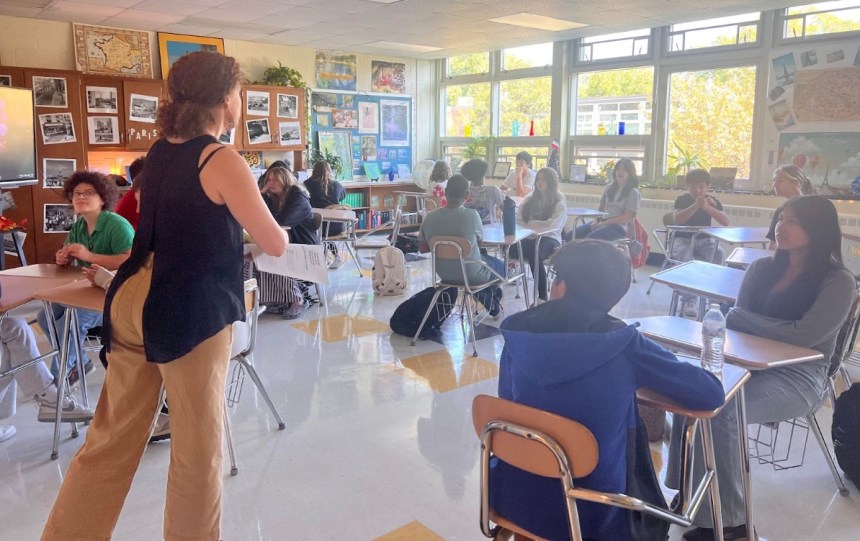
Mr. Beardsley’s Global Human Geography class has been exploring global cultures through a combination of in-class interviews and research projects.
Students were assigned with creating 20 questions about culture and religion. After they created their questions, they then asked the questions they created to their classmates.
“I was hoping that students learned a little bit about each other’s culture, and realized that although we are all different and come from different backgrounds, we share so many similarities with each other,” Beardsley said.
The goal of this assignment was to gain insights into a variety of cultures and religious practices from the backgrounds of their peers.
“My favorite thing about that assignment was getting to learn new things about my classmates’ cultures and religions,” junior Emma Johnson said. “It taught me a lot about other people’s backgrounds and it was interesting.”
By interviewing each other, students gained valuable insights into many different backgrounds within the classroom, allowing students to expand a deeper understanding and notice similarities within different cultures and religions in real-time.
“Getting to know more about my classmates’ backgrounds was my favorite part of the assignment,” junior Lexi Kirby said.
Students were not only tasked with interviewing their classmates but also had the opportunity to be interviewed themselves.
“I think by coming up with their own questions and being able to ask them to a classmate, students were able to find out things about their peers that they never knew before,” Beardsley said.

(Photo by Christian Galligan)
CHEMISTRY AND THE EARTH SYSTEM WITH MS. TURCOTTE
By Amilio Venditti – Staff Reporter
Students in Ms. Turcotte’s Chemistry class recently conducted a lab on Spectral Analysis.
With the use of handheld spectrometers, students observed the wavelengths of the unknown gas spectrum tubes and the wavelengths of the natural light from the sun.
“Students used spectroscopes to separate light into its individual wavelengths and used the data (the corresponding colors and wavelengths) to identify three elements,” Turcotte said. “First, they looked at white light from the sun which separated into what is a continuous spectrum (full rainbow), then they observed the light emitted from three different gas tubes (light bulbs filled with different elements in their gas form), to observe the line emission spectrum that resulted (specific individual lines of color).”
The goal of the lab was to learn about the wave properties of light, interactions of light and matter, and ultimately to identify the gases in the gas tubes by their line emission spectrum.
“I personally enjoyed trying to discover which element I was looking at based on the spectrograph, I found the process of elimination and comparing different graphs and charts to be pretty fun,” sophomore Elizabeth Ramsauer said. “Then again, I could barely see the spectral lines due to a faulty spectrometer, so no wonder the part that required the least use of that to be the most enjoyable.”
This lab helped a lot of students understand how light is emitted, and showed that there is more than one way that elements can be distinguished from each other. In an environment where one would not be able to procure a scale that can measure the mass of an atom, using spectral lines could be a very helpful way for scientists to differentiate different elements.
“My favorite part was coloring the graphs of the spectral lines,” sophomore Harkaran Sekhon said. “I also understood that we only see a small part of the frequency table which is visible light.”

(Photo by Cora Aitkenhead)
ALGEBRA II WITH MS. LOCH
By Cora Aitkenhead – Staff Reporter
Ms. Loch’s Algebra II class has been exploring effective learning strategies by doing fun problem solving in class.
Each day the class works through a Math Medic, a worksheet designed to use math material, problems, and equations in real world scenarios. Loch finds that the Math Medic worksheets give students a better understanding of what they are learning, and helps bring the learning to life.
“Students can better understand the value of collaboration, technology, and persistence in tackling mathematical challenges,” Loch said. “By working through these types of problems, students not only improve their technical math skills but also gain a deeper understanding of how to apply those skills in various contexts.”
These worksheets however are clearly delivering messages to students of how to best budget money, all the way to the most efficient architectural structures and patterns.
“Math Medic is very helpful, because it shows me why what I’m learning is actually important,” junior Jared Saludes said. “Especially when it comes to money, Math Medic is teaching me the most effective ways to use and account for it, which you can’t learn in many other classes.”
While learning is the most important thing, an occasional break for a game never hurts and is a great way to bring up a class’s energy. This is why Loch began implementing an occasional 2-5 minute break to play a round of Family Feud, encouraging thinking and problem solving skills during a break.
“The competitive and interactive nature of the game helps students stay energized and motivated,” Loch said. “Students enjoy a moment of fun, helping to alleviate stress and creating a more positive classroom environment.”
This combination of a class where students learn and still get to include some high-competition fun has been immediately effective. Students have expressed enjoyment and appreciation for this teaching approach.
“As a student, getting a break like this during class, even just for two minutes, is extremely helpful,” sophomore Sam Matist said. “We learn a lot, so the occasional break is pretty fun, and very important.”

(Photo by Dani Kotansky)
MARKETING 1 WITH MR. BELER
By Dani Kotansky – Staff Reporter
In Marketing 1, Mr. Beler’s students engage in fun activities to learn the fundamentals of marketing, especially the 4 P’s – Product, Place, Price, and Promotion.
Students recently were assigned a slideshow to fill in about the three biggest marketing days of the year coming up, Black Friday, Small Business Saturday, and Cyber Monday. Students filled in the blanks on the slides and used different websites to learn more about the history of these days and how they tie in to marketing, specifically price and promotion, 2 of the 4 P’s.
“For marketing, these are the biggest sales of the entire year,” Beler said. “From Black Friday, to Small Business Saturday, to Cyber Monday, these are some of the top selling days in the entire year.”
Students found this activity interesting, and were able to have insights as to how market research and promotions make these shopping days big for people in the marketing field.
Freshman Norah Fedigan felt the project was interesting to get insight into these holidays where all people do is shop.
“I learned about how these days originated and when they were founded,” Fedigan said. “I can’t wait to go shopping on these days with deals coming up.”
Freshman Ella Aoki also found this project unique, as students don’t typically think about all the history behind holidays like Black Friday.
“I love how we got to learn about these special shopping holidays, especially their history,” Aoki said.
Beler felt this project was impactful for Marketing students, and they could learn a lot about these holidays that students don’t view as particularly important.
“Students learn the importance of the marketing that takes place to make this a big event,” Beler said. “Now students understand how businesses come at consumers.”

(Photo by Aaryan Doshi)
ENGLISH 1 WITH MRS. ANDERSON
By Aaryan Doshi – Staff Reporter
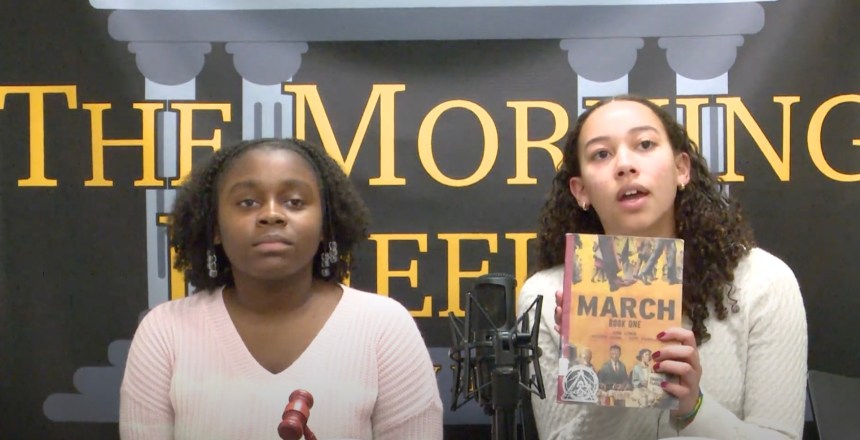
Mrs. Anderson’s English 1 class recently learned about different causes that led up to the Civil Rights Movement.
Students in Anderson’s class had to make a slideshow presentation about an event that led up to the Civil Rights Movement.
“I hope students gain a deeper understanding of the struggles and achievements of individuals who fought for equality,” Anderson said. “I also want them to develop critical thinking and empathy by connecting historical events to current issues of fairness in their own lives.”
The presentations needed to be three to five minutes long and include interesting and important facts about the student’s topic. To keep the audience involved, the students needed to come up with some fun and thoughtful questions for the audience to answer.
“In English, we are learning about the Civil Rights Movement, and we are working on a project about an event that caused the Civil Rights Movement,” freshman Logan Thomas said. “I learned a lot about the Civil Rights Movement and I am glad we did a project on it because it helped me learn about the Civil Rights Movement.”
Students shared that this unit helped them better understand the Civil Rights Movement and its causes. The students especially enjoyed the creative challenge of designing a project with an interactive element, which made the learning experience more engaging. Overall, students found the unit both educational and enjoyable.
“In English, we worked on a project about the Civil Rights Movement and important events during it,” freshman Dylan O’Neil said. “I am doing my project on Jackie Robinson and about him breaking the color barrier and being the first African-American to play in Major League Baseball.”

(Photo by Ella Franzman)
BROADCAST JOURNALISM WITH MS. KELLY
By Ella Franzman – Editor-In-Chief & Editorial Editor
Ms. Kelly’s Broadcast Journalism class has been working hard on producing winter sports content and the Class of 2025 Senior Video.
The students’ assignments have been to create either winter sports “hype’”videos, captain and senior interviews, and interviews with coaches. Another big task has been the Senior Video, which includes the traditional segments, “Where Will You Be In 10 Years?” or “What Is Your Favorite High School Memory?”
“We’re getting ready to start our Lawliday Season and Lawmas videos right now,” Kelly said. “I’m super excited to unveil this year’s Santa, and work with the students to create another great Lawmas video.”
The Lawmas video has been a great tradition in the Jonathan Law community and they look forward to producing the video once again.
“During Broadcast my group had been mostly working on filming and editing our podcast, but another main focus for our group has been to film for the Senior Video,” senior Addy Barber said. “We have been going around school during any free periods we have to make sure we can get as many members of the senior class as possible.”
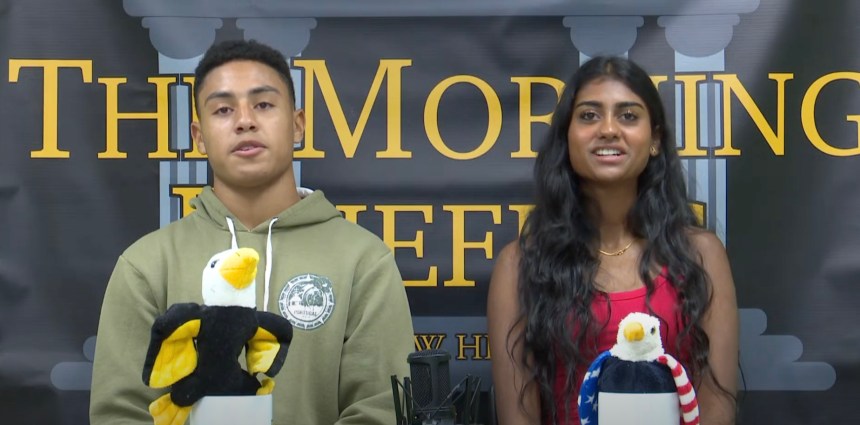
Other assignments the students have been working on are recording episodes of their podcasts and working on producing The Morning Briefing each morning.

(Photo by Taylor Coretti)
AP PSYCHOLOGY WITH MS. BURNS
By Taylor Coretti – Staff Reporter
Law’s AP Psychology classes are engaging in hands-on activities to help them learn more about different areas of the brain and body.
Students got to work in groups to create an endocrine amusement park where they pick a ride or element of an amusement park to represent the elements of the endocrine system. AP Psychology teacher Ms. Burns likes to create hands-on tasks for her students to create a fun and effective learning system.
“By designing an amusement park where each attraction corresponded to a specific structure, gland or hormone, students were required to research the functions of the structures and translate that information into an interactive and memorable format,” Burns said. This process reinforced understanding of the endocrine system’s components and their roles within the body.”
The goal of doing interactive activities is to help understand the topic better. Senior Maddy Baranowsky felt this assignment was effective in being able to remember the information learned about the endocrine system.
“Something I took away from the endocrine amusement park assignment was creative ways to remember the different parts of the system,” Baranowsky said.
Everyone in each class got to pick their own group to work with. Senior Julia Ryan found that working with the people you want to work with makes the activity more enjoyable.
“I enjoyed doing this project with my friends,” Ryan said. “It gave us an opportunity to do school work in a fun way as we all worked together and made the project creative and fun for us.”

(Photo by Kishal Shah)
AP LITERATURE WITH MRS. ROUMELES
By Kishal Shah – Staff Reporter
Mrs. Roumeles’s AP Literature class recently examined the prevalence of science and history in gothic literary works such as “Frankenstein.”
The class recently finished reading the novel “Frankenstein “by Romantic author Mary Shelley – previously known as Mary Wolfstowncraft – and is now dissecting the prevalence of topics such as science, religion, and history in this radical and gothic novel.
“Even though ‘Frankenstein’ is a fictional tale, what’s important is to not only learn about how it reflects the romantic ideals, but also its themes of human nature and that duality between good and evil,” Roumeles said. “We can kind of look at our own behavior and see what the catalyst is for behaving in a moral or amoral way, and how we can relate a fictional tale to how the themes play out in real life.”
The class concluded after the lecture the relevance of other subjects and real world connections when discussing literary works such as “Frankenstein” because it helps students draw connections between famous themes in literature, and how those ideals are presented in sciences, history, and religion in the real world.
“I liked this lesson because it allowed me to gain a further understanding on the background of the author’s life, and why she came to write such a radical and gothic novel in the 18th century,” senior Carol Jiang said.
The class observed how Mary Wolfstonecraft – who was a renowned feminist icon of the age – wrote the novel Frankenstein, which included romantic and gothic perspectives in her novel, which was considered a radical and progressive practice.
Through a class discussion and observing a powerpoint presentation, the class comprehended how the overarching theme of Shelley’s novel was the separation of religion in the journey to acquire scientific knowledge.
Moreover the class concluded through a lecture about how pursuit for knowledge for the sake of pursuit may sometimes be unethical, as represented in examples in history of unethical psychological experiments performed in society.
“This lesson was like a continuation of previous lessons where we learned to think about perspectives you would gravitate to otherwise,” senior Naina Khan said. “In this case, the historical background and scientific and ethical questions were raised about the theme and concept of ‘Frankenstein.’”

(Photo by Courtney Russo)
SPANISH 3 WITH MR. RODRIGUEZ
By Courtney Russo – News Editor
Mr. Rodriguez’s Spanish 3 classes for sophomores and juniors recently worked on a project entitled “Un Dia Inolvidable.”
Students were given first half of the story and were expected to write the second half.
“The purpose of the project was to have students use the irregular preterite tense verbs and vocabulary about camping in sentences that simulate real-world situations,” Rodriguez said. “Having students use the grammar in sentences helps them to be able to put sentences together and form original thoughts, not just remember the conjugations of verbs.”
This was the class’s final assignment before having a test on irregular preterite verbs.
“This project helped me apply our vocabulary and grammar to real-world scenarios, boosting my speaking and writing skills,” sophomore Arnav Saxena said. “It also improved my understanding of harder sentence structures, making me more confident for the test.”
Students had a great time being creative and using the Spanish that they learned in class. Rodriguez showed an example project and students created their work based on what they saw.
“I enjoyed incorporating the Spanish we learned in class on our project,” sophomore Kristia Gonza said. “I enjoyed working with all of my group members.”
After completing this project, Rodriguez hopes his students build a better understanding of irregular preterite tense verbs.
“By the end of the project, the students were expected to recognize the irregular preterite verbs, conjugate them correctly, use them in a story that makes sense as well as pronounce the Spanish vocabulary during the recording portion of the project,” Rodriguez said.

(Photo by Tim Firla)
JOURNALISM 2/3/4 WITH MR. KULENYCH
By Tim Firla – Entertainment Editor
Thanksgiving Week was a busy one for Law’s Journalism 2/3/4 class and students posted numerous videos, articles and podcasts about the week’s festivities.
Journalism teacher Mr. Kulenych was proud of the effort put forth by the Advocate editors. Journalism students posted serveral Thanksgiving articles and produced the annual “What Are You Thankful For?” video.
“The Thanksgiving season is always a busy time for The Advocate staff,” Kulenych said. “Our reporters and editors have to cover all of the Thanksgiving Week games plus all of the other school events and fundraisers that occur in November. On top of that, we’ve worked to put out our traditional Thanksgiving videos. We have so many fun Thanksgiving season traditions here at Law and it’s our staff’s job to keep the school community informed about all of them.”
Senior Entertainment Editor Will Smith has taken Journalism for four years and has been involved with many Thanksgiving Week posts.
“The month of November is a big month for The Advocate,” Smith said. “During this month, there are countless activities that are going on and its our job to report and get coverage on it.”
Each piece of Advocate content, whether it is an article, podcast, video, or social media post needs to meet a certain criteria before it can be published online.
“Our class is a little different because all of our assignments are posted for other people to read or watch so it’s important to keep up the quality of what we’re producing,” Junior Editor-In-Chief Kayla Markowitz said. “Our articles need to be reviewed and videos have to be edited before posted to ensure that what we’re putting on social media is not only entertaining, but also accurate and informative.”

(Photo by Molly Lynch)
INTERIOR DESIGN WITH MS. CRISTANTE
By Molly Lynch – News Editor
Ms. Cristante’s Interior Design course gives students an overview on everything they need to know about the world of interior design.
The course is split up into five units that provide all of the information necessary to pursue a career in interior design.
As students are finishing up Unit 5 of the course, Cristante had pairs of 2-3 students go into the halls to locate and take pictures of various things they saw around the school that show examples of elements and principles of design. Students then had to submit those photos to a Google Doc and explain how each picture shows the principles of design.
“Students previously had several opportunities to create visuals of the elements and principles of design,” Cristante said. “This assignment taught them how to identify them within already existing designs and challenged them to think differently (creatively) about a place they spend time in everyday.”
This course teaches students the deeper meaning of things they see everyday.
“I find it beneficial to recognize that elements and principles of design are everywhere and to see how it is used in our lives everyday,” junior Jordyn Torres said.
Students engage in fun assignments that also help them understand the curriculum at the same time.
“I definitely had fun with this assignment,” junior Charlotte Baldieri said. “It was different than just sitting in a classroom doing online work.”

(Photo by Harshitha Kothapalli)
AP HUMAN GEOGRAPHY WITH MR. ROUMELES
By Harshitha Kothapalli – Editor-in-Chief
Students in Mr. Roumeles’ AP Human Geography class have recently completed their Family Migration Map.
Using Google My Maps, students were tasked with utilizing their new learnings about migration to create a map of the roots of their family. They were asked to pay special attention to dates, locations, and reasons for movement.
“In Human Geography we very often look at human activity on a global scale, and sometimes forget our personal place within the big topics,” Roumeles said. “I assigned this project so students could interact with the concepts of human migration by applying them to their own family history. I really feel that the more personal and relatable a topic is, the easier it is to learn and understand; and that was the overall goal of the project.”
The project allowed students to discover new understandings about their own past and connect it with the ideas they were learning in class.
“It gave me a new perspective on the way I see my background,” junior Kayla Markowitz said. “Being able to see my own history laid out on a map and also being able to understand the concepts behind it was so compelling.”
Not only did this project resonate with students on an educational and personal level, but it also let them get creative.
“I was able to talk to my parents and grandparents about where I came from and have conversations I wouldn’t normally have the opportunity to have,” junior Santina Scarpa said.

(Photo by Ava Grippo)
CREATIVE WRITING WITH MS. SMUNIEWSKI
By Ava Grippo – Entertainment Editor
Students in Ms. Smuniewski’s Creative Writing class are wrapping up the first drafts of their short stories.
Creative Writing, an English elective, is currently in their short story unit, working on their own stories.
“My goal is that students write a short story that they are proud of,” Smuniewski said. “I enjoy this unit because I find that students are usually invested in their work and want to craft a story that is engaging and meaningful.”
The students are able to use their imagination on this assignment and create something unique.
“I am writing a short story about a cowboy by the name of Fargis Santiago III who goes on a life changing journey to save the world from a gang called the Renegade who want to take over the world,” senior Izzy Vancho said.
Students are learning how to better write and use their skills.
“I hope to learn to better write things like dialogue and descriptions in order to properly convey the emotion or image I’m trying to create,” senior Brady Funk said.
Smuniewski has high hopes for this assignment and is excited to see what the students come up with.
“I’m hoping to see interesting, creative storylines that showcase the many skills and concepts we’ve studied throughout the semester,” Smuniewski said. “This unit is important because it allows students to write something that is entirely a creation of their imagination, which is an opportunity that doesn’t often come by.”

(Photo by Ella Hopkins-Gianotti)
WORLD HISTORY WITH MR. ROUMELES
By Ella Hopkins-Gianotti – Staff Reporter
In Mr. Roumeles’ World History class, students attended the Enlightenment Convention.
Over three classes, Mr. Roumeles’s students have been given one Enlightenment thinker to research and several others to lightly discuss for a debate on the following topics: government, religion, education, rights, and property.
“I wanted students to understand the big ideas about society that were challenged during the Enlightenment,” Roumeles said. “By representing an Enlightenment thinker, I ultimately wanted students to become aware of their thinker’s positions, but also scrutinize that of their contemporaries.”
The students learned about the different ways of thinking of each Enlightenment thinker.
“I learned about philosophers’ different political points of view during the Enlightenment and how even though they were all trying to change the mindset of people around them,” freshman Anwita Puttam said. “I learned that their points of view are very different and very similar on different topics of religion, government, education, etc.”
All of the students were easily able to provide information on their Enlightenment thinkers during the convention.
“My favorite part of the Enlightenment Convention was how all of my classmates contributed to the conversation,” freshman Layla De La Cruz said. “Everyone did their part and were able to successfully talk about their Enlightenment thinker.”
Other students enjoyed this assignment for different reasons.
“It was kind of stress-free because I knew that I had enough time to do it, the research was easy, and the environment is good there,” freshman Isabelle Phelan-Clark said.

(Photo by Abigail Merenda)
JOURNALISM 1 WITH MR. KULENYCH
By Abigail Merenda – Staff Reporter
Mr. Kulenych’s Journalism 1 classes reviewed a band called “Almost Monday” and their album “DIVE.”
Each class listened to two songs from the album – “Is It To Late?” and “Can’t Slow Down.” After listening to each of the songs the students had to write a review about their opinion.
“The purpose of the album review lesson was to give students a real-world, real-time experience of being an entertainment reporter,” Kulenych said. “Students were given background information about the band, lyrics to two songs, and we listened to the album in real time in class together. Working collaboratively on writing a review of the album gave students the opportunity to bounce ideas off each other and make sure each review was detailed and complete.”
Students had mixed feelings about the band Almost Monday and their album.
“Personally, I didn’t enjoy the band that much,” senior Taylor Coretti said. “This is because I wasn’t able to understand the lyrics and their music style is not something I usually listen to.”
Senior Kishal Shah shared her opinion about the band and the themes of their songs.
“I think the band’s music is definitely loud and energetic, and might sometimes only resonate with a specific target audience,” Shah said. “Although the general ‘summer vibe’ theme comes across, the songs themselves can be a little overwhelming and might only make sense in certain settings. Personally, I don’t love the songs I’ve listened to, but everyone of course forms their own opinions and has their own taste.”
Kulenych said that regardless of students’ opinion of the band, he was pleased to see them work through all stages of the review writing process.
“It’s always a fun lesson to do each year, regardless of whether students enjoyed the album or not, because they get to put themselves in the shoes of an actual reporter through all steps of the writing process,” Kulenych said.

(Photo by Logan Thomas)
HEALTH AND SAFETY 1 WITH MR. SWEENEY
By Logan Thomas – Staff Reporter
Health teacher Mr. Sweeney recently went over a lesson about good decision making and about how students can prevent themselves from making bad choices.
Students used what they learned about decision-making to answer questions and make slideshows about the topic. They also learned how to avoid bad decisions and how to prevent them from happening.
“You cannot make progress without making decisions,” Sweeney said.
During the lesson, students learned about different scenarios to prevent making bad decisions. They also worked on a project that made them create a character that was able to make a good decision or was able to make a bad decision.
Students either chose their character to go home and study or they weren’t out to party. There are many different ways students could have made their character.
“In class, we are learning about decision making,” freshman Dylan Gaillard said. “The projects and what we do in class will help a lot when something happens in the future so we can make the right decision.”
Sweeney explained how students also have to make good decisions based on their self-values. Self-values are very important when making decisions. Self-values are what people focus on in their lives that change how they act or live around people.
“In health, we are learning about decision-making,” freshman Aaryan Doshi said. “We are working on a project right now and it’s a comic strip of characters making a good decision. This unit is all about making the right decision.”

(Photo by Dylan Gaillard)
ENGLISH 1 WITH MRS. EVANS
By Dylan Gaillard – Staff Reporter
English teacher Mrs. Evans recently had her freshman students start their Social Justice Issue Project.
Students were tasked with choosing a topic they were interested in – income inequality, peaceful protests, and the #MeTooMovement were among some choices. They had to create a brief informative presentation that made their classmates aware of the issue while simultaneously engaging their audience with questions or interesting facts.
“I wanted to be sure my students have a clear understanding of social justice and what constitutes a social justice issue,” Evans said. “As I also believe in choice in learning, I’ve asked that we complete a mini research presentation on a social justice issue”
This project helped students learn more about Social Justice issues, and it was fun for the students because it is a topic that affects them and their lives.
“At first, I was only slightly interested in researching the topic of Animal Welfare, but once I began researching I started learning a lot and it is a great topic to be educated on,” freshman Cora Aitkenhead said. “Through this project I got to learn a lot more about my own topic, but also learned a lot from everyone else’s presentations.”
Since not many classes at school regularly discuss Social Justice issues, students were excited at the opportunity to address the topics.
“I was very interested in the different things going on around the world,” freshman Patrick Mulligan said. “We never really learn about this topic in other classes so it was very cool to learn about Social Justice Issues.”

(Photo by Carly Ranilla)
CHEMISTRY LEVEL II WITH MS. TURCOTTE
By Carly Ranilla – Staff Reporter
Miss Doolan’s Chemistry Level II class focuses on the properties, composition, and the structure of elements and compounds and how they change.
Students were recently put into groups and were all asked to watch a water-dropping experiment in the back of the classroom. After observing the system, students talked in their groups about what they saw and how the dropper had any relation to lightning.
This exercise was a helpful way for students to witness examples of energy being transferred to create a lightning strike.
“I showed the Chemistry class the water dropper experiment as a way to simulate lightning in a safe way in a classroom,” Doolan said. “It was supposed to show them the process happening in a cloud and what produces lightning.”
Sophomore Joeliez Gonzalez was surprised by the results of the experiment.
“I noticed there was a spark in between the copper coins that were on top of the bucket,” Gonzalez said. “But it only happened because the water dripped into cups that connected to some wires that connected back to the coins.”
While making it an educational investigation for the students, Doolan also managed to make it a fun and memorable learning experience.
“My favorite part of watching the water dropper experiment was not only witnessing the spark between the copper coins, but also understanding the neutrons and particles that caused it to happen,” senior Kylee DelMedico said.

(Photo by Aiden Ramos)
HUMAN ANATOMY AND PHYSIOLOGY WITH MS. DOOLAN
By Aiden Ramos – Staff Reporter
Ms. Doolan recently assigned her Human Anatomy & Physiology students musculoskeletal posters.
Students were grouped and tasked with tracing a classmate’s outline. Once completed, they divided the outline down the center, illustrating the muscular system on one side and the skeletal system on the other.
“The musculoskeletal project has my students create life-sized posters to show the major muscles and bones in the human body,” Doolan said. “I add in an opportunity for extra credit for the most creative poster so this adds a little bit of competition to the assignment. The project provides an opportunity for my students to work collaboratively together and be creative and engaged when learning the names and locations of the major muscles and bones.”
Students work in groups and each group chose a different theme to base their skeleton and poster on.
“I enjoyed getting to be creative and come up with my own ideas, and colors, but doing it while learning about science and the human body,” senior Christian Galligan said.
Doolan adds an opportunity for extra credit for the most creative poster which adds a little bit of competition to the assignment.
“The most challenging part of the project was putting all of the bones, muscles, tendons, and ligaments in the correct places, and making sure that everything was the right size,” senior Cesar Mendez said.

(Photo by Henry Smith)
INTRO TO PHOTOGRAPHY WITH MRS. ROMANOWSKI
By Henry Smith – Staff Reporter
Photography teacher Mrs. Romanowski recently had her students take pictures using a dynamic perspective, shallow depth of field, and rule of thirds.
Students were able to go around the building to capture images. Once students had taken their final images they turned them in on Google Classroom.
“I hope that students got a better understanding and level of control within their camera throughout this assignment,” Romanowski said.
The activity had the students focus on the aperture and manual focus challenging students to find the perfect settings. The students’ photos had to clearly capture a defined subject with the background completely out of focus.
“It was challenging but really fun,” senior Nick Morales said. “It took a while to get the right image, but it was all a part of the process.”
It took the class three periods for students to complete the assignment. Each student took their time to create a creative and correct photo.
“It was fun going around the school and taking photos,” freshman Lukas Saraco said. “Changing the setting on the camera was difficult but with help I was able to use the correct settings and take a good photo.”

(Photo by Chloe Edmonds)
ENGLISH II WITH MR. HEALY
By Chloe Edmonds – Social Media Editor
Students in Mr. Healy’s English II class are reading “Catcher in The Rye” by J.D Salinger and recently completed a reflection on Holden’s character.
The lesson had several purposes: practicing skills students have been working on, encouraging collaboration, and helping students recognize key moments in the novel.
“We’ve been using notice and note moments pretty much every day trying to get reps in, so noticing those key moments, like ‘aha’ moments or words of the wiser, becomes automatic when you read,” Healy said. “Once you notice and note them, you can begin the work of deeper analysis by asking questions about their meaning, what the author’s purpose in including them, and what they reveal about characters.”
Students enjoyed the lesson and found it insightful to discuss Holden’s character.
“Dealing with real world issues made me feel more connected to Holden’s character and made the message Mr. Healy was trying to get across much easier to understand,” sophomore Aiden Ramos said.
The lesson was very in character for Healy’s teaching style as he finds assigning collaborative work better since students can feed off of each other.
“The lesson has contributed to what we’ve already been learning in this unit,” sophomore Alivia Kaplanka said. “Reading the chapter as a smaller group of four people makes for deep discussions with my peers since it’s a lot more grounded when we read in class.”
For this lesson, Healy wanted his students to ask meaningful questions about the text and record deeper thoughts about it.
“Instead of me saying, ‘Holden keeps asking this same question. Why?’ and pointing it out to you, I wanted to see what you thought was important or meaningful,” Healy said. “And more often than not, you all both cover things I would have covered anyway, or bring up new and interesting ideas about the text that I never would have.”

(Photo by Kayla Markowitz)
AP MACROECONOMICS WITH MS. HEALY
By Kayla Markowitz – Editor-In-Chief
Students in Ms. Healy’s AP Macroeconomics class created personal circular flow models to demonstrate how their very own factors of production impact their contribution to the economy.
To combat the difficulty of understanding how the circular flow of an economy works, AP Macro students were asked to create a model showing how they contribute to the economy through providing labor, earring income, and putting that money back into the economy by spending it.
“We started to do the Circular Flow Model project to give students a more real world idea of how money and goods flow in our economy on a more personal level,” AP Macroeconomics teacher Ms. Healy said. “Students create the model centered around themselves or a family member if they don’t have a job. Students get to take a much closer look at how they provide resources to the “factor market” through the hours they work each week, they get to see how their labor, and other resources like rent and materials, are purchased and utilized by businesses to then create products they then spend money on in an endless loop.”
By going through the process of finding out how much they work and their weekly income, learning how much money it costs for the businesses they work at to operate, and then estimating how much of their income they put back into the economy, students were able to grasp a deeper understanding of how money flows in the economy.
“Making my own circular flow model helped me understand how the economy flows because it gave me a visual to connect back to my own life,” senior Sana Joshi said. “By physically making a model of how the economy affects me, it allowed me to understand how the economy affected the general population”
The project encouraged students to be innovative because all of the information came from their own life experiences.
“My favorite part about the project was how creative I could be with it, and overall I feel it deepened my understanding of this unit and the economy as a whole and how money and labor flows in their own life,” senior Basel Chwiki said. “The model is a representation of how students contribute to the economy with their labor and how they choose to spend their income.”

(Photo courtesy espn.com)
HONORS HUMANITIES WITH MR. KULENYCH AND MR. ZURAW
By Christian Galligan – Staff Reporter
In Honors Humanities, students are given the opportunity to learn about history, literature, and society.
To begin their unit on Subcultures and Countercultures, teachers Mr. Zuraw and Mr. Kulenych gave students the opportunity to watch the ESPN documentary “The Fab Five,” based on five freshmen who played basketball at the University of Michigan in the early 1990s.
“The Fab Five” introduced students to a famous counterculture in society and provided them with a sample documentary that they could use as a template for their upcoming Subculture Documentary Project.
“The documentary showed students the impact a counterculture group can have on society,” Kulenych said. “Students also had to evaluate the director’s decisions in terms of who was interviewed, what B-roll footage was used, how certain shots were filmed, and how the story was told.”
The “Fab Five” documentary not only helped students understand the concept of countercultures but also allowed them to brainstorm ideas for the documentaries that they will produce on their own.
“For the ‘Fab Five’ assignment we are learning about how to make a good documentary and learning more about subcultures in documentaries,” senior Ella Franzman said. “The documentary is teaching us good angles and what types of shots we should have when we make our documentary for Humanities.”
The documentary was able to teach students about what cultural impacts look like and also helped them understand the background of the “Fab Five.”
“I learned they created a significant cultural impact through multiple perspectives, such as sports and fashion,” senior Ivan Galicinao said. “They changed how people saw the game of basketball and what it represented, as they would wear baggy shorts and trash talk, which was never done before them.”
The documentary was viewed as a great start for students, as they are expected to have their own documentaries completed by the end of the quarter.
“Watching this documentary gave students a template for how to film their own upcoming documentary projects,” Kulenych said. “Humanities students will have to make all of the same producing decisions themselves when they produce their own documentaries on subcultures here at Law or in the Milford community.”

(Photo by Reid Moulton)
SPANISH II WITH MR. MCPARTLAND
By Reid Moulton – Staff Reporter
Mr. McPartland’s Spanish II class has just started a project for “hay que” and “se prohibe” vocabulary and how to use it.
The project is to help students understand how other countries around the world speak and how you can advance your knowledge with other languages. Students were able to work in pairs and had two and a half class periods to work on this.
This project is supposed to give rules and things that incoming freshmen should do to be successful next year.
“I hope students learn how to effectively communicate rules and advice in Spanish beyond the language itself,” McPartland said. “The project also encourages them to think critically about what it takes to succeed in high school and how to express those ideas in a clear and concise way. Students are developing their ability to express things that should and should not be done in Spanish, which is an essential skill for practical communication.”
This project helped expand students’ knowledge of Hispanic culture, and helps students prepare for their future with languages.
“The project helps me understand the unit better, and I think it will really make things easier to come,” freshman Daniel Rascoll said. “Being able to elaborate with other students really makes an impact with my learning.”
Students not only wrote about rules for incoming freshmen, they also got artistic by making drawings.
“It helps sharing ideas with other students and getting their perspective on what they think about the assignment,” freshman Arthur Rossi said. “The project allows me to get creative with my work, and lets me show my thinking outside of the Spanish.”

(Photo by Anwita Puttam)
FRENCH II WITH DR. EVANS
By Anwita Puttam – Staff Reporter
Dr. Evans’ French II Level 1 class recently had a group quiz focusing around the city Brittany in France.
The quiz was set up so that on the first day, students would have to answer 50 questions with just their general knowledge. Then they were given reading packets in French that broadened their information on Brittany. On the second day, students would work in pairs to compare each other’s answers, getting a new viewpoint on the questions while also negotiating with each other to prove which answers were right.
“My goal was to have you finish a quiz with more knowledge about the French region of Brittany than you started with; in essence, you were learning and processing new information while being assessed on previously learned material,” Evans said.
The goal of this style of taking quizzes was to expand the information of the students, while also seeing how far they had come with their knowledge on Brittany.
“Here it would have been nice to study everything that was on the quiz, yet we didn’t know all of the answers and even so, completing the quiz was still achievable with the ready, and even with the help of a fellow classmate,” freshman Breana Aquino said. “Breaking it down and comparing with somebody else was honestly beneficial, and helped us understand the questions and our answers better.”
This style of quiz taking allowed students to understand what they already knew, but also helped them gain new knowledge.
“This kind of style for quizzes is very unique and intelligent,” freshman Yara Saim said. “This style of taking quizzes would benefit students who might have trouble with the lesson. The given article can also teach students more about the topic at hand, showing them more than what they studied in the classroom.”

(Photo by Taylor Mola)
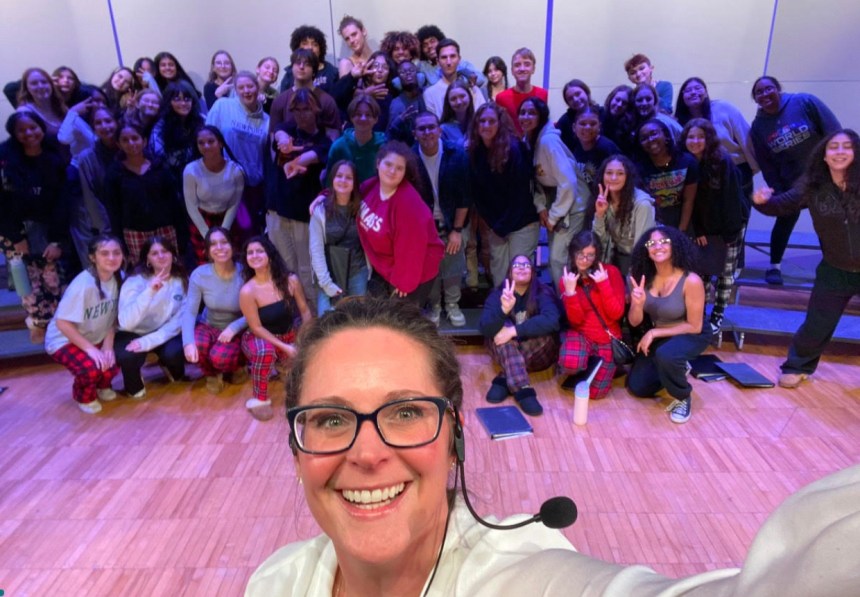
CHOIR WITH MS. JONES
By Taylor Mola – Staff Reporter
The Jonathan Law Choir is working hard, rehearsing, and doing activities to prepare for their upcoming Winter Concert.
Choir Director Ms. Jones starts every day with different engaging warm-ups to prepare the students for class. The warm-up is followed by announcements so students know important dates and other information.
“We are working on so much in class,” Jones said. “I send out recordings for kids to work on at home, so by the time we get all back together the next day we are ready to work. We have a lot of part and section work that we do that needs to all be put together, so students need an idea so they are learning how it works all together.”
In class, students all gather together in their sections – Soprano, Alto, Tenor, or Bass – to work on the song or skill for that day. The Choir is consistently working on getting better day by day.
“I think everything is going really well,” senior Joshua Valentine said. “I know Concert Choir is the best it has been and Advanced Vocal Ensemble is going great. We all have most of everything down, and our class time is getting used very well. I’m just excited as this is my last Winter Concert and my last year of high school Choir.”
The Winter Concert is made up of six to eight songs that are all structured and performed differently. These songs help students to understand different kinds of music and learn how to be able to sing all types of music.
“We have a lot of great songs that are done very well and are going to be great,” sophomore Lexi Localzo said.

(Photo by Madi Black)
INTRODUCTION TO CULINARY WITH MRS. LOPEZ
By Madi Black – Social Media Editor
Mrs. Lopez’s Introduction to Culinary classes recently made cinnamon rolls.
Students loved this assignment and Lopez enjoyed helping students to expand their horizons by making new food that they can easily make at home.
“My favorite part of this activity is to see the satisfaction in my student’s that they gave it their all,” Lopez said. “Even though it wasn’t perfect, they tried and learned and that is what this is all about. Mistakes in the kitchen are guaranteed and should be looked at as a part of the learning process. I would absolutely do this activity and recipe again and again.”
Even though this was a complex activity, many students enjoyed making the food and later eating it. Sophomore Maddie Nash loved making the food and being able to remake the food when she made a mistake.
“My favorite part about making the cinnamon rolls would be messing up and redoing it,” Nash said. “I like how Mrs. Lopez does not rush us and lets us take our time.”
Senior Cameron Upchurch said that the rolls were one of his favorite foods and it was interesting to be able to learn what went into making the food.
“I love getting the cinnamon rolls from the mall,” Upchurch said. “When I found out we were going to be making them I was so excited.”

(Photo by Vaughn Kraynak)
ROBOTICS 1 WITH MR. BARCELLO
By Vaughn Kraynak – Staff Reporter
Robotics teacher Mr. Barcello recently presented his Robotics 1 class with a new challenge: to pull as much weight as possible using their robots with the addition of gears.
Depending on the size and order of their gears, students could build their robot to gain speed or strength based on the challenge they are given. The students’ goal was to attach a bucket of weights to their robot and be able to pull the weight.
“The purpose of this assignment is to discuss the idea of gear ratios,” Barcello said. “Combining the different gears affects the torque and power as well as the speed.”
Attaching a smaller gear to the motor and adding additional larger gears can cause the robot to increase it’s power and pulling speed. On the other hand, attaching a larger gear to the motor and adding additional smaller gears can lead to an increase in the robots speed.
“My favorite part about the gear activity is figuring out how the gears work with each other to produce power and speed,” sophomore Abdulla Faial said. “I like being able to experiment with different combinations.”
To make things more exciting, Barcello has turned the challenge into a competition amongst his students. Sophomore Justin DeGregorio currently is at the top of class, with his robot successfully pulling 15 pounds.
“I’m really proud that I was able to pull 15 pounds,” DeGregorio said. “It took a lot of changes to my robot and a lot of fails to make everything work right.”

(Photo by Connor Ryan)
THE LIVING EARTH WITH MRS. MERCALDI
By Connor Ryan – Staff Reporter
Mrs. Mercaldi’s Living Earth Level 1 classes had some fun last week as they worked on an earthworm dissection.
Students had to cut open the earthworm using tools given by Mercaldi. They were assigned to write down measurements and identify the body parts.
“I enjoyed doing this dissection – I liked how I was able to work with my friends and classmates,” freshman Lia Veteri said. “I also was very unfamiliar with the tools and then after and during the dissection I understood how to use them.”
The students did not have to finish the dissection; this activity was just to have them learn how to dissect and if they enjoyed it. The students were partnered into groups of three, with two people being the experimenters and one being the note-taker.
“The experiment was meant for the kids to learn about how earthworms work and I really saw improvement in this experiment in the kids with the tools,” Mercaldi said
Students enjoyed the experiment and many said it was the most fun they have had this year.
“I really liked this experiment for multiple reasons,” freshman Ryan Woods said. “One, being able to work with my friends; two, being able to learn how to use new tools; and lastly, seeing my other classmates work hard and same with my friends.”

(Photo by Matthew Sanchez)
ORCHESTRA WITH MR. PELAGGI
By Matthew Sanchez – Staff Reporter
Band Director Mr. Pelaggi recently rehearsed songs with his Orchestra students to prepare for the upcoming Winter Concert on December 18.
The pieces that the Strings Orchestra will be performing during the upcoming Winter Concert are “Burst,” “Allegro Molto,” and “Swan Lake.” At the start of class, Mr. Pelaggi makes his students tune together so that they are ready for playing. During class, he works with the Orchestra for all parts: violins, violas, and cellos.
“I usually start class with a warm up or exercise, then move into the repertoire we play at concerts,” Pelaggi said. “When it gets closer to the concerts, we spend more time on repertoire than exercises, and vice versa when we have more instructional time.”
Pelaggi works with all members of the ensemble right up until the concert. The entire Orchestra listens to each other before playing for tuning. Junior violinist Jared Saludes is excited to play the Winter Concert selections.
“I think they’re super cool, especially Swan Lake because it’s a well known piece,” Saludes said. “‘Allegro Molto’ is my personal favorite because of its changing dynamics.”
Members of the ensemble enjoy playing their parts. They all work as a group and improve with every practice.
Freshman violinist Erik Borowski said that Pelaggi has helped him improve throughout the year.
“Mr. Pelaggi has helped me improve greatly,” Borowski said. “I wasn’t confident with my violin skills until I had his class. He helps me with bowing, fingering, reading the music, and lots more.”

(Photo by Logan Mullarkey)
AP U.S. HISTORY WITH MR. LUI
By Logan Mullarkey – Sports Editor
Mr. Lui’s AP United States History class recently worked on DBQ skills, focusing on reform movements from the early 1830s, like abolitionism, temperance, and women’s rights.
The class was assigned a DBQ with seven documents where students had to describe each one, connect it to the topic, and create a HIPP statement (Historical Context, Intended Audience, Purpose, and Point of View).
“I was hoping that students could really hone their skills in analyzing primary sources and connecting them back to larger historical themes,” Lui said.
Students split into small groups to write responses for the three categories, then presented their work on the board for the class to review.
“I thought this activity was helpful because it gave us a chance to see what other groups came up with and how they approached the assignment,” junior David Guery said.
Afterward, the class participated in a gallery walk where students gave feedback on each other’s responses, providing new perspectives on the assignment.
“My favorite part was walking around during the gallery walk and seeing how others interpreted the documents,” sophomore Elizabeth Ramsauer said.
By the end, students not only improved their DBQ writing skills but also gained a deeper understanding of reform movements in American history.

(Photo by Brady O’Neil)
AP GOVERNMENT AND POLITICS WITH MR. ZURAW
By Brady O’Neil – Staff Reporter
Mr. Zuraw’s AP Government and Politics class offers students the opportunity to get college level information on different topics of the U.S government, including political institutions, public policy, and civil rights.
In order for his students to understand the different roles of government in the U.S, especially in individual states during massive catastrophes, Zuraw constructed a lesson using Hurricane Katrina to demonstrate the different levels of government and their individual involvement. Students were split into groups, and were given three separate levels of government – state, federal, and local.
“The point of that lesson is to bring some of the content vocabulary from the unit to life,” Zuraw said. “The concept of cooperative federalism is much easier to understand when you are actively acting it out. So by having the students each take on the role of a level of government and discuss different solutions to issues that arose during the hurricane, it really highlights the need for the cooperation of the levels of government (and also highlights the difficulties).”
This lesson helped students strengthen their understanding of government and their involvement in the states.
“I had trouble understanding the difference between the federal government’s involvement and the state government,” junior Cooper Pietrowski said. “This lesson really made it clear to me how the federal government has power over the other factions, but the lower levels try to keep the federal government from interfering with their work.”
Not only was this a great way for students to learn about government, but it was a very collaborative assignment that required students to talk to one another in order for full comprehension to take place.
“It allowed me to collaborate with people I usually wouldn’t talk to,” Pietrowski said. “I think it allowed me to be a lot more receptive to other peoples opinions because I usually don’t talk to those people, and it took bias out of the equation.”

(Photo by Sebastian Beltran)
MARINE SCIENCE WITH MR. MORAZZINI
By Sebastian Beltran – Staff Reporter
Students in Mr. Morazzini’s Marine Science class recently studied the chemical properties of water and its impact on marine ecosystems.
The assignment, “Water Polarity,” is essential for Marine Science students, as it allows them to understand many more ocean processes, from nutrient transport to climate regulation. By exploring how water interacts with itself and other molecules, students want to better understand the fundamental workings of the marine environment.
“The polarity of water leads to its high heat capacity which makes water resist changes in temperature, therefore moderating the temperature of the ocean making it suitable for marine life. Also because of this, living on the coastline of Long Island Sound we tend to have slightly warmer winter and cooler summer conditions than inland areas (due to water’s heat capacity),” Morazzini said. “Water’s polarity also affects its density which causes layering in the ocean and affects the way marine life interacts at different ocean layers. Sometimes you can find large schools of fish hanging out on a thermocline which is where water temperature changes drastically due to density differences.”
Water molecules have a slight positive charge on the hydrogen atoms and a negative charge on the oxygen atom, which creates a dipole moment. These properties, resulting from polarity, are the reason why water sticks to itself and other surfaces, influencing ocean currents and wave dynamics. Water’s ability to dissolve salts and gases is key to maintaining marine biodiversity and supporting food chains.
“It’s fascinating how such a small molecule can have an impact on the world,” junior Yeiden Nieves said. “Learning about the polarity of water and understanding why the oceans are so dynamic.”
The high thermal capacity of water moderates global temperatures, avoiding extreme fluctuations. This property allows small organisms to move across water surfaces and influences gas exchange in marine environments.
“Now I see why scientists say water is the lifeblood of our planet,” senior Evan Nash said. “It’s amazing how something so simple is connected to everything.”
Morazzini teaches the importance of the polar nature of water and helps students delve deeper into the science that shapes the oceans.

(Photo by Morgan Cappock)
THE LIVING EARTH WITH MR. MORAZZINI
By Morgan Cappock – Staff Reporter
Mr. Morazzini’s Living Earth class recently inspected the digestive system of earthworms in a lab.
This lab took place during a block period and showed students how a real earthworm digestive system works. This hands-on activity engaged students in what the class had previously discussed in past lessons.
“Having the patience to go through the process of actually dissecting the earthworm engages the students,” Morazzini said.
Students were partnered up into groups of two and three and took turns dissecting the earthworm and writing data on their worksheets.
“It was new,”freshman Emilia Wojnarowicz said. “It’s something that is more fun to do than it sounds. And I feel like it’s a really good way to understand the earth better.”
The earthworms were preserved in formaldehyde and students cut along the middle of the skin just above the large intestine and over organs while pinning the skin to the base to open it.
“The experience of dissecting a once living creature is unlike any activity I have ever participated in,” freshman Malachy Conlon said. “The unexpected excitement was unique in every way. Not only learning, but seeing the digestive structure of an earthworm is fascinating.”

(Photo by Aislyn McKernan)
ADVANCED CULINARY WITH MS. RYAN
By Aislyn McKernan – Social Media Editor
Students in Ms. Ryan’s Advanced Culinary class recently planned, prepped, and cooked their own personalized beef stew.
The students planned out a beef stew that they could customize to their own tastes. They had several days for meal planning and prep, and then on a block day, students cooked their stew.
“Various lessons lead up to each person making their own version of the beef stew. They learned about the different cuts of beef, explored different spices and blends, searing and braising, and time management,” Ryan said. “Students were able to customize their stews, choosing seasonings, carbohydrates, and vegetables. The vegetarians in the class learned the same searing and braising methods using dense vegetables.”
The students in the class liked that they could customize their stew and thought it was a good learning experience. They got to experiment with different seasonings and food.
“The only thing I would do differently is change the cooking time of the beef,” sophomore Eden Jordan said. “I was happy with all my other customization to my stew.”
This activity shows each student’s tastes in food and seasoning.
“I like this lesson because since it is an individual cooking activity, I get to see each student put these lessons into practice,” Ryan said.
Students who prepared this meal had a very positive experience.
“I enjoyed the meal; it was a good combination of spices and ingredients,” sophomore Nicoletta Pacific said. “I would definitely make this meal again.”

(Photo by Haley Stroffolino)
CIVICS & AMERICAN GOVERNMENT WITH MR. LUI
By Haley Stroffolino – Social Media Editor-In-Chief
Students in Mr. Lui’s Civics class are learning about how a bill becomes a law in a fun, interesting way.
Instead of just reading or writing about it, they’re creating skits, songs, and board games to show what they’ve learned.
Students benefit from this because it challenges them to think outside the box and collaborate with their classmates,” Lui said. “It also introduces some new vocabulary that students might not be familiar with which means they’ll need to ask questions and do research.”
The project is an opportunity to connect what students learn in class to the real world.
“This is a good way to learn because it makes a boring topic more fun and engaging,” junior Emily Roos said.
For many students, the creative approach made the topic more interesting.
“I think this project was important because every student should know how the government works,” sophomore Natalie Rendon said. “I liked it because Mr. Lui lets us be creative and express ourselves while showing what we learned.”
At the end of the project, the students get the opportunity to play the board games they’ve designed and listen to the songs they’ve created.
“It’s awesome because they get to showcase and celebrate the hard work they’ve put into their projects,” Lui said.

(Photo by Matthew Sanchez)
INTRO TO BUSINESS WITH MRS. ISRAELITE
By Adrian Vitale – Staff Reporter
Students in Mrs. Israelite’s Intro To Business class recently completed an assignment on the differences between McDonald’s franchises and other fast food franchises around the world.
The assignment showed students the differences in food menus in restaurants in different countries around the world.
“The purpose of the project was for students to explore how different countries and cultures impact the menu offerings at McDonald’s locations around the world as part of our unit on global business,” Israelite said.
The assignment was originally done on a Google Doc, though students were given the opportunity to make the assignment into a Google Slides project and present it to the class for extra credit.
“The project was fun and it was really cool learning about the different foods other countries McDonald’s had,” freshman Aaryan Doshi said.
Students learned about cultures in different countries through the lens of the McDonald’s menu.
“It was great, and learning about different cultures around the world was fun,” freshman Yusuf Genc said.

(Photo by Cesar Mendez)
SPORTS MARKETING WITH MR. BELER
By Cesar Mendez – Sports Editor
Students in Mr. Beler’s Sports Marketing class are starting to create their own sports franchises while taking into consideration cost and best location for the team.
Students picked a city to place their team and created logos and merchandise. They did everything necessary to create a fun and sustainable franchise.
”The purpose of this assignment is to show all of the different fascist of creating a professional sports franchise,” Beler said. “The research about the city of choice and does it have the capacity of supporting a team. The marketing behind all of the decisions of why you chose the team and the psychology of color schemes when selecting team colors. Once defined, creating a team and all of the marketing responsibilities such as team ticket sales, drafting players to define the organization, and creating a team website to keep fans updated in this social media world.”
The main goal of the assignment was to understand all the marketing and promotion that occurs for every sports team.
“I had fun creating a team because it was cool to make a website and logos for everything,” junior Yeiden Nieves said. “It was also cool taking players of real teams and putting them onto mine.”
Students were able to take any players in the real word and put them onto their team to createthe best team available.
“Putting good players on my hockey team made it fun to create the best new team in the NHL,” junior Jack Lefevre said.