Author Archives: The Advocate Online

SPORTS: Boys Tennis Serves Up Memorable Season

(Photo courtesy yearbookavenue.com)

(Photo courtesy yearbookavenue.com)

By Jessica Cuevas & Nick Ferrara – Staff Reporters

Senior captains Ian Hugo and Bobby Phong help lead their team to a memorable 2016 season.

Overall, the boys team finished with six wins. They also competed in SCCs and captain Bobby Phong made it to states and lasted until the third round.

Hugo played tennis for two years out of his high school career while Phong played for three. Although they were short high school careers, they still took the most out of their time spent on the court.

“Tennis was definitely one of the highlights of my high school career, and although tennis is over I still hope to play as a hobby with friends in college,” Hugo said.

The two captains for sure acquired experience and learned valuable lessons that will stick with them for the rest of their lives.

“The leadership position can make me better because I can now have a bigger voice on the team and it helps me motivate other players on my team when they are down,” Phong said. “I try my best as a captain to have people hit more on the court, so I try to run a lot of captain’s practices.”

The team worked hard this season in order to improve their skill set . Motivation played a big role in improvement for the team, it helped them stay positive even through the losses.

Motivation wasn’t the only technique for improvement.

“Throughout the year, we improved by gaining experience by playing with new partners, playing singles and doubles, and learning from watching each other play,” senior James Mercaldo said.


The team set many goals for themselves at the beginning of the season in hopes of going far by setting high standards. Each player pushed their teammates to give 110% on the courts.

“As a team we all do our best to win as many matches as we can, as well as doing good individually,” Hugo said.


Overall, the boys tennis team tried their hardest to reach their goals and some went beyond their expectations. It was a great season for the boys, new friendships were made and valuable life lessons were learned.

It feels good to come to the end of my high school season, all of school is winding down and tennis is a fun, more casual sport for me, I have always enjoyed the team but it’s nice to see the season winding down,” Mercaldo said.

Even though the season is over, there were many memories made on and off the court that will last members of the team a lifetime.

NEWS: Junior Class Enjoys Prom At Villa Bianca

(Photo courtesy twitter.com)

(Photo courtesy twitter.com)

By Nia Cordero and Arielle Eighmy – Staff Reporters

Jonathan Law’s junior prom was a tremendous success from dancing to food to the beautiful weather.

The event was was planned by Law’s Student Council.

Junior Jillian Bendlak, who is a part of the Student Council, said everyone worked hard and worked together.

“First we had to choose a venue. We chose Villa Bianca this year, we had some other choices but they ended up being too expensive so we thought this was the perfect choice,” Bendlak said

Villa Bianca proved to be a gorgeous outdoor venue, perfect for dancing the night away and attending events like prom or even a wedding.

“It was beautiful, it was outside and luckily we had a beautiful day with no rain,” Bendlak said.

Along with the appealing scenery there was a variety of delicious food served.

The variety of food included tacos, steak, pasta, appetizers, and, of course, dessert.

“We looked at the menu and looked at the different food styles so we would have four stations to choose from,” Bendlak said.

A lot of thought went into how the venue looked to all the students.

“After we got all that set up we got to go into more of the details like colors which were blue and silver, we got to choose flower arrangements and seating arrangements,” Bendlak said.

Months of preparation went into making this night great for everyone.

“We started planning in October and it took months,” junior Zach Anderson of the Student Council said. “After all the stress and hard work we put in it was all worth it in the end.”

Members of the Student Council were excited about being in charge of planning the prom.

“The fun part of planning prom was knowing that it was our own prom, and knowing that we had a hand in it all,” junior Lanie Ackley said

Before heading to the venue, many students met at the Green downtown to take pictures together.

“It was really fun seeing everyone dressed up and having fun,” Ackley said

Everyone had their own way of transportation from party buses to limos.

When arriving to prom, students were given their table numbers and received their prom favors.

“The night started off slow with people just socializing and eating,” Ackley said

Prom was filled with fun music and a photo booth.

“As the night progressed people started to get up and dance more, the pictures from the photo booth came out great and there were a lot of fun props to use,” Ackley said.

SPORTS: Law Boys Lacrosse Team Compiles Best Ever Record

(Photo courtesy yearbookavenue.com)

(Photo courtesy yearbookavenue.com)

By Catie Rice – Staff Reporter

Boys lacrosse just finished a very successful spring season.

The boys ended their season with a  6-10  record, which is one game better than last year’s record.

“This season has been the best at Law, needing one more win to make it to the state playoffs.” senior captain Tyler Cavallaro said

The Lawmen had a very young team this year and are looking forward to getting better every year.

The team’s three senior captains were Logan Danville, David Patrick, and Tyler Cavallaro.

Cavallaro was the leading scorer on the boys team with 35 goals. Patrick was the second leading scorer with 33 goals.

Danville had the most ground balls this season with 97.

Patrick showed his leadership on and off the field all season by never giving up and getting the team amped up before every game.

Mike Forget is the coach of the boys team and is in his fifth year coaching the Lawmen. He came from Bunnell where he was an assistant lacrosse coach.

Key players on the team this year were Patrick, Danville, Cavallaro, sophomore Jake Bombace, and sophomore Jimmy Boyle.

Some difficult opponents the boys faced are Cheshire, Notre Dame-West Haven, Foran, and Shelton.

The game against Foran was a battle. It was a high intensity game and the boys kept up. It was a close game but the boys came up short, losing by three.

“We had our closest Foran game this season and will continue to work hard and not give up so we can beat our cross-town rivals,” Boyle said.

The team is excited for all of its young talent to come back next season.

“The sophomore class is very strong and will have to take a stronghold of the program as juniors next year,” Forget said.

Forget’s goal for next year is to make the state playoffs.

“Next year we need to work on playing more as a team and conditioning,” Patrick said. “We need to add more players as well.”

SPORTS: Girls Lacrosse Team Makes Return To States

(Photo courtesy yearbookavenue.com)

(Photo courtesy yearbookavenue.com)

By Colleen Rice- Staff Reporter

The Law girls lacrosse team ended its season on a high note.

The girls’ regular season record was 8-8. They also qualified for the state tournament again this year.

The team’s captains consist of sophomore Stella Patrick, junior Angela Sciuto, and senior Kayla Carollo. They are a relatively younger team with only two seniors graduating – Carollo and Kelly Scianna.

“I’m sad that this is my last season, but I couldn’t have asked for a better team to play with,” Carollo said.

Carollo started playing lacrosse her sophomore year and has progressed immensely throughout her seasons on the team.

“Starting lacrosse sophomore year was scary but instantly became my favorite sport,” Carollo said. “My teammates and coaches have been amazing.”

Some difficult teams the girls played this season were Lauralton Hall, Hamden, and North Branford.

“Even though we lost a few games the team always stayed together and gave it our best shot,” junior Becca Tighe said.

The team beat rival Foran twice this season. The first game they played against Foran was at Foran on May 9 and Law won 16-5. On May 23, the girls defeated Foran once again, 11-10 in overtime on Senior Night.

“Beating Foran was definitely the highlight of my season,” Sciuto said. “There’s always so much energy and competition when we play against them.”

Sciuto was temporary sidelined due to a knee injury suffered during the Lyman Hall game. She helped lead her team to a successful season and was soon back on the field to help against the Lions.

Other key players for the team this season were Andria Torres and Olivia Keator on attack, Colleen Goodwin, Bethany Edwards, and Catie Rice and Stella Patrick in goal.

“Our goal every season is to do better than the previous season,” head coach Jessica Shaw said.

Freshmen are always welcomed to the team and have made a great impact this season.

“I liked playing this year and getting to know the coaches and the team,” freshman Mary Lonergan said. “It was nice as a freshmen coming into such a welcoming team.”

5 QUESTIONS WITH…Freshman Erin Goodwin On Being Principal For The Day

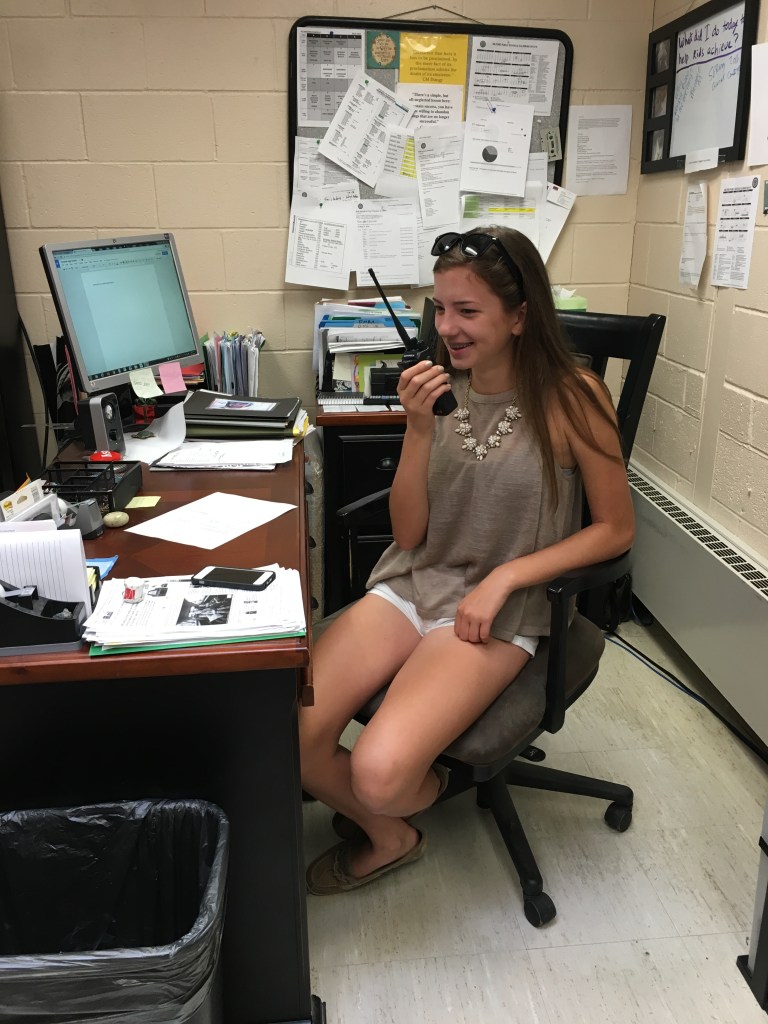
(Photo by Emily Carroll)

(Photo by Emily Carroll)

By Emily Carroll and Valeria Araujo – News Editors

Freshman Erin Goodwin won a contest at the recent “March Madness For Madide” fundraiser pep rally that allowed her to be Principal for a Day at Law. She spoke with Advocate news editors Emily Carroll and Valeria Araujo during her day replacing Mr. Thompson as principal on May 27.

Emily Carroll and Valeria Araujo: Were you nervous before starting your day as principal?

Erin Goodwin: At first it was kind of intimidating because they told me that I was in charge of everything and told me all of my tasks in the morning. Then I got used to it as all of the staff got to know me. After I started doing everything, it started to become fun.

EC & VA: What have you done as principal?

EG: So far I’ve been walking around and giving Lawmazing prizes such as sunglasses and frisbees. I’m also going to be greeting the 8th graders who are coming for the picnic. We waited for them to get off the bus and then we watched them play frisbee. It was good and they looked like they were having a good time.

EC & VA: How does it feel to be principal?

EG: It’s pretty fun. I like how I can excuse my friends for a while. It’s also fun to boss around all of my teachers

EC & VA: What were some of the perks of being principal?

EG: I am able to talk to a lot of more people who I might have not been able to talk to because of all the Lawmazing stuff I was handing out and it’s more open and fun. Me and some friends were also just watching a movie in his office.

EC & VA: Who are you inviting to your luncheon and what are you planning to eat?

EG: We are getting food from Napoli Deli and I’m inviting my friends Ally Stein, Jessica Postighone, Adriana Izzo, Samara Thacker, Cali Jolley, and Pam Ellison.

NEWS: NHS Raises Money For Mental Health, Cancer Research At Annual Brain Bowl

(Photo courtesy Nisali Fernando)

(Photo courtesy Nisali Fernando)

By Abby Williamson – Staff Reporter

Jonathan Law’s National Honor Society hosted its annual Brain Bowl on May 19.

The Brain Bowl is a contest that challenges students and faculty to test their knowledge while raising money for mental health awareness and brain cancer.

“The Brain Bowl has been a tradition at Law for 10 to 15 years,” NHS advisor Ms. Turcotte said.

During the weeks prior to the Brain Bowl, the NHS walked around and collected donations during lunch.

Every dollar donated counted as 10 points for whichever class the donation came from.

“We were able to raise roughly $500 from walking around lunch waves alone,” senior NHS member David Patrick said.

This year’s Brain Bowl raised roughly $775, the best outcome in years.

A total of $550 was raised by students and faculty. An additional $225 was raised by business advertisements in the program.

For the first time, the money was split between two organizations. One, helping physical health of the brain and the other, mental health (in honor of Laura Gonzalez).

“We decided to divide our profits to two organizations in order to honor former NHS member Laura Gonzalez,” junior NHS member Melanie Coleman said.

The sophomore class raised the most money, and also won the Brain Bowl.

To get into the Brain Bowl, students and teachers took a 50 question quiz on random topics.

The top four testers of every grade/faculty were selected to be featured in the Brain Bowl.

“We didn’t have a great turnout when it came to the number of people taking the test, but we did raised a lot of money which is the most important factor,” junior NHS member Lexi Fisk said.

The freshmen team consisted of Jessica Postighone, Samara Thacker, Lola Hazarika and Spencer Mehan. The sophomore team was Meghana Jaladanki, Colleen Hugo, Jordan Beck, and John Fowler. The junior team featured Melissa Chodziutko, Madison Murphy, Kevin Chesler, and Sam Rossi. The senior team included Jennifer Rondinelli, Adam Streeter, Jake Fucci, and Dan Ouellette. Mrs. Briggs, Mr. Barcello, Mr. Stanton and Mr. Vitelli completed the faculty team.

The competition pinned freshmen, sophomores, juniors, and seniors against each other. The winning class, the sophomores, then went against the faculty.

This year’s theme was “High School Musical” and the final question was based on just movie.

The sophomore class took the victory when they got the final correct answer and the faculty did not.

NEWS: Thompson Reflects On School Year, Class Of 2016

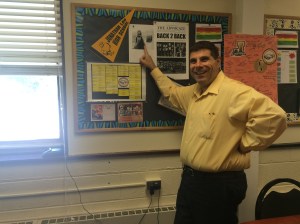
(Photo by Valeria Araujo)

(Photo by Valeria Araujo)

By Emily Carroll – News Editor

As the school year comes to a close, principal Mr. Thompson took time to speak with Advocate news editor Emily Carroll about his his fifth year at Jonathan Law. Here is what he had to say about the past year and what is on the horizon for the Law community:

Emily Carroll: What are some of your best memories from this year?

Mr. Thompson: I think my favorite memory is yet to come. When I see the Class of 2016 receive their diplomas, knowing they are ready for the next chapter in their lives, I will be so excited for them and anxious to hear about their success.

EC: How do you think Law did academically, socially, and athletically this year?

MT: Academically, I think this was a very strong class. We had over a third of the school at the Honors Breakfast which says something about the direction we are heading. I made a reference in my speech at the breakfast to Dr. Barbiero who is the District Supervisor for Social Studies, a former Law teacher and assistant principal who is retiring, and he said to me that there used to be such a small breakfast. To have that cafe packed makes you realize that you can achieve and deserve to achieve. Socially, I think we are a very caring community. There are a lot of different jobs out there at different schools, but we all like to stay here because we are part of a real community. It’s a very exceptional place, one like I’ve never seen. And athletically, all the spring sports are going to the state tournaments which is really cool and is a great way to end our year. I think that the path ahead for our fall sports and winter sports look brighter so I think that’s pretty exciting.

EC: Some students were wondering what keeps you so positive?

MT: Coffee. No, all kidding aside, it’s gratitude. I am very grateful. It’s not really a job. It’s a vocation for me, not an occupation. That makes the bad days greater in their struggle and it makes the good days really awesome. I think I have been very blessed from my family to just learn how to be grateful. And coffee.

EC: What is your favorite part about the Jonathan Law community?

MT: My favorite part about the Law community is the fact that everybody cares about everyone else. We have good days and bad days, but at the end of the day there’s a lot of love and that’s what keeps me coming back every day.

EC: What are you going to miss most from the Class of 2016?

MT: I am going to miss the individuals. I am going to miss so many people in this class who brought so many different strengths to our school and who have so many special gifts. I know that sounds silly but I am really going to miss those individual moments where there’s a conversation with some of the seniors. Everybody has so many different areas of interests and it’s really great to be able to be more personalized.

EC: Are there any big plans for next year?

MT:  We are actually starting on Friday (May 26th). We have an eighth grade picnic from all the kids from west shore. They will be here to celebrate an end of the year picnic and that’s 75% of our freshman so we will be able to meet them. We are going to be doing some different things with the freshman academy next year. We will have the kids go to their first few days of classes and do some work to help with their transition into high school. From all that I hear, it is a nice group of kids and we are excited about that.

EC: Looking back to when the Class of 2016 were freshman, what sort of changes and improvements have you seen?

MT: This will be part of my graduation speech. I have been really struggling with it because it’s very easy to say this was the forgotten class or this was the class that experienced a lot of loss and tragedy and we had to run to heal and help, but that’s just not true. This class has so many different individual strengths that I have seen leaders emerge from sophomore to junior to senior year. I’ve seen so many different skill sets.  So, I have seen a class that has really grown into its own and no one should make any type of generalization because they would be nonsense.

EC: What advice do you have for the Class of 2016 and their journey to college?

MT: Aww, listen to my speech. I can’t give you all of the stuff. Don’t ever let anyone tell you ‘you can’t,’ because you’ve proven over the four years that you can. So, just don’t let anyone tell you ‘you can’t,’ because that’s just not true.

EC: What are your plans for this summer?

MT: I am going to the Dominican Republic in July. My happy place. I’ve been going every year for the past three years. I will also be doing a lot of yard work. Right now my yard looks like a parking lot. It’s in really bad shape, but that will be my summer project.

EC: Is there anything else you would like to say to the Jonathan Law community?

MT: Just, thank you. Thank you for letting me be part of your community. Thank you for each and every day. It’s really a great place to be. It’s Lawmazing!

SPORTS: Law’s Golf Team Closes Out Sensational 12-4 Season

(Photo courtesy yearbookavenue.com)

(Photo courtesy yearbookavenue.com)

By Charlie Fonck and Owen Paiva – Staff Reporters

The Law golf team has enjoyed one of its most successful seasons ever, which included a victory in the Mayor’s Cup.

Led by head coach Mr. Koorejian, assistant coach Mr. Batson, and captains Max Caserta and Jake Mola, Law golf has reached new heights this season, and are poised to finish the season in style.

“Our season went well,” Mola said. “This is the first time the team had more than 10 wins and our team is almost at where we want to be which is states. This season is the best we’ve had in a long time; it’s a season full of many wins and not many losses.”

The Lawmen beat Foran 189-205 and 195-222 and beat Platt Tech and Foran to win the Mayor’s Cup.

“Phenomenal season. Best one in 20 years,” Koorejian said.

Mola will continue to lead Law next season, and hopes to continue playing golf at a collegiate level.

“I’m trying to go to college to play golf,” Mola said. “That is the goal, and I’m going to try to do everything I can to play.”

Koorejian said that he is excited for next season

“Jake Mola and Brian Hayes will be the highlighted seniors,” Koorejian said. “And the upcoming sophomores Ryan Mola and Zach Smith (will contribute).”

Mola encouraged more kids to play golf for Law next year.

“Next season we need more kids,” Mola said. “We will have a top four but we need kids to step up or find kids who can play the game of golf.”

Mola consistently medaled this season, not knowing how many times he had medaled himself.

“Too many to count,” Mola said.

Senior Matt Marino shot par, medaling with a 32 on the Orchards course in the Mayor’s Cup. Jake Mola shot a 35 and Max Caserta shot a 37. These were the three best scores on the day.

Law wrapped up the successful season with a 170-181 victory over Lyman Hall.

Jake Mola medaled with a 40, and Matt Marino continued his great shooting with a 41. Max Caserta also continued his steady year with a 46 and Ryan Mola shot his lowest round of the year with 43.

Mola and Marino will represent Law at SCC’s.

SPORTS: Shea Finishes Tennis Season Unbeaten

MJD_9371

(Photo courtesy yearbookavenue.com)

By Brianna Arnold and Bianca Hanania – Staff Reporters

Senior tennis captain Emma Shea had a perfect spring season.

Shea finished the year 23-0 as Law’s 4th singles player, shattering the school record for wins in a season. She also broke Lianne Maynard’s career record for wins with 49.

Being a part of the tennis team is very important to Shea. She works hard every match to motivate the team and do her best.

“As a captain, I try to encourage positive thinking, whether we were up 6-0 or losing 0-6,” said Shea. “It is Important to never give up because tennis is just as a mental game as a physical game.”

The team’s lineup has changed a lot this season, but everyone on the team was able to adjust well and play to the best of their ability.

“Everyone is so flexible when it comes to lineups – whether it is playing a new position or even taking a loss for the sake of the team,” said Shea.

Shea will attend RPI in the fall and hopes to continue to play tennis there. She is excited for her new journey but also sad to leave Law.

“When I go to college, I will definitely miss my team and Coach K,” said Shea. “I love the game of tennis, but my teammates and coach truly made my years playing tennis at Law an unforgettable experience.”

Being undefeated is something that rarely happens in a sports season. Shea researched her opponents before she played against them so she would know what to expect.

“As my wins began to add up, the thought of playing became quite stressful because i wanted to stay undefeated,” said Shea. “While I played, the key for me was to stay calm, stay confident, and to never lose hope.”

Even though Shea could not qualify for states because she plays 4th singles, she is excited to help the team win as many matches as they can in states.

“I think the team was so successful this year because we have a great coach and a talented group of girls,” said Shea. “We all contribute to winning.”

Junior captain Megan Gleason sees how hard Shea works to lead the team to success.

“Emma’s energy drives and motivates the team to work as hard as she does,” said Gleason. “We love her.”

Junior captain Victoria Contaxis looks up to Shea as a role model.

“Emma is a great captain because she is just a natural leader and she is not afraid to speak up,” said Contaxis. “She is also a talented tennis player and has an undefeated record which is amazing.”

Head coach Mr. Kulenych has seen Shea improve over the three years he has been her coach and knows how hard she works on and off the court.

“Emma is the epitome of a student-athlete,” Kulenych said. “I don’t know how she does. I don’t know when she sleeps. She works so hard on the court and in the classroom and sets an amazing example for the rest of the team.”

Junior Deepika Senthilnathan is part of the Science Slub and has many classes with Shea.

“Emma is a great athlete and a hard worker in class too,” said Senthilnathan. “She is one of the best captains and will be hard to replace next year.”

Many girls on the team look up to Shea and only ever hope to make an undefeated record.

Senior Anna Downs has known Shea all four years and is inspired because of her motivation.

“Emma is truly the definition of someone who is dedicated in every sport she plays,” said Downs. “Leaving the team is going to be hard but Law will always be our home.”

Kulenych said that the team has big shoes to fill to replace Shea next season.

“What she was able to do this year was unbelievable,” Shea said. “At her spot, no match is easy. Points last forever, matches last forever, but Emma grinds matches out better than anyone I’ve ever seen. She’s such a smart, relentless player who just finds a way to win.”

SPORTS: Lawmen Finish Successful Regular Season, Return To States

(Photo courtesy twitter.com)

(Photo courtesy twitter.com)

By Kristin Frank – Staff Reporter

As the school year comes to an end, so does a successful season for the Law baseball team.

The Lawmen bounced back from a three-win season a year ago and qualified for states this spring.

The team defeated E.O. Smith in the first round of the state tournament on May 31 and will next face East Haven in the second round.

The baseball captains include Robert Griswold, Frankie Mucciacciaro, and Evan Carollo. These three boys have led their team on and off the field this season.

The captains all agree that their team has improved by having a stronger sense of communication on the field.

“Our team has gotten better from last year’s by becoming more of a unit and playing for the entire team instead of playing for themselves,” Griswold said.

The juniors on the team are just as focused as their captains, which helped out this season.

“I think I’ve helped by my work ethic,” junior Mitchell Smith said. “Other guys see how hard I work and being focused during practice led them to work just as hard.”

Even though he is one of the youngest players out on the field during games, Carl Maxwell has added to the team’s success.

“I’ve just tried to help the team in anyway I can and perform when my number is called,” Maxwell said. “I’m looking forward to improving on the season we had this year.”

This season was filled with many memorable games, including a win over Fairfield Prep on May 13. The two teams played at Harbor Yard in Bridgeport. Another notable win came on Senior Night when Law defeated Hale -Ray 9-0. In that game, Carollo pitched a perfect game to end his successful regular season.

“My favorite game this season was the Harbor Yard game,” Griswold said. “ It was an intense game and was our best overall performance of the year.”

Mucciacciaro believes the reason the Lawmen won more games than last year is by the chemistry built this year during practices and games between the players. Also, his teammates all share a common goal that everyone is focused on out on the field.

All players have had personal goals they wished to accomplish this year as well.

“This year I have been doing a lot better with hitting my spots on the mound,” senior Kyle Frey said. “As for the team, we are starting to understand each other more and getting used to playing with one another.”

There are only a few moments left of high school ball for the seniors on the team. They have all grown closer throughout the years and a couple are continuing to play summer baseball in a few weeks.

“I will miss the guys I’ve been playing with all my life and the memories I have made on the team,” Carollo said.

Griswold, on the other hand, will continue his career by not only playing for a team in the summer, but playing in college, Division I ball for LIU-Brooklyn.

NEWS: Law Drama Club Takes Curtain Call For The Year With “Seussical The Musical”

(Photo courtesy twitter.com)

(Photo courtesy twitter.com)

By Tyler Chavez and Nisali Fernando – Staff Reporters

Jonathan Law’s Drama Club struck gold with its production of “Seussical the Musical.”

On April 15 and 16, the Jonathan Law Drama Club put on a production of “Seussical the Musical.” The “lawmazing” cast of 25 performers wowed the audience with bright colors, catchy music, and a story of triumph in the magical world of Seuss.

The show, which was the last production of the year, marks a successful run for the Drama Club.

“This year was really successful,” said Junior and stage manager Ann Reed. “We had two great shows and we really came together as a family”.

“Seussical the Musical” tells the story of multiple Dr. Seuss characters, focusing mainly on the story of “Horton Hears a Who”.

“What I think is really interesting is that this is a kids show,” said junior Jill Bendlak, who played one of the Whos. “I have never seen a show with so much color in it before!”

The show follows Horton the Elephant  as he tries to protect a clover carrying the small planet of Who where JoJo, his family, and the rest of the Who’s live. Along the way, Horton is impeded by the Sour Kangaroo and the Wickersham Brothers, but is assisted by his neighbor, the bird with the one-feathered tail, Gertrude McFuzz.

“I was really impressed with how simple, yet beautiful and colorful the stage was,” said Spanish teacher Mrs. Fortin, who saw the show with her children.

The show is known for its vibrant, colorful atmosphere that can reach an audience of all ages. Younger fans love the music, colors, and humor, while older fans enjoy seeing the classic Seuss characters on stage and interacting together.

“My kids loved the show,” said Fortin. “They had never seen anything like it.”

The musical was a family favorite bedtime story brought to life. Familiarity and youthfulness flooded the atmosphere, in the world of Seuss it’s okay to be a little silly.

Earlier in the fall, the club performed, “Almost, Maine” a romantic-comedy play following the stories of nine interconnected couples.

“I had such a great time getting to know everyone in the club and performing for everyone who came to the shows,” junior Nikita Potnis said.

Current members of the Drama Club were pleasantly surprised to see new people join and contribute to the club.

‘It’s great because your family grows and you make a lot of new friends,” Bendlak said.

Members of the “Seussical” cast, both old and new, hold fond memories about preparing for the show and learning their parts. Rehearsals were considered a fun, energetic time.

“I think my favorite part [from rehearsals] was when we would play games and dance for warm-ups because everyone was always having such a good time and enjoying themselves,” Potnis said.

The show has also left an imprint on those who took part. Its charm has created memories for those onstage.

“I loved the opening number,” Potnis said. “It’s so high energy and fun and it was so great while we were performing on opening night and people started cheering before the song even ended.”

Offstage, stage managers work tirelessly to keep the show running smoothly. From managing props to preparing sets, without them the show would be at a complete standstill.

“Backstage is where everything comes together, there’s a lot of moving parts that have to work together,” Reed said.

Stage managers are constantly on edge, as they have juggle many things at once.

“I have around 15 nightmares before every show about certain scenarios happening backstage,” junior and stage manager Sarah O’Brien said.

Through the hard work of the cast and crew, the show sold out opening night, and rave reviews followed every viewing.

“It was a riveting experience,” junior Sam Rossi said. “I was really impressed with Maddie Baldieri and Emma Hudd and JP has the voice of an angel.”

Seussical the Musical, kept its audience on the edge of their seats. The show was interactive (live auctions and questions to the audience) and during moments of sadness, there was not a dry eye in the house.

“My favorite part was the auction,” Rossi said. “I got to participate and it was amazing.”

Current members are already looking forward to what the future has in store for the Drama Club.

“Here’s what’s happening: new merch, new shows, new team building, and new choreography,” O’Brien said.

As the school year comes to a close, members who will be reaching their final year of Drama Club reminisce on the success of the program.

“When we joined freshman year the club was very small,” Reed said. “But it’s been great to see it grow and I can’t wait for us to come full circle in this now successful program.”

FEATURES: Childhood Obesity Problem Continues To Grow

(Photo courtesy bewhealthadvisor.com)

(Photo courtesy bewhealthadvisor.com)

By Catie Rice – Staff Reporter

Second-grader Nicholas Reeves, who lives in Tennessee, is battling the bulge of child obesity at just eight years old. Reeves is a very active child who loves to play basketball, but weighing 117 pounds has impeded his progress in many ways.

“He can finish eating a meal and then five minutes later he goes in the kitchen saying that he’s hungry again.” Angel Reeves, Nicholas Reeves’ mom said.

Reeves had to have his tonsils removed because the thickness of his neck was causing sleep apnea.

Beyond the emotional toll of taunting and teasing, the stakes for obese children can be as high as for obese grownups.

Reeves is only one of the many children battle with child obesity. Childhood obesity has more than doubled in children and quadrupled in adolescents in the past 30 years.

Overweight is defined as having excess body weight for a particular height from fat,muscle, bone,water, or a combination of these factors. Obesity is defined as having excess body fat.

Overweight and obesity are the result of “caloric imbalance”—too few calories expended for the amount of calories consumed—and are affected by various genetic, behavioral, and environmental factors.

More than two percent of young children were severely obese, five percent of 6-to-11-year-olds were severely obese and 6.5 percent of 12- to 19-year olds were severely obese from 2011 to 2012.

Up to one out of every five children in the U. S. is overweight or obese,

“This generation is on track to be the first generation in America that’s less healthy than their parents,” First Lady Michelle Obama said.

Obese youths are more likely to have risk factors for cardiovascular disease, such as high cholesterol or high blood pressure. Children and adolescents who are obese are also at a greater risk for bone and joint problems, sleep apnea, and social and psychological problems such as stigmatization and poor self-esteem.

Later in life, children who are obese are more likely to become obese adults. Consequently, adult obesity is associated with a number of serious health conditions, including heart disease, diabetes, metabolic syndrome, and cancer.

Treatment for childhood obesity is based on a child’s age and if he or she has other medical conditions. Usually it includes changes in a child’s diet and level of physical activity. In certain circumstances, treatment may include medications or weight-loss surgery.

Good habits established in childhood help adolescents maintain healthy weight despite the hormonal changes, rapid growth and social influences that often lead to overeating.

Four-year-old New York resident Samantha Stevens is also struggling with obesity. At 54 pounds, Samantha is the biggest girl in her pre-kindergarten class .By the standard medical definition, Stevens is actually counted as obese.

“She eats very slowly and deliberately and finishes everything on her plate,” Stevens’ mom, Lori Cohen, said.

Samantha entered a program on Long Island run by Dolgoff, who set out to help her get healthier in a six-month period.

Dolgoff created a kid-friendly program called “Red Light, Green Light, Eat Right.”

“I took every food and divided them into either red light, yellow light and green light categories. I made it fun for the kids.

Green light foods are go. Yellow light foods are slow. And red light foods are bad

The main idea is to get kids, and their parents, to think before they eat.

In today’s society it may be hard for children to make healthy food choices and get enough physical activity. Some bad factors may be,Advertising of less healthy foods,No safe and appealing place, in many communities, to play or be active,and an increase in portion size.

Child obesity is now caused by many other factors like fast-food plus processed food adding in some preservatives, some sugar; a mix of video games, television, computers and our dependency on cars.

Surprisingly, Lack of breastfeeding support affects a child’s weight. Breastfeeding protects against childhood overweight and obesity.However, in the United States, while 75% of mothers start out breastfeeding, only 13% of babies are exclusively breastfed at the end of six months.

A review of studies in the journal Archives of Disease in Childhood, researchers found that kids who sleep less than the recommended amount of about 13 hours a day at age two are more likely to be obese at age seven.

Lifestyle issues like too little activity and too many calories from food and drinks are the main contributors to childhood obesity but genetic and hormonal factors may play a role as well.

Some kids may turn to food as a coping mechanism for dealing with problems or negative emotions like stress, anxiety, or boredom. In most cases, Children struggling to cope with a divorce or death in the family may eat more as a result.

Also if a child was born into a family of overweight people, he/she may be genetically predisposed to the condition. There are certain genetic diseases and hormonal disorders that can predispose a child to obesity, such as hypothyroidism,Prader-Willi syndrome, Cushing’s syndrome.

Body mass index (BMI), expressed as weight/height2 (kg/m2), is most often used to define overweight and obese conditions. Using a growth chart, a child’s pediatrician will calculate your child’s percentile, and how he/she compares with other children of the same sex and age.

Dr. Gail Nunlee-Bland,a pediatric endocrinologist and director of the diabetes center at Howard University Hospital has seen firsthand the causes and effects of childhood obesity in her own practice.

“It’s just not the child’s problem – and really encouraging families to have more physical activity in their lives, to choose healthier food,” Nunlee-Bland said. “So we really need to work on this in our society so that we can break this vicious cycle.”

Obama, is challenging all of America to turn around the trend in children’s health by putting an end to the epidemic of child obesity. She launched “Let’s Move!” on February 9, 2010.

It was created as a comprehensive initiative dedicated to solving the problem of obesity within a generation called “Let’s Move!” so that children born today will grow up healthier and able to pursue their dreams.

The program focuses on five pillars: Creating a healthy start for children, Empowering parents and caregivers, Providing healthy food in schools, Improving access to healthy, affordable foods, and Increasing physical activity.

Since the movement started, Disney announced that it will require all food and beverage products advertised, sponsored, or promoted on various Disney-owned media channels. The U.S. Olympic Committee and several of its national governing bodies have provided beginner athletic programming for free or low cost to more than 1.7 million kids since 2012, and through the Healthier U.S. School Challenge, more than 5,000 schools now meet high standards in nutrition and fitness.

To prevent the chances of becoming overweight, parents should limit their child’s consumption of sugar-sweetened beverages, provide plenty of fruits and vegetables, eat meals together as a family as often as possible, limit eating out, especially at fast food restaurants, and limit TV and other electronics to less than two hours a day

Also, parents should be sure their child sees the doctor for wellness checkups at least once a year. During this visit, the doctor measures a child’s height and weight and calculates his or her BMI.

Reeves has set out on a program designed for obese kids. Reeves entered a program led by a team of experts at the Pediatric Weight Management clinic at the Monroe Carell Jr. Children’s Hospital at Vanderbilt University in Nashville, Tenn. Dr. Greg Plemmons monitored his progress.

Plemmons said Reeves was just young enough that his condition was still reversible.The child then met with a physical therapist. At the end of the appointment, he was given a list of individualized goals. Reeves was working on his new healthy goals. He played basketball with his brother while, back in the kitchen, his mom helped him with portion control.

“He is greater than the 95th percentile, and the No. 1 thing that he is at risk for developing as a young adult is type 2 diabetes,” Plemmons said. “That’s the No. 1 thing that we see directly related to obesity. He is also at risk for heart attacks and heart disease. He’s at risk for low self-esteem, he’s at risk for mental health issues.”

Reeves’ story is a prime example of a child who is overweight that is trying to turn his life around.

(Some information cdc.gov, mayoclinic.org, abcnews.com)

FEATURES: Stresses Continue To Build For Today’s Teens

(Photo courtesy blr,org)

(Photo courtesy blr,org)

By Renee Lynch – Staff Reporter

Megan Grabowski, a senior at Jonathan Law High School in Connecticut, is highly involved in her academics and outside of school activities.

Grabowski, is an honor student, who is looking to become a nurse, is also a captain of the high school gymnastics team and is employed, working 18-20 hours per week.

Many full-rounded students, including Grabowski, experience major stress due to the inability to balance school work, working, sports, and relationships with friends and family.

“It’s hard for me to balance my academics, when I also have a job and have other after school activities,” Grabowski said.

Teenagers in high school are also stressed due to SATs, ACTs and college applications.

“College applications were so stressful for me,” Grabowski said. “There were so many different criteria for each school, including separate personal essays, and also it was hard to have everything completed for the deadlines, when I had homework and studying to do on top of that.”

Research shows that 30 percent of teens reported feelings of sadness due to stress, 31 percent of teens felt overwhelmed due to stresses, 36 percent of teens are tired because of stress, and 23 percent have skipped meals because of stress.

On average, students reported their feelings of stress on a 5.8 out of a scale of 10.

“In order to break this cycle of stress and unhealthy behaviors as a nation, we need to provide teens with better support and health education, at school and at home, at the community level and in their interactions with healthcare professionals,” Norman B. Anderson, the APA’s chief executive and senior vice president said.

Stress seems to be getting worse for some teens, according to the survey. About 31 percent of kids said their stress level had increased in the past year, twice as many as those who said it went down, and 34 percent said they expected their stress level would rise in the coming year.

One recent study from the Stanford School Of Medicine indicates the number of children ages 7-17 doubled since 1991.

High-stakes tests, such as the TAKS in Texas and the FCAT in Florida, are particularly stressful, for students and teachers because students in certain grades must pass these tests to advance to the next grade. In Florida, children as young as 8 years old face the prospect of being held back if they fail the test, creating considerable stress.

Another source of school-related stress occurs in high school where more students are taking more rigorous classes, such as Advanced Placement (AP) classes offered by the College Board. In the past 25 years, there has been explosive growth in the number of students taking AP classes, with one-quarter of all high-school graduates having taken at least one in 2004.

In addition, more high-school students are now taking the PSAT twice and the SAT and ACT at least once, if not multiple times.

“SAT scores are very crucial for your college application,” Grabowski said. “So, taking my test created stress and was very nerve racking.

The college admissions process has become more demanding, the the percentage of high school graduates has gone up 24% since 1991, an additional 17,000 graduates queuing up for college admission, leading colleges to become more picky.

Due to college becoming more demanding; the more admissions tests, more rigorous classes, more applications, more college tours. All these factors intensify stress, on top of all other stresses.

Bryce Goldsen, a junior at Bishop Blanchet, a Catholic high school near Seattle, carries a near-4.0 grade point average, takes advanced placement history and language arts classes, plays varsity tennis, participates in mock trial events and sits on the city’s local youth commission.

“Most of my stress comes from the pressure to perform well day in and day out,” he said.

Students want to please their parents by getting good grades, creating stress among teens of all ages.

Parents set unrealistic expectations for their children; studies show that parents often push their student to take higher level courses, though the child may not meet the requirement for those courses.

Parents should talk to stressed children about their feelings, make sure they get enough sleep and that they are not overscheduled.

On top of these factors, teens are stressed to fit in, to be popular, to be liked so they will not be bullied for being different.

Seventy-one percent of students have reported bully being a serious problem at their school. Being the victim causes stress for a student, intensifying anxiety and depression.

Being active is supposed to be a stress reliever for athletes, however, it could create more stress rather than relieving stress.

Student-athletes can have a late away game, only to arrive back at home at 8pm on a school night, having loads of AP and honor course classes of homework to do.

Also, athletes are driven to be the best, which may mean putting in extra hours at the gym to get faster, and stronger. However, improving in a sport will mean less time to get sleep and do homework.

“When I get home from a gymnastics meet, it could be around 7 p.m. or 8 p.m.,” Grabowski said. “I would still have a plentiful amount of AP Psychology and Calculus to do. Along with work and friends, it’s hard to balance all the work, while improving on myself as a gymnast.”

Signs of stress includes tears, crankiness, nightmares, attitude, and physical symptoms, including stomach aches, headaches and vague body pains.

High school junior, Hannah O’Brien, 17, of Acalanes High School in Lafayette, California has seen some of these extremes. She says she has witnessed student crying after getting low test scores, and seen students go days without sleep for a few days in a row to keep up with homework.

“I personally have seen so many of my closest friends absolutely break — emotionally, physically and mentally — under stress, and I knew a lot of it was coming from school work,” O’Brien said.

Over scheduling is a huge impact on student stresses. Students will enroll in too many AP classes that they can handle, and not be able to manage their time with other activities.

“For me it’s either do well in school and hangout with friends and not practice for gymnastics, or hangout with friends and do well in gymnastics, but fall behind on school work,” Grabowski said. “It’s so hard to balance.”

Parents should be on the lookout for previous stated symptoms of stress, however, eating disorders, alcohol and drug abuse are also signs of stress.

“Parents should look for a change in grade status, attendance, tardiness, lack of responsiveness in the classroom or at home, and withdrawal into solitude,” said Richard Hall, assistant headmaster of Atlanta’s Lovett School.

There are safe, healthy ways for teens to cope with stress, however, according to the APA stress in America report, forty-two percent of teens have reported that they don’t know how to cope with stress, or they don’t do anything to cope with it.

Physical activity is reported to be the most effective way for teens to cope with their stresses. Whether this means playing a sport, going for a jog or taking a dog on a long walk.

Sleep is highly recommended to cope with stress, considering students do not get enough, To better sleeping habits, it is encouraged to cut back on watching television or engaging in any screen time at late hours, along with cutting back on caffeine intake.

Another way to handle stress is to focus on hobbies. Listening to music, drawing or painting and going to the movies could be a key component to relax someone after a stressful day.

Talking to someone about stresses is always a great idea. A parent or teacher may have ideas to help out to manage stress.

“After dealing with all types of stress throughout my high school career, I’ve learned what helps me manage stress, however it’s an ongoing trial and error process,” Grabowksi said.

Figuring out which coping mechanism works best will take time, but experts believe that everyone will figure what works for them.

“Sleeping, eating and going to the gym really are my prime mechanisms to manage stress,” Grabowski said. “The gym helps me relieve stress, due to endorphins being released, I have a more positive mindset.”

(Some information courtesy of psychologytoday.com, webmd.com, nbcnews.com, apa.org, nyu.edu and medicaldaily.com)

FEATURES: Teens Dealing With Variety Of Stresses

(Photo courtesy drnicholaswarner.com)

(Photo courtesy drnicholaswarner.com)

By Megan Grabowski – Staff Reporter

Tom Poulis, a senior at University High School in Southern California, is really feeling the stress that most teens feel throughout their high school years. Poulis is mainly stressed over applying to colleges, as well as multiple other things including his academics and his extracurricular activities. He is president of the debate club, an officer with Amnesty International, and a student representative on the Associated Student Body Cabinet, among other activities that he needs to keep up with.

For Poulis and the majority of high school students, stress is a something that they have to deal with on a daily basis. Stress can be caused by multiple different things. Some of the big causes of stress in teenagers are school, sports and activities, their friends and family, or a job that they have. Stress can have a big impact on teens.

“At the extreme, and I want to emphasize that this is the extreme, we’re seeing more kids who are engaging in self-mutilation,” said adolescent medicine specialist Kenneth Ginsburg. “It’s a way of taking control over their life when they feel their life is out of control. And I see quite a few kids with eating disorders. It’s kids who just feel like they can’t handle everything they’re doing.”

School alone is a big cause of stress for teenagers. Teens have a constant workload and are expected to somehow get all of the work done on time and done right. According to the American Psychological Association, teens routinely say that their school year stress levels are far higher than they think is healthy.

“You have to be able to perform at a much higher level than in the past, when I was in high school,” said Dave Forrester, a counselor at Olympia High School in Olympia, Washington. “We have so many choices for kids. They need to grow up a little faster about what they want to do and how they’re going to do it.”

On top of academics, many teens participate in after school sports and activities. Even though these activities are supposed to be fun, they usually add extra stress onto the teens shoulders.

Bryce Goldsen understands what it takes to get everything done. He is a junior at Bishop Blanchet, a Catholic high school near Seattle. He has a 4.0 grade point average, takes advanced placement history and language arts classes, plays varsity tennis, and sits on the city’s local youth commission.

“Most of my stress comes from the pressure to perform well day in and day out,” said Goldsen.

A survey by the American Psychological Association stated that just under 60 percent of teens said that having to manage too many activities was a “somewhat or very significant” stressor. Most teens reported that their stress levels affected their performance at home, work, and school. Respondents said that it is tough to keep their grades up, especially when they have a busy schedule after school with limited time to do homework.

Grades, homework, tests, and after school sports and activities are not the only factors that go into teen stress. Teens’ relationships with their families and friend groups cause them more stress than you would think. The struggles of dating, fitting in, and friendship are magnified by social media even when the school day ends.

Today it is rare to find a teen who does not have a phone or Internet access and it is true that this technology can cause them more stress than they already have. With smart phones, instant messaging, and social networks, the social environment of the school has spread into the home. Teens’ social problems follow them home and they cause mental stress while the student should be relaxing or studying.

“It follows them home,” said Tim Conway, who directs the counseling department at Lakeland Regional High School in Wanaque, N.J. “There is no escape anymore.”

The American Academy of Pediatrics considers peer pressure and social life a teenage stress factor. Although teens may have a solid group of friends, their peers may pressure them to hang out instead of studying, break ties with former friends that the group doesn’t consider “cool” anymore, or experiment with alcohol, drugs or sexual activities that go against their morals or family rules.

Family problems can also cause teenagers to feel the stress at home. Arguments with siblings and parents is a big factor in how the teen feels at home. After coming home from a stressful day at school, teens should be able to relax at home and have a way to escape. Stress in teens can come from their parents pressure to do well and be successful.

Teen stress levels are found to be higher than those of adults, so the support from adults is truly what teens need.

“It is alarming that the teen stress experience is so similar to that of adults,” said Norman B. Anderson, the American Psychological Association’s chief executive and senior vice President. “In order to break this cycle of stress and unhealthy behaviors as a nation, we need to provide teens with better support and health education, at school and at home, at the community level, and in their interactions with healthcare professionals.”

Another major cause of stress in teens is lack of sleep. Teens need about eight and a half hours of sleep every night in order to keep healthy and energized. Not getting enough sleep can cause a teen to be tired and stressed, and being stressed about something can cause a teen to not be able to sleep. It is an unhealthy cycle.

Teens report sleeping an average of seven hours on a school night and sleeping an average of eight hours on the weekend.

This year’s Stress in America survey shows that stress may be interfering with Americans’ sleep, keeping many teens from getting the sleep they need to be healthy. Sleep is a necessary human function and when we do not sleep long or well enough, our bodies do not get the full benefits of sleep.

Teens are more likely than adults to say they do not get good quality sleep and have more trouble achieving their sleep goals. Teens are also more likely to say they feel stressed from a lack of sleep than adults are.

It is very evident that teens feel more stress overall than adults do. As a result, teens need effective ways to cope with stress and to avoid stress in order for them to live a healthier lifestyle. According to the American Psychological Association, it is normal to have some stress in life, but if stress persists at high levels for a long time, it can have lasting negative effects on health.

According to Dr. Henri Roca, a Family Medicine Physician, believes that stress can be avoided.

“No one and nothing can make you feel stressed, said Dr. Roca. “Stress is our natural response to our interpretation of the world.”

Dr. Roca believes that there are three components to coping with stress. You should redefine the circumstance so that it is no longer stressful. Once stress gets into the body, exercise is the best way to get it out of the body. And lastly, in order to reduce the likelihood that stress even arises, it is imperative to create stress management skills.

Some of the best ways to avoid stress in teens is to get enough sleep, exercise daily, eat healthy foods, and stay organized.

According to the American Psychological Association, physical exercise is one of the most effective stress busters. Getting enough sleep is essential to keeping stress levels down. An important way to keep stress down is keeping a balance. You need a balance between school, homework, friends, work, sports, etc.

However, the most important thing is to enjoy yourself, do things you love doing, and be happy.

Tom Poulis was feeling the stress right at the beginning of the school year.

“I’ve been in school for three weeks and already it’s really hectic, because you get thrown into all this college stuff,” said Poulis. “And people are always telling you, ‘Apply here.’ And when are you going to take your SATs? And on top of that I’m taking four AP classes. So already, the stress level is very high.”

However, Poulis says he genuinely enjoys all of his activities and courses in school, which is what keeps him going. That is why it is important for teens to manage their stress and simply have fun with what they are doing.

(Some information courtesy nbcnews.com, drhenriroca.com, apa.org, npr.org, washingtonpost.com, everydaylife.globalpost.com, and livestrong.com)

FEATURES: Doctors See Rise In Youth Sports Injuries

(Photo courtesy safekidsworldwide.com)

(Photo courtesy safekidsworldwide.com)

By Maeve Rourke – Staff Reporter

Brie Boothby was excited to play out her field hockey season for Riverbend High School in Virginia. On September 10, 2013, Boothby was at an away game not too far from her hometown. The opposing team was at her goal trying to score, while her team was scrambling around to get the ball out. Amongst the chaos, Boothby took a a field hockey stick to the head and blacked out. In that moment, she turned from a optimistic teenage athlete to an anxious girl plagued with constant headaches.

“The next thing I remember was walking off the field,” Boothby said. “I got ice from the trainer, answered questions like ‘what day is it?’ and ‘what did you have for breakfast?’ and then went back in the game. Looking back, there was no reason to go back into the game after a head injury like that.”

That night, the 17-year-old began to feel nauseous, and began losing her memory. A trip to the doctor revealed Boothby had sustained a serious concussion that left her with permanent brain injuries.

It took Boothby 10 months of physical therapy just to be able to stand up without falling over. Since then, Boothby said that her school work suffered, and she’s been diagnosed with ADHD.

Over time she realized that she had lost several key moments of her life. Brie could no longer remember her first kiss, first date, passwords, or some days even what month it was. She became easily distracted, couldn’t make eye contact, and carried a vomit bag with me at all times.

“My GPA dropped so much that I’m really anxious about college,” Boothby said. “I’m not sure if I’m going to get into what I’ve worked for my entire life.”

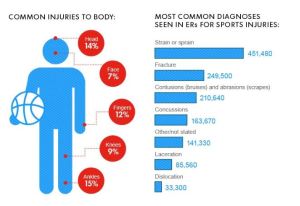
Boothby is one of 1.35 million youths that have sustained a sports injury that year. Thousands of young athletes continue playing through their pain, and further their injuries everyday.

According to a Med Sports System Study, high school athletes account for an estimated 2 million injuries, 500,000 doctor visits and 30,000 hospitalizations each year.

No single sport is specifically to blame for the increase in sports injuries. Instead, experts suspect that choosing to play one sport all the time, or playing several sports all at once, are factors leading to what are called overuse injuries. In fact, nearly half of injuries sustained by middle school and high school students during sports are overuse injuries.

“Unfortunately, there is not a lot of education built into the system to help prevent overuse injuries and this has contributed to a ten-fold increase in high school injuries in recent years,” orthopaedic specialist Dr. Jeffrey Guy said.

Also, young athletes today train more, have better equipment, and coaching. These factors all play into the increase of injures. Today, children discover what sport they enjoy at a young age. Parents are increasingly pushing their children to play that one sport year round to become better. Constant involvement in one specific sport puts stress on the muscles, tendons, and even bones that are used, ultimately resulting in an overuse injury.

Research reported earlier this year found that young athletes who played a single sport for more hours a week than years they were old — such as a 10-year-old who played 11 or more hours of soccer — were 70% more likely to experience serious overuse injuries.

There is also increased pressure on young athletes to support their team, and play in college. When injured, athletes are often afraid to tell their coach or parents because they do not want to disappoint anyone.

Similarly to athletes, coaches feel pressure to leave injured players in the game. In fact, a new study by national research group Safe Kids Worldwide which surveyed 3,000 athletes, coaches and parents, found that 42 percent of kids said that they have downplayed or hidden injuries so that they could keep playing, and 53 percent of coaches said they’ve felt pressure to put injured players back in the game.

In addition, parents and coaches do not normally implement sufficient safety precautions for their players.

According to the U.S. Centers for Disease Control (CDC), although 62 percent of organized sports-related injuries occur during practice, one-third of parents do not have their children take the same safety precautions at practice that they would during a game.

Letting the body rest, conducting preventive and strengthening exercises, and following proper technique are among injury prevention strategies recommended in a report created by multiple sports medicine physicians at Loyola University Medical Center . It also says athletes should be encouraged to speak up about injuries, coaches should be supported in injury-prevention decisions, and parents and young athletes should become better educated about sports safety.

“These statistics don’t have to be part of the game if we take some simple precautions,” says Kate Carr, Safe Kids president and CEO.

There is not only an increase in overuse; there has also been a rise in serious injuries.

“Although the number of injuries cited in the report may seem high, the actual number is likely even higher,” Neeru Jayanthi, a sports medicine physician at Loyola University Medical Center said.

Approximately 25% those injuries end up being serious, Jayanthi said.

Many parents and organizations have noticed the increase in youth injuries, and are seeking a change. According to the CDC, more than half of all sport injuries in children are preventable.

“One of the biggest problems with youth sports is that they are unregulated,”  Bob Ferraro, Sr. CEO of the National High School Coaches Association said. “The National High School Coaches Association believes that there should be a standardization of rules that protect our young athletes when it comes to injuries.”

The National High School Coaches Association think it should be mandatory to have medical personnel at each game to attend to injuries and to make all medical decisions about re-entry to the game. While current economics may make this financially impossible, the NHSCA suggests that youth programs seek-out athletic trainers, EMT’s, doctors and nurses to volunteer their services.

Safe Kids Worldwide, a global organization dedicated to preventing injuries in children, is one of the most successful institutions in preventing injuries in athletes.

Safe Kids works with more than 200 partners across the country to hold free youth sports safety clinics for coaches, parents, young athletes and league organizers. The clinics provide the knowledge and skills essential to preventing sports injuries and emergencies in young athletes. The content for the clinics is based on relevant information and tools to combat the most common and severe injuries in sports today, including acute and overuse injuries, dehydration and concussion. They also work with parents and community leaders to urge school boards to adopt best practices and guidelines to address all sporting injuries among their student-athletes.

Since the creation of the program in 2010, the organisation has reached more than 700,000 parents, coaches and kids with key information needed to keep athletes active and safe. Additionally, they have held more than 1,000 clinics and awareness events to increase the knowledge and awareness of sports injury prevention.

Also the STOP (Sports Trauma and Overuse Prevention)’s public outreach program focuses on the importance of sports safety-specifically relating to overuse and trauma injuries. The initiative not only raises awareness and provides education on injury reduction, but also highlights how playing safe and smart can enhance and extend a child’s athletic career, improve teamwork, reduce obesity rates and create a lifelong love of exercise and healthy activity.

In addition, in the event of an injury the Sport Trauma and Overuse Prevention’s website has a list of specialists that you can contact that will accurately diagnose and treat the injury.

These programs prevent thousands of athletes a year from sustaining a sports injury. They do not have to worry about sitting out for a season, or their future being impacted by a preventable injury.

Not only are organizations dedicated to preventing injury and helping those who are hurt, but also athletes such as Brie Boothby.

Boothby has created a peer support group called Concussion Connects to help others cope with the effects of suffering a severe concussion.

“I am grateful for the lessons I have learned throughout this difficult journey,” Boothby said. “Today, I remain a proud survivor of a Traumatic Brain Injury and am blessed to live (and remember) another day.”

Brie is enjoying her final year of high school and looks forward to fulfilling her dreams by going away to college next year.

(Some information courtesy of Today.com, SafeKids.org, stopsportsinjuries.org, and USAtoday.com)

FEATURES: Social Media Keeps Teens Connected But Comes With Risks

(Photo courtesy huffingtonpost.com)

(Photo courtesy huffingtonpost.com)

By Danielle Tancredi – Staff Reporter

Kate Dwyer, an 18-year-old college student, conducted her own social media experiment last year when she tried to quit social media for 72 hours. Even though she labels herself as someone who doesn’t entirely rely on social websites such as Twitter or Instagram, she started having trouble the first day without using her phone.

On day one, she admits that even when she was out trying to avoid any form of media, she felt the urge to take pictures for Instagram. She also found herself unconsciously opening apps after answering text messages, but then quickly closing them after realizing what she was doing. She began feeling desperate only at the start of day two when realizing that she had to access forms of media for a work project and felt the urge to give in. Ultimately, she was successful for the most part, but the 72 hours taught her that “the feeling of connectedness on social media is an illusion,” since the people teens communicate with on social media is one way of seeing into other people’s lives they don’t speak to in real life. This easy access of communication has led teens to social media addiction.

Social media has made its positive impact through businesses, cultures, and politics, but where does its greatest influence fall? Based on research, 92% of teens admit going online at least once a day and 56% admit they go online several times a day. Social media websites such as Facebook has around 1.5 billion users, and Twitter has around 300 million. Teenagers’ reliability on social media has greatly increased as well as a link to having a greater risk of anxiety, depression, impaired sleep, and/or poor self-esteem.

Scott Campbell, an associate professor of communication studies at the University of Michigan, says that social media isn’t all bad.

“Kids are getting a lot of social support through social media,” Campbell said. “Still, research has shown that there is definitely a causal path between social media use and lower well-being in general.”

Though this may be a problem for people of all ages, teens are more vulnerable to these negative effects.

Today’s children ages 8-18 are called “Generation M2,” and their free time, or most of their time, is dependent on electronic devices. Generation M2 spends close to eight hours a day in front of various electronic screens, which is more time than school and sleeping. The average teenager also sends an average of 3,400 texts a month, which is more than 100 a day, according to estimates from a 2010 Nielsen survey.

It’s easy for a teen to get caught up in communicating through social media since they can accomplish many tasks that are important to them offline such as staying connected with friends and family, and sharing pictures. Although many positive opportunities can come from its impact on socialization, such as creating and expanding new ideas, risks tend to vary. It’s been researched that when preteens and teens spend a great deal of time on social media sites, they can begin to develop symptoms of anxiety and depression. Teenagers may be put under the pressure of making themselves available 24/7 when it comes to having to always respond to texts and posts. These symptoms can be caused by the lack of sleep teenagers get on a daily basis. Research has shown that teenagers need 9.5 hours of sleep every night, but on average only get 7.5 hours. This will lead to irritableness, exhaustion, and depression which can also lead to catching colds and flus.

June Eric Udorie, a 17-year-old high school student, recently wrote a blog about her experience losing her phone and how it affected her.

“For the week that I was phoneless, it felt like a disaster,” Udorie said. “I love my phone. It gives me quick access to information and allows me to be constantly looped in with my friends, to know exactly what is going on in their lives. By the end of the week, I got used to not having a phone and I enjoyed the break from social media, but there was a lingering sense of sadness at the back of my mind that there would be conversations I had missed, messages that had been sent, funny videos shared, and night-time chats that I would probably never see.”

Teens are clearly invested into their phones and social media, but what seems to not be as obvious to others is the effect on mental health, especially teenage girls.

“When using social media, I tend to compare myself to other people,” Jonathan Law senior Jenna Caron said. “I feel like if I wasn’t online as much, I wouldn’t feel the need to be like other people.”

The pressures of social media can set teenagers to have high standards for themselves when it comes to apps like Instagram, and if these standards aren’t met, self-loathing and bullying can occur.  While being exposed to so much information in the media while also balancing school and extracurricular activities can be a major contributor to stress.

Psychologist Peddell Hall explains that many parents expect their teens to get straight A’s, which not only causes major anxiety and depression but also makes teens feel the need to belong since it is difficult to maintain a social life as well. Therefore, they use social media sites that only impact their stress more. Unrealistic body types aren’t on only Snapchat, Twitter, and Instagram, but also TV, movies, music, magazines, and advertising as well. Social media messages play a major role in shaping gender norms and body satisfaction.

Many high school students and college students couldn’t imagine a day without updating their Twitter feeds or Facebook statuses, which can impact academic performance. Researchers who tracked first-year college students’ use of 11 forms of social media over the course of the academic year found that they nearly spend 12 hours a day using social media on average. There was a correlation between lower GPAs and higher social media use on average.

A recent study of researchers at The Miriam Hospital’s Center for Behavioral and Preventive Medicine shows the connection. The study included texting as well as watching TV and movies.

Jennifer Walsh, who was the lead author of the study, wrote that students who spent the most time on social media had “fewer academic behaviors, such as completing homework and attending class, lower academic confidence and more problems affecting their school work, like lack of sleep and substance abuse.”

It’s easy to make the connection that more hours spent on social media leaves only some left to study and do homework. With students who have extracurricular activities as well, there are even less hours in the day to focus on school when social media is involved.

“An assignment that should take me 30 minutes ends up taking me an hour and a half to get it done,” Jonathan Law senior Kayla Carollo said. “Since I always have my phone on me and people texting me, I have to stop my work to answer back. And with sports, it leaves me even less time to do homework.”

Besides the distraction, it’s also easy for students to get answers and other school information which defeats the whole purpose of learning the material. This also results in many methods of cheating. Students can actually pay websites to write a paper or download one, which results in less knowledge learned from the class. For the brain, this increases the reliability on internet information and less data remembered. Overall, this results in a decrease in academic performance as well.

Kate Dwyer’s social media experiment generalizes the rest of the average teenage population and their connections with social media. Many positives come along with online sites such as easy information and quick communication. Unfortunately, this generation’s needs for these positives may result in addiction. Social media now revolves around most teen’s daily lives. Social networking influences difficulty in one’s self-regard and vulnerability to peer pressure. This may cause depression and other mental health effects like anxiety. Social media becoming a major distraction can also impact student’s academics if they put more focus towards Twitter and Instagram.

(Some information courtesy teenvogue.com, theguardian.com, sciencedaily.com, digitalcommons.edu, ecampusnews.com, huffingtonpost.com, techwalla.com)

FEATURES: Inequality Debate Rages On In Women’s Soccer

(Photo courtesy odysseyonline.com)

(Photo courtesy odysseyonline.com)

By Ann Reed – Staff Reporter

To 11-year-old Molly Reed, the members of the U.S. Women’s National Soccer Team are superheros. Their fast footwork, and overwhelming success remind her that if she works her hardest, she too can be a superhero. The look of utter disappointment that came over her face when she first learned of the pay gap was one i will never forget.

“Equal pay for equal play, equal pay for equal play.” This is the sound that can be heard miles away from Pratt and Whittney Stadium in East Hartford, as twenty thousand fans plea for equality. This is a game Reed has been counting down the months to, dreaming of the moment that she could see these powerful women grace the field. However, there was a different energy in the air, one of  which she has never experienced. An energy of anger and disappointment.

After being informed that the women she aspires to be are unjustly underpaid, Reed’s response was, “But why? They work just as hard as the men! That doesn’t make any sense!”

Reed isn’t the only one to feel this way; thousands of fans all around the country have voiced their disbelief in this stark injustice. The statistics are staggering. U.S. women’s soccer players make a mere one fourth of what the men soccer players make, despite being the highest ranked team in the world opposed to the men’s ranking of twenty-ninth in the world. The women made $16 million more for US Soccer then the men last year, yet they are getting paid significantly less. For a won game, each Woman’s National team player receive $3,600, plus a $1,350 bonus. For the exact same victory, the men’s national team would receive $5,000 each plus an $8,166 bonus. Getting views is not a problem for the Women’s national team either, in fact, last July’s Women’s World Cup final was the most watched soccer match—men’s or women’s—ever in the U.S., with some 25.4 million viewers.

The problem doesn’t lie solely in American soccer, however. According to USWNT midfielder Carli Lloyd, Yorely Rincon, the Colombian midfielder and a friend of Lloyd, told her that players on that team had not been paid for four months.

“We want to help them, too,” Lloyd said. “It’s a shame. We’re trying to set the standard and get what we deserve.”

This movement for equality is not a new development; in fact, the fight began back in January for several women’s soccer stars, when they filed a request to U.S. Soccer for equal pay for equal work. Instead of considering this request, or even discussing the inequality with the women’s, U.S. Soccer sued all women involved. After issuing a statement saying it was “disappointed” that the action was taken, U.S. Soccer issued a second statement Thursday afternoon, saying it is “committed to and engaged” in negotiating a new CBA “that addresses compensation with the U.S. women’s national team when the current CBA expires at the end of this year.” The President of USSF adds by saying”We think very highly of the women’s national team and we want to compensate them fairly, and we’ll sit down and work thru that with them when all of this settles down,”

“I’ve been on this team for a decade and a half, and I’ve been through numerous CBA negotiations, and honestly, not much has changed,” U.S. Women’s National Team Goalkeeper Hope Solo says,”We continue to be told we should be grateful just to have the opportunity to play professional soccer, to get paid for doing it.”

How are women all around the world supposed to gain the confidence needed to demand what they deserve when they see women trying to and being sued in return? If the women that are known all around the world for being the toughest and the strongest can’t get the equality they deserve, then how are everyday women supposed to. The hierarchical diffusion of inequality is one that is preventable, which is what makes it so painful. Advocates argue that if U.S. Soccer simply gave the women what they deserve, other major corporations would see that it is the right thing to do and the cycle would start to be broken.

To top everything off, the US Soccer Federation is a nonprofit organization, making it confusing as to why they are basing compensation decisions not based on performance, but on potential revenue, especially after Title IX. In fact, Title IX did not change much for women in any sports. Women in Tennis do earn equal prize money at all four grand-slam events—the Australian Open, the French Open, Wimbledon and the U.S. Open. However, when looking farther into their salaries, Women can earn up to 37,000 dollars less than their male counterparts. In Basketball, the highest-paid player in the WNBA makes roughly one-fifth that of the lowest-paid player in the NBA. Two years ago, 52 NBA players each earned more than all of the players in the WNBA combined. And within the golf world, the LPGA awarded a total of $61.6 million in prize money, while the PGA awards five times that with $320 million. These women are training just as hard as their male counterparts, and in whole, are more successful than them, yet they still continue to be unjustly consempated.

The wage gap is not an isolated instance within sports, In fact, the average woman in the U.S. makes 77% what a man makes for the same work, with an even lesser percentage for women of minorities. The wage gap includes women in all lines of work, with the largest ones occurring with Physicians and surgeons and personal financial advisors.

It is interesting that some of the most educated women in the country, (doctors and physicians), are the ones being treated with the most inequality. Furthermore,  this stark injustices is nothing new, and according to predictions, won’t be going away anytime soon.

According to the OECD, the U.S. gender pay gap is 17.9%. These pay gaps aren’t fading anytime soon; at current rates of progress, gender wage equality will take another 70 ‘years to materialize. And that is just within the United States. There are plenty of countries around the world with even more inequality than right here at home. While the pay gap in the U.S. is 17.9%,, Korea’s is 36.6%.

This is an unimaginable amount for women in the U.S., as many already feel their current situation is as bad as it can get. What makes the wage gap so difficult to comprehend is that completely lacks ration. Opposers to equality say that women get paid less because they work less, and are less educated as a whole. There is absolutely no truth to this statement, as a matter of fact, women outnumber men in college not only in the U.S, but all around the world. Other opposers to equality say that women get paid less because they are more likely to take maternity leave than men are to take paternity leave. But even if this difference didn’t exist, the gender gap in pay still would, and a lack of education, skill, and experience cannot explain it. The only explanation for this gap is simply discrimination against one gender.

Although on April 6, at Pratt and Whittney Stadium in East Hartford, the U.S. Women’s National Team walked away with a win over Colombia, their fight towards a much larger win continues on. It is disheartening that, as of right now, Molly Reed may never know what it feels like to be equally consempated. At just eleven years old, Reed has already learned had to learn the harsh lesson that no matter how hard she works, she will never be treated or paid the same as her male counterparts. She arrived at that game a young girl with big dreams, and she left a whole new person, with a firm grasp on reality. Watching sports is supposed to provide hope for a nation, a feat the U.S. Women have succeeded in doing, however if we continue down this path of inequality, hope could be lost for many more young women out there just like Reed.

(Some information courtesy of nytimes.com, espn.go.com, huffingtonpost.com, fortune.com, newsweek.com)

FEATURES: Girls Deal With Increased Pressure Of Societal Beauty Standards

(Photo courtesy youtube.com)

(Photo courtesy youtube.com)

By Isabela Roldan – Staff Reporter


Wake up. Brush teeth (5 minutes). Foundation, concealer, powder, blush, eyebrows, eyeshadow, liner, mascara, lipstick  (20 minutes). Find outfit (15 minutes). Brush and tame hair (10 minutes). Last minute final touches (5 minutes).

When Olivia Tramuta, a junior at Jonathan Law, first wakes up in the morning for school, her first thoughts aren’t about preparing mentally for the day ahead of her, but rather preparing physically for it by following these exact steps.

After spending an average of 55 minutes in the morning to choose a suitable outfit and finish her makeup for school, she has no time to in the morning to do basic necessities, such as eating a proper breakfast.

Although certain girls may avoid this meal, or others, intentionally in order to achieve a more slim figure which is admired in today’s society.

“I wouldn’t eat breakfast…Most days, I didn’t eat lunch….And I might have a snack at some point during the day,” said Quita Tinsley, a youth activist writer for The Body is Not an Apology magazine.

For Tramuta, and many other girls, ensuring that they look their best is seen as more of a priority than ensuring that they are well prepared for their day. A girl spending an average of 30 minutes per day getting ready will have devoted 10,950 minutes in a year.

Societal beauty standards have been a long-standing issue among the public, but even more so in today’s day and age due to advanced media and changing beauty standards.

Men and women are body shamed constantly by peers and expected to meet certain standards regarding what they should wear and what they should look like (weight, makeup choices, and body/facial features).

“The media and society often tell us what we should perceive as perfection, which we then perpetuate in the notions and ideals we carry,” said Georgina Jones of Bustle Magazine.

Major diseases which affect masses of people have even arose from these ideals. Anorexia Nervosa, Bulimia Nervosa, Binge-Eating Disorder, Body Dysmorphic Disorder, and Social Anxiety Disorder are just some of those various diseases.

People affected by Body Dysmorphic Disorder tend to obsess over the appearance of their hair, nose, hands, feet, and skin. For men affected, they tend to worry over the appearance of their body size and muscular build.

Although this disorder is psychological, many affected by BDD perceive themselves as having something physically wrong with them and thus avoid seeking out psychiatric help, and rather turn to cosmetic surgical solutions.

Eva Fisher, a student at Colorado State University, was one of the many affected at an early age by Body Dysmorphic Disorder.

When Fisher turned 16, she became increasingly focused on her appearance and began comparing herself to peers at school along with models in magazines. This sparked her lasting insecurities.

“My eyes were too small and close together, my nose too large, my forehead too short, and my chin too long…I identified my body as ‘pear-shaped’ according to the fashion magazines I read.”

After turning 18, she finally confessed her developing struggle to her mother, telling her of her decisions to never get married or have children due to her concern that her children would share her flawed features.

In response to this discovery, Fisher’s mother decided to support her by offering to pay for her cosmetic surgery. This surgery proved to be completely ineffective, however.

She later discovered, aftering reading a Shape magazine article about BDD, that the symptoms listed matched perfectly with hers. This allowed her to receive further insight and reassurance about her case and potential psychiatric treatment for it.

Fisher’s case shows how deeply set in the struggle can be for those affected and is a clear example of a patient’s thinking.

Since skin appearance is one of the major concerns of BDD patients, some begin to pick at their skin to fix it, but end up making it worse. This method is not recommended by doctors.

New fashion and beauty trends arise daily, making it a bit difficult for people to keep up. Contouring fades and strobing becomes the new fad. Being curvy fades and skinny becomes beautiful.

“Body ideals shifted to center on an idealized slimmer figure, leading to the popularization of various products and methods to reach this goal,” said Kelsey D. Lamkin of the Huffington Post.

In early ancient times, being pale, using perfume instead of showering, being curvy, wearing wigs, and being blonde was in. Nowadays, white, blonde, tall, and skinny have become the certain specifications for being beautiful.

Many girls struggle to manipulate their appearances through chemical processes such as hair dying, hair perming, and UV tanning.

These methods of manipulation seem harmless and are otherwise brushed aside, however, they both do possess strong consequences which can affect users’ health.

Despite the consoling speeches and advertisements that tanning salons preach to their users, the aggregating damage caused by UV radiation can cause premature skin aging (wrinkles, brown spots, etc.), along with skin cancer.

According to the Skin Cancer Foundation of America, people who tan for the first time before the age of 35 raise their risk for Melanoma, a highly cancerous mole, by 75 percent.

A recent study by JAMA dermatology has also found that the number of skin cancer cases due to tanning is higher than the number of lung cancer cases due to smoking.

Tawny Willoughby, a 27-year-old registered nurse in the state of Alabama, is one of these fateful few.

Willoughby spent most of her time as a teenager, laying out in the sun or using UV tanning beds at least four or five times a week. This would be one of her biggest regrets in life.

At the age of 21, she was diagnosed with skin cancer and has since removed six carcinomas, or cancerous tissues.

“I had my first skin cancer diagnosis at 21,” said Willoughby. “Now, at 27, I’ve had basal cell carcinoma 5 times and squamous cell carcinoma once (excluding my face).”

Hair processes tend to be another very popular beauty trend in today’s culture. Many people turn to bleaching their hair to create a lighter look for themselves. Hydrogen peroxide is often combined with chemicals such as ammonia and a toner to change the pigmentation of hair.

Bleaching has many risks such as stripping the hair of moisture, causing hair cuticles to separate and leave the hair broken, burning sensations on the scalp along with redness and itching.

Hair perming is another highly used process, usually used by women with coarse hair. The process consists of applying heat and chemicals to the hair in order to make it straighter or curlier.

Perms which are incorrectly done can cause the hair to lose its normal elasticity, which makes it brittle and more prone to breakage. Scalp damage is another high concern for perms. Redness, itching, burning, and peeling on the scalp can also occur. Ceased hair regrowth, altered texture, and baldness may also occur.

Not only are all of these beauty methods potentially dangers, but also very costly.

Usual perms tend to range from being $30-$150, depending on the individual’s hair type and the salon’s price preference. Hair coloring, however, can range up to as much as $215 for an overall color, also depending on the type of hair, the salon, and the color an individual wants to receive.

The strife for achieving a perfect image to match the one’s of models in magazines and on television, seems to be a never-ending race. This is due to the fact that many advertisements that display gorgeous models, to promote products, are greatly altered using popular tools such as PhotoShop.

It is almost guaranteed that every celebrity has gone through some sort of post-production alteration to their images in order to make them appear more glamorous and fitting with today’s beauty standards.

Actress Kate Winslet is no stranger to this process, as she has appeared on television multiple times, along with many turn ups in magazine advertisements.

After appearing on the cover of GQ’s latest 2003 British magazine cover, Winslet noticed the magazine editors had altered her body through photo manipulation. This tactic of digital slimming is widely used by almost all magazines across the nation in order to make the subjects look more appealing and fit to how society thinks women should look.

However, Winslet claimed that this manipulation was excessive. The model said that she had not wished to be altered to look like that, as they reduced her leg size “by about a third.”

Since image alterations for models on magazine covers is so common and accepted by most people, excluding the models directly affected, no fallout occurred to the editors who slimmed Winslet down.

The media’s submission to these outrageous body “norms” will not end anytime soon. However, if the people in today’s society allow themselves to accept their features and their bodies as a whole, issues such as these wouldn’t arise.

Nevertheless, Tramuta continues her efforts to comply with these societal commands. She continues to expend any amount of money necessary to corporations which seek to solely profit from self-doubts.

(Some information courtesy of teenvogue.com, storify.com, thebodyisnotanapology.com, mic.com, adaa.org, healthresearchfunding.org, aafp.org, semel.ucla.edu, bdd.iocdf.org, hellomagazine.com, allday.com, rehabs.com, docakilah.wordpress.com, bustle.com, cbsnews.com)


FEATURES: High School Athletes Deal With ACL Injuries

(Photo courtesy Catie Rice)

(Photo courtesy Catie Rice)

By Colleen Rice – Staff Reporter

Catie Rice was prepared to have a stellar sophomore soccer season at Jonathan Law. Rice was ready to play in her first preseason scrimmage of the year at West Haven High School. As the whistle blew, Rice’s athletic life would soon be changed forever. She was running on the left side of the field as the ball was kicked in the opposite direction. Alone, Rice pivoted to follow in the direction of the ball, suddenly collapsing to the turf. In serious pain, Rice was taken off the field and later examined at a local hospital. Soon after the MRI, the doctor told her that she had suffered a torn ACL and that she would need surgery in order to have a future in sports. After an extensive six months of physical therapy and doctor appointments, Rice returned to athletics, needing a brace until a full season passed.

“Tearing my ACL was one of the most difficult things I’ve experienced in my athletic career,” Rice said. “I think I’ll always play different now after my surgery but I’m glad to be back doing what I love.”

Rice is one of 100,000 athletes every year who tear their ACL in the United States. The anterior cruciate ligament (ACL) is a crucial stabilizer for the knee. Most ACL tears occur in athletes of high demand sports and activities. Many studies have shown that a majority of tears occur in high school sports such as soccer and basketball. This injury is most prevalent (1 in 1,750 persons) in patients 15-45 years of age.

Approximately 70 percent of injuries are non-contact and occur when the athlete is trying to change directions, slow down or land from a jump. In contact injuries, a direct blow can cause the knee to hyperextend or bend inward (valgus stress) according to Beaumont Orthopedic Specialist.

The anterior cruciate ligament (ACL) is in the middle of the knee. It prevents the shin bone from sliding out in front of the thigh bone. Most ACL tears are seen in the middle of the ligament, or the ligament is pulled off the thigh bone. These injuries form a gap between the torn edges, and do not heal on their own if athletes intend on returning to sports.

Eighteen-year-old “Amy” expressed her story of tearing her ACL. When she was a freshman in high school she tore her ACL, meniscus, and LCL in a jv basketball game. She then got surgery and used her hamstring for the new graph. Once Amy recovered she played softball in her sophomore year and yet again tore lateral and medial meniscus, thus undergoing her second surgery. Junior year went smoothly and she finally thought she was going to get past her ACL struggles. Speaking too soon, Amy ended up tearing her ACL, lateral and medial meniscus in her right knee during the last week of her senior basketball season. Amy was in and out of the operating room for her knees but never gave up hope and is on the road to recovery.

For most tears, especially for athletes, surgery is necessary. The cost of ACL surgery varies across the country and from facility to facility. The average cost of ACL surgery in 2010 was between $5,000-$6,000. But this cost did not include the surgeon’s fees or the anesthesiologist’s fees. The total cost of ACL surgery can be as high as $11,500. During the operation, the surgeon will either prepare the graft, if from a cadaver or harvest it from another area of the patient’s body. Then the surgeon places an arthroscope in the knee to examine the joint. Any cartilage injuries are repaired, then the surgeon removes the torn ACL stump, drills into the femur and tibia, puts the ACL graft in place and attaches it. The surgeon then checks to make sure the graft has good tension and the knee has full range of motion.

In preparation for surgery, patients should do several weeks of physical therapy in order to strengthen the knee and get it as straight as possible for a better outcome from surgery. One single physical therapy session costs around $100. Some exercises patients do are made to stretch out the knee. For example, patients do a lot of work on the bicycle and light weight training. It is crucial to minimize pain and swelling, restore range of motion in the knee, and to rebuild quad muscle.

There is mental preparation that patients need to undergo as well. The recovery and rehabilitation process following ACL reconstruction is long and difficult, thus this is a good time to begin to mentally prepare the patient for the process.  In addition, doctors can educate the patient on the time and effort that will be required to return to a sport at an even higher level than prior to their injury. A major obstacle most patients face is the set back the injury causes. Being prepared and knowing how much effort and time it takes to recover fully from the surgery will cause a better outcome both physically and mentally.

“Sitting on the bench and watching my team play was definitely one of the hardest parts mentally speaking,” Rice said. “You want to be able to be on the field and help your team out but you know you can’t.”

Talking about one’s feelings to an adult or physical therapist will help as well.

Dr. Vivek Sharma explained the step by step procedure of an acl reconstruction surgery. Surgery can be both arthroscopic and open surgery. Reconstruction of the ACL begins with a small incision in the leg where small tunnels are drilled in the bone. Next the new ACL is brought through these tunnels, and then secured. As healing occurs, the bone tunnels fill in to secure the tendon. The normal ACL is a taut rope-like structure which goes from the femur to the tibia. Probing of this ACL indicates that it is lax and frayed. This indicates a functionally incompetent ACL (torn ACL).

To reconstruct the ACL, it is necessary to remove all of the existing damaged ligament. This is done with a motorized device which is called a shaver. In some patients, the “notch” where the ACL is located is extremely narrow. If the notch is not widened, then the newly reconstructed ACL may be at risk for re-rupture. To decrease the probability of injury to occur, the notch may be widened using a burr.

At this point, attention is directed to the patella tendon. Incisions are made at the inferior pole of the patella and at the tibial tubercle. Each incision is approximately 1.5 inches in length. After making the skin incisions, the tendon is identified, and the central third is harvested with a bone block at each end of the tendon. Initially, the tendon is removed from the tibial tubercle area. The graft is then passed beneath the skin and retrieved from the superior incision. Harvesting is completed. For the graft to heal, blood vessels must grow into the reconstructed ACL. To hold the graft in place, a screw is inserted into the femoral drill hole. This particular screw is a bioabsorbable screw. A second screw is inserted into the tibia to hold that part of the reconstruction in place. Following this, the reconstructed ACL is inspected. Now the procedure is completed and the healing process may begin.

Once the surgery is over patients start to undergo recovery. Patients are set to start physical therapy and light workouts immediately after surgery. The first two weeks after  concentrates on decreasing the swelling in the knee and regaining knee extension, with less concern about knee flexion. This is accomplished by elevating/icing the leg and riding the stationary bike.Two weeks after surgery, the goal is for patients to achieve and maintain full knee extension and increase quadriceps muscle function. While knee flexion of only 90 degrees is the goal for this stage, obtaining full extension is more of a priority.Patients can typically return to driving two weeks after surgery because crutches won’t be needed. Some people heal differently though so it all depends on the person.

The American Physical Therapy Association (APTA) recommends that patients do exercises without pressure on their leg (called “non-weight-bearing exercises”) and ones that have they placing weight on the leg (“weight-bearing exercises”). These exercises might be limited to a specific range of motion to protect the newly-healing ACL graft. The therapist might use electrical stimulation to help restore the quadriceps (thigh) muscle strength and help the patient achieve those last few degrees of straightening the knee.

Rice had a successful surgery and recovered in about six months and is now back and ready to play sports.

“I’m going to work hard to be a better athlete than I was before the surgery,” Rice said.

(Some information courtesy ryortho.com, sports-injury-info.com, apta.org, orthoinfo.org, viveksharmamd.com)

FEATURES: Depression Affects Millions Of Teens Nationwide

(Photo courtesy usnews.com)

(Photo courtesy usnews.com)

By Abby Williamson – Staff Reporter

Seventeen-year-old Australian teenager “Amanda” had the same feelings for years. Her gloomy mood left her with very few friends and a family who didn’t know how to help her. People at Amanda’s high school gave her no attention as if she was invisible. Even Amanda’s boyfriend claimed she was too stressful for him and broke up with her. It wasn’t until Amanda started seeing someone at the local Child and Youth Mental Health Service Center that she discovered what was causing her despondent behavior. She was diagnosed with anxiety and depression.

“I had these feelings for a long time, years in fact, but it wasn’t until May 4, 2009, that I realized how wrong something was,” Amanda said. “Unfortunately, this was the same day I wanted it all to end.”

Amanda is one of many teens around the world who suffer from depression. Depression is the most prominent issue existing among teens nowadays.

As of 2014, approximately 2.8 million adolescents in the United States experienced at least one major depressive episode over the past year. This statistic represents an average 11.4% of teens aged from 12 to 17 of the U.S. population. While depression is more likely to occur with a family history, females are more likely to develop depression than males. More specifically, 17.3% of the teenagers who experienced depression in 2014 were female and 5.7% were male.

Bullying, a lack of social skills, learning disabilities, poor parenting or caregiving and the loss of a parent to death or divorce are the most common factors in teenage lives that can trigger depression. Teens who suffer from depression are likely to suffer from additional illnesses, as well. Some of these disorders are anxiety disorders, attention deficit hyperactivity disorder (ADHD), bipolar disorder, and eating disorders such as bulimia and anorexia.

The most common changes that a teen experiences when suffering from depression are sleep, eating, energy, concentration, and self-image. Amanda experienced this firsthand when she developed her depression.

“I was only 16 and I was confused. It felt as though there was a big wall between me and any possibility of a future or any hope,” Amanda said.

Because behavioral changes are considered to be something normal among teenagers, most teens do not even realize that they suffer from depression. Parents also unintentionally fail to give teenage depression attention since depression among teens and adults are significantly different. When troubled with depression, teens are more likely to be easily frustrated and experience angry outbursts. Additionally, more common side effects that teens are affected by and adults are not are unexplained aches and pains, extreme sensitivity to criticism, and antisocial behaviors.

When these symptoms go unnoticed and untreated, teens tend to do poorly in school, abuse substances, retain a low self-esteem, and engage in violent, reckless behavior.

“Depression in teens usually goes undiagnosed, and often leads to drug and alcohol abuse or additional behavioral disorders. Furthermore, depression is the leading cause of suicide,” Teen Depression Specialist Doctor Carol Glod said. “In a recent national survey of high school students, nearly 20% of teens thought about attempting suicide, and more than 8% made a suicide attempt.”

Like Amanda, teenager Kevin Breel suffers from depression. Breel considers having depression as living a “double life”. He seems like a happy, popular basketball player in school but is miserable in reality.

“Real depression isn’t being sad when something in your life goes wrong,” Breel said. “Real depression is being sad when everything in your life is going right.”

Breel believes that his depression was caused by the loss of his best friend in combination with his parents getting a divorce.

“I felt so unhappy and I couldn’t explain why or justify why to anyone. So I didn’t feel like I could talk about it,” Breel said.

The question is: how does teenage depression begin and can it be controlled?

Teenage depression is very broad issue. No teen experiences the same form of depression nor the same side effects, therefore it is difficult to trace it back to what initiated it. However, stress is the most common trigger of depression.

One of the most common branches of stress that causes depression among teens is school. Teens who experience trouble with school performance and problems when engaging with peers are more likely to develop depression than kids who succeed socially and academically. In addition, personal problems such as confusion with sexual orientation, judgemental parents, and a rough home life can each have a major effect on whether or not teens suffer from depression.

In a world where teens are pushed to “grow up” and be independent, having miserable moods isn’t a reason to reach out for help. This, of course, is a major reason why depression in teens goes unnoticed.

A common argument on why depression in teens is overlooked is that teens are uneducated on the topic. However, that is not the case. Teens are educated on depression in health classes but never seem to take it seriously.

“When it comes to teens and depression, the problem isn’t the lack of education, it’s the lack of common sense,” Jonathan Law health teacher Mr. Sweeney said.

Because of this, about 86% of the depressed teenage population are suffering from untreated symptoms. Therefore, careless teenage behavior in combination with overbearing stress leads to developing stress.

“I knew I needed help, but how? Where? Who could help me and more importantly who would want to?,” Amanda said. “I had no idea what was happening to me.”

When it comes to medicating depression, most cases can be simply treated. In fact, approximately 60-80% of depression cases can be contained through psychotherapy and medications.

“The fastest way to treat depression is with a combination of therapy and medications,” Dr. Susan Uhrich said. “It is also the best way of treating depression.”

Amanda decided to treat her depression with therapy, and not medications.

“I went to a psychologist with whom I just talked and in all honesty, I left feeling worse than I did when I arrived,” Amanda said.

It wasn’t until she had weekly sessions with the Child and Youth Mental Health Service Center where they helped her work through problems based around creative expression that she started to see a change in her depression.

On the opposite end of the spectrum, Breel almost let the weight of depression take his life.  Fortunately, Breel got help. He began speaking at schools to try to educate teens about depression. Breel caught the attention of TED, an organization dedicated to sharing ideas, and his story became famous.

When it comes to preventing depression, there are tons of measures both teens and parents can take.  Studies show that if a child receives cognitive-behavioral therapy in a group setting, it can help prevent or delay the onset of depression. This is the case especially with a teen whose parent has a history of depression since the child at greater risk for becoming depressed.

Other than regular counseling appointments, eating a balanced diet and getting regular exercise are easy ways to steer from depression.

More specific ways that parents can prevent depression from affecting their teens are making sure that the child has an active social life and strong support system. Whether it’s  at home, through teachers, family members, or friends, a strong sense of support and acceptance can keep a teen away from depression.

Amanda is still battling depression, but she has learned how to cope with the array of sorrow feelings and go on with her life. She puts her story out in the open with hopes that teens struggling with depression stumble upon it and find the hope to get through depression and move to a brighter future.

“There is always someone out there who knows what you are going through and there is always someone who can and wants to help you. What I never realised but I want you to realise is that you are worth it,” Amanda said.

(Some information courtesy today.com, beyondblue.org, nimh.nih.gov, healthline.com, usatoday.com, familyaware.org, webmd.com,and healthtap.com)

FEATURES: Cyberbullying Among Teens Continues To Rise

(Photo courtesy kernhigh.org)

(Photo courtesy kernhigh.org)

By Arielle Eighmy – Staff Reporter

Amanda Todd, born in British Columbia in 1996, was very happy and easy-going person until  an anonymous person on Facebook convinced her to flash her topless body to him. A year later, the anonymous person posted the photo on the internet for everyone to see. This caused a string of bullying, harassment, and tormenting to the point that Amanda had to change schools several times. Her reputation was ruined, she had no friends, she was beaten up by some classmates, she even tried drinking bleach but was saved at the last minute.

Months later, Amanda Todd took her own life. The hate still went on even after her death. The authorities couldn’t find the suspect of all this harassment because they weren’t of interest in the case.

Cyberbullying can lead to depression, anxiety and suicide. Many teens suffer from this and you can prevent this from happening by getting people involved that you trust and let them know what’s going on.

Cyberbullying takes many forms such as sending mean threats online, posting harmful messages or posts, spreading rumors, sexting or stealing someone’s account. Over 25 percent of adolescents have been bullied repeatedly over the internet or using cell phones.

The most common types of cyberbullying is spreading rumors or sending/posting mean and hurtful posts or comments. The bullies believe this to be funny and posting or sending inappropriate things can harm them when they want to go to college or pursue a job. Whatever you post or send will stay there forever.

The most common locations for cyberbullies are in chat rooms, in e-mails, and on social networking sites. The sad part is that only one in 10 teens tell their parents about being a cyberbully victim. There is a correlation between how much time teens spend on social media networks and the likelihood that they will be bullied.

Being bullied can make people feel helpless, lonely, and cause problems at home. People who bully others do this to feel in control over the person and could be because they are having issues themselves and feel the need to take it out on someone who seems weaker than them.  It is important that the parents of both children know what is going on and try stop what is going on.

It is good for the victim of cyberbullying to not respond to hateful texts or posts, save all evidence that someone is harassing and giving you a hard time. Also if the school gets involved then it can put a stop to the bullying and this can help others come forward and talk about what is going on. Unfortunately, 58 percent of teens do not tell their parents about being harassed online and suffer since they don’t tell anyone. Some people believe bullying is just a part of growing up but this is intentional and extremely mean. The consequences are unbearable for the victim and can cause anxiety and depression.

Cyberbullying is growing more dangerous and malicious. Students have been becoming more aware of the threats made online, spread rumors or scandalous pictures. Cyberlaw expert Parry Aftab was honored by Congress in 2005 because of her cyber safety.

“In high school, they don’t call it cyber bullying at all,” Aftab said. “They call it digital drama, they call it life. They don’t want to call it bullying because they think it makes them look weak.”

Most times schools are busy dealing with in school bullying rather than internet bullying.

“Schools can work to set some policies and behavioral expectations, but it’s nearly impossible for school administrators to police the internet,” Kenneth Trump, a school safety expert and president of National School Safety and Security Services said.

Bills have been brought to Congress about cyberbullying, but unfortunately, Aftab said, lawmakers have failed to find the right definition.

“I’ve been doing this over the past 16 years,” Aftab said “But I’m losing this battle.”

Teens tend to create more of issue by continuing to send hurtful messages or inappropriate pictures.  Teens should not send the pictures or harmful comments to more people because this just creates a bigger problem.

“If a child receives a photo circulated through social media there are many things that he or she can do. Perhaps the most important thing is to let someone know and not be part of the problem, but part of the solution,” Debra Pepler, scientific co-director of PREVNet, a national authority on research and resources for bullying prevention said.

The summer after Tyler Clementi’s high school graduation , he started to share with people that he was gay. Clementi attended Rutgers University, and he had a roommate named Dharun Ravi, who decided to take a video of Clementi kissing another man. This video was shared among many people. Clementi found out that others teens were criticizing him over Twitter. On September 22, 2010, Tyler Clementi committed suicide by jumping off the George Washington Bridge. Almost a week after his suicide, his roommate was charged with invasion of privacy.

Ryan Halligan was a bright kid who developed speech language and motor skills from preschool to fourth grade. He started receiving help from education services. Ryan’s struggles and hardships through school made him an easy target for kids to pick on him. In February of 2003, Ryan and a bully had a dispute which then ended with what seemed to be like a true friendship between the two children. Unfortunately,  Ryan had shared personal information with his supposed friend who soon let out a rumor that Ryan was gay. The bullying continued during the summer of 2003.

Ryan thought he had finally became good friends with a very pretty and popular young girl, through instant messaging. The girl made Ryan think that she liked him which led to him sharing more personal information which was copied and pasted to all of her friends. On October 7, 2003, Ryan Halligan committed suicide. Shortly after his death, John, Ryan’s father found all of the messages between the girl during the summer.

Approximately half of all young people have experienced some form of cyberbullying, and 10 to 20% experience it regularly. The most common type of cyber bullying is mean, hurtful comments and spreading rumors. Girls are as likely as boys to be cyber bullies or their victims.

Kids who are bullied may start struggling at school,they will receive poor grades, have low self esteem, use alcohol or drugs and even drop out.

Interestingly enough, kids that were bullied when they were younger had three times more suicidal thoughts than other adults. People who are bullied begin to have increased feelings of sadness and loneliness, changes in sleep and eating patterns, and loss of interest in activities that the person enjoys.

95% of social media-using teens who have witnessed cruel behavior on social networking sites say they have seen others ignoring the mean behavior; 55% witness this frequently.

Bullying is becoming more common over texting and about 90% of students see the online cruelty and ignore this behavior.

Megan Meier, a 13-year-old girl, was a victim of cyberbullying and as a result of that, she committed suicide just weeks before her 14th birthday. Megan dealt with ADD, depression and issues concerning her weight. Sixteen-year-old Josh Evans wanted to be friends with Megan on a social networking site, MySpace. They communicated all the time but never spoke in person. Soon enough, Josh decided he didn’t want to be friends anymore and then began saying cruel things to her such as ,“The world would be a better place without you.”

The bullying grew as more kids on the internet started taunting her, too. After Megan’s death, Tina Meier founded the nonprofit Megan Meier Foundation. Later that fall, Tina was informed that an old friend of Megan was impersonating “Josh Evans,” and saying all those things to her over MySpace.

(Some information courtesy nobullying.com, bullyingstatistics.org, guardchild.com, stopbullying.gov, netsmartz.org, usnews.com, globalnews.ca, nobullying.com, cyberbullying.org)


FEATURES: Phong Balances Academics, Athletics, Rap Career

(Photo courtesy Bobby Phong)

(Photo courtesy Bobby Phong)

By Vishal Manglani – Staff Reporter

Law senior Bobby Phong wakes up in the morning and never expects to be bored at any part in the day. After his long day of academic classes, Phong practices as the captain of the tennis team. At home, Bobby stays committed to his rapping career, performing for audiences and releasing songs.

Soon, Phong is ready to start a new chapter of his life as an incoming freshman at Sacred Heart University. Phong has been exponentially growing in his high school career and has no intent to stop as he begins college. Along with his impressive transcript, he has given more definition to himself as an artist and a tennis player.

Phong’s teachers and peers have no complaints when it comes to assessing him on his schoolwork.

“Bobby is enthusiastic in class and eager to share his creativity – especially in my video production class,” technology education teacher Mr. Barcello said.

Over his four years in high school, Phong’’s academics have gained more significance as his career went on.

“Bobby always puts his academics before rapping, making sure his schoolwork is always complete,” said Jax James, Bobby’s producer.

James has seen Phong’s growth mainly in the past two years as a student and as a rapper. Phong recognizes the importance of his schoolwork in relation to his future as a rapper and a person.

With so much on his plate, many wonder how Phong manages to keep up with his school work when his leisure is consumed by his tennis and rapping career.

“Bobby handles his rapping, schoolwork, and music better than I ever could,” James said. “Somehow he always finds a way to get everything done in a timely fashion. He never ceases to amaze me.”

With so much on his plate, Phong remains focused and hard-working. The harder he works, the more he gets done.

“I have to juggle a lot of things as well, but a lot of times Bobby seems like he is able to focus more than me and knock out his work so we can book more shows.” said Zack Bailey, Phong’s manager.

Phong’s hard work and dedication to his academics have definitely paid off.

“It has come to my attention that he is attending Sacred Heart University,” Bailey said. “Bob shows a lot of intelligence in his vocabulary and common sense. This definitely ties into his rapping career.”

Phong’s future at Sacred Heart University will, without a doubt, feed into his growth.

Phong’s tennis career has been constant throughout his life. Currently, Phone is ranked 19th in Connecticut, 45th in New England, and 1,198th in the nation.

“I’ve been playing tennis for eight years so tennis has been in my life for a while,” Phong said. ““It means a lot to me because it has build my character and let me be able to meet people,who are now my close friends.”

Phong did not play tennis at Law his freshman year, but immediately made his mark as a sophomore. He led the team in wins and was named All-SCC..

His junior year, Phong lead his team in wins again made All SCC. He was also named captain of the team This year, Phong is projected to make All-SCC once again, lead his team in wins, and make states for the third year in a row. He also remained team captain.

“l am more ambitious and I try to fight for things i want now,” Phong said. “Basically tennis makes me more dedicated.” Phong’s tennis career will not stop making him fight for what he deserves.

Phong’s rapping career is the aspect of his high school career that shows the most growth. Originally, his art was a simple hobby and he rapped for jokes. However, with the release of his first song “Rigamortis,” a remix of Kendrick Lamar’s song, created much buzz around the school and sparked his rapping career.

The song quickly received over one thousand views on YouTube. His newer songs also receive the same amount of attention and it’s growing due to his public appearances at local clubs and events.

“In the course of a year, Bobby has gone from performing at only prom, to performing at the space in Hamden, Toad’s Place and PLM for Maren,” James said.

Phong’s producer and manager both have a profound effect on his career and life.

“With my help, the improvement of overall sound quality of Bobby’s music has brought him to the next level,” James said.

James is one of the main reasons Phong has been able to expand as a rapper from recording in his bedroom to performing in front of large crowds.

Bailey also plays a large role in Phong’s rapping career.

“He wants me to book shows all the time, which inspires him to put together songs and content that he can sell to venues and clubs.,” Bailey said.

Without Bailey, much of Phong’s fame and support would be non-existent.

Phong’s supporters have recognized his rapping as a hobby, but are beginning to see it more as a profession and expect him to move onto bigger and better things.

“He has grown in confidence and his ambitions have risen to a new standard,” said Masur Ahmed, Bobby’s close friend. “Performing in front of real people has placed a new found pressure on him to succeed and move onto greater things.”

Phong’s rapping style is unlike other big name rappers in the music industry. While most rappers rap about money, drugs and girls, Phong raps about his feelings, stories and anger, doing so with passion.

“Bobby has become very passionate about his art. Its very noticable that I get more calls asking about updates and new ideas from him compared to other DJs,”  Bailey said.

It is hard to pinpoint exactly where his passion falls in his music simply because there is so much to take in at once.

“After I listened to his music, I realized it got a lot deeper, more fluent and had a lot of style,” said Bailey. “Most of the time he is able to channel his anger anger and frustration and anger into his music which shows a lot of growth”.

His music continues to be sung with passion and heart in his newer songs. For Phong, his music isn’t about the fame he gets; it’s the passion he releases into the world.

On Soundcloud and YouTube, Phong’s songs can be found under his rapping name B-Phong. His newest songs are “Im B-Phong” and “Can We Both Talk”. In both songs, listeners can hear and understand Phong’s varying styles of music.

“Can We Both Talk” is a very elegant song and contains a very soft spoken chorus. This song was released on one year anniversary of his rapping career, which fell on Valentine’s day. To put a spin on this song, Phong made the song about love and dedicated it to “all the single ladies.” This style of music is just one of the varying styles of Bobby Phong.

“I’m B-Phong” is a very angry, and fast-paced song. This is nearly the opposite of “Can We Both Talk.” Both songs have received extensive positive feedback. In “I’m B-Phong” he raps about being the 18-year-old he is from Connecticut, wanting to be something more. He also outlines his battle against the stereotypes and criticism he has been hearing all his life.

Phong’s peers and teachers have recognized him for being dedicated to his work, whatever it be.

“He seems very dedicated to things he’s interested in – rapping and tennis especially. He also seems dedicated to annoying me occasionally,” Barcello said.

Phong dedicates countless hours of his life to master what he loves.

“Just know that is not just talent or luck,” Ahmed said. “It’s the hours that get you far. As far as I can see, he puts in hours.”

As Phong graduates from Law and enters a new chapter of his life, he knows that his work ethic and passion will carry over. His workload will increase as he studies in Sacred Heart University, but Phong will not fail to keep up with his various growing careers.

Additional information on Phong can be found on http://www.tennisrecruiting.net. His music can be found on YouTube and SoundCloud under the name “B-Phong”.

FEATURES: Trust, Patry Inspire Law Students To Stand Up For Voiceless

(Photo courtesy danieltrust.com)

(Photo courtesy danieltrust.com)

By Nisali Fernando – Staff Reporter

At the age of five, Daniel Trust’s life was radically altered by the Rwandan Genocide of 1994. While most five-year-olds are concerned with cheerios and Disney channel, Trust was forced to witness the murder of his mother in cold blood. His mother, a Tutsi, along with thousands of others, were targeted and exterminated by Hutu rebel forces in Rwanda. Trust recalls being placed in a circle alongside other Tutsis and “one by one” they fell. As the blade fell on his mother’s neck, his innocence went with it.

Since that day, Trust has rewritten the narrative. He is more than just a victim of the Rwandan Genocide. Since immigrating to the United States in 2005, Trust has managed to open a foundation in his name that “supports students from low-income communities with their educational and career needs, and to honor teachers, who are making a difference in the lives of these students and communities in which they teach.” He speaks at high schools to bring light to the Rwandan Genocide and hopes to teach and inspire students to make a difference. A man, torn down by years of hatred and suffering, proves that with determination good things can happen.

(Photo courtesy right2thrive.org)

(Photo courtesy right2thrive.org)

Though Trust’s situation may be unique, he demonstrates that no matter the obstacles in the way, to create change in the world, one must take their future into their hands and take action. This action however, has been taken, aside from Trust many others have devoted their lives to making the world they live in a better place. They have all come together to stand up for the voiceless and advocate for change. Be it from a social media platform or knee deep in the sewage of Nairobi, Kenya.

Janet Patry, a Connecticut native, participates in the latter. Unlike Trust, Patry’s story is a little less bloodied. She first arrived in Kenya to embark on a, “big adventurous trip.” Her adventure took another turn when she came across Neemaland, a boarding school housing 22 young girls. Compelled to make a change, Patry promised these girls that they would indeed go to school and get an education, and that she would return to Kenya.

She did not go back on her word, and since her expedition to Kenya, Patry has founded Right 2 Thrive and relocated to Kenya permanently. Right 2 Thrive is an organization set out to, “invest in women and children to break the cycle of generational poverty.” Patry, since the establishment of her organization in 2008 has managed several incredible feats. Including enrolling 1,800 women in business and empowerment training, training eight mothers to start businesses, and guiding the take off of five successful businesses. On the adolescent side, the organization has sent six students to high school and has managed the impossible feat of sending two students to University.

Trust and Patry are two incredibly inspiring people. They work tirelessly to promote their causes, but it doesn’t stop there. It became apparent after their speeches that the duo wanted more than the sympathy of students. They meant to motivate students to make a change, to persevere, and reach their goals – goals that they themselves have devoted years of their lives to.

Trust, while on stage addressing the students of Jonathan Law High School began to tear up. Much of the crowd looked up at him remorsefully as he recounted his dream of coming to America.

“America is the country where you could do anything,” Trust said. “I had been dreaming of coming to the US since I was 11 years old.”

At 15, this dream became a reality when Trust’s Visa had been approved. On the stage, a man who had recently just broken down during his presentation after going through a slideshow of his deceased family members, stood proudly as he recounted his journey of the American Dream.

Aside from a slight Rwandan lilt, Trust’s English is almost perfect. Which is no surprise because he forced himself to learn English with the help of his high school’s ESL teachers and television shows. With this determination he enrolled in Southern Connecticut State University and majored in business management. The same man who had dreamed of America, managed to conquer it’s native tongue and graduate from a qualified university. Trust, “had hope and faith things would get better” and because of his willpower his situation shifted advantageously.

Patry who now lives in Kenya, found her calling leaving America behind. Nairobi, the capital, has a poverty rate of 49.1% translating to at least 16,728,251 people out of a population of a whopping 45,545,980 (2014). Ultimately proving to the ambitious Patry that her work is cut out for her.  While speaking students at Jonathan Law High School, Patry recalled the sickening sanitary conditions in the streets of Nairobi. Raw sewage flows in the street, and children who play in these toxic water suffer from rashes, stomach aches, diarrhea, and dehydration. Many children in Kenya (and in most developing African countries) do not live past 10 years old. And of those who do survive past 10, at least 2 million are orphaned.

The disheartening conditions in Kenya not only motivated Patry, but forced her to immerse herself in the lifestyle. She was taking no shortcuts, during her first night at Neemaland, Patry slept atop a lumpy mattress with a flashlight by her side to keep the critters away. Since that day Patry has remained hands on with her organization. The relocation to Kenya was sparked by the fact that she could, “do so much more if I was on the ground there,” Patry said. Determined to end this cycle of poverty, where half of the country is incapable of surviving. Patry understood it was not enough to educate children, but their mothers had to be educated as well. She, alongside others in her organization teach the mothers of the students they educate how to develop self-worth, new skills, income generating techniques, and how to keep their children in school.

Trust and Patry, though on opposite hemispheres, manage to ignite and cultivate change for the better.

After Trust’s presentation was over, the audience was left with a devastating feeling of anguish and helplessness. For many, Trust’s wavering composure was the most heartbreaking parts of his presentation. Ms. Rowley, an English and Social Studies teacher at Jonathan Law High School, organized the event. She has known Trust since he was a teenager, and recounted one other time during his 10 visits to the school where he had cried. “It was a perfect storm of events that were happening at the time, just talking about his loss culminated in that overwhelming moment for him,” Rowley said.

Sydney King, a Junior at Jonathan Law High School wholeheartedly agreed with Rowley. Trusts’ outburst of emotion, “brought everything that we watched previously in Hotel Rwanda right before us,” King said. “Although I could never even imagine the whole of his pain, I felt just a small bit of it and that made the issue very real for me.”

Patry’s story was equally as stirring and Mr. Roumeles, a History teacher at Jonathan Law High School was in awe of both speakers. “I really admire them both,” Roumeles said. “Especially Janet for what she does on a daily basis, and I admire Daniel for dealing with things the way he has.”

Almost immediately, following the presentations, many students rushed up to the speakers to ask them questions; and in Trust’s case to share a warm embrace. Students, who hours before were complaining about missing class time, took selfies and exchanged stories with the speakers.

“Seeing so many of you (students) really get engaged, for some it was even a life changing event, that made it all worth it,” Rowley said.

One of the most memorable pieces of advice to advocate for change came from Mr. Dooley, another History teacher at Jonathan Law High School. “Even on a small scale, the Milford community or the Jonathan Law community can make a real difference,” Dooley said,  “Any improvement, any difference we can make, helps a lot. I hope that came across to the students.”

For students like King, the message was apparent, “as I move forward and choose my career path and future I would love for it to align closely with the missions of these two wonderful people. Since the assembly I have been looking into philanthropy as a serious option for my future.”

Daniel Trust and Janet Patry came to Jonathan Law High School to spread the word about two deserving causes, and in the process managed to transform the atmosphere of the high school toward kindness and selflessness.

Once the speeches were over and after the tears were shed, change was no longer an impossible feat. As a society, people live in a world surrounded by horror and it is our responsibility to get involved and make a difference. People can no longer stand idly by, they must take action and in the words of Trust, “stand up for the voiceless.”

For a man who wasn’t meant to live past the Rwandan Genocide, Trust’s story is one of triumph and perseverance. As he stood on the stage recounting his story he was no longer a victim, he was a survivor.

(Some information courtesy danieltrustfoundation.org, right2thrive.org, ruralpovertyportal.org, worldbank.org)

FEATURES: “Hamilton” Shines Light On Hollywood’s Diversity Problem

(Photo courtesy vogue.com)

(Photo courtesy vogue.com)

By Tyler Chavez – Staff Reporter

In the heart of New York City’s Broadway stands the Richard Rodgers Theatre. Home of prominent shows such as “Guys and Dolls,” “How to Succeed in Business Without Really Trying,” and “Chicago,” the theatre holds the largest number of Tony Award winning musicals and plays with 10. Today, the theatre houses the Broadway show that has captivated the world: “Hamilton.”

“Hamilton” tells the story of founding father Alexander Hamilton. One of the lesser known founders of our country, the show uses a unique blend of hip-hop and rap to cover Hamilton’s life from his arrival in New York City to his death at the hands of a duel with Aaron Burr. But the music isn’t the only thing that has caused “Hamilton” to gain traction, the show has also become famous for its impressive cast of diversity. When the audience looks at the leads of the show, they are seeing a cast of non-white, biracial actors. The show’s creator, Lin-Manuel Miranda, is no stranger to diversity on Broadway. His previous show, “In the Heights”, was famous for the same reason as it was about a hispanic neighborhood in Washington Heights.

But the timing of “Hamilton” is also interesting. In another major entertainment industry, the past year’s Oscars awards ceremony was also under fire the exact opposite reason. For the second year in a row, all nominees for actor, actress, supporting actor, supporting actress, and director were all white, something that had not happened in decades. However, films featuring people of color such as “Straight Outta Compton”, “Concussion”, “Creed”, and “The Hateful Eight” were noticeably snubbed for major awards despite the critical and commercial success. People began to speak up as they were outraged at the lack of representation and diversity in the film industry. And then, there’s “Hamilton,” a show that is firm on its racial diversity, and has gained so much success because of it. The success of “Hamilton” and other racially diverse shows raises the argument as to how racial diversity can help Hollywood and why the film industry needs to progress and be more inclusive.

“It’s not diverse for diversity’s sake,” said Daveed Diggs, who plays both Marquis de Lafayette and Thomas Jefferson, “It’s that these are the actors who should play these parts, and it looks like America looks.”

Indeed, the cast of “Hamilton” displays a rainbow of cast members. For the first time that people can think of, founding fathers such as Aaron Burr, Thomas Jefferson, James Madison, Alexander Hamilton, and, first president George Washington, are being played by black, biracial, and Hispanic actors. Hamilton’s wife, Elizabeth Schuyler, is played by Asian-American actress Phillipa Soo. Ensemble members and King George are played by white actors, but the lead actors are all non-white, something that American media often does not see.

“Hamilton” is a story about America, and the most thing about it is…it’s told by such a diverse cast with such diverse styles of music,” said Renee Elise Goldsberry, the actress who plays Angelica Schuyler. “We have the opportunity to reclaim a history that some of us don’t necessarily think is our own.”

Renee’s quote truly resonates with many people of color who feel as if early American history is not “their” history since they were not included in the conversation and many were treated as property. They feel separated from the rest of American history. The juxtaposition of actors of color being the leads shows audience members that yes, this is a part of their history too. They are Americans and this is their American history. For the first time, they are being shown as fighters and leaders of the American Revolution.

Beyond that, children of color are also seeing people who look like them in the spotlight, something that is very rare. Growing up, the only time I heard last names like mine or heard Spanish like I did was when I watched a show like “Dora the Explorer”. There were very few Hispanic families or Hispanic children on my TV. And millions of black, Asian, and Hispanic children like me have felt the same thing. As we grew up, we saw so little traces of people like us. That shapes the way we look at the world. When all the models and stars you see on screen are white, it changes the way you look at yourself. You feel like an outsider and like a “token” when finally included. You almost never felt truly involved in the country that so frequently brags about how diverse it is.

The diversity of “Hamilton” has truly helped in its success, as the show has won a Grammy award, is among the top grossing Broadway shows of the past season, makes an average of $1.5 million a week, and is even expected to break the $1 billion mark before it leaves New York City. Celebrities and politicians, including President Obama, from all walks of stardom have gone to seen the show, praising it and spreading the word.

The success of “Hamilton” brings to attention something that has gained much traction in the past few years: diversity in media. Is there a correlation between diverse productions and success? According to a UCLA study conducted between 2012 and 2013, yes. Films with relatively diverse casts also saw the biggest global box office returns. On the television side, the 2014 Hollywood Diversity Report showed that TV shows with casts of 41 to 50% non white characters earned the highest revenue.

The proof is in the numbers; diverse TV shows and movies sell. People want to see more than just largely white casts. People of color want to see people who look like them in movies and shows. And when studios get it right, they’re making more money. And yet, the numbers are also showing that these same media outlets are not featuring enough representation and are under-representing people of color and women.

Even though nonwhite minorities represented 36% of the population in 2010 (and that number is expected to quickly ascend into the majority within the near future decades), they filled just 5.1% of lead roles in broadcast TV comedies and dramas. They also had only  10.5% of lead roles in film. The numbers get even worse when you learn that only 2.3% of films had casts with diversity percentages similar to the general population. The data is almost shocking. A country that frequently boasts on how much of a “melting pot” it is does not even remotely represent that on screen.

Women are being treated to a similar under-representation. According to the UCLA report mentioned earlier, in 2013, women only made up 25% of lead actors in film. Despite the obvious pool of talent to choose from Emma Watson to Jennifer Lawrence, women are given the short end of the stick. But if you notice, the names I mentioned are white women. Women of color are going to be given even less representation compared to their already underrepresented white co-workers. But there is some hope. TV shows with nonwhite, female leads such as “Jane the Virgin,” “How to Get Away with Murder,” and “Empire” are receiving critical and commercial success. The time are changing, but they are changing too slow compared to the general population.

The lack of diversity has stirred up quite a controversy in recent years. That controversy reached its tipping point this past year with the “Oscars So White” fiasco. People of color not being appreciated in the Academy Awards is nothing new, but 2015 was an especially bad. For the second year in a row, the nominees for actor, actress, supporting actor, and supporting actress were all white. That is not even including films such as “Straight Outta Compton”and “Creed” which were snubbed for directing and writing nominations (even though Sylvester Stallone, one of the few white actors in “Creed” picked up a nomination for best supporting actor), and “Salma” which was also snubbed in 2014 for multiple awards. This also does not include the fact that no Asian actress has won an award in 58 years, and no Latina in general has taken an award home in 54 years.

The anger about the lack of diversity led multiple prominent black film stars such as Spike Lee and Will and Jada Pinkett Smith to boycott the Oscars, calling for reform in the executive offices of film and TV studios. Host Chris Rock ripped the Academy in his opening monologue, referring to the Oscars as “the White People’s Choice Awards” among other jokes about the lack of diversity. He finished the show by proclaiming, “Black lives matter.”

Beyond the numbers showing the revenue and backlash from colored communities, diverse casts are something that many people want to see themselves. One of the biggest draws to “Hamilton” was that

If there was any doubt about it before, it is clear now to see that Hollywood and American media in general has a diversity problem. The fact that productions like “Hamilton” need to be put in the spotlight because it is so diverse says enough. In a perfect world, diverse casts would be the norm and would not need to be beacons of light.

And even though all the numbers show that diverse casts make more money, Hollywood continues to snail towards the finish line that is diversity. Which brings us back to “Hamilton”, the show that for so many people has sparked the conversation on diversity in media. As the Broadway hit edges closer to a national tour, the producers have already made it clear that they want to continue the theme of a diverse cast when the show hits the road, leading some to become angry as they saw it as an “anti-white” movement (even though the show’s creators have made it clear that diversity is a major aspect of the show, as it would be for a show like “In the Heights”).

As show creator Lin-Manuel Miranda Jr. and his cast continue to rake in revenue and awards (they just broke a record 16 Tony nominations), time will only tell if Hollywood and other media outlets will take note and move towards diversity. The future seems bright to many as the topic is finally getting recognition, and TV studios have also seen the benefit of diverse casting, but only time will tell if American media learns a lesson from “Hamilton” and embraces diversity.

(Some information courtesy of npr.org, huffingtonpost.com, thegeektwins.com, passionweiss.com, deadline.com, ew.com,.latimes.com)

FEATURES: Screening Room Changing Movie Distribution Industry

(Photo courtesy thewrap.com)

(Photo courtesy thewrap.com)

By Owen Paiva – Staff Reporter

After years of wishing and hoping, packed cinemas across the U.S. were treated to the premier of “Deadpool” on February 11. Many walked out ecstatic, their immense expectations met by the film, an event to behold, especially in IMAX, with the action scenes shining through good audio and visual design and editing.

Two months before this, a galaxy of fans eagerly flocked to the cinema to see “The Force Awakens,”, the seventh installment in the Star Wars saga. The feel of Star Wars was finally back, and to many it was their first viewing of the franchise in theaters.

The theater experience enriches certain movies. It allows the audio to be loud and crisp, and fully provide the effect intended by the editor. “Avatar” and “Titanic” Producer Jon Landau sums this up best.

“Both Director James Cameron and I remain committed to the sanctity of the in-theater experience,” Landau said. “For us, from both a creative and financial standpoint, it is essential for movies to be offered exclusively in theaters for their initial release. We don’t understand why the industry would want to provide audiences an incentive to skip the best form to experience the art that we work so hard to create.”

A new start-up service is being proposed by Napster co-founder Sean Parker, known as Screening Room. This will be a service that allows for the broadcast of movies, while they are currently in theaters, in your home.

The company is offering new movies in the home for $50 at the same time as they open in theaters. It would charge $150 for access to the anti-piracy equipped set-top box that transmits the films. Customers have 48 hours to watch the movies, and the idea is to capture an audience older than teens and young adults, who might have responsibilities such as children that prevent them from going to the theater.

In order to convince studios and exhibitors to back the plan, Screening Room is cutting them in on a significant percentage of the revenue. Theater owners could get as much as $20 of the $50 fee.

Customers will also receive two free tickets to see the movie at a cinema, which will further benefit exhibitors when concessions are purchased. Still, this idea is causing people in the industry to go ballistic, especially the National Association of Theater Owners.

The National Association of Theater Owners may only be interested in the money they earn from sales and concessions; however, others are concerned for other reasons. The whole movie-viewing experience could be set to change.

To some people, the theater experience is holy. They love the the gigantic screen, the comfy chairs, the amazing audio system – none of which they can replicate with a home cinema.

Yet, home cinemas could be the way of the future, and could provide a more accessible experience to the public. Babysitters would not be needed for parents for a PG-13/R rated movie, and the hassle of the trip and overpriced food in concessions could be avoided.

Many people also prefer matinee showings which are generally before noon or on Tuesdays due to the $5  ticket price. Otherwise, tickets are generally $12-$13.

Theater chains like the Alamo Drafthouse are gaining popularity because they offer an experience previously not available in cinemas. These are cabaret style theaters where customers can order and be served food and alcohol during the film, as cabaret style tables accompany the seats. The food served at these theaters is not the usual faire, as it is actual restaurant-quality food. Besides great food, Alamo Drafthouse does not tolerate texting or phone use in their cinemas, as evidenced by their famous “Don’t Talk/Text PSA”

With many competitors copying this style, it could be the new trend that saves traditional cinema. But with the growing trend of digital media, can it compete with the notion of brand new movies being accessible from the comfort of home?

Cameron and Landau are not opposed to having films in the home, but they feel the period of exclusivity for theaters needs to remain.

“To us, the in-theater experience is the wellspring that drives our entire business, regardless of what other platforms we eventually play on and should eventually play on,” Landau said. “No one is against playing in the home, but there is a sequencing of events that leads to it.”

There is a service similar to Screening Room, which is not drawing much flack. It is known as Prima Cinema, and it offers movies straight into subscribers’ homes. The service costs $750-$1,000 per movie, which makes it favorable only to the Bel-Air crowd and not a meaningful threat to cinemas.

“It’s not a scaleable business,” said one insider.

Hollywood heavyweights are divided on this issue. Famed directors such as Steven Spielberg (“Indiana Jones,” “E.T. ,” “JAWS”), Peter Jackson (“Lord of the Rings,” “Hobbit”), and Martin Scorsese (“Goodfellas,” “Taxi Driver,” “The Wolf of Wall Street”) have voiced their support of Sean Parker and Screening Room, as they are purported shareholders.

Across the aisle, the aforementioned duo of James Cameron and Jon Landau (“Titanic,” “Avatar”), and Christopher Nolan (“Dark Knight Trilogy,” “Interstellar,” “Inception”) have opposed the initiative,

“It would be hard to express the great importance of exclusive theatrical presentation to our industry more compellingly than Jon Landau and James Cameron did,” Nolan said.

Nolan is a fan of the IMAX set-up, and his movies utilize the full potential, both visually and audiolly. This process allows his movies to be exactly how he wants them.

That same crowd was mired in debate back in 2011, when Jackson and nearly two dozen other directors penned a letter objecting to studios’ deal with DirecTV to shrink the theatrical release window, which, they believed, would threaten the theatrical business.

Only one director has had a change of heart so far. Peter Jackson opposed DirecTV’s deal, but is now found at the forefront of Screening Room supporters.

Jackson made comments regarding differences between the two different services and why he had a change of heart.

“I had concerns about ‘DirecTV’ in 2011, because it was a concept that I believe would have led to the cannibalization of theatrical revenues, to the ultimate detriment of the movie business,” Jackson said.

“Screening Room, however, is very carefully designed to capture an audience that does not currently go to the cinema. That is a critical point of difference with the DirecTV approach – and along with Screening Room’s robust anti-piracy strategy, is exactly why Screening Room has my support. Screening Room will expand the audience for a movie – not shift it from cinema to living room.

He continued: “It does not play off studio against theater owner. Instead it respects both, and is structured to support the long term health of both exhibitors and distributors – resulting in greater sustainability for the wider film industry itself.”

Even with the measures taken by Parker and Screening Room to appease theater owners, resistance is still massive.

Reports have even come out about cinema juggernaut Disney, who also owns Marvel, who churns out blockbusters, Lucasfilms/Lucasarts who owns “Star Wars” and “Indiana Jones,” and Pixar, 3D animation pioneers. Millions of children flock to see movies under the Disney umbrella.

Why is this so important to Disney and theater owners? There is a substantial profit in concessions, since movie theaters usually mark up prices, especially in candy. Disney and theater owners do not want to lose out on these profits.

The debate may soon go to the public if Screening Room begins to gain steam. This will divide movie-goers mainly the casual fans and the cinema crowd.

When directors take full advantage of resources available, they can create a masterpiece for all to enjoy. Would action scenes pop in a move without the stunning sound of IMAX, and would movie scores carry the same magic if they were on television instead of theaters?

These are questions that cinema fans will ask, but they may not affect the casual crowd. There are benefits of Screening Room, but it could be harmful to the current medium of movie distribution.

Whether moviegoers are in favor of or in opposition to Sean Parker’s startup, it paints a painfully clear message for the future of cinema. It is at a crossroads, and the future of movie distribution could be radically different 20 years from now.

Movie theaters owners do not fear just Screening Room, they also fear the potential change in the industry, and some directors are scared to adapt, as their methods may not work in future mediums. No one knows what the future holds, but theater owners and directors fear the change that may be coming to the industry.

(Some information courtesy of ew.com,screendaily.com,variety.com,deadline.com,cinemablend.com, thewrap.com, and highsnobiety.com)

FEATURES: No Easy Answer To Standardized Testing Debate

(Photo courtesy educationworld.net)

(Photo courtesy educationworld.net)

By Brianna Arnold – Staff Reporter

Jonathan Law senior Amita Sastry, just like any high school junior or senior taking the SATs, was stressed out beyond belief. She was stressed out not because she didn’t know the material but because so much of it was dependent on the score she got. When she was studying for the SAT she wasn’t trying to improve her skills, she was trying to learn shortcuts to maximize on the number of points she could obtain to get to get a high score. Preparing and studying for this one test was the dependent factor to see if she would even be considered into Yale, Brown or Harvard.

Standardized tests have been a part of Sastry’s academic life since elementary school. Sastry knows that they are in place to measure people’s skills and how well they are doing. However, they compare the scores to other students and the expectations colleges and other institutions have, rely too heavily on the score as a gauge of “preparedness” and almost like “eligibility” for college.

“The minimal skill set for tests and this one score on the SAT cannot possibly predict how well you do in college,” Sastry said. “I feel like it shouldn’t be emphasized so heavily and considered this giant obstacle to overcome to get into a school.”

Sastry is just one of over a million other students that begin to get clammy hands, have trouble breathing, have the inability to sit still, and even have nausea while taking standardized tests such as the SAT, ACT, and HSPT.

Standardized tests are dreaded by many students because standardize test scores are factors in how much federal funding schools receive and whether a student can get into the college of his or her dreams.

Katy Bowman, a researcher on the effectiveness of standardized tests, knows how much schools put pressure on students to do well on testing. They also set standards for teachers to meet in order their students receive good scores on their tests.

“Advocates say the tests raise the bar on student achievement and that they are the best way to ensure that students around the country are meeting similar curriculum standards,” Bowman said. “Proponents also believe that teachers will do more to nurture the learning environment within their classrooms if they are rewarded when their students perform well on standardized tests.”

Some people are on the fence about standardized testing, They are used to help students, teachers, schools, and parents know what students have learned and what they still need to study. Teachers can use information from the tests to design lessons to help their students.

However, students are often stressed out and worried because one test defines their placement, and or acceptance in other schools.

There are positive and negative views on if standardized test are effective.

Those in favor of standardized testing believe that the tests are proven to measure the success of a student. Without testing, they argue, policy makers would have to rely on tests scores by individual schools and teachers who care a lot about the success of their students. They are argue that standardized tests are not narrowing the curriculum; they are focusing on important basic skills all students can master. According to a study in the October 28, 2005, issue of the peer-reviewed Education Policy Analysis Archives, teachers in four Minnesota school districts said standardized testing had a positive impact, improving the quality of the curriculum while raising student achievement.

Many parents also approve of standardized tests. In June/July 2013, the Associated Press-NORC Center for Public Affairs Research poll found that 75% of parents say standardized tests “are a solid measure of their children’s abilities” and 69% say the tests “are a good measure of the school’s quality.” 93% of parents say standardized tests “should be used to identify areas where students need extra help” and 61% say their children “take an appropriate number of standardized tests.”

Many schools are now using performance assessments. They measure a student’s ability to do an actual task, such as conducting a chemistry experiment. This test focuses directly on complex performances and the knowledge and skills required to complete these tasks. However, performance assessments can be seen as difficult, costly to score, and require a lot of classroom time.

Opponents of standardized tests argue that the tests do not give a complete picture of a student’s knowledge. Some students are not good test takers or have bad days here and there.

Many teens taking the SATs argue that the multiple-choice format used on standardized tests is not the correct assessment tool for the real world. It encourages only a way of thinking that there are only right and wrong answers. Some argue that the format is also biased toward male students, who studies have shown adapt more easily to the game-like point scoring of multiple-choice questions.

In a video posted to Facebook by the White House on October 24, 2015, President Obama pledged to take steps to reduce testing overload.

In “moderation, smart, strategic tests can help us measure our kids’ progress in school, and it can help them learn,” Obama said. “But I also hear from parents who, rightly, worry about too much testing, and from teachers who feel so much pressure to teach to a test that it takes the joy out of teaching and learning, both for them and for the students. I want to fix that.”

Testing is shown to affect eighth-graders the most, who spend an average of 25.3 hours during the school year taking standardized tests. Testing affects even younger students, with the average pre-K class giving 4.1 standardized tests. Students are often overwhelmed by how much testing teachers give out tests to prepare for these standardized tests. Many teachers have to change their instruction to “teach to the test” and believe that tests do not give students a view of the real world.

Supporters of standardized tests argue their cost-effectiveness and help in data analysis. Standardized tests are graded by computers rather than humans. This reduces costs by eliminating the need to pay graders as well as enforcing objective standards. The second advantage is seen when a local school board needs to determine the overall level of achievement. Standardized tests could help ensure, for example, that all of the sixth-grade students will be evaluated on a common, objective standard. This allows a fair evaluation of sixth-graders and helps determine which schools or classes may be in need of improvement.

Just like Sastry, thousands of teens struggle when it comes to taking standardized tests. They put a lot of pressure on students when it comes to college. Often, teens get stressed about taking tests in general and aren’t the best test takers. Standardized tests do have some benefits, they give colleges and schools a look into how well a student is doing other schools and colleges. Testing students starting when they’re younger helps them adjust to test taking strategies.

There are ways to prepare for the test like SAT and ACT; however,most of them cost money. Kahn Academy along with the College Board allow students to study from their PSAT scores and design a schedule to help them review for their next SAT. Test taking is hard to master but with time can improve.

There isn’t a definite answer to whether standardized tests are bad or good. Students that are worried about testing should see a counselor or work with their teacher in order to improve their scores. Standardized testing has been going on for decades and doesn’t seem to be going away.

(Some information courtesy cogito.edu, procon.org, washingtonpost.com, teaching.about.com, usnews.com, and everydaydebate.com)

FEATURES: States Moving To Protect Teens From Over-Tanning

(Photo courtesy worldnow.com)

(Photo courtesy worldnow.com)

By Jessica Cuevas – Staff Reporter

Glenna Kohl started using tanning beds when she was 16. It started out as an occasional thing, only for prom and graduation, but as her love for being bronze grew, so did the amount of hours she spent in a tanning bed. She was at the salon almost as often as once a week. This habit grew quick and soon enough she became diagnosed with melanoma, the deadliest of skin cancers, at age 25. It changed not only her life but her entire family’s.

“She wasn’t resentful; she focused on getting better,” said her father, Bob. “Back when we all first got the news, it wasn’t a matter of if but how soon she’d be cancer-free.” Glenna is just one of the 2.5 million teens that use tanning booths each year. 35% of these girls are only at the age of 17 and many girls start as early as age 13.

Many people, including the 2.5 million teens that use beds, do not realize how dangerous beds can be to your skin and health. More than 419,000 cases of skin cancer in the U.S. each year are linked to indoor tanning, including about 245,000 basal cell carcinomas, 168,000 squamous cell carcinomas, and 6,200 melanomas.

Tanning beds emit mostly UVA (ultraviolet A) rays that penetrate deep into the skin, as deep as the dermal-epidermal junction. These rays can damage your cells’ DNA at precisely the place where most melanomas begin.

Essentially this all causes abnormal cells to begin to grow which is how melanoma can form. Tanning beds also emit some UVB (ultraviolet B) rays that also increases your chances of getting melanomas as well as other types of skin cancer.

There are other negatives impacts of tanning as well besides cancer.

There are often dieses found in correlation with tanning use in the eyes, most often these diseases can be treated like inflammation in the cornea, but other chronic eye problems can be developed like cataracts.

Other effects of tanning include photoaging, a term that refers to premature aging of the skin due to exposure to UV radiation. The skin will typically develop a texture similar to leather and wrinkles, it will sag and sun spots can develop.

The most overlooked effects are the ones you can’t physically see happening like spread of diseases such as staph infections and some sexually transmitted diseases in beds that are not sufficiently cleaned and disinfected between uses. Excessive exposure to UV rays can also affect the immune system, making your body vulnerable to disease.

Tanning is also particularly dangerous for younger users because people who begin using tanning beds during adolescence or early adulthood have a higher risk of getting melanoma.

“We’re seeing younger and younger patients coming to us with skin cancer,” said Dr. Eleni Linos, assistant professor of dermatology at the University of California-San Francisco. “That is a new phenomenon.”

Some states in the U.S. have taken note on this issue and begin to pass laws prohibiting indoor tanning for minors younger than 18. These states include California, Delaware, Hawaii, Illinois, Louisiana, Minnesota, Nevada, New Hampshire, North Carolina, Texas and Vermont. If indoor tanning has to be prohibited in some states, then wouldn’t you think that teens would finally understand that it’s not good? Apparently not.

Many people do not even begin to think about all these risks and how detrimental tanning is to our health when they head to salons to try and achieve their perfect tan. Glenna sure didn’t think about the risks when she began tanning.

Of course she knew that is was bad for you but never believed that it was that serious, that a little tanning would do no harm. “As health-conscious as Glenna was, she didn’t connect tanning with skin cancer,” said Colleen Kohl, her mother.

Like Glenna, the risks with tanning and skin cancer are often overlooked in girls her age. They are only a mere thought compared with the desire to be golden tan. This is because being tan is almost always associated with being “pretty”, while pale is perceived as being “ugly.”

This theory has been investigated at many universities. Researchers use websites that allow users so rate each other, in this case they used Hotornot.com, to see if your hotness score raised when they Photoshopped people to tanner.

They photoshopped 45 photos of women who were aged 21 to 35 to look more tan. The original photos and the photoshopped versions were posted to the website at different times in the day. The researchers found that the darker version was twice as likely to be rated as more attractive.

“When I look in the mirror I feel more attractive when I’m darker, like my face is prettier. It’s 100 percent a confidence boost for me,” says Lauren Kafka age 31 from Miami, who uses a tanning bed around three times a week.

There have been many campaigns by health organizations to warn the public about the risks of tanning but have had limited success. Even with awareness there are still about 28 million Americans that frequently use tanning booths each year and tanning-bed use among teens has been growing as well.

One campaign that’s been trying to spread awareness is the “Take a Stand, Don’t Tan!” campaign run by the Melanoma Research Foundation (MRF). They encourage everyone to take their pledge to avoid using indoor tanning beds and also try to educate everyone on the physical impacts tanning has on the body.

Tanning not only has physical impacts on your body, but also economical impacts to your wallet. According to Business Wire, in 2003: 10% of Americans spend on average $300 per year to tan indoors. This equates to a total U.S. market for tanning of over $9 billion per year, and does not include the $3 billion tanning products market.

This cost doesn’t include the tanning lotions, the membership cards you can receive in order to get special perks or deals. Also this doesn’t include the extra amounts of money people will pay to get unlimited sessions.

Also, a law passed back in 2010 by the Obama administration states that businesses who offer indoor tanning services are required to collect a 10 percent excise tax, on top of the state’s already set sales tax, on the indoor tanning services they provide. Of course the law passed caused unnecessary costs to already pricey tanning packages so it was then repealed in early 2015.

Unfortunately the biggest impact of tanning is death. In December 2008, Glenna Kohl had lost her fight to cancer and passed away. She was only 26.

Her parents, being as devastated as they were, decided to start a campaign in honor of Glenna to raise awareness to the importance of melanoma and UV protection. “Glenna’s not here to inform people of the dangers,” said her mother, “so we’re going to continue her work for her.”

Glenna leaves her legacy of hope that one day people will realize the costs of tanning aren’t worth it. Hopefully her passing and her story will make you think twice about heading out to tanning salons.

(Some information courtesy cosmopolitan.com, mfne.org, skincancer.org, abcnews.com, wisebread.com)

FEATURES: Leagues Continue To Deal With Concussion Problems

(Photo courtesy insightbusiness.com)

(Photo courtesy athleticbusiness.com)

By Nick Ferrara – Staff Reporter

Austin Collie started in the NFL by being a fourth round draft pick for the Indianapolis Colts in 2009. Collie is a wide receiver. Collie also played for the San Francisco 49ers, BC Lions, and the New England Patriots. Austin Collie attended Oak Ridge High School in California. His senior year, he recorded 60 receptions for a total of 978 yards and 18 touchdowns. Many awards came his way in high school; he was a PrepStar and SuperPrep All-American as well as being voted Northern California’s Most Valuable Player. After being scouted and recruited by Stanford, Arizona, Arizona State, Washington State, Oregon State, Colorado, and Utah, Collie signed with BYU. In 2004, Collie was named MWC Freshman of the Year. He was also named the MVP of the 2007 Las Vegas Bowl and all–MWC first–team receiver in 2008.

On November 7, 2010, things would change drastically for Austin Collie. A game against the Philadelphia Eagles; two defensive backs treated Austin Collie’s 6-foot, 205-pound body like a rag doll. It was two consecutive hits on both sides of his head by Quintin Mikell and Kurt Coleman; then silence. Collie laid on the turf frozen in unconsciousness. After 10 minutes inaudible and senseless, Collie was taken off the field by the medics.

For some football players, this would have been the end. Collie always wanted more football and always got up. The main issue was the concussions always kept coming.  Bad hits came from the Eagles, The Steelers, The Jaguars, and more. Collie was soon known for being the king of concussions.

“A study of 2,500 retired NFL players found that those who had at least three concussions during their careers had triple the risk of clinical depression as those who had no concussions” Dr. Kevin Guskiewicz, research director of the University of North Carolina’s Center for the Study of Retired Athletes said. “Those who recalled one or two concussions were 1 1/2 times more likely to be diagnosed with depression.”

Austin Collie went from being a young, vibrant athlete for the Indianapolis Colts to out of the NFL in five years and done with football by the age of 30.

“I don’t enjoy people talking about me or tagging me to concussions,” Collie himself said in 2013 while training for an NFL comeback that never happened. “It doesn’t make me happy.”

Collie hated not being able to go back on the field. Making the decision to not play football again was one of the hardest decisions Collie had to make in his life. Collie was well aware of the science of it all and the science of his concussions. Collie studied this and relied on it heavily each time he decided to strap on his helmet and go back out on the field. Since Austin Collie decided to retire from football, he might as well pursue the science he studied so much as a football player: concussions. Collie spends most of his time at a facility in Provo, Utah that treats the very brain injury that wrecked his once-promising career with the Colts. Cognitive FX claims to be the most advanced concussion treatment center in the world.

“I’m fortunate to have found out early, in 1990, just two years after I retired, that I have neurological damage. I try to manage it. I know what can trigger headaches and try to avoid it” Hall of Fame Linebacker, Harry Carson said. “I have short term memory problems, so I make a special effort to remember people and names. I have to work harder, but it’s important.”

CFX offers world class treatment for people suffering from cognitive problems caused by injury, accident, or disease.  CFX is the place to go when no other place has been able to provide the answers or solutions to your cognitive problems.  In fact, CFX services have attracted professional athletes like Tom Brady and Austin Collie, who have enlisted fNCI and CFX services into their standard cognitive care regimen.

Ironically, Austin Collie, even out of retirement, can’t get away from concussions. At least now it’s of his own reconciliation. Instead of sustaining them, he’ll be researching and investigating them. Furthermore, educating athletes young and old, no matter the sport, about the injuries misconceptions. First on his agenda: Set the record straight on the impression that an athlete who suffers a concussion can’t rehabilitate. Many think time is the only medicine.

“Wrong,” Collie says. “Just because you had a head injury, people assume you’re going to keep deteriorating, that dementia is right around the corner. Not true. What we’re doing is taking a proactive approach. We’re identifying the weaknesses in the brain and making those strengths.”

Collie explains how the brain is like a muscle: it can be rehabilitated. If anyone is to know, it’s Austin Collie. He’s lived it, and felt it. After Collie’s frightening concussion in Philadelphia, he made his first stop in Utah at Cognitive FX after his first concussion. After that visit, Collie’s education began to grow and he never returned to the field without a full clearance from the doctors there. Dr. Alina Fong and Dr. Mark Allen are the ones who take care of him, a pair of leading concussion experts, along with a professional, well-trained crew. Ever since then, he’s been a regular patient, and even now undergoes regular check-ups.

During his time at the clinic, Collie was rehabbing his brain just like an injury he had in 2012 when he ruptured his patellar tendon his last season with the Colts. Both of these injuries followed the same ideas to heal themselves: rehabilitate and grow stronger from them. The brain is just like a muscle you injur. After healing his patellar tendon, he came back with the Patriots and caught 5 passes for 73 yards in two playoff games with the patriots in 2013. Which was the last season of his career in the NFL before the team electing to not bring him back to play.

“You are supposed to be tough. You are supposed to play through pain. You are not supposed to cry. We are taught that early on in the game as kids. Tough sport. Brutal sport. It’s like the gladiator” Hall of Fame Running Back Eric Dickerson said. “People want to see the big hits. They wind up on Sports Center. And as a player, you don’t want to admit you are injured.”

Collie spent one season with the BC Lions of the CFL. Attaining 43 catches for 439 yards and seven touchdowns. Collie soon realized after this season it was time for him to move on from the beautiful game he loved most, football.

Collie dug in at Cognitive FX and dove into case studies and research in an effort to learn more about the head trauma the NFL seemed to know very little about.

“For some people, one concussion is enough—they are slow to recover and they should give up the sport. But most athletes recover in 7 to 10 days.” Dr. Robert Cantu, Professor of Neurosurgery at Boston University Medical School and Co-Director of the Center for the Study of Traumatic Encephalopathy said.

Concussions are technical injuries and many people have different tolerance levels. Some are able to operate after multiple concussions, and others are unable to function after one bad one. Athletes need to know themselves and what they can handle in order to stay healthy. After one concussion, certain steps need to be taken in order to rehab that injury.

Cognitive FX has many advancements in their technology and research that makes them the most advanced concussion treatment center in the world. One advancement offered by the clinic: Instead of studying an injured brain with a simple MRI; Cognitive FX studies them with the use of an fNCI which stands for functional NeuroCognitive Image, a more powerful diagnostic assessment that picks up on more subtle impairments. The clinic claims an fNCI scan provides more information about brain function in 24 minutes of patient testing than 6-10 hours of traditional testing.

“I’ve always had an interest in medicine,” Collie said, “And hopefully that’s what my future holds.”

Athletes need to know themselves, and their limits. Many other professional athletes share Austin Collie’s story. The ability to know your body and know the steps to take once injured is something Austin Collie had a lot of time to practice. Concussions are serious injuries; but they can be rehabilitated if you allow them to.

(Some information courtesy athleticbusiness.com, burlingtoncountytime.com, bizjournals.com, indystar.com, wikipedia.org, headcasecompany.com, and stonephillipsreports.com)

FEATURES: Advancements Being Made In Battle Against Alzheimer’s

(Photo courtesy doc-advice.org)

(Photo courtesy doc-advice.org)

By Kristin Frank – Staff Reporter

In 2002, John Dauscher, a husband, father of eight, and grandfather of 10, was diagnosed with a devastating disease that would impact the last seven years he had to live. When Dauscher was 70, his irregular patterns and abnormal memory loss determined the fact that his brain had developed the Alzheimer’s disease.

Living with this permanent illness was no easy ride. For the last two years of Dauscher’s life, he was no longer able to speak; it was like his brain forgot how to. Also, he did not eat, chew, or swallow for the final year of his life. Dauscher had Alzheimer’s for seven years, and in those seven years he never went to a hospital to treat this disease. The morning of his death, his wife, Frances Dauscher, woke up to find her husband unable to breath correctly. He was struggling and his face was pale. That morning, he was admitted to the hospital.

“Happy Birthday, Mary,” Dauscher said two years before he passed away on December 23, 2009. Little did his family and friends know these words were the last to be spoken from Dauscher. Mary Dauscher is one of John’s five daughters. At this birthday party for Mary, the family spoke to Dauscher for the last time.

Alzheimer’s is proven to be a hereditary disease. Dauscher’s older sister and brother also lost their battle in fighting Alzheimer’s. There are many other members in this family that are able to inherit this setback in life. There is only little time before another generation is affected by Alzheimer’s. Many treatments are on the way to prevent this heartbreaking disease from taking over the lives of the Dauscher family and others.

John Dauscher is one of the 5.5 million people in the world who has suffered from Alzheimer’s. In 1906, Dr. Alois Alzheimer noticed irregular changes in a woman’s brain tissue who had passed away from an unusual mental illness. Her symptoms of the disease include memory loss, language problems, and unpredictable behavior. From Dr. Alzheimer’s findings, this is house the name of the disease came to be.

Doctors have proven that Alzheimer’s disease is a serious illness that affects the brain and how it operates. A human brain is broken up into three parts essentially. The largest part of the brain is the cerebrum. The cerebrum involves remembering, problem solving, thinking, and feeling. This part of the brain also controls the movement of the body. The second part of the brain controls coordination and balance. This part sits in back of the head; it is called the cerebellum. The brain stem is located beneath your cerebrum and in front of your cerebellum. This connects the brain to the spinal cords and controls automatic functions that include breathing, digestion, heart rate, and blood pressure.

The cortex of a human brain is known as the “thinking wrinkles.” The certain functions that the cortex is linked to are: sensations, sights, sounds, smells, generates thoughts, solves problems, makes plans, forms and stores memories, and controls voluntary movement. When someone suffers from Alzheimer’s, all of these functions that seem effortless for us, are unmanageable for them.

Alzheimer’s is a disease that destroy neurons which are the main cells in the brain. The neurons connect and communicate at synapses. Synapses contain information from one neuron flows to another neuron across a synapse. They contain a small gap of separating neurons. This site in the brain consists of: a presynaptic ending that contains neurotransmitters, mitochondria, and other cell organelles.

On April 10, 1980, an organization was created to help and provide support to anyone who may be caring for a loved one with Alzheimer’s. Alz.org offers detailed information about the brain and how it works, as well as home remedies and medications to try and treat this disease.

There are current medications that are used to lessen the symptoms of Alzheimer’s such as memory loss and confusion, for a limited time. Although the medications as of right now, cannot cure the disease or stop it from progressing, doctors and the U.S. Food and Drug Administration (FDA) are on their way to approving more drugs for a cancellation of Alzheimer’s. Cholinesterase inhibitors and memantine are medications used to treat the cognitive symptoms such as memory loss, confusion, and problems with thinking and reasoning. Doctors have noted that as Alzheimer’s progresses, brain cells die and connections among cells are lost. This causes the cognitive symptoms to worsen.

These medications are used to not fully cure the disease, but to lessen or stabilize symptoms for a limited time. The stabilization of the disease is done by either drug, Cholinesterase inhibitors or memantine, altering certain chemicals linked with carrying messages among the brain’s nerve cells. In more recent years, doctors have prescribed both Cholinesterase and memantine together. Doctors believe that taking these two medications at the same time, will increase the chance of slowing down the process of memory loss and confusion which are aspects of Alzheimer’s.

The benefits of Cholinesterase inhibitors vary depending on the different parts of the brain. When analyzing the cerebrum, which controls problem solving and memory, Cholinesterase prevents the breakdown of acetylcholine, a chemical messenger crucial for those functions that are managed in the cerebrum.

When taking these inhibitors, it can delay the symptoms that this disease carries for six to 12 months. This is an average of half the people who have taken them and has seen partial success of what they had hoped for, prior consumption. There are some downfalls of Cholinesterase inhibitors. The side effects that come along with taking this drug are tolerated. The reactions include loss of appetite, nausea, vomiting, and an increased frequency of bowel movement.

There are three cholinesterase inhibitors that are prescribed more commonly than others. Donepezil, is recognized to treat all stages of Alzheimer’s. When dealing with mild to moderate Alzheimer’s, both Rivastigmine and Galantamine is approved.

As for Memantine, this drug works in similar ways to Cholinesterase inhibitors when considering the delaying of Alzheimer’s. Memantine regulates the activity of glutamate, which is a different messenger chemical than acetylcholine. Glutamate mediates a lot information in the brain and plays an important role in the learning process and memory. It is a powerful excitatory neurotransmitter that is released by nerve cells in the brain. Glutamate is responsible for sending signals between nerve cells.

There are a few more medications that the FDA have approved of as well. These drugs treat the symptoms of Alzheimer’s, but not the disease as a whole. Donepezil, also known as Aricept, is approved for all stages of Alzheimer’s. The FDA accepted Donepezil in 1996. Rivastigmine, or called by its brand name, Exelon, is approved for all stages as well. This drug was FDA approved in 2000.  The last and most recent drug that the administration has approved was another type of Donepezil and Memantine. This drug goes by the name of Namzaric. Namzaric was approved in 2014, and in the last two years has been put to use by many Alzheimer’s patients. Many cases have proven that prescribing high doses of vitamin E can help cognitive changes of this disease.

Similar to Cholinesterase and Memantine; Donepezil, Rivastigmine, and Namzaric come with side effects. As for Donepezil and Rivastigmine, nausea, vomiting, and loss of appetite are normal when taking these. Namzaric will bring headaches, diarrhea, dizziness, and bruising. These side effects are more intense to put up with.

The list of medications and treatments for Alzheimer’s goes on. The most important thing to note is that there are future treatment breakthroughs. Hundreds of researchers are looking for new and modern ways to treat this disease. Although current medications help disguise the symptoms and stages of Alzheimer’s, doctors just aren’t satisfied. After all the years of cases and studies that went along with each of the drugs prescribed today, they do not fully treat the underlying disease. This breakthrough drug that researchers and doctors discuss of, would treat the root of this disease as well as delay or even stop the cell damage in the brain. This will help prevent the disease from worsening because it will cease the destroying of the cells that cause the symptoms to appear.

In the future, there are several, promising drugs in the development process and in testing. This is the perfect time to change the way Alzheimer’s work and manipulates our brain cells. Finally, for the future generations of families just like the Dauscher’s, there is hope for a brighter and longer life.

In the following years to come, many lives and relationships will be saved. This devastating disease has caused millions to suffer for the last of their years to live. John Dauscher was one of the 5.5 million diagnosed with Alzheimer’s. Imagine how different his life could have been with the right treatments and breakthroughs to stop the symptoms from conquering his brain.

Since researchers and doctors are creating new medications, stories like Dauscher’s will be heard less often and occur rarely. The ending of Alzheimer’s is just around the corner and will soon bring success to many.

(Some information courtesy of alz.org)

NEWS: Law, Milford Celebrate Maren Sanchez At Second Annual PLM Festival

This slideshow requires JavaScript.

By Ian Hugo, Emily Carroll, Valeria Araujo, and Nicole Macchio – Advocate Editors

Jonathan Law hosted the second annual Peace, Love, and Music from Maren Festival on April 30 to celebrate the life of Maren Sanchez.

This year’s PLM planning committee consisted of Law history teacher Ms. Burns, Jesse Hudd, Mike Hudd, Elena Garet, Karen Passecredo, and principal Mr. Thompson. The six committee members have met every Wednesday since January to discuss the plans for the event.

For the second straight year, Colony Grill sponsored the event and made a sizable monetary donation. Over 30 raffle prizes were donated by local businesses.

Dozens of volunteers help throughout the day, including many Law faculty members.

“I think that having the festival every year it’s a really nice way to see the Milford community come together and see the kids come back that were really good friends with her be here and help each other heal,” Burns said. “Our school staff is unbelievably supportive and they are willing to be there to do anything. It wouldn’t be possible without them.”

Sanchez’s friends were moved by how the Law and Milford communities came together again to honor Maren. Thousands attended this year festival, which was held on Law’s baseball and softball fields.

“The event means so much to me it makes me so happy seeing everyone back at Law celebrating Maren’s life,” said alumni Darby Hudd.

The day kicked off with ahundreds of runners taking part in a 5K race around Milford.

One hundred percent of the proceeds from the festival go back to Milford students through the annual Maren Sanchez Scholarship. The scholarship is not based solely on academics; it honors a well-rounded student that embodies all of the qualities that Maren possessed.

Besides games like dunk-tanks and bouncy houses the event also had booths with many different activities. Those at the event could browse through booths set up by local businesses as wells as booths run by many Law clubs and students that promoted their individual causes.

The Kindness Club, which was created in memory of Maren, celebrated her legacy by painting Ben’s Bells and giving kids stickers as they talked about how to promote kindness. Law art teacher Mrs. Murphy, wanted to spread the kindness that was shown to them when they needed it most.

“It’s important to remind you of what it means to be a good person what it’s like to care for other people just the be a better person in general,” junior Kindness Club member Nisali Fernando said.

There was also a booth set up in memory of former Law student Laura Gonzalez, who passed away last year. Those at the booth were just happy to be a part of the event and celebrate the lives of two of the friends and classmates.

“We wanted to prevent suicide prevention and honor our loss,” Law senior Amita Sastry said. “Being able to remember her at this event means a lot to us.”

One of the highly-anticipated events of the day, the second annual Peace, Love, and Music From Maren kickball tournament, kicked off at 10 a.m. on the softball field.

The tournament consisted of 23 teams, each made up of at least six people including two girls, which were mostly comprised of Law students ranging from freshmen to seniors. The bracket was set up with five rounds, the first two consisting of games lasting five minutes, the third round lasting seven minutes, the semifinals lasting ten minutes, and the final lasting ten minutes as well.

“[The tournament is] just some good old-fashioned recess fun…like I’m back in elementary school,” said Law senior Nolan Beardsley of the eventual tournament winners The Kickballerz.

The tournament was overseen and run by Law staff with Mr. Young and Mr. McPartland taking turns pitching, Mr. Ragaini as catcher/umpire, Mr. Sarullo, Mr. Kulenych, and Mr. Bainer as umpires, and Mr. Boynton as the day’s exuberant announcer.

While a day for fun, tensions ran high all throughout the games with collisions on the basepaths, diving catches, slides (even though they were not allowed), lots of strategy, and big kicks into the outfield. Along with the intensity, most teams brought a sense of formality with some teams donning matching shirts, headbands, eye black, and even some players opted for cleats to help them dig into the field’s dirt basepaths.

With each team bringing their A game as soon as they stepped out onto the field it was a spectacle for all those on hand to watch.

Last year’s tournament winners Recess All-Stars lost a thriller in overtime to Balls & Dolls, in which the objective was to see who could kick the ball and have it land closest to the cone, as Balls & Dolls kick landed closer to the cone than the All-Stars’ kick which saw the upset complete.

With all teams confident in their abilities it was always going to be a closely-contested tournament with each star-studded team putting their best foot forward to edge closer to the coveted championship trophy.

After an exciting day of play and fun, the Kickballerz came to reap the spoils of victory after defeating the Dirty D’s in the final. The Kickballerz, whose roster consisted of Erin Saley, Destin Johnson, Nolan Beardsley, Paige Szygiel, Laura Dulin, and Jess Centore, had a strong run of play throughout the tournament and came out on top.

“It felt good to win knowing we were underdogs coming in,” said Johnson, a Law senior.

While the spirit of competition was high, the tournament ended up bringing the community together while providing some fun for all those involved, whether they be playing, officiating, or just simply watching.

“It’s a great day to remember Maren and it was fun to play in the kickball tournament, it brings people together,” said Law alum Tyler Curtin.

With a great turnout this year, PLM attendees will be hoping the kickball tournament is a staple of the event for years to come.

“The kickball tournament was such a fun event to be a part of,” Kulenych said. “We had players of all ages, a lot of close games, and everyone had a blast.”

Another major aspect of PLM is the music played throughout the day. Local artists and even students perform at the event to provide song and dance for the event. To kick off the day, the choir sang a show tune medley.

“I think the music is very important,” said history teacher Ms. Mannion. “The music keeps people dances and singing and brings back memories for people and it’s really important. It is peace love and music.”

The music had a great variety with songs for everyone to enjoy.

“I think that it’s nice that there is a variety and that it’s for all different ages,” said alumni Haley Palmer. “There was rock and roll for the parents and rapping for the younger kids and it’s all positive music.”

There were 12 bands that volunteered their time and talent throughout the day, headlined by the Rum Runners. Seniors Max Caserta, Anna Downs, and Bobby Phong were among the performers, as well as alumni Kira Topalian.

“I had a great time,” Phong said. “It was good representing for Maren and Laura because Laura was a good friend of mine.”

Law alum Jeremy Doucette agreed.

“The music is very enjoyable and is a nice background for the event, its keeps up the real social mood and keeps everyone’s spirits up,” Doucette said.

All in attendance said that that had a great day honoring an amazing life.

“I’m from Sandy Hook, so I get it,” said Newtown resident Judy Byron. “It’s a great idea and it’s a great way to make people remember and not forget and that make people all over become more proactive because of activities like this.”

English teacher Mr. Nigretti said, “My favorite part of all of this is that it’s for Maren, but it gets everyone to come together and forget about all the petty stuff that really doesn’t matter and that is what this day is about.”

NEWS: Law Springs Into Action To Help Student In Need

By Emily Carroll and Valeria Araujo – News Editors

Jonathan Law held a pep rally on March 31 to celebrate “March Madness” and to help a fellow student in need.

In the spirit of being #lawmazing, Law came together in support of senior Maddie Sweedler who is going through treatments for leukemia in Pennsylvania. The pep rall also celebrated the accomplishments of Law’s sports teams, clubs, and activities.

“What we are trying to do is bring together the whole idea about being #lawmazing; it’s a celebration of everything,” principal Mr. Thompson said. “Most schools have pep rallies which are all about  sports but what we celebrated was everything else that we do in the law community like the color guard, the dance team, the band, everything.”

One of the many positive aspects about the pep rally was the amount of excitement the crowds of students had to support and celebrate their school.

Some students teachers and other faculty members came up with the idea of having this pep rally to help Sweedler and to keep spirit alive after the “Winter Blues” pep rally.  

“When we were planning the pep rally, we talked about exploring new things because mostly pep rallies are solely about sports, but since we have so many different clubs and afterschool activities at Jonathan Law, we wanted to try and tie everything in together,” athletic director Mr. Sarullo said. “Unfortunately we couldn’t get to all clubs in 45 minutes but we tried to include as many as possible.”

Many students helped make the “March Madness For Maddie” pep rally a day to remember, including senior Ian Hugo, who MC’ed the entire event, and junior Ben Waters who DJ’ed. The Dance Team performed for the crowd, the Unified Sports team played basketball, and there were many basketball-themed contests and games.

One event that had everyone reeling was the Bobo contest, which featured Thompson’s dog. Sixty-four students (16 from each grade) were chosen from the hundreds who bought raffle tickets in the week leading up to the rally.

The field of 64 students was narrowed down each day and the final eight contestants were awarded a tennis ball to be used in the Bobo contest. After a frantic run down the court, Bobo chose the tennis ball belonging to freshman Erin Goodwin.

“I was really excited because I knew it was for a good cause after (assistant principal) Mrs. Drew explained Maddie’s story, it was really touching,” Goodwin said. “It’s cool that I won but participating made me feel good.”

Goodwin won the opportunity to “Principal For The Day” and won a catered lunch for her and seven friends. Overall, $1,500 was raised to benefit the Sweedler family.

“I knew the minute that we had our class meetings that our students and staff would come together to support a member of our Law family,” Drew said. “We had so many students volunteer to help sell tickets for the raffle, and so many groups agreed to perform at the pep rally.”

Teachers and students alike enjoyed the rally and were impressed with how much spirit the school showed.

“I have worked in three high schools and Law is a special place,” physical education teacher Mrs. Blude said. “We have talented students, including Ian as the MC, and you cannot compare what we have to other schools.”

ENTERTAINMENT: “Black Mass” Tells True Story Of Organized Crime

(Photo courtesy blackmassthemovie.com)

(Photo courtesy blackmassthemovie.com)

By Arielle Eighmy & Nia Cordero – Staff Reporters

“Black Mass” takes place in South Boston during the 1970s and 1980s. This movie stars Johnny Depp, Benedict Cumberbatch, Dakota Johnson, and Joel Edgerton. Depp, who plays James Whitey Bulger, is the leader of an Irish mob called “Winter Hill”. In the movie Bulger finds himself in dark waters and comes across an opportunity to form an alliance with the FBI and former childhood friend, John Connolly (Joel Edgerton) to take down a mutual enemy, the Italian mob, known as the Angiulo family. Forming this alliance grants Bulger and the rest of the Winter Hill gang immunity from the government.

Depp portrays Bulger, a real-life organized crime lord in Boston and does a phenomenal job. Bulger is a controlling, manipulative man with a reputation of being violent without hesitation, Striking fear through the streets of Boston. Depp’s realistic fits of anger make the viewer feel as if they are also in fear of Bulger. Depp is known for his good acting and directing. He also stars in films such as “Pirates of the “Caribbean” and “Alice in Wonderland”.

Connolly plays Edgerton, an FBI agent who decides to join forces with Bulger and his gang. Connolly and Bulger formed a strong relationship at a young age growing up close by. With a bond already formed, Connolly reaches out to his long time friend, Bulger, looking to help him. Edgerton does a great job in playing this role. He is comical, sincere and edgy. His character adds comic relief to this intense film.

Benedict Cumberbatch plays the part of William Bulger, the brother of Whitey Bulger. In the movie, Will is a leader in the Massachusetts Senate, and is oblivious to his brother’s alliance and crime. Bill adds an innocent feel to the movie and shows the diversity between two brothers going down separate paths.

Dakota Johnson, who plays Whitey’s long time girlfriend and mother of his son,  Lindsey, also stars in the movie “Fifty Shades Of Gray.”  In “Black Mass,” Dakota portrays a sweet and caring mother and girlfriend, the complete opposite of Bulger, but both shared an equal love for their son Douglas, who becomes very ill. This brought out another side to Bulger and adds more sympathy to the film, showing that even the bad guys have feelings.

This movie had many highlights, it leaves viewers in suspense and wanting to know what is going to happen next. The foreshadowing in the movie keeps viewers guessing, and on the edge of their seat. It is full of laughs, tears and action which draws viewers in. The actors and actresses all play their roles perfectly and bring the film together with their emotions.

There are also some weak points to the film, however. The movie is based off of a true story and could have portrayed more of the events that happened in real life. Also, the Italian mob was the focus of Whitey and the FBI’s plan but were not shown or made as important as they should have been.

“Black Mass” is a movie for those who like action, suspense, twists, and turns. This movie would also be good for people who are interested in real-life crime stories. It is a dark and intense film, with a real storyline of events to follow. Towards the end of the film, actual pictures of the men in the Winter Hill gang are showed and gives the viewers an insight on how the men acted towards each other. Overall, “Black Mass” is interesting and has all the components to keep a viewer on the edge of their seat.

Rating: 4 out of 5 stars

ENTERTAINMENT: Stefani’s New Makeup Line Worth The Price

(Photo courtesy youtube.com)

(Photo courtesy youtube.com)

By Amanda Downs – Staff Reporter

Recently Gwen Stefani, the lead singer of the band No Doubt, has partnered up with Urban Decay, a well-known makeup brand. The line is called Urban Decay x Gwen Stefani and features a range of products from lip liners to eye shadow pallets.

Urban Decay is known for their quality makeup and highly-pigmented eye shadow palettes and have a big following. Their brand is sold in stores such and Ulta, Sephora and Macy’s. This collection is a limited edition and there have been many positive reviews sao far.  

The whole collection features an eye shadow palette, a blush palette, a brow pallette, and a few lipstick and eyeliner shades. The colors in the eye shadow pallet can be seen as bland, the pallet is made of mostly neutrals colors with some electric blue, pink and gold shades. It has mostly shimmer shadows with some beautiful matte ones. The pallet offers many new shadows by the brand and their staple “blackout,” which most people can say is the blackest and most pigmented black on the market.

The lipstick comes in six shades and are a mix of matte and glossy. The colors range from a rich ruby red, a deep fuchsia and tone down to a sheer nude. They are long wearing and creamy. The lip liners are made to go with the lipsticks and are the same colors. Many people love the lip liners as much as the lipstick.

The blush pallet that is part of the collection gives users an option of six unique shades. The pallet includes a highlight shade, a bronzer and four different pink blush shades.

The brow box comes in one shade bathwater blonde, which has a dark blonde and light blonde shade. The perk about this brow box is that it comes with two mini angled brushes to shape your brows and a mini pair of tweezers.

The disadvantage to this great collection is the price. Although Urban Decay is prestige makeup, everything in the set is pricey. The lipstick is the cheapest part of the collection at $18, and the lip liner costs more than the actual lipstick at $20. The prices are comparable to other brand names like Too Faced and Smashbox, but there are cheaper drug store brands that could do the same job.

The eye shadow pallet is priced at $58, but doesn’t have as many color options if you’re trying to go for a dramatic look.  Many prefer the company’s well known naked pallets priced at $54, which isn’t much better price-wise, but they have a greater variety of colors. If you feel like splurging on some nice quality makeup, this collection seems worth it.

Rating: 4 out of 5 stars

ENTERTAINMENT: New Movie Looks Into “The Secret Life Of Pets”

image-2

(Photo courtesy imdb.com)

By Isabela Roldan – Staff Reporter

Ever wonder what goes on at home when you leave your pets alone?

The question we’ve all been curious about will finally be answered with the upcoming release of “The Secret Life of Pets.”

Director Chris Renaud who is most popularly known for his smash hits, “Despicable Me”,”The Lorax,” and “The Minions,” hopes to hit it big with yet another family fun animation.

Once humans leave their homes to pursue the day of work and school, pets follow by starting their daily routines which include hanging out with each other, talking about their owners, and practicing adorable tricks and looks to be rewarded better snacks.

This 3D film will be released on July 8.

The movie follows the life of a pampered terrier named Max, living in a New York apartment. This pooch struggles to deal with being neglected after his beloved owner, Katie, adopts a massive mutt named Duke, who battles to be the new center of attention.

The two dogs must put their rivalry aside when they find themselves stranded on the street and pursued by a rabbit mastermind named Snowball who has an evil plan in mind. The seemingly adorable hare and his army of abandoned animals, self-named the “Flushed Pets,” seek to retaliate against happy critters and their owners in an act of revenge.

The creatures of Max’s apartment complex venture off into the city in an attempt to find their neighbors, all while being wrapped up in the “Flushed Pets” evil arrangement.

The film will include a plethora of well-known comedy actors including Kevin Hart as Snowball, Louis C.K. as Max, Eric Stonestreet as Duke, and Ellie Kemper as Katie.

“The Secret Life of Pets” will also include well-known comedy co-stars such as Jenny Slate who plays Gidget, a spunky pomeranian, Steve Coogan as an interrogating alley cat, and Bobby Moynihan as Mel, a dopey pug.

“I think the balance between really capturing the physical behavior of these pets and making them look and seem like our pets, and then making them just a bit more human, and enhancing their personalities and their motivations more is always satisfying,” Slate said.

Director Chris Renaud is also partnering up with Yarrow Cheney as co-director in order to perfect the film.

“The good thing about having a co-director is, these movies take so long, that it’s nice to have a collaborator who you can bounce ideas off of, and he can have ideas that help moments, and have someone to have a conversation with and develop the film with,” Renaud said.

“The Secret Life of Pets” will have pet lovers across the nation laughing at the silly antics of animals and leave them wondering what their pets are really doing at that exact moment while they’re enjoying the film.

ENTERTAINMENT: Troye Sivan Brings Eccentric Style To His Debut Album

(Photo courtesy youtube.com)

(Photo courtesy youtube.com)

By Ann Reed – Staff Reporter

YouTuber Troye Sivan reminds listeners what “YOUTH” is like with his debut album “Blue Neighborhood.”

Originally from South-Africa, this raised Australian is no stranger to success in the entertainment industry. Troye Sivan is a triple threat; earning success as an actor, singer, and YouTuber, all before even turning 21. The now twenty year old got his first taste of fame at the mere age of fourteen, when he played James in “X-Men Origins: Wolverine”,  going on to star in the “Spud” movie franchise, (mostly popular in South Africa) that same year. His YouTube career began in 2007 when he began posting videos of himself singing. It wasn’t until 2014 that he started posting Vlogs, grossing over 4 million subscribers since then.  His debut album “Blue Neighborhood” sold around 65,000 copies in the first week.

“Blue Neighborhood” is screaming with emotion from the second play is pressed to the second the last note is sung. Listening to this album is like having a window directly into Sivan’s soul, seeing him as both an artist and human in the purest form. Opening up on topics ranging from inner conflicts to toxic relationships, “Blue Neighborhood” tells the listener every aspect of Sivan’s life.  Nothing is off limits with lyrics like “This voice inside has been eating at me, trying to replace the love that I fake, with what we both need”, and “So if I’m losing a piece of me maybe I don’t want heaven”, (both from Sivan’s song titled “HEAVEN”). Sivan’s immense vulnerability  helps the listener connect to him as an artist, making them feel as if they was reading an entry from Sivan’s diary. This kind of connection is one that causes the listener to want to listen to this album over and over again, and enjoy it more every time.

The song that epitomizes this album as a whole has to be Sivan’s fourth single, entitled “YOUTH”. This song is a roller coaster, ranging from slow to fast tempo within seconds, reminding the listener of what it was like to be young and sporadic. The phrase “What if” is repeated a total of nine times throughout the song, making up most of the structure of the verses. This phrase instills in the reader the possibilities associated with youth itself. Being young is all about the “what if’s” in life, for you have your entire life in the palms of your hands. You can do and be whatever you want, a feeling often lost with age. Sivan is here to reignite the flame of possibility in listener of all ages, and reignite he does.

With emotion so raw, the fact that Sivan backed up his beautiful lyrics with such overproduced tracks is a little disappointing. While the lyrics are gorgeous, their emotion become muffled with loud electric keyboards and overwhelming bass lines.  Those aspects take away from the meaning of the song, leaving the listener yearning for more out of Sivan. If the artist was to release an acoustic version of this album however, it would be without flaw.

This album is perfect for music lovers who are looking for a soundtrack to their upcoming summer. This album is eccentric, unpredictable, and raw, perfectly epitomizing the “YOUTH” Sivan vocalizes so well.

Rating: 4.5 out of 5 stars

NEWS: Hypnotist Jim Spinnato Dazes And Amazes At Law

Photo by Abby Williamson)

(Photo by Abby Williamson)

By Bianca Hanania and Abby Williamson – Staff Reporters

Jim Spinnato left the participants sleeping and the audience wide awake during his hypnotic show that took place at Jonathan Law on March 28.

Spinnato’s production was a fundraiser for Law’s Post Prom and was organized by parents Lesley Anderson and Sharon Edwards.

“The hypnotist was an amazingly funny show,” Anderson said. “The audience was engaged and laughed for over an hour and a half straight. The volunteers that were hypnotized were great sports and were hilarious.”

Edwards was also very proud of the show’s accomplishment.

“It was a great fundraiser for Post Prom,” Edwards said. “Hopefully because everyone liked it we will have an even better turnout next year. I am glad that everyone who attended had a great time and enjoyed benefiting the junior class.”

Sharon Edwards’ daughter, junior Bethany Edwards, wasn’t disappointed the night of the hypnotist show.

“The show was really interesting, I was entertained the whole time,” Bethany Edwards said. “I will definitely go next year and encourage more people to come.”

Some people, like junior Matt Zancewicz, were skeptical of hypnosis before Spinnato came to Law.

“I didn’t think it would work, so I thought trying it would be fun,” said Zancewicz.

Zancewicz was hypnotized into doing many things including chasing a dog named “Fluffy” around the audience.

Spinnato also hypnotized junior Victoria Contaxis into thinking her belly button spoke and made her cry at the “Itsy Bitsy Spider.”

“I believed in hypnosis but this is the first time I have ever experienced it,” Contaxis said. “I only started remembering what I did once people told me, but it definitely was a lot of fun.”

Junior Brianna Arnold enjoyed the show from the audience.

“I didn’t really believe that hypnosis worked on people but watching my friends being tricked into doing things they would never do in their right minds proved that it does,” Arnold said.

Law’s Post Prom is being held at the Shelton Sports Center on May 20. This show was a major benefactor towards the Post Prom.

Including the raffles and tickets sold, the show raised a profit over one thousand dollars.

Because of how well the show went, the Post Prom committee is planning on having it again next year.

“I would definitely go to another hypnotist show,” Contaxis said. “But this time I would like to watch the people get hypnotized.”

ENTERTAINMENT: Zayn Malik Hits Right Notes With Debut Album

(Photo courtesy telegraph.co.uk)

(Photo courtesy telegraph.co.uk)

By Nisali Fernando – Staff Reporter

From mesmerizing falsettos to mind-bending musicality, Zayn Malik proves his worth in the world of music.

Zayn Malik released his debut album, “Mind of Mine” on March 25. “MoM” allows listeners a walk through his mind and it’s a sort of jumbled yet, organized mess. He manages to compress a story of love, lust, heartbreak, and carelessness into 18 well-crafted songs (included in the Deluxe version) Over the course of a year, Malik has managed to compose, arrange, and release an album that sets the bar incredibly high for pop music. Yet the 23 year old Brit is no stranger to the world of music, having only a year prior been a member of the boyband, One Direction.

When Malik left One Direction, speaking behalf on every One Direction fan in the world, there was a lot of crying. A lot of crying and a lot of anger. He was a driving force in the boyband and one cursory Facebook post later, he was gone. “After 5 incredible years, Zayn Malik has decided to leave One Direction…” In the months following this break Malik revealed those years weren’t all that incredible. He exposed the truth behind the censorship of the band’s ability and spoke out on his unhappiness in the group; which led to even more crying. Many fans have been unable to forgive Malik for his departure, but it’s obvious Malik will never apologize for his choice.“MoM” offers a sense of closure to fans and an invitation to join him on his new journey. It’s obvious Zayn is happy, and the 1d boys are too. The world of music has changed since March 25, but there’s no reason to cry anymore over Malik; it’s all jubilance as listeners delve into “Mind of Mine”

“Pillowtalk,” the first single off the album, was released on January 29. The track itself is quite self-explanatory, Malik dives head first into this world of maturity and sexuality, and listeners are left aghast. He uses his newfound freedom to his best ability, and presents the artistry that survives in “the bed all day.” His vocals cut like glass through an intense synth beat, and the somewhat repetitive lyrics make the song unforgettable. Malik’s vocal ability cannot be contested, and the effortless blend of RnB and techno are unlike anything he’s ever released. He croons, “It’s our paradise and it’s our war zone,” and listeners cannot help but feel at ease. The track may be littered with mature/explicit language, but it managed to debut at Number One on the Billboard Hot 100 (25 songs have done so in the past). According to Billboard, “Pillowtalk also opens atop the Digital Songs and Streaming Songs charts, with 267,000 first-week U.S. downloads sold and 22.3 million U.S. streams.”

“Intermission: Flower” is definitely one of the best tracks off of the album, and it’s not even in English. Malik recounts a tale of unrequited love entirely in Urdu, “Until the flower of this love has blossomed, this heart won’t be at peace. Give me your heart…” Somehow the English translation isn’t as transcendent, but he shatters the expectations of transition music in an album.  Supported only by a sitar, Malik’s vocals carry the track to another level.

“She”  is one of the more fast-tempo tracks of the album. Malik combines RnB and dance perfectly, and leaves listeners bopping their heads. The track isn’t meant to be emotional or open to interpretation, he sings about a back and forth romance. A sort of, ‘should I stay or should I go,’ situation with a girl who, “wants somebody to love, to hold her. She wants somebody to love, in the right way. She wants somebody to love, to kiss her.” The track isn’t innovative lyrically, but the laid back vibe of the song invites listeners to let loose and dance.

“Bordersz” is a soulful, sultry track about intimacy in a relationship. Malik asks his partner to, “break down all of our walls.” He confronts the boundaries and insecurities in their relationship and says, “right now I wanna see it all. I don’t wanna cool off, so let’s cross the lines we lost.” He serenades listeners with his soothing voice demands, “all of you.” (Hopefully consensual)

“Fool For You,” starts as a soft, silky piano ballad and transforms into a full fledged power ballad backed by powerful guitar chords. Malik stuns listeners with his vocal range, the track is overwhelmed with riffs.  Every lyric has a stunning vibrato and it’s obvious that Malik will never hold back again. He belts, “Cause I’m a fool for you and the things you do. I’m a fool for you and the things, the things you do,” and there’s nothing left to do but sway alongside his harmonious voice.

“Befour” is one of the more easy-going tracks of the album. The mid-tempo, percussive track addresses the hate towards Malik. Electronic, drum music floods the track as he claims, “So say what you wanna say, what you want, shame is you won’t say that to my face.” He understands the consequences of leaving One Direction, but refuses to apologize for it. He is no stranger to the world of music and public scrutiny but for the first time in his life he is allowed to be unapologetically himself.

Some say his abrasive nature is off-putting. Malik rushes into this sense of maturity and sophistication. He incorporates sex and obscene language into his music without blinking an eye. For those who know him as the quiet, shy boy from One Direction, this bad-boy, uncensored Malik is a little overwhelming. (According to my mother, a diehard Malik supporter, “the cursing and F-bombs are just too much.” He seems desperate to do whatever’s possible to get away from the “boyband” image.)

Yet behind this “badboy” persona and inappropriate language, Malik’s talent still shines through. There is no arguing Zayn Malik has one of the most unique, well-rounded voices of this generation. From the momentous crescendos in “Wrong” to the impressive ragas (a type of riff/vibrato specific to South Asian music) in “It’s You,” Malik exceeds expectation for “Mind of Mine”. He has a long way to go to rebrand himself away from “that kid who left that boyband.” If that means cursing or singing about sex, (probably every song on the radio) it’s a small price to pay to be able to see Malik reach his true potential.

Zayn Malik may no longer be part of One Direction, but his career is headed in the right one.

Rating: 5 out of 5 stars

ENTERTAINMENT: Rihanna Climbs Charts With “ANTI” Album

(Photo courtesy collegecandy.com)

(Photo courtesy collegecandy.com)

By Vishal Manglani – Staff Reporter

Rihanna is starting to blow up in the hip hop and R&B industry with the release of her new album “ANTI”. Before this, she has been featured in hit songs such as “FourFiveSeconds” with Kanye and Paul McCartney. Recently, she has topped charts with multiple songs off the album “ANTI”

Rihanna has shown her success through her new songs “Desperado,” “Work,” and “Needed Me,” which are all in the Billboard Top 5.

Rihanna’s traditional style is rhythmic and melodic. Her songs like “Umbrella,” released in 2007, are prime examples of the basis of her music. This melodic tone has stayed persistent as she advanced through her career.

However, she has modernized the style of her music in her new album. Her rhythm is now matched by heavy beats and her soul tone has morphed into one that matches today’s popular artist’s style such as Fetty Wap. Her songs are about love and being dominant. This has been her focal point through the years of her career.

On the album, Rihanna transitions from a slow and mellow tone to a fast and modern tone.

Rihanna’s most popular song of the album is “Work” featuring Drake. The song is infused with rasta and R&B tones and lyrics. The song is about love and how she would cherish a loved one with a second chance.

However, she has more mellow songs in “ANTI” such as “Close to You” which has a slow pace with a elegant piano tone throughout. The song is about love for someone and dedication to keep them safe whether they need it or not.

Rihanna sings with soul in a majority of her songs. The most prominent one is “Higher”. In songs like these, she displays the power of her voice and hides the mellow tone of the music. She transitions from this tone in the next song, “Never Ending” where she sings with a fast pace and over a guitar instead of a mellow piano. She reaches a modern tone in the song “Same Ol’ Mistakes” where the music transitions from instruments to beats and her voice becomes more rhythmic.

Rihanna shows an impressive use of tone and tempo in the album. In the song “Needed me” she shows an impressive display of the reaches of her voice. She reaches high pitches and a repeating tempo. Not only does she reach a variety of tones, but she is powerful when going to new heights in her music.

Rihanna’s music is only becoming more and more popular. The increase in her success and modernization of her tone will lead to more songs to be released that top charts around the country.

Rating: 5 out of 5 stars


ENTERTAINMENT: “Zootopia” Gets Wild Praise

(Photo courtesy zootopia.com)

(Photo courtesy zootopia.com)

By Tyler Chavez – Staff Reporter

“How about we make a film where animals have their own society and there are no humans?” The trope has been beaten to death. There are hundreds of films, cartoons, and comics where the entire premise falls on animals having their own society. And yet, we haven’t gotten sick of it. Not many are good, but it always manages to crawl back into our media. So what sets Disney’s “Zootopia” apart from the others? Why has this film received so much critical and commercial success despite having such a simple premise? Is it just the Disney touch, or does Zootopia have some deep story and message to tell us?

Starring Ginnifer Goodwin (“Once Upon a Time”, “Big Love”, “He’s Just Not That Into You”) as Judy Hopps, Jason Bateman (“Horrible Bosses” “Arrested Development” “Paul”) as Nick Wilde, and Idris Elba (“Thor”, “Beasts of No Nation”, “Luther”) as Chief Bogo, “Zootopia” tells the story of a young, bunny officer named Judy Hopps. Hopps is special because she is the first bunny officer in the city of Zootopia. But once on the job, she discovers all that glitters is not golden and is stuck as a meter maid. It’s not until she meets a wise-cracking, con artist fox named Nick Wilde that she uncovers a conspiracy concerning the city’s carnivore population. The two go off on a crazy adventure to discover what is causing the carnivores to go “wild” and attack others.

Right from the start viewers will notice how amazing this film looks. The city of Zootopia is gleaming, bright, colorful, and filled with life. The animals are cute and the size differences add diversity and a more realistic look. Those larger, heavier creatures like the rhinos move slower and tower over the faster, smaller animals. Indeed, the layout of the city also reflects this. Beyond the urban zone are regions for cold, deserts, rain forests, and even a section just for rodents that is part of a good chase scene. The layout of the city is well-thought and detailed. It’s not just animals of similar sizes living in a uniform sized city, it’s animals of natural, realistic shapes and sizes in a city that compensates for the various sizes with its architecture.

The humor in this film is also done extremely well. Animal gags are easy to do but that also makes them hard to master; but “Zootopia” delivers a number of different jokes with animal gags and smart writing. The scene with the sloths running the DMV is still hilarious and laugh out loud funny despite being shown countless times in trailers. Typically, scenes shown in trailers do not have the same effect in the movie, but that scene still cracks me up. The writing also shines through to add more laughs. Instead of depending on just animal puns and such, the writing is smart, well delivered, and funny.

The bigger attraction about the film is its message. “Zootopia” delivers an honest, home-hitting message on anti-racism and our modern society. In this world, carnivores no longer hunt down herbivores (what they eat now is never answered), but some animals still hold old preconceptions about their fellow creatures. Carnivores are seen as savage, wild, and unpredictable dangers. Small animals are seen as weak and timid. Even more so, once some carnivores are caught attacking, the majority herbivore population become scared and retaliated by having mass arrests of carnivores, firing them, not trusting them, and pinning them all as savages. The message also adds a layer of complexity to the characters, particularly Nick Wilde. Nick was attacked and bullied because he is a carnivore, and that abuse led to him choosing and living the life he does. It can also be seen in the herbivores once they gain up on carnivores. We see how they still hold onto old prejudices and discriminate against carnivores because they fear for their safety. It’s not hard to tell that this message is supposed to represent what we as a society are facing today: racial prejudices still creeping in, blaming an entire culture for the acts of a few, and mass arrests of a minority population. The metaphor is not subtle, but it’s so effective and so powerful.

Watching “Zootopia” and realizing the metaphor actually made me emotional. Seeing a message about modern racism told so powerfully and so straight to the point was amazing to me. One major criticism of modern children’s films is that none of them have messages or morals. They’re just jokes, no story, no lesson to learn, just jokes. “Zootopia” shuts that stereotype down. The message it has is one that we all need to be reminded of today. And this is just the surface without dwelling into the metaphors for police brutality and profiling and drug addiction.  

While the message of this film carries it a long way, the plot does leave something to be desired. The biggest problem is the obvious plot hole. This is a society where carnivores and herbivores live equally, but the question of what carnivores now eat is never brought up. Is it synthetic meat? Have they switched to a different diet? This question could have been a central point of the plot, and it’s a very important detail to leave out, but it is instead tossed aside and not even used for a joke. This isn’t enough to really bring down the film and its quality, but it was still an annoying detail that stayed in the back of my mind throughout the film.

“Zootopia” is a film that can truly be liked by anyone. Children will appreciate the bright visuals, cute characters, visual gags, and the thrilling story. Also, children will pick up on the metaphor this movie tells. Kids are smarter than people think; they’re aware of things going on in the world around them and they absorb the media they watch. Adults will still get a kick out of the social commentary, deep, relatable story, and funny writing. “Zootopia” has already beaten “Frozen” with an astonishing $73.7 million opening weekend. The film still has that Disney charm, while proving that the studio can tell a modern story with a modern message. Only Disney can create an animated film with such a powerful, relevant message. If this is the future of Disney and animated kids films, than the future is very bright.

Rating 4.5 out of 5 stars

ENTERTAINMENT: Older “Always Sunny” Episodes Still Hold Up

(Photo courtesy

(Photo courtesy

By Owen Paiva – Staff Reporter

With Season 11 just wrapping up and Seasons 1-10 streaming on Netflix, “Always Sunny” is a spectacle to behold. Often called “The Next Seinfeld”, it is over ten years old, yet people are unaware of its existence. A mix of sitcom and dark comedy, it is the tale of four friends who own Paddy’s Irish Pub in Philadelphia. Season 1 was produced at a much lower production value, but Fox ,and in particular, Danny DeVito saw enough in the show to fund it. This was a big break for Rob McElhenney, Kaitlin Olson, Glenn Howerton and especially Charlie Day. Charlie Day steals the show as Charlie Kelly, the bumbling fool with a heart of gold. The show centers on the various situations the “Gang” get into, whether it be trying to be a band, increase the attendance at the pub, or taking a vacation to the Jersey Shore.

The show’s main strength is character development, viewers really get to see each member of the “Gang” get flushed out, and the chemistry between certain people. The chemistry between McElhenney’s Mac, Day’s Kelly, and DeVito’s Frank is amazing. Highlights of the relationship include forming the band “Chemical Toilet” ,  and especially in the Season 2 premier which is when Frank is introduced. When the whole gang is together or broken up into smaller groups, hilarity ensues. This is on display in many episodes, with my 3 personal favorites being season 4’s “The Nightman Cometh” and Season 7’s “The gang go to the Jersey Shore” and “CharDee MacDennis, The Game of Games”. I won’t say too much about these episodes, but “The Nightman Cometh” calls back to an earlier episode, and how it expands on what was introduced was hysterical.

The show’s main weakness is not a glaring issue, but is a matter of who is watching it. Some people do not like dark comedy, poking fun of “Taboo Issues” or any offensive content, and this is how the show could not appeal to certain people.  The show is not offensive just be offensive like “Family Guy”, instead having good writing and storytelling, and incorporating the dark comedy as humor. With 8.8/10’s on IMDB and TV.com, and a 96/100 for critics and a 94/100 for audiences on Rotten Tomatoes, then the “weakness” does not even affect critics.

The show gets better and better with each season, viewers wonder “How will they top it this time?” Then they see an episode where recurring villains take the gang hostage, or a sequel to a previous episode, and their mind is blown.

When fans watch all the seasons, they see the characters and the production quality develop. They find out who their favorite is, probably Charlie, and they understand why these people are the way they are.

If people need a show to laugh at after a long day of school or work, or just a new show to binge, “It’s Always Sunny in Philadelphia” is worth watching.

Rating: 5 out of 5 stars

SPORTS: Lacrosse Captain Carollo Sees Successful Season Ahead

Photo courtesy yearbookavenue.com)

(Photo courtesy yearbookavenue.com)

By Danielle Tancredi – Staff Reporter

Senior Kayla Carollo is the only senior captain of the Law girls lacrosse team this year, along with sophomore captain Stella Patrick and junior captain Angela Scuito.

Carollo was interested in trying a new sport her sophomore year, which was when the girls lacrosse program started at Law. She immediately loved it, and since then lacrosse has been her favorite sport because of her supportive coaches and teammates.

Carollo was a full-time JV player as a junior and is now on varsity as a senior. She said she is honored to be a captain.

“I love being lacrosse captain,” Carollo said. “My teammates and coaches make all the practices and games such a good time. I love the sport and I love everyone I get to play with.”

Carollo has always been committed to the team’s daily practices, which are two hours long, six days a week.

Carollo also recently attended the SCC Captains Council, where she met up with other lacrosse captains in her team’s division.

“It was a great experience to meet and bond with other captains of lacrosse teams that we will be competing against throughout our season,” Carollo said. “We learned leadership and communication skills that will be helpful to me and my co captains for the season.”

Carollo’s teammates are excited about this upcoming season as well.

“This season I’m looking forward to team bonding,” freshman Mary Lonergan said.  “Our lacrosse team has a bunch of great girls and I can’t wait to become close with them.”

Along with the other captains, Carollo helps with team bonding and makes practices more enjoyable for the players.

“So far the season has been better than any other,” senior Kelly Scianna said. “It feels more like a family and all the captains make it really fun.”

Carollo hopes to build off of last year’s successful season.

“I hope that we can make it to the third round in states this year,” Carollo said. “Last year was the first season that girls lacrosse had a varsity program and we made it to states, so I know that we can do even better this year. We’re working hard and so far we’re off to a great start. I can’t wait for more to come.”

NEWS: Laise Inspires Students To Succeed In Math

(Photo by Cyntia Santos)

(Photo by Cyntia Santos)

By Cyntia Santos – Staff Reporter

In a short time, Ms. Laise has already made an impact on the Jonathan Law community.

Laise began teaching at Law last year and is a proud member of the Math Department. She teaches Statistics, Algebra 2, and Geometry.

“She is a great teacher who is willing to go the extra mile to help her students out. She really makes math look easy and teaches us really well,” sophomore Ryan Lawless said.

Laise attended Fairfield University for five years. She majored in mathematics as an undergraduate and secondary education in graduate school.

“Ms. Laise’s positive energy has been the perfect addition to our math department,” math teacher Mrs. DiPrimio said. “She is a team player who always contributes new ideas and strives to do all she can to make her students’ succeed.”

Laise loves that math is very structured. There is always a step by step process to get to the answer.

“Ms. Laise is a fantastic teacher and is very kind and easy to talk to,” senior Thomas Marchitto said. “She’ll take time out of her free periods to help students who need extra help and will stay after school for however long the students needs.”

She also likes that math is a universal language. For example, her family lives in different country and speaks a different language, but she can help them solve math problems the same way.

Laise was inspired to become a math teacher because she enjoys helping others understand math. During her freshmen year of college, she was convinced to be a math major by Calculus professor.

“The final step that helped me decide I wanted to be a teacher was when I tutored Calculus on campus my sophomore year at Fairfield,” Laise said. “I decided I love to help others with math so I minored in education to be on the path of becoming a teacher.”

Laise likes that high school students keep her on her toes and she loves how honest they are. She believes that every student that comes into her classroom with a different story, a different way of learning, and a different attitude towards math.

“I like that Ms. Laise has your best interest at heart and she makes sure you don’t slip up during class and she’s always trying to make sure you get whatever material that were doing,” junior Larissa Santos said.

Laise said that if it was not for the great school environment at Law, her first year of teaching would not have run as smoothly as it did.

“I must shout out the math department for being so supportive and helpful; it makes being a new teacher not so scary,” Laise said.

NEWS: National Art Honor Society Welcomes Newest Members

(Photo courtesy Miss Main)

(Photo courtesy Miss Main)

By Maeve Rourke – Staff Reporter

Jonathan Law’s National Art Honor Society inducted its newest artists this month with a beautiful ceremony in the Media Center.

The ceremony included a song played by the Law orchestra, and a speech from Maria Thibodeau, who graduated from Law in 2011 and is currently receiving a degree in art education.

“Maria delivered a beautiful and inspiring speech to the inductees,” National Art Honor Society Advisor Miss Main said.

The NAHS is designed specifically for high school students who have shown an outstanding ability and interest in art.  It gives its members the opportunity to receive national recognition and art scholarships.

“We enjoy sharing ideas, and bringing many different kinds of art to the club,” Main said. “It’s a good way for students to discover different kinds of art.”

The National Art Honor Society serves as a great place for young artists to come together and talk about their art.

“I enjoy the club because it is composed of  the school’s most passionate artists,” senior co-president Julia Streeter said. “It’s nice to talk to each member, and learn about their ideas for their next art project.”

The National Art Honor Society also aims to raise awareness of art education throughout the school and community.

I’ve always loved art, it’s something that has always been apart of me,” senior co-president Kristen Plouffe said. “It’s a great way to give back to the art community.”

The NAHS is currently working on a mural, granted by the Milford Education Foundation, in order to show the importance of art to teenagers in modern day. Each member will create their own piece of art for the mural, and collaborate to make them connected.

Once the piece is finished, all members will be presenting the mural at a special breakfast sponsored by the foundation in June.

Working on this mural has taught the members valuable life skills.

Communication is crucial to have,” Plouffe said. “When you have lots of artists together, you have to compromise and figure out which ideas you want to include.”

Overall, every member of The Art Honor Society loves being apart of the group and showcasing the art they worked hard on.

This club gives the opportunity for many people to develop their passion and skills for art,” junior member Deanna Melillo said. “Being a part of this club helps to show others  how a group can come together and make something truly amazing, and I can’t wait until our mural is complete so the community can understand what I mean.”

SPORTS: Girls, Boys Tennis Teams Take The Court

Photo courtesy yearbookavenue.com)

(Photo courtesy yearbookavenue.com)

By Catie Rice – Staff Reporter

The boys and girls tennis teams are trying to serve up a successful season.

The girls return many strong individual players who gained varsity experience last season.

“We have a really talented group coming back,” head coach Mr. Kulenych said. “The girls worked really hard in the offseason to get ready for the spring and we should be very competitive.”

The team finished with a 7-13 record last year. The goal for this season is to make states which means the team will need to win 10 matches.

This year’s captains include senior Emma Shea and juniors Victoria Contaxis and Megan Gleason.

Other key players on the team this year are Maeve Rourke (junior), Trisha Brady (junior), Deepika Senthilnathan (junior), Meghana Jaladanki (junior), Brianna Arnold (junior), and Anna Downs (senior).

“The team for this year looks great and we hope to have another successful season,” Contaxis said.

There are several new players that will have an immediate impact on the team this season. Sophomore Brianna Gardner will play #1 singles and freshman Monica Pydipati will play doubles.

This will be Kulenych’s ninth year coaching the girls tennis team.

“Mr. K. always  pushes us to do our best and works with us when we are having trouble during a match,” Arnold said.

The girls open their season on Wednesday, April 6, at home against East Haven.

The boys tennis team, meanwhile, finished off its 2015 season with a 4-13 record and are hoping to improve a lot this year.

The captains for this season are seniors Bobby Phong and Ian Hugo.

Some key players are James Mercaldo (senior), Manar Almidani (junior), Brandon Macey (senior) as well as Hugo and Phong.

“I believe the team is going to be much better if we keep working hard at practice with the help of our coach, Jared Dye,” Almidani said.

The team will have to work hard against  challenging opponents like Xavier and Cheshire but plan on capitalizing against teams such as Wilbur Cross and Career.

The Lawmen have set several team and individual goals for the season.

“Bobby (Phong) is looking to make states again this year and Brandon Macey and I are looking to improve on our six wins last year,” Hugo said. “We also hope to make states as a doubles partnership.”

SPORTS: Contaxis Looking To Ace Spring Season

MJD_9363

(Photo courtesy yearbookavenue.com)

By Kristin Frank – Staff Reporter

As a junior captain of the Law girls tennis team, Victoria Contaxis has a promising season ahead of her this spring.

Contaxis leads by example in everything she does on the court. She is described as a hard-working and dedicated player.

“I try to lead the team by encouraging everyone to have a positive attitude and to never give up on a match,” Contaxis said.

Even though Contaxis has been playing for Law’s tennis team for three years now, this was not an unfamiliar sport for her coming into high school.

“I played on and off from elementary school until eighth grade in tennis clinics,” Contaxis said. “My first real match was my freshman year.”

Contaxis herself shows how hard work can really pay off. She commits herself to hours of this sport a day.

“I commit most of my time during the week to tennis in the high school season,” Contaxis said. “In the off-season I play two times or more a week indoors.”

Contaxis is close with many girls on the team. She is an outstanding leader and really supports all of her teammates.

“Tori always tries to encourage everyone to do their best and never looks down on us when we mess up,” junior Brianna Arnold said. “She is definitely the perfect leader for our team.”

There are many other key players on this team this year, such as juniors Megan Gleason, Maeve Rourke, and Trisha Brady, as well as senior Emma Shea and sophomore Brianna Gardner.

These players all contribute to the team’s success throughout the season.

Contaxis believes this year’s team record will improve from last year. She is hoping for another division win.

Being the great role model Contaxis is, she helps her teammates become better players themselves.

“Tori is just is so nice to everyone and you never are too scared to speak with her,” said Gardner. “Personally, this helps me become more relaxed on the court knowing that someone is always rooting for me and the rest of the team as well.”

Contaxis is always supporting her teammates during practices and matches, helping them to strive for success.

“I try to motivate my teammates to always work hard and play with all of their effort,” Contaxis said. “Whether they are playing jv or #1 singles, it is important to play your hardest.”

The head coach of the girls tennis team, Mr. Kulenych, said that Contaxis is a leader of the team on and off the court.

“Tori is everything you want in a player and a captain,” Kulenych said. “She is such a talented player but she still works so hard every day in practice and is such an amazing role model for the rest of the team.”

Contaxis has a lot of plans for this upcoming season. She is excited to lead her team to a successful spring.

“I am looking forward to personally work on improving my attitude and mentality because tennis is such a mental sport,” Contaxis said. “Also, spending time with my teammates is something I look forward to do.”

SPORTS: Law Baseball Swings Into New Season

RBW19125

(Photo courtesy yearbookavenue.com)

By Megan Grabowski – Staff Reporter

The Jonathan Law baseball team is ready to start their new season this year.

The team is looking to make a comeback after a rare 3-17 record last year. Their ultimate goal is to make states.

Head coach Mr. Simler is looking to make improvements to ensure success this season.

“I’m looking to improve our hitting and ability to put up runs,” Simler said. “It’s my goal to be able to finish out games and win them.”

Captains for this season are seniors Rob Griswold, Evan Carollo, and Francesco Mucciacciaro. All three captains are ready to lead the team and plan on ending their high school baseball careers on a high note.

“I’m looking forward to this season,” Mucciacciaro said. “It’s senior year and I’m gonna give it all I got.”

Key players for this season include Griswold, Carollo, Mucciacciaro, senior Kyle Frey, and junior Jeremiah Bravo.

“This year we have a lot more experience so we will feel more comfortable with each other,” Bravo said.

Some of the hardest teams the Lawmen will play this season include Amity, Notre Dame-West Haven, and Fairfield Prep. The team is ready for the challenge.

“I’m excited to see how the hard work from the past three years pays off and how the bumpy roads we’ve gone through prepares us to be mentally tough enough to compete with the best,” Carollo said.

The Lawmen are a very close group and some of the teammates have been playing together for years. The underclassman are looking to keep the team close as they get older.

Sophomore Carl Maxwell plans on being successful over the next few years.

“I’m excited to improve on last years season and get more wins,” Maxwell said. “Being an underclassman, it’s good to get varsity experience and learn how the game changes as you play at higher levels.”

The Lawmen are looking forward to playing Fairfield Prep at Harbor Yard in Bridgeport on May 14 this season.

“It’s exciting, Harbor Yard is a fun place to play and many of us have played there in the past,” said senior Tom Marchitto. “We know playing there will be a big game so it’s something we are all looking forward to.”

The seniors are looking to have a successful final season.

“I can’t believe it’s already our last season,” said Mucciacciaro. “I really want to make this one count.”

The team opens up their season on April 5 at home against Branford.

SPORTS: Law Lacrosse Gears Up For Season Ahead

RBW19324

(Photo courtesy yearbookavenue.com)

By Colleen Rice – Staff Reporter

The girls and boys lacrosse teams are getting ready for a winning season.

Last year was the girls’ first varsity season and they finished strong with a 7-9-1 record and qualified for the state tournament.

The team’s captains are sophomore Stella Patrick, junior Angela Sciuto, and senior Kayla Carollo.

“It feels great to be an underclassmen captain but also intimidating because I’m younger,” Patrick said. “My personal goal is to help my team beat Foran twice again this year.”

The girls lacrosse team won 13-6 in their first scrimmage against Bunnell High School on March 28.

Some key players on the team are Sciuto (junior), Patrick (sophomore), Colleen Goodwin (sophomore), and Olivia Keator (sophomore).

“I have high hopes for the team this year and want to make at least the second round in states,” Sciuto said.

The team is led by head coach Jessica Shaw and assistant coach Lynette Martinez. The two have coached the girls lacrosse team at Jonathan Law for two years now.

“I am very excited for the start of our season,” Shaw said. “I am most eager to see the improvement in our two brand new goalies, Mimi Chrzastek and Kyra Murray. They are stepping up to fill a difficult position and are learning quickly.”

Some difficult games on the schedule this year include Foran, West Haven, Sacred Heart, and Lauralton Hall.

Jonathan Law’s boys lacrosse team finished last season with a 5-11 record.

The team’s three senior captains – Logan Danville, David Patrick, and Tyler Cavallaro – are prepared for a great season.

“We have a strong leadership core from David, Tyler, and I so hopefully that will lead us to the state playoffs this year,” Danville said.

Some key players on the team consist of Patrick, Danville, and Cavallaro, Jake Bombace (sophomore), Nick Torres (junior), and Jimmy Boyle (sophomore).

The head coach of the team is Michael Forget.

Some difficult games the boys will be facing are against Cheshire, Notre Dame-West Haven, Foran, and Shelton.

“Being on the team is great and it is a lot of fun,” Bombace said. “I definitely recommend anyone to play because you can learn quickly.”

The team’s first game is against Stratford at Law on Saturday, April 2 at 11 a.m.

SPORTS: Griswold Prepares For Final High School Baseball Season

(Photo courtesy  yearbookavenue.com)

(Photo courtesy yearbookavenue.com)

By Brianna Arnold – Staff Reporter

Senior baseball captain and shortstop Rob Griswold is getting ready for his final high school baseball season.

“I commit my daily hours to playing baseball,” Griswold said. “When I am not in school you will probably find me with some type of baseball equipment in my hand.”

Griswold is excited for the upcoming season, hopfull that they will beat their last year’s 3-17 record.

“Our record should greatly improve from last year, hopefully qualifying for the state tournament this year,” Griswold said.

Senior captain Evan Carollo is good friends with Griswold and cannot wait for their last baseball season to begin.

“Together we lead the team in a way where everyone will follow,” Carollo said. “We do a good job communicating on and off the field.”

Their hardest competition for the Lawmen this season will be Amity or Fairfield Prep. Both schools have strong teams that bring their “A” game every game.

Mitchell Smith, a junior on varsity, has known Griswold for three years and knows how much passion he has for baseball.

“Rob is definitely a key player on our team,” Smith said. “He has always showed his dedication since I’ve been on the team.”

This is Griswold’s second year as a captain on the team and he likes to get everyone ready for the season.

“I like to lead my team by example and carry myself,” Griswold said. “I want them to be independent and carry themselves.”

Griswold is ready to finish his last high school baseball season and play division one in college.

“I am very excited to play college baseball and have been playing ever since I can remember,” Griswold said. “This is a dream of mine.”

Junior Jeremiah Bravo has been on varsity for two years and looks up to Griswold as a leader for the team.

“Rob motivates everyone and pushes them to be the best player they can be,” Bravo said.

Griswold’s coaches are proud of him and are excited to see him get back out on the field for the final time.

“Our coaches do a good job in making us the best we can be,” Griswold said. “They put us in situations where we have the ability to succeed and they not only make us better baseball players but they mature us and prepare for the real world.”

Griswold has high hopes for this season.

“Key players are going to be our seniors and the young guys that are going to have to step up and help,” Griswold said.

SPORTS: Law Softball Eager To Start Spring Season

MJD_9320

(Photo courtesy yearbookavenue.com)

By Paige Szygiel – Staff Reporter

The Lady Lawmen are very confident for their 2016 season.

They have high expectations and plan to fill the big positions they lost.

This year the team is led by senior captains Erin Saley, Gege Romero, and Megan Smith.

“My expectations for this season are to make states and make it through the first round again,” Smith said. “I expect the underclassmen to step up and work their hardest to fill the positions we lost last year.”

The Lawmen lost three big starters last year, and were a little hesitant on how the younger freshman would fill their positions.

“Some upcoming freshman are Cali Jolley in the infield working at shortstop and Ally Stein tracking balls in the outfield,” sophomore Erin Harrigan said.

Some other freshmen are Erica Boehm and Gina Bocamazzo.

“I’m very excited for this season to start,” Jolley said. “They expect a lot from everyone and that really motivates me to do the best I can.”

The talent doesn’t just stop there: the team is filled with very talented players and that will be a key to getting to their goal of reaching the state tournament.

“Gege Romero is one of our key players,” Saley said. “We rely on her because she can play multiple positions in the infield and is very confident.”   

One of the team’s strengths is the bond they have on and off the field.

“I’ve been playing with these girls for awhile, even before high school,” Romero said. “We’ve all created great bonds and all of us are great friends.”

The Lawmen know which teams will be tough this season.

“Some challenging teams will be Lauralton, Amity, and East Haven because they always go far in the tournament,” Saley said.

They will put their key players to the test and they are confident that they will be the ones coming out on top.

“Maddie Murphy is one of our big hitters,” Smith said. “We lost big batters last year and she definitely has what it takes to step up her game even more this year.”

The senior leaders plan to steer their team in the right direction.

“We all look up to the captains,” Boehm said. “They help us with whatever we need and make sure we fully understand the positions we have to fill.”

SPORTS: Law Golf Team Heads To The First Tee

FullSizeRender

(Photo courtesy twitter.com)

By Renee Lynch – Staff Reporter

The golf team is looking for success in their 2016 season and is excited to hit the course.

“I’m very excited about this years team,” head coach Mr. Koorejian said.

Law has plenty of talent, coming from both upperclassmen and underclassmen.

“We should have a pretty good team this year,” senior Matt Marino said. “We didn’t lose anyone from last year and we have new kids on the team who have potential for the future.”

Talented players include Marino, captain Jake Mola (junior), and captain Max Caserta (senior).

“Mola, a three-year starter and a junior captain, should be a top scorer this year along with his four year starter co-captain Caserta, with help from Marino and newcomer Brian Hayes (junior),” Koorejian said.

The season will start on April 6 against Career Magnet at Law’s home course at Orange Hills Country Club.

The boys have worked hard in the off season, attempting to improve their weaknesses.

“I personally need to work on making my swing more consistent to have a successful senior year season,” senior John Ralston said.

Law will face cross-town rival Foran on April 13 on Foran’s home course. Foran will return to Law’s home course on Monday, May 2, for another rivalry match.

“I think that we will fair better against Foran this year considering they graduated three of their top six players,” Petrie said. “I’m hoping to go out and sweep them this season.”

With some additions to the team, Lawmen golfers plan to have a great season.

“We didn’t graduate any seniors last year and we have additions to the team, so underclassmen will really be playing a part this season,” Petrie said.

Hard work and dedication will give the team success to achieve their goals.

“We’re looking to have a great season,” Caserta said. “We might be able to make states as a team this year, considering we have the same team as last year, plus some new freshman.”

The golf team has underclassmen talent with potential for promising seasons to come in the future.

“We have five sophomores and two freshman that can develop into future leaders of the team,” Koorejian said.

The team’s seniors are excited about their last high school golf season.

“I don’t play golf to win, I play to challenge myself everyday because on the course it’s just you and yourself,” Marino said.

« Older Entries Recent Entries »