
EDITORIAL: Nvidia’s DLSS5 AI Technology Is An Affront To Video Game Development
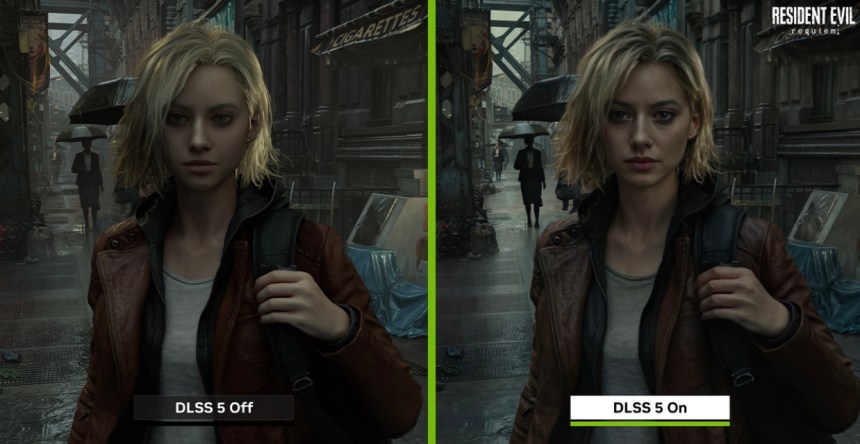
DLSS5’s effects in Capcom’s Resident Evil Requiem (Photo courtesy NVIDIA)
By Tyler Lilly – Staff Reporter
In March, Nvidia revealed DLSS5, a new AI upscaler that is supposed to visually enhance games. However, the announcement has been met with significant backlash. Nvidia has used AI upscaling since 2018, which has, up until this point, mostly been received positively. DLSS stands for Deep Learning Super Sampling, and the technology runs video games at a lower resolution internally, and upscales them to a higher resolution. This increases performance and allows lower end devices to run more complex games. DLSS launched in February 2019, and is currently on the 4th version. DLSS5 is set to release in 2026, but works very differently from previous iterations. Instead of simply upscaling the image, it now puts it through an AI image generator to “improve” the graphics. This comes with several ethical issues associated with generative AI, and also just doesn’t look good.
The AI used to “enhance” the games makes them look completely different, changing the art in ways the developer never intended. Distant textures look deformed in ways that only an AI upscaler can do. Character models look different, especially in facial features. Many people online have noted an uncanny valley effect and have called the technology an “AI slop filter.” DLSS5 is meant to make games look more photorealistic, but it undermines the artistic vision of the developers.
Generative AI has also recently been driving up the prices of hardware, including Nvidia’s own. AI models require large data centers and servers to be trained. This has caused a large increase in demand for RAM and memory components, resulting in price increases. Companies such as Nvidia have been selling their RAM to AI companies instead of their customers or other tech companies. Trying to sell this new technology as a benefit is a slap in the face to their customers and partners because they are actively contributing to making their own products more expensive.
Nvidia has said that the technology will be optional, but there are reasonable concerns that it eventually will not be. DLSS5 is meant to improve visual fidelity, lighting, textures, etc, at the cost of ruining the artistic integrity of a game. If Nvidia pushes their new AI “enhancer” enough, developers might be encouraged to do the bare minimum for their games’ graphics and let AI fill in the gaps. Minimal lighting effects, low-resolution textures, bad models, and more will all be able to be soullessly filled in with AI slop, lacking human touch. Users who choose to opt out would be left with bad-looking games that run poorly.
NVIDIA’s DLSS5 might sound good to someone unfamiliar with gaming and generative AI, but it also could be detrimental to gaming by driving up hardware prices, making games look grossly uncanny, and giving developers room to let AI fill in the gaps of their games, and ironically, decreasing the quality of graphics in the process.
 The Advocate Online