
“TODAY AT SCHOOL WE…”: The Advocate Staff Reports On Their Favorite Daily Learning Experiences
Most of the articles written by The Advocate staff each month focus on Law’s extracurricular activities, sports teams, and student achievements outside of the classroom. But what about the lessons that students are learning in the classroom from 7:20 a.m.-1:58 p.m. every day? This special series – compiled by the Introduction To Journalism and Advanced Journalism classes – takes our readers inside the classroom and answers the age-old dinner table question: “What did you do at school today?”
Thank you to all of the teachers who participated.

(Photo by Jolyne Saludes)
AP UNITED STATES HISTORY WITH MR. LUI
By Breana Aquino – Staff Reporter
Mr. Lui’s AP United States History classes recently learned about President Andrew Jackson and his importance to United States history.
For this assignment, students had to analyze websites, political cartoons, a document, and watch media to gain information about the Unites States’ 7th President. Along with the analyses, students had to take notes and answer questions in regards to the events and ideologies associated with Jackson.
“I want students to be able to take a stance on Jackson as a President,” Lui said. “Whether they view him as a champion of the ‘common man’ or a problematic leader, I want them to support their position with primary sources.”
The purpose of the assignment was to understand the policies of Andrew Jackson and why he was a polarizing President.
“I thought it was interesting how the assignment portrayed Jackson in a bad way and showed him from a different perspective,” sophomore Erik Borowski said. “I learned a different side of Jackson, how he kicked the Indians out of their land and created the Spoils System.”
This specific assignment has been done for the past few years. Lui uses it as an opportunity for students to further their knowledge, yet also practice skills such as reading comprehension for the AP exam.
“It was very informative by including articles about Jackson himself and his ideologies,” sophomore Jolyne Saludes said. “The assignment educated me on people’s perspectives of Andrew Jackson, from the Cherokees to the civilians.”

(Photo courtesy Evelyn Rossi)
CHEMISTRY AND THE EARTH SYSTEM WITH MS. TURCOTTE
Recently, students in Ms. Turcotte’s Chemistry and the Earth System classes have been learning and writing about ionic compound formation.
“When we’re learning how to do formulas for ionic compounds we always have to find the lowest ratio of ions to get the neutral compound,” Turcotte said. “So this is just an activity that gives them another visualization of what that means.”
Students engaged in an activity involving puzzle pieces to form ionic compounds, find the ratios, and learn the correct names and symbols for them. Students considered the activity both fun and informative.
The visualization aspect of this activity definitely aided students in their understanding of how ionic compound ratios can be found with the ion charges that can be found in the top right corner next to the element symbol.
“It’s easy to get confused when you’re dealing with things and forces you can’t see, so seeing the puzzle pieces models definitely helped make the topic more digestible,” sophomore Janelle Dimaya said.
Another student touched on how she thought the activity was fun, and gave the class a chance to move from their seats, and work with their friends.
“It was fun because we got to get up from our eats and move to lab tables, which was a breath of fresh air from our normal ‘pods’,” sophomore Breana Eloise Aquino said.
Overall, the activity was deemed as one of the best yet this year, in terms of information and learning, but also entertainment.
(Photo courtesy Alexandra Oliveira)
ENGLISH 1 WITH MS. KELLY
By Alexandra Oliveira – Staff Reporter
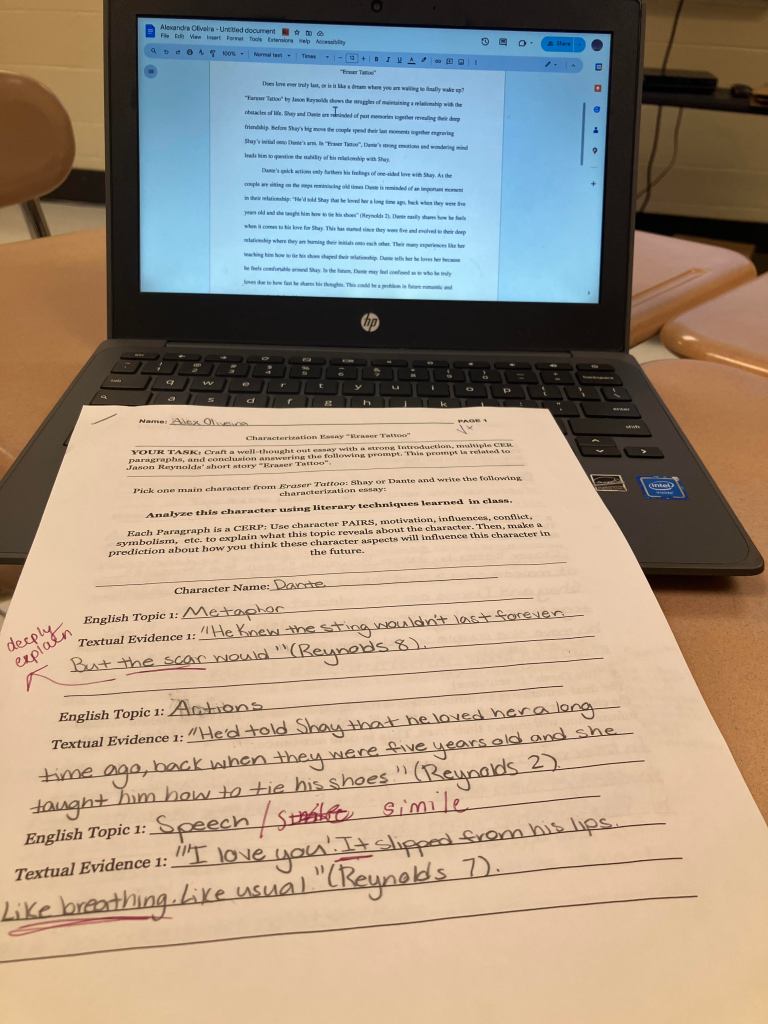
Ms. Kelly’s English 1 class recently used critical thinking skills to understand characters on a deeper level.
Students in Kelly’s class wrote a character analysis essay on Jason Reynolds’ short story “Eraser Tattoo.”
“For our character analysis essay, I wanted students to apply their inferencing abilities to a short story,” Kelly said. “The real world application of these skills will help students to listen, empathize and infer what others mean when they speak to them and interact with them.”
The essay needed to be five paragraphs and include an introduction, three body paragraphs, and a conclusion. Each body paragraph required a claim, evidence, reasoning, and a prediction.
“While I was writing the character analysis essay, I learned how to properly plan and write an essay by using the format that Ms. Kelly gave us,” freshman Delaney Morrin said. “Using what I was taught allowed me to write an essay much easier than I ever could before.”
Prior to writing students found meaningful quotes from the story and planned out their essay. Students shared they enjoyed this step to better prepare themselves for the final draft.
“I did enjoy writing this essay,” freshman Maria Cianciullo said. “My favorite part was probably working on the paper we used to organize and set the essay up and how we were able to get help and feedback in class as we wrote.”
(Photo courtesy Gabby Rodriguez)
SPANISH 3 WITH MRS. MORAZZINI
By Gabby Rodriguez – Staff Reporter
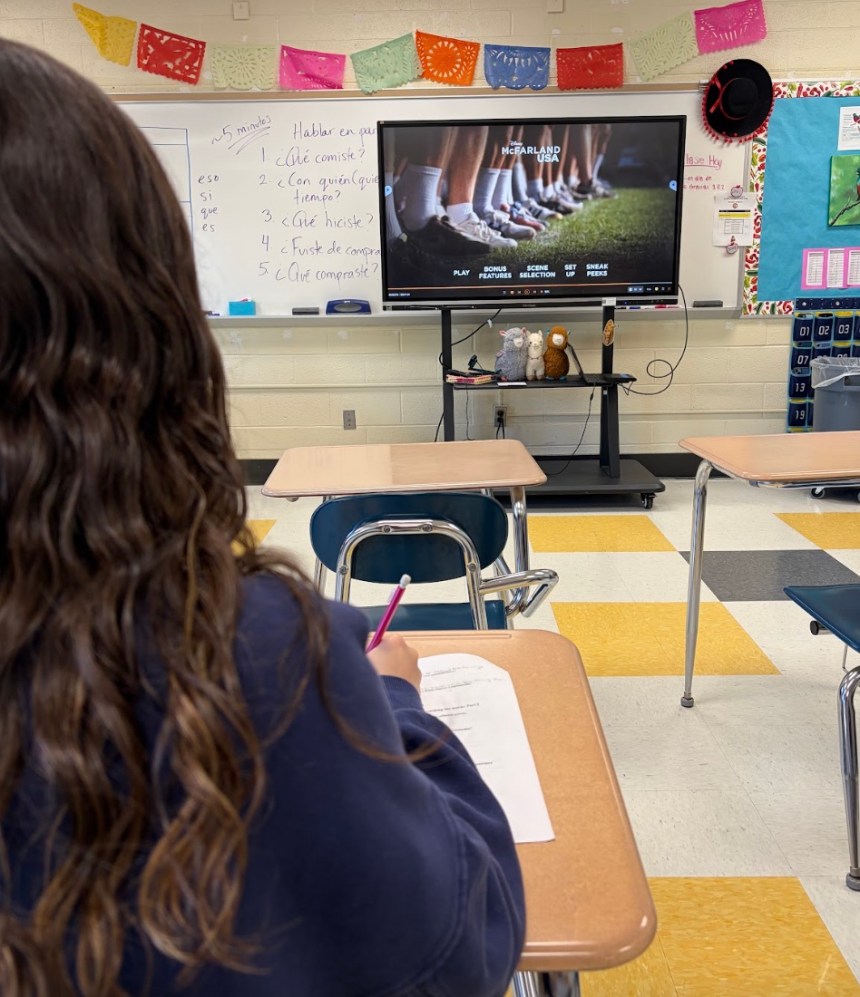
Students in Mrs. Morazzini’s Spanish 3 class recently began watching the movie “McFarland, USA”, diving deeper into the class’ Sports Interaction Unit.
The movie allows students to apply vocabulary and grammar in purposeful ways while adding fun to the curriculum.
“As students watch, they make connections between the story and the content we are studying, particularly the Preterite and Imperfect tenses and vocabulary about athletic competitions, effort, emotions, and personal goals,” Mrs. Morazzini said. “When students are enjoying an activity, it leads to more authentic communication and deeper retention of vocabulary and grammar structures.”
There were similar opinions amongst students since they both enjoyed the movie, and it improved their Spanish acquisition.
“As I’m watching the movie, I see the Spanish translation, which helps me better match the English words with the Spanish ones,” sophomore Hazel Yilmaz said.
Spanish can be difficult, but the addition of the movie helped touch on different Spanish comprehension skills.
“I like it because it helps me see how much I’ve been learning,” sophomore Grace French said. “It also helps my listening skills.”

(Photo courtesy thenewyorker.com)
INTRODUCTION TO JOURNALISM WITH MR. KULENYCH
By Marina Cosmas – Staff Reporter
In Introduction To Journalism, Mr. Kulenych’s students recently watched and reviewed the 1976 film “All The President’s Men” directed by Alan J. Pakula.
Each class watched and filled out a Viewing Guide while watching to get a better understanding of the events in the film. The document was filled with different varieties of questions, ranging from factual to opinionated.
“We watch ‘All the President’s Men’ in Journalism every year because it shows students the power of investigative journalism,” Kulenych said. “It demonstrates the importance of persistence, accuracy, and ethical decision-making in reporting – and the students get to learn a little history about President Nixon and the Watergate scandal along the way.”
Students felt that watching this movie gave them a new perspective on how other journalists work.
“I feel like this movie gave me a better understanding of what is expected as a journalist,” Freshman Teagan Liphardt said. “Especially the language they used in the movie, and the way they asked their questions definitely gave me a better understanding of how I should be writing as a Staff Reporter for the Advocate.”
While the movie review differed from other assignments in the class, students found it enjoyable. Learning how the two lead journalists, Washington Post reporters Bob Woodward and Carl Bernstein, had written their own story showed students how much journalists could accomplish.
“I enjoyed the movie and learning the process of how journalists make their articles using evidence and finding quotes,” freshman Alex Oliveira said. “I would like to do something similar to this assignment again because I enjoyed doing a fun activity, like watching a movie, while still learning something from it.”
(Photo courtesy Sarah Hammad)
THE LIVING EARTH WITH MRS. MERCALDI
By Sarah Hammad – Staff Reporter
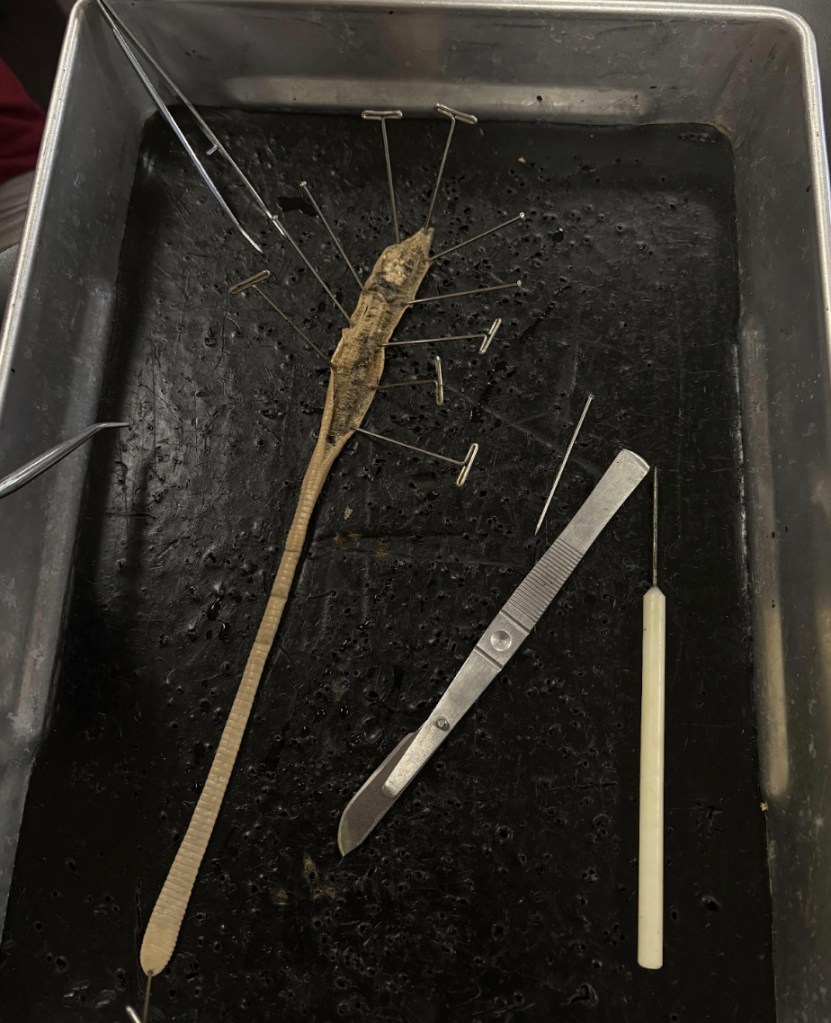
Mrs. Mercaldi’s Living Earth classes conducted a worm dissection in their Science classes around the first two weeks of November.
The worm dissection was the last project the students did to wrap up what they learned about plant and animal cells.
“The Earth worm dissection helps students to create a deeper connection with the structural adaptations that are found in different body systems,” Mercaldi said. “This activity is considered engaging because students need to use tools in order to reveal the different structures which help to refine motor skills and observation skills.”
Since worms don’t have teeth, the gizzard acts as a grinding mechanism to help worms break down their food to a digestible level.
“It was engaging because it was hands-on activity, and let me explore something real instead of just looking at pictures,” freshman Mihika Dabhade said. “I gained a clearer understanding of how a simple digestive system works and why each organ matters.”
Students also learned that worms have five hearts called aortic arches that work in a wave-like rhythm to pump blood from the dorsal vessel.
“The worm dissection was a deep dive into the digestive system and for me, a visual learner, it helped me to picture the process of the digestive system and how it truly worked,” freshman Nadia Cepeda said. “The dissection taught me the different parts of the digestive system and how they work together in the worm, or another living animal.”
(Photo courtesy Tiana Rosiak)
AP LANGUAGE AND COMPOSITION WITH MRS. LUCIA
By Tiana Rosiak – Staff Reporter
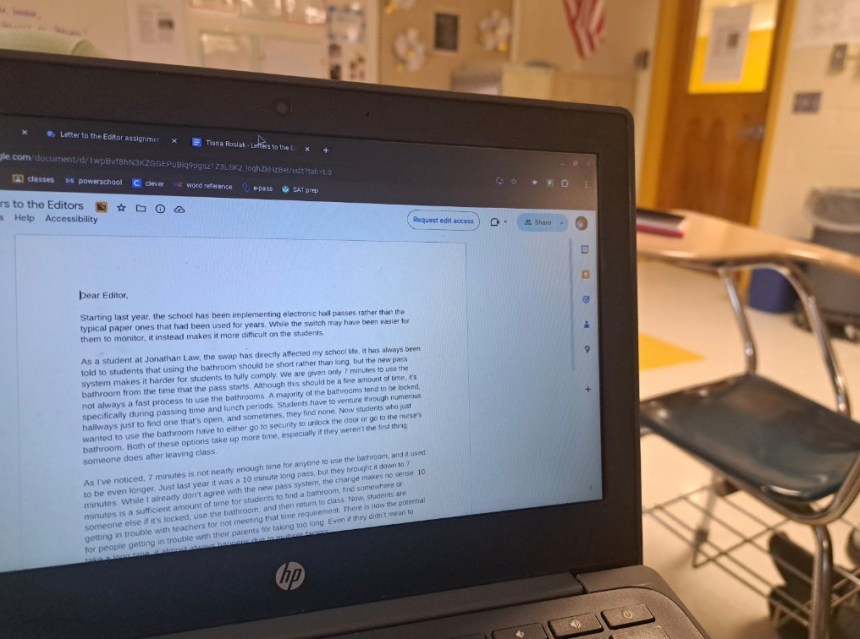
Students in Mrs. Lucia’s AP Language and Composition have been writing their own versions of letters to the editor.
Based on letters containing opinions that get sent to newspapers, the assignment gave students the opportunity to pick a rule or policy from Jonathan Law that they disagree with and write their own letters to explain their side. In addition, students were tasked to combine concepts that they were recently taught.
“My hopes for this assignment are two-fold; the actual point of the assignment is to practice building the appeals of ethos, pathos, and logos,” Lucia said. “But more importantly, in this real-world task, I also hope students work on developing their voice when it comes to situations that matter to them.”
Students found an array of topics within the school that they had a strong opinion about and argue against it. While some chose newer additions into the school, others chose older topics that had been bothering them for a while.
Junior Natalia Alvarado wrote about something she’s passionate about: the newly-changed breakfast policy at Law.
“I did it on the new breakfast policy,” Alvarado said. “It’s unfair to make students wake up even earlier to be able to eat.”
For students like junior Caeley Beattie, the assignment came easy when it came time to write.
“I’m doing it on the girls’ bathrooms and how they’re not all open,” Beattie said. “I feel like the assignment’s relatively easy mainly because I value this issue and I want bathrooms to be more open then they are.”
(Photo courtesy Emma Bonanno)
HUMAN GROWTH AND DEVELOPMENT WITH MRS. RODRIGUES
By Emma Bonanno – Staff Reporter
Mrs. Rodrigues’ Human Growth and Development courses give students understanding on how children grow up throughout life.
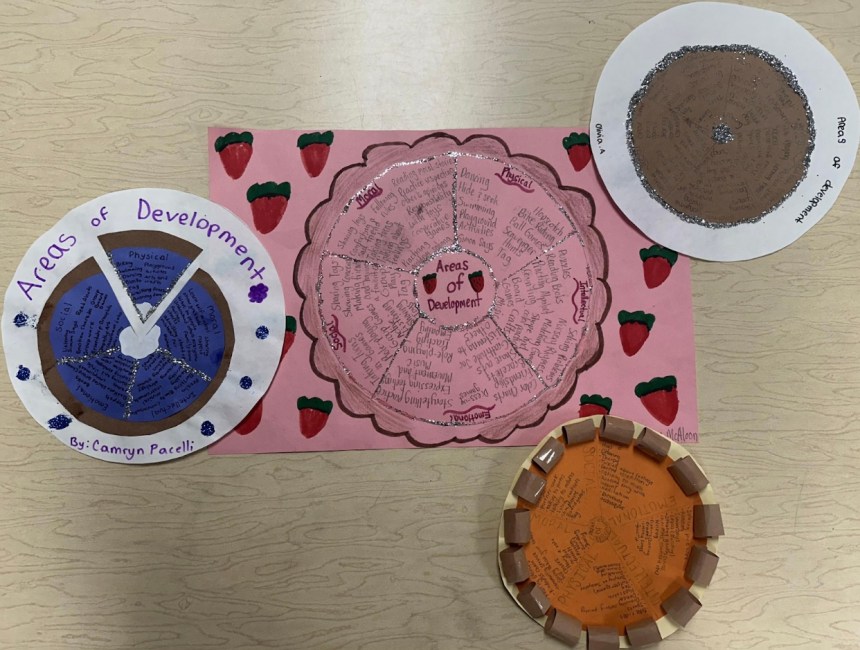
Students recently learned about the five areas of development: moral, physical, intellectual, emotional, and social. They then made a paper pie with specific examples of activities children can do to improve the areas of development.
“The purpose of this project was for students to apply the concepts they learned, the five areas of development: moral, physical, intellectual, emotional, social (M PIES), to the hands-on experience they have with the preschoolers in our program and young children in general,” Rodrigues said. “Through the project, they took their thinking a step further and came up with several specific activities that foster development in each of the five areas.”
This project introduced students to many new aspects that deepened their understanding of the course.
“I learned that there are many different aspects that go into the development of a child,” sophomore Sophia Montini said.
This project proved to be fun and enjoyable for all of the students in class.
“My favorite part of the pies project was being able to research and learn about the different areas of development in a child.” sophomore Giada Siano said.
Many students loved the creative aspect of the M PIES project, finding it to be one of the most engaging parts to the assignment.
“Some of the students took their creativity to levels beyond the expectations, relating the visual they made to the acronym ‘PIES’ and crafting finished products that were full of color and even 3D ‘crust,'” Rodrigues said.
(Photo courtesy Eason Dong)
GEOMETRY WITH MRS. HULL
By Eason Dong – Staff Reporter
Mrs Hull’s Geometry class has been exploring proofs in a variety of ways this year.
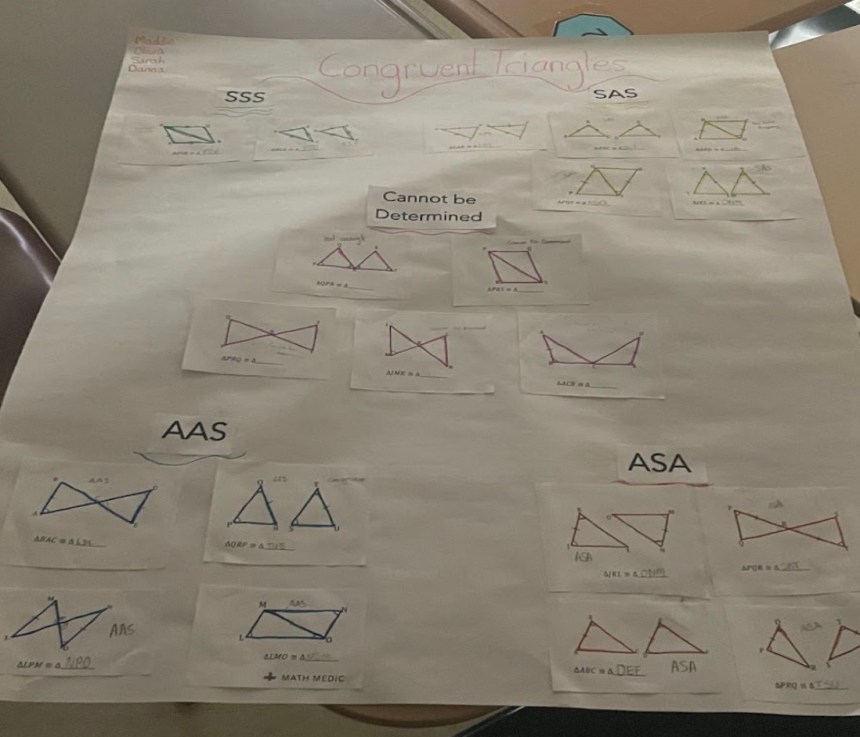
Students were assigned a mini-poster project where students had to organize triangles into their own proof sections. They explored the different ways of triangle congruence through this poster.
“The goal for me when teaching proofs is for students to find a way to organize their thoughts in a way that is convincing and easy for the reader to understand,” Hull said.
Proofs are one of the many challenges that Geometry students have to overcome this year.
“Proofs are not my strongest suit, and they’re hard to catch into, but I don’t mind learning them,” freshman Maddie McAloon said.
Many students start proofs by building on what they have been given.
“When I see a given in the proof, I take use of it, building off of it to try and solve the proof,” freshman Cole Veteri said.
Hull said proofs help students through the use of evidence and reasoning.
“Nowadays, it is very tempting to let the internet and AI do our thinking for us,” Hull said, “And for young adults, justifying your own reasoning and evaluating the reasoning of others are important life skills.”
The goal for Hull is to help students become good at doing proofs by using strategies like being organized and making it so it is easier for students to understand.
(Photo courtesy Kendall Upchurch)
THE LIVING EARTH WITH MR. MORAZZINI
By Kendall Upchurch – Staff Reporter
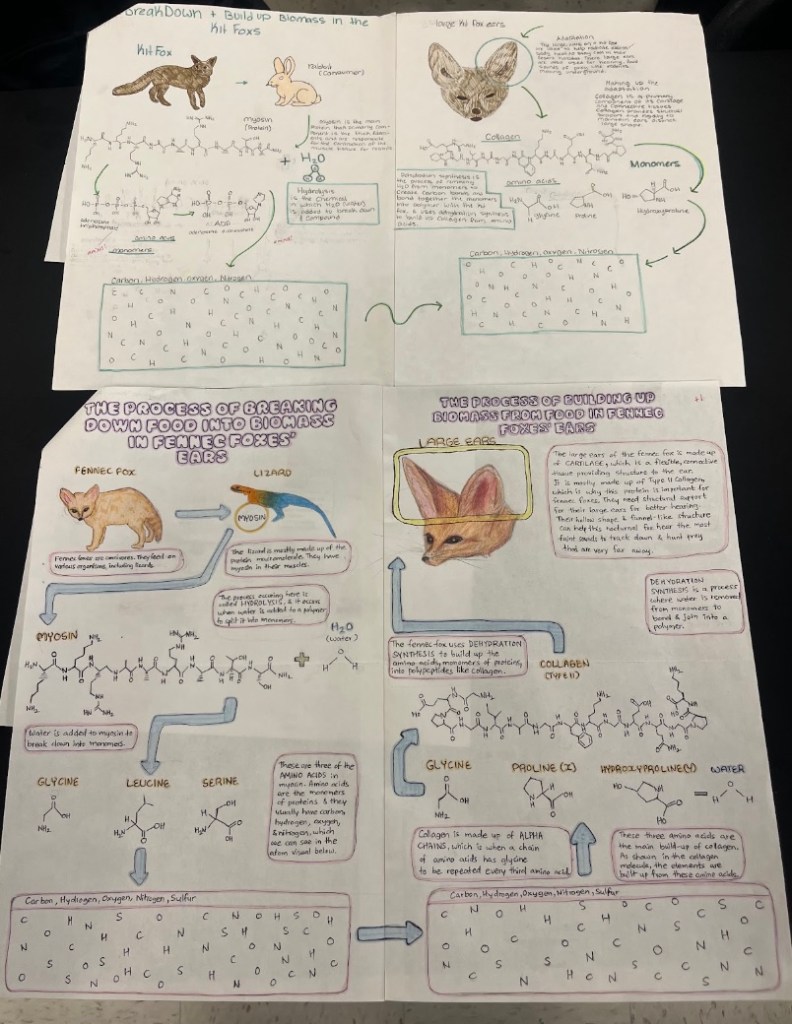
Mr Morazzini’s Living Earth class recently created a building biomass model using a combination of research and poster creation.
Students were given the assignment to investigate how their chosen organism feeds and what specific biomolecules it obtains from its food. Then they modeled or sketched how that food is broken down at different levels.
Students learned a lot from this project – not only about the specific molecules but the importance of the information its self.
“We actually learned a lot together,” Morazzini said. “Some of the information students uncovered was new to all of us.”
This project was a learning experience for each and every student in class.
“For example, one student discovered the specific protein used as a neurotoxin by box jellyfish and connected it to the jelly’s diet and how that adaptation is formed,” Morazzini said.
Some students came across some challenges along the way.
“One thing I found difficult about the project was organizing the poster and setting up all my pictures and information into a neat way,” freshman Alex Oliveira said.
Many students enjoyed making the poster and learning more by researching.
“The biomass project helped me learn a lot about the animal I chose,” freshman Delaney Morrin said. “I learned how animals function and what involved in their physical features. This whole project was very beneficial for me because it helped me better understand the unit.”
(Photo courtesy Fiorella Gargiulo)
HUMANITIES WITH MR. ZURAW AND MR. GIANGREGORIO
By Fiorella Gargiulo – Social Media Editor
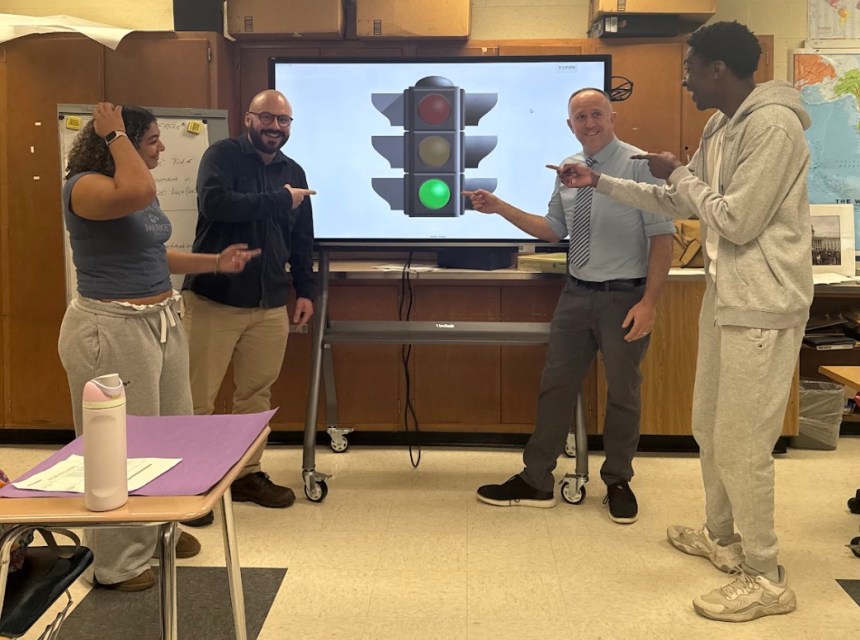
Mr. Zuraw’s and Mr. Giangregorio’s Honors Humanities class has begun the process of creating mini-documentaries, highlighting the various subcultures present within and beyond Law’s community.
Students were recently introduced to the project and have begun proposing the thesis and research question for their documentary. Using T-Sheets, students were instructed to record their plans for the audio and video portion of this assignment.
Zuraw, a History teacher, believes that student-made documentaries are a great way to inform the class on different subcultures and get them thinking deeper about what culture they are a part of.
“Students gain a deeper understanding about subcultures when they have to investigate one and create a documentary on it,” Zuraw said. “It forces them to take the concept of a subculture, and turn it into an observable reality in the form of a documentary that they have to create.”
Giangregorio, an English teacher, aims to enlighten senior students on how to analyze news and gain a deeper perspective of the evolving world around them.
“We hope that Humanities helps students think critically about the world around them,” Giangregorio said. “We’re constantly bombarded with information, so it’s more important than ever to learn how to find the right information.”
Senior Nadia Nuzzo plans on informing peers on a subculture she is a part of in her documentary.
“My documentary is going to be used to show the relationship between offense and defense in Powderpuff,” Nuzzo said. “This documentary will show what a practice looks like, as well as how our coaches and players felt throughout the two weeks.”
Senior David Guery has already gained a multitude of knowledge in Humanities, even only after a few months of class.
“My Humanities education has taught me to thoroughly analyze and compare different perspectives before concluding,” Guery said. “For example, when we were watching an O.J. (Simpson) documentary, from what I’ve heard from my peers, I had the impression he didn’t do it, but after really seeing multiple documentaries, I now think it was very likely that he did, in fact, do it.”
(Photo courtesy Teagan Liphardt)
SPANISH 2 WITH MRS. TROMBETTA
By Teagan Liphardt – Staff Reporter
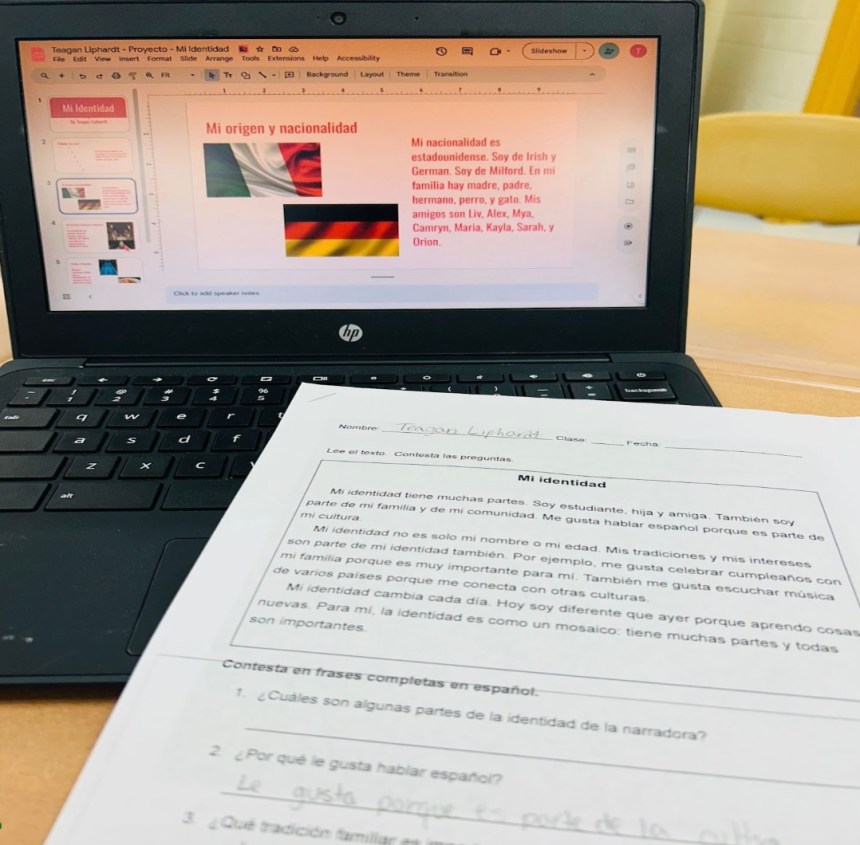
Mrs. Trombetta’s Spanish 2 class recently worked on a project called “Mi Identidad.”
Students were instructed to create a short booklet or digital project about themselves using vocabulary they have been learning and using in class.
“The goal of creating a Spanish project about students and their identities using thematic vocabulary was to help students express who they are in Spanish in a meaningful and authentic way,” Trombetta said.
This project helped students learn new terms in Spanish as they used new vocabulary about my identity in the presentation.
“My favorite thing about the assignment was that I got to explain things about myself. I like that we are able to express ourselves with this by sharing our family’s history and what we like to do,” freshman Gabe Roberto said.
Students had a great time being creative plus using the Spanish vocabulary they learned in class and applying it to their project.
“This project helped me learn new terms in Spanish as I used new vocabulary about my identity in the presentation,” freshman Alex Oliveira said.
Trombetta hoped the assignment helped students improve their vocabulary.
“By using vocabulary related to identity, such as personality traits, interests, family, culture, and daily life, students practiced communicating real information about themselves while building confidence with the language,” Trombetta said. “The project encouraged them to make personal connections, use Spanish creatively, and understand how identity can be described and celebrated in different cultural contexts.”
(Photo courtesy Mihika Dabhade)
WORLD HISTORY WITH MRS. BRADFORD
By Mihika Dabhade – Staff Reporter
Students in Mrs. Bradford’s World History class recently completed a simulation explaining the causes of the French Revolution.
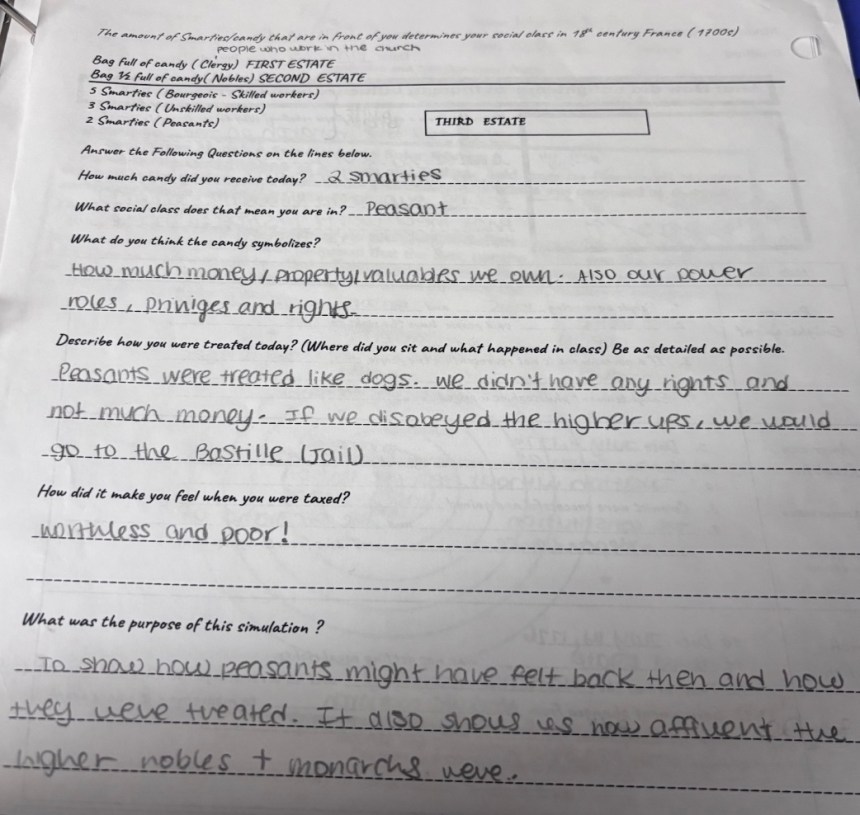
The activity helped students experience what life was like for the Third Estate and understand the unfair treatment of peasants that pushed people toward rebellion. The simulation placed students into different social classes and gave each group rules based on pre-revolutionary France.
Peasants dealt with extra work, sudden punishments, and strict limits. This helped students see how difficult daily life was before the revolution.
“It was meant to show the inequality and the treatment of finance, economy, and taxation in pre-revolutionary France,” Bradford said. “I wanted them to understand the conditions that led the Third Estate to revolt and remember the major causes of the French Revolution: taxation, poor treatment, inequality, and arbitrary arrest.”
Students said the hands-on activity made the lesson more memorable and meaningful.
“We can talk about it forever, but until you actually experience something similar, you can’t understand how frustrating it was,” freshman Olivia DeSimone said. “It also made me realize how fortunate we are today.”
Classmate Madison Sears shared a similar reaction to the experience.
“People were punished and banished for no reason,” Sears said. “Being treated like a peasant helped me put myself in their shoes and understand how rough that time was.”
The simulation helped the class connect more deeply with the causes of the French Revolution and the struggles faced by everyday citizens.
(Photo courtesy Ryan Woods)
U.S. HISTORY WITH MR. BATSON
By Ryan Woods – Staff Reporter
Mr. Batson’s U.S. History class is learning about the Spanish-American War through videos and projects.
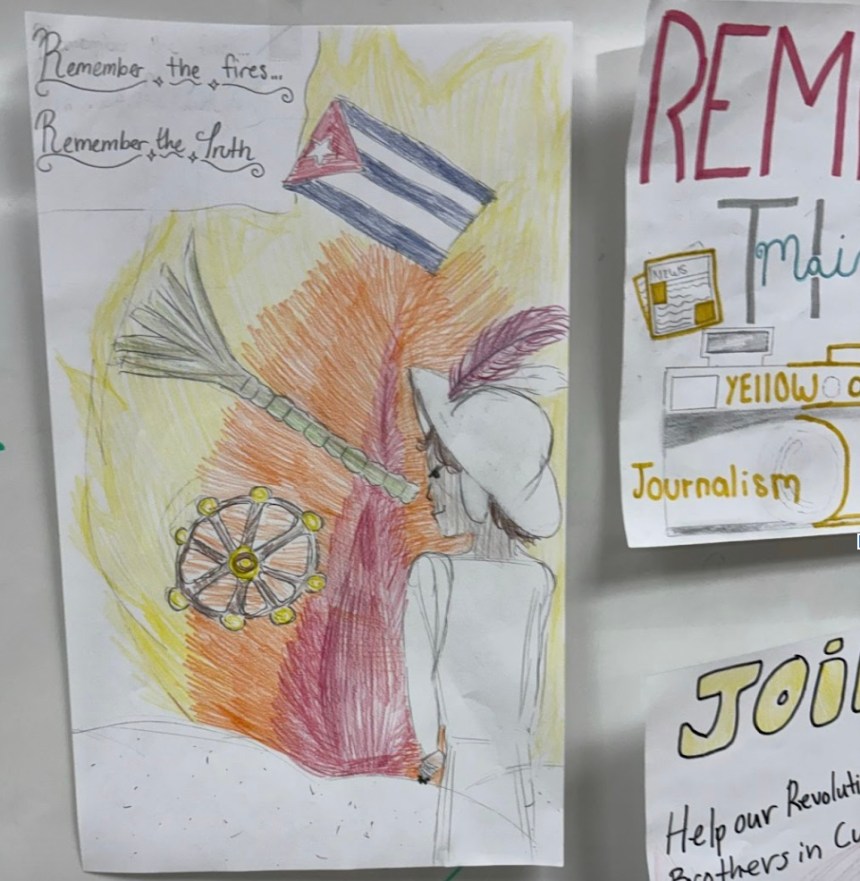
Students were assigned to make a propaganda poster about the three main causes of the Spanish-American War and then presented it to the class.
“This war, along with Imperialism, is what really catapulted the United States onto the world stage,” Batson said. “After this war, is when the United States went from mostly focusing on just domestic affairs to becoming involved in world affairs. The rest of the world realizes we are a major player, and albeit we are challenged a few times the United States rises to the challenge.”
The goal of this assignment is to learn the outline of this war without going into greater detail.
“My favorite part of the propaganda poster assignment is working in groups and being able to be creative and make something unique,” sophomore Connor Ryan said.
Working on this poster helped students understand what people had to go through during this time.
“It was fun to do and I learned a lot from it,” sophomore Aaryan Doshi said. “I liked how we were able to do our own thing and not have to follow and guidelines or rules, which made it a lot more fun and interesting.”
(Photo courtesy Molly Lynch)
ADVANCED CREATIVE WRITING WITH MR. HEALY
By Molly Lynch – Editor-In-Chief
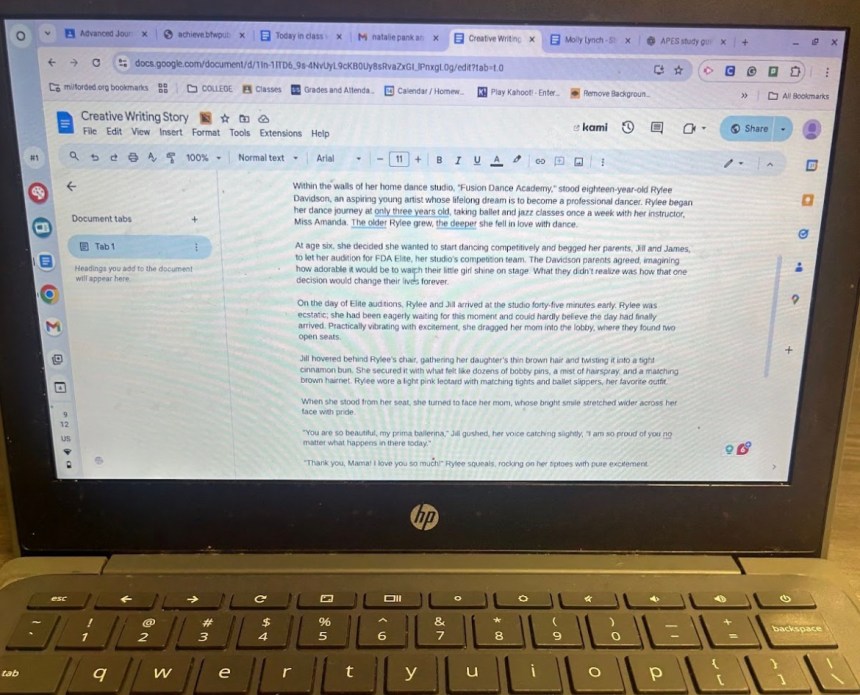
Today, in Mr. Healy’s Advanced Creative Writing class, students spent the period continuing to write their first round of short stories.
Healy introduced this assignment at the end of October, and since then, his classes have consisted of using the period to work on our stories. Since we have been working on this assignment for a few weeks now, students are all at different points within their stories and are all working towards new goals each class.
“The main focus of this assignment is to be your first test as a creative writer who wants to be published,” Healy said. “We’ve done lessons on all the basic components of stories, we’ve read short stories, and now it’s your turn to try your hand. Having taught this class for years though, the real purpose of it is to see what you can do; it’s for us to see where your strengths and weaknesses are.”
Healy explained how all of the lessons he has taught so far came into play within this assignment. He crafted an agenda that perfectly aligns all of the mini lessons with this big assignment which allows us students to have a clear understanding on what to do without any hesitations or confusion.
“I think this assignment is beneficial for me because it really helps me push my limits as a writer,” senior Ciara Tavarez said. “Before this class, I was unable to finish any poem or story I wrote. Now with this structured environment, I am able to fully plan and meet the deadlines.”
This assignment gives students the opportunity to work independently on their stories while also using Healy’s guidance to help keep themselves on the right track.
“My favorite part about the process that we go through in class is that we are given free range to come up with our own ideas and concepts,” senior Natalie Pank said. “There isn’t a formula we need to follow or a word count that we need to reach. We get to write stories until we the writers feel like they’re complete.”
(Photo courtesy Delaney Morrin)
WORLD HISTORY WITH MR. DOOLEY
By Delaney Morrin – Staff Reporter
Mr. Dooley’s World History class has been working on projects about the French Revolution.
Each student was assigned an important event from the French Revolution or from Napoleon Bonaparte’s life. Dooley finds that this project connects to what students previously learned about the Enlightenment.
“It kind of rounds up what we learned previously from the Enlightenment, seeing Enlightenment ideas put into action,” Dooley said. “So it’s kind of a two fold, moving forward with the French Revolution and pulling in ideas from what we learned in the last chapter.”
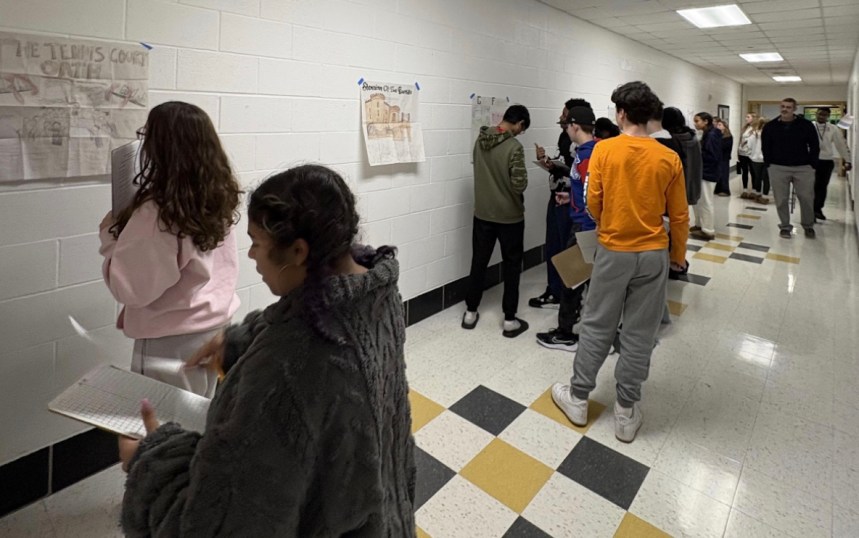
This project was assigned to students to learn about French Revolution events in depth. Once students finished their project, classes did gallery walks with worksheets to learn about events their classmates worked on.
“This project helped me better understand the time period of the French Revolution, specifically my event which will help me prepare for future tests and assignments,” freshman Alexandra Oliveira said.
Students worked on a worksheet that was based on the questions that students answered on their posters. This worksheet allowed students to learn about more events than just their own. This gives students a better understanding of the unit, which will be very important for upcoming tests and the midterm.
“This project helped me understand what we are learning because the research and organization needed for the project caused me to retain information better,” freshman Maria Cianciullo said. “Personally, projects can help me remember what I learned better than having it spoken to me.”

(Photo courtesy Dani Kotanksy)
AP GOVERNMENT WITH MR. ZURAW
By Aislyn McKernan – Social Media Editor-in-Chief
Mr. Zuraw’s AP Government class has been learning how a bill turns into a law by creating fun projects to explain the process.
Students were assigned to choose a way to present the process of how a bill becomes a law. Some of the options were to create a board game, a podcast episode, a poster, and more. Students got to pair up and use their creativity to explain how this process works.
“I assign this project so students can have a choice to demonstrate what they know and gain the necessary knowledge for the AP test,” Zuraw. said “ It allows them some flexibility and an opportunity to be creative as well.”
Students could choose a specific bill to demonstrate its path to becoming a law, or they could give an overview of how any bill can get passed. It also talks about different parts of the government and their role in this task.
“This project helps me learn more about how the government works and what steps are needed to be taken in order to pass bills or laws,” sophomore Isla McKeand said.
This project clearly demonstrates the necessary steps for how a bill becomes a law and also encourages students to work together and explore new ways to express the information they learned. Students were very receptive to this project because of the creative freedom they gained.
“I like this project because I am able to learn the information in a fun and engaging way,” junior Julia Scibek said. “I am creating a board game for this project, and it has been a fun, new, and creative way to work.”

(Photo courtesy Dani Kotansky)
FRENCH 3 WITH DR. EVANS
By Dani Kotansky – News Editor
In French 3, Dr. Evans’ students learn French language and culture through fundamental topics such as different tenses are taught alongside fun vocabulary like food and special holidays.
Recently, the focus has been on shopping at a market, and creating a script using the past tense to describe your trip. The script will eventually be used in a video project to demonstrate understanding of the vocabulary and create an engaging video product.
“Ultimately, after being revised, added to, and polished, students will use the script to voice over a digital project about their experiences at a market, their food preferences as children, and a meal at a restaurant,” Evans said. “For now, students are gathering up information and being exposed to fresh ideas and inspiration through class activities (watching a Netflix show about a French chef, playing bingo with food vocabulary, learning/being assessed on expressions that will help them speak and write more fluently about past events, reviewing how to form the two past tenses, studying additional vocabulary related to food, learning new useful verbs, etc.).”
The script has only been written in class and without technology, so it is the personal work of every student. Sophomore Peyton Kondor felt the script benefitted her learning about real French living and culture.
“The French script has helped me to understand both the French language and culture better as a whole,” Kondor said.
Sophomore Emma Ciccarelli has enjoyed the process of this in class project.
“Making this script has been a fun experience that has allowed me to use what I have learned in a new way,” Ciccarelli said. I am also really looking forward to starting the video portion of the project soon.”
Overall, Dr. Evans believes her students will be proud of their final video product.
“This project will hopefully remind students that language learning is much more about process than product, and will encourage them to put together all of the disparate pieces they’ve been introduced to in order to create one cohesive, creative, personalized digital story,” Evans said.
(Photo courtesy Logan Thomas)
BAKE SHOP WITH MS. RYAN
By Henry Smith – Sports Editor
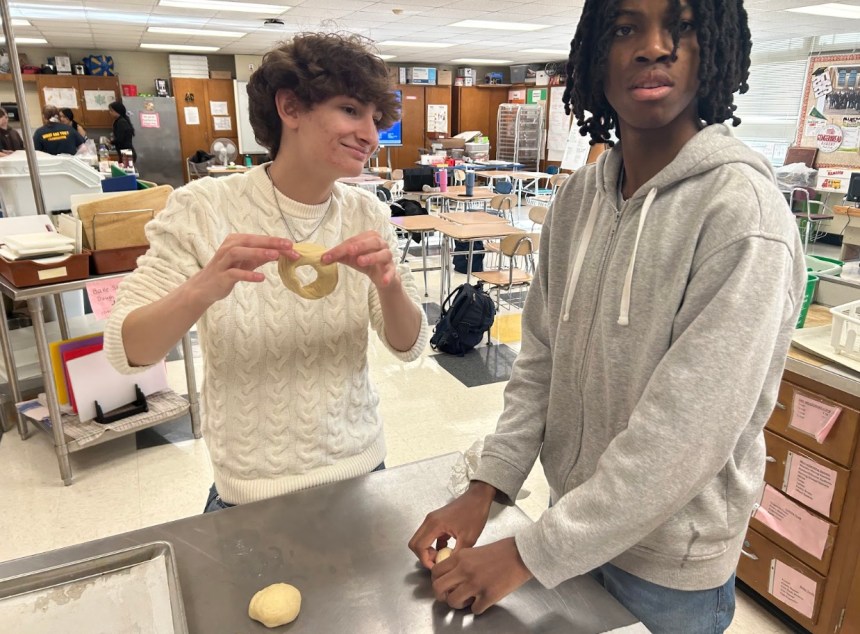
Students in Ms. Ryan’s Bake Shop class recently made bagels.
The students spent three days working through each stage of the bagel making process, from preparing dough to shaping and boiling before baking.
“I enjoy teaching the bagel making assignment because it builds upon our yeasted dough experience,” Ryan said. “It’s fun to see the transformation from the various stages in completing the bagels.”
Students enjoyed the hands-on process and the freedom to personalize their work.
“I like the way we got to choose what type of bagels we made,” junior Omari Burton. “They were really good.”
Students in the class enjoyed working together and seeing how everyone’s bagels turned out. They liked sharing the experience with friends while making their own creations.
“I enjoyed working with my friends and seeing how everyone else’s bagel turned out,” junior Tyler Medvegy.
Students learned why their texture and flavor differed in the bagels from standard bread.
“Bagels are technically yeasted bread, but students get to learn why the texture and taste differ from standard bread,” Ryan said. “Since the dough has to be proofed twice, it takes us three days to complete this assignment.”
(Photo courtesy Cora Aitkenhead)
ANTHROPOLOGY WITH MS. HEALY
By Cora Aitkenhead – News Editor
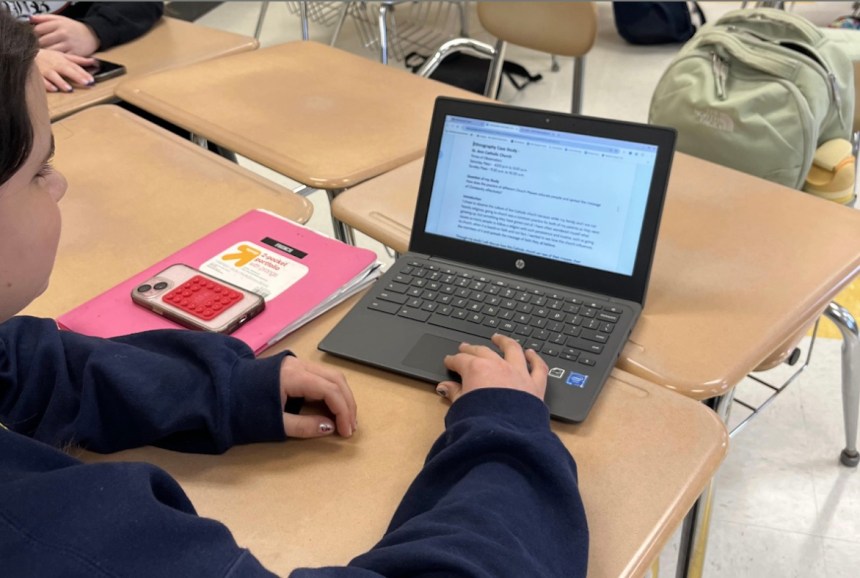
Students in Ms. Healy’s Anthropology class learned about behaviors and practices of different cultures through completing an Ethnography case study on a culture of choice.
Each Anthropology student selected a culture they are unfamiliar with, or does not associate with a part of their daily routine. Students then chose a destination where they would conduct multiple one hour observation studies on the behavior in that location demonstrating the culture they chose, and further writing a case study comparison on the cultural behavior in their location.
“That project was a way for students to get familiar with the process of anthropology and observing culture. You had to go to a different setting and just observe your surroundings very intentionally,” Healy said. “It’s also a great way to reflect on your experiences and make you think about what you’re observing and why.”
A key factor in the students’ observation instruction was to remain impartial, and not consider pre-notions as an influence in the observations they were collecting.
“My biggest takeaway from the project is that it is important not to compare other cultures to your own when observing them,” senior Lilly Olmstead said. “A challenge I faced was taking objective notes, but overall, learning about a new culture was interesting.”
Another key instruction in the study was to purely be an observer, permitting students from interacting with others or being an influence on the environment.
“My study was pretty difficult, as I did want more social behavior, like conversations or even brief passerby moments of a good afternoon. But I didn’t get that,” junior Caeley Beattie said, “I did get lots of cars passing by, though it was not conversational; it was observable.”
Students concluded their studies with a small presentation of their data, and a cross-culture comparison between the culture they studied, and the culture a classmate studied.
(Photo courtesy Logan Thomas)
ENGLISH 2 WITH MS. SMUNIEWSKI
By Logan Thomas – Entertainment Editor
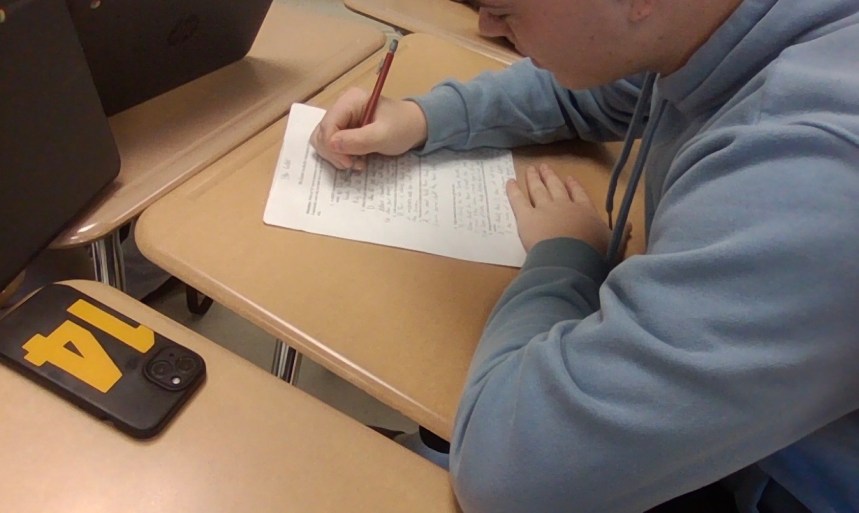
English teacher Mrs Smuniewski recently conducted a fun classroom activity of Agree or Disagree, also known as an Anticipation Guide, on life morals.
The assignment started debates throughout the class. It also helped the students grasp a better understanding of a new unit and a new story.
“I like to do these before we begin a new book because the activity allows students to take a stance on debatable statements, and the statements expose them to key ideas that they’ll see in the book,” Smuniewski said. “It’s fun to hear the different opinions that exist in the class, and I also enjoy that it gets kids up and moving; it’s a nice change of pace from group work or individual work.”
During the activity, students talked about life morals that related to a new story that they will be reading. They used debating skills during class which helps there argumentative skills.
“During class, I really enjoyed the Anticipation Guide because it helped me get a better understanding on the new unit,” sophomore Dylan Gaillard said. “We also had fun debates with other classmates.”
On a piece of paper, students wrote whether they agree or disagree with each moral. They then wrote a reason or two why they think this way, then used this knowledge in the debates.
“In the activity we had a great discussion wth everyone about why we agreed or disagreed with each moral,” sophomore Reid Moulton said. “All of the conversations were about life and how everyone should live.”
(Photo courtesy Abigail Merenda)
ENGLISH 3 WITH MRS. ROUMELES
By Abigail Merenda – Sports Editor
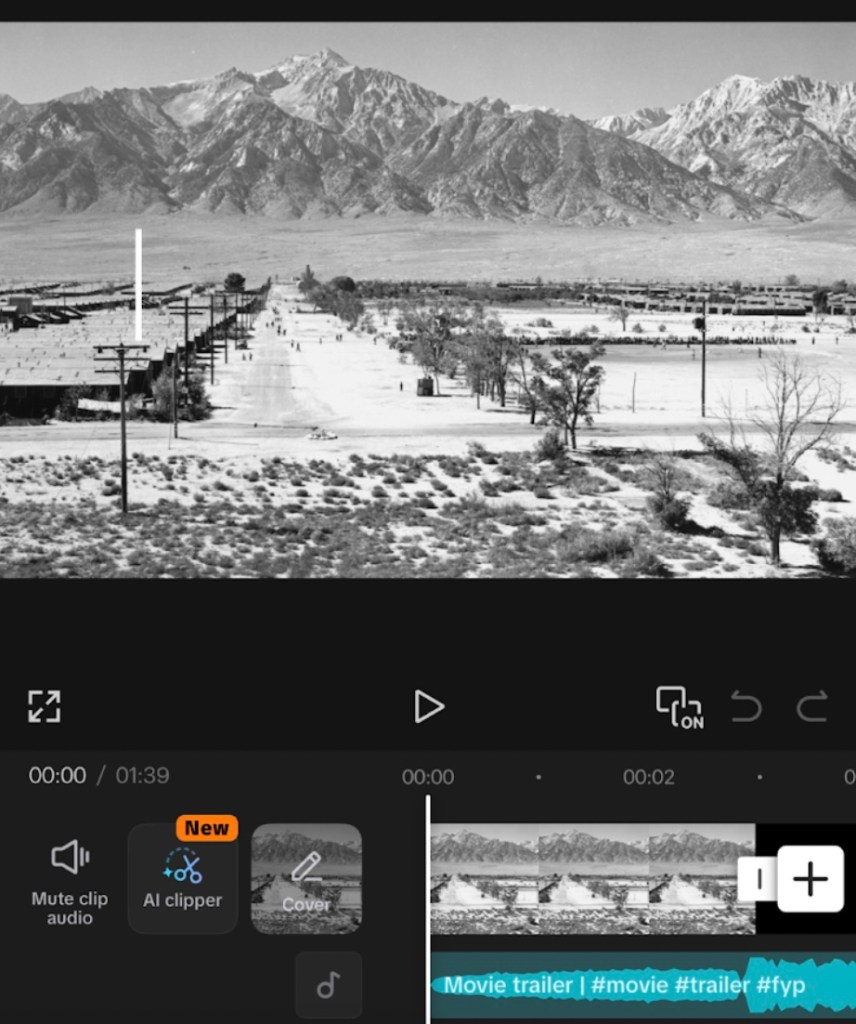
Mrs. Roumeles’ English 3 classes recently created movie trailers for their Book Clubs.
Each class was separated into different Book Clubs and after four weeks of reading, they were assigned to summarize their books into a movie trailer using WeVideo or Capcut.
“The purpose of the movie trailer was to have students work collaboratively with a common text,” Roumeles said. “It also allows students to showcase the entire novel experience, engage and challenge students with the use of technology, compare and contrast with their peers and evaluate the product (extra credit for highest number of votes) and to create something fun and entertaining.”
Students had very positive feedback about this project.
“I think this project was a fun way to end our book club,” junior Courtney Russo said. “I think competing with our classmates was a fun challenge.”
Junior Matthew Witteman also thought this was a unique project.
“I thought it was a fun and a unique way for us to do a project on a book,” Witteman said.
(Photo courtesy Dylan Gaillard)
ALGEBRA 2 WITH MR. FRANK
By Dylan Gaillard – Sports Editor
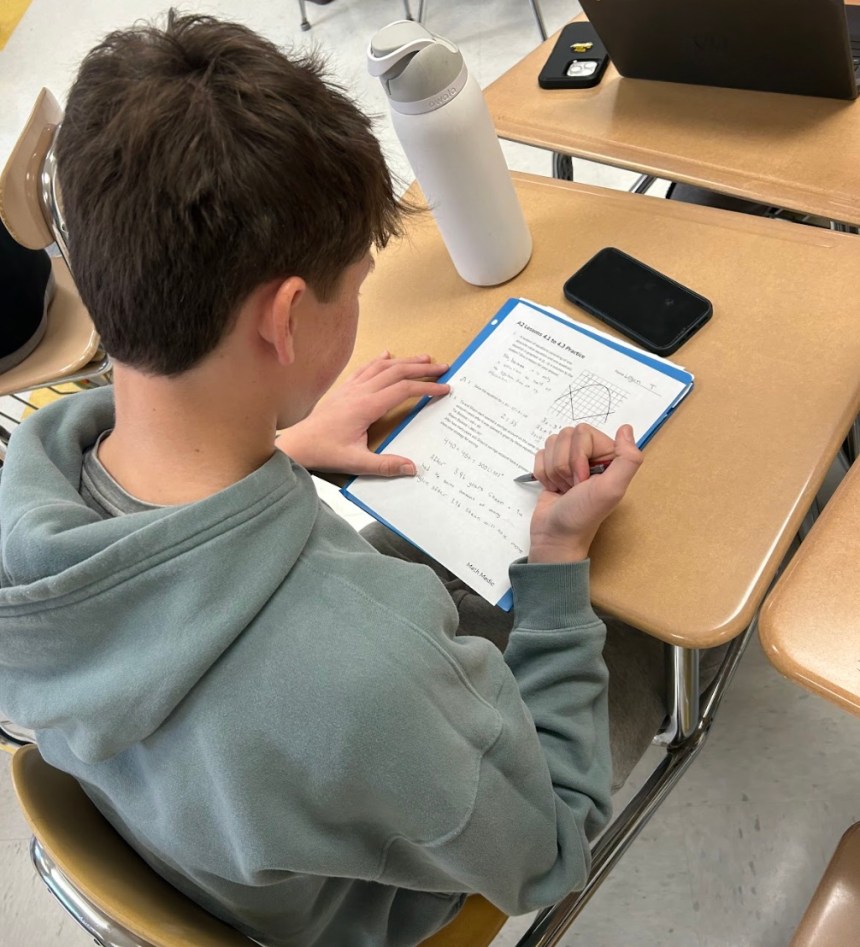
Students in Mr. Frank’s Algebra 2 class are learning strategies for solving equations and nonlinear systems.
Frank has ambiguous goals for his students. He wants his students to find the answers to difficult math problems but also to understand the context of the problem.
“A goal I have for graphing assignments is for my students to be able to find solutions of nonlinear systems using graphs and to be able to explain the meaning of the solution in context of the problem,” Frank said.
Students are using critical thinking while learning and solving these problems.
“We work on some challenging math equations and graphing problems, and we also use different tools like the calculator and Desmos to learn,” sophomore Logan Thomas said. “We also write lots of notes that are helpful in the future.”
Students in Frank’s class have to work through difficult assignments, but they use the strategies they learn and get through them.
“In class, the topics we learn are very difficult sometimes, but the strategies we learn during class really help and make the questions make sense to us,” sophomore Arthur Rossi said. “Sometimes we find hard questions, and Mr. Frank always helps us get to the answer.”
(Photo courtesy Jackson King)
SPANISH 4 WITH MR. MCPARTLAND
By Jackson King – Staff Reporter
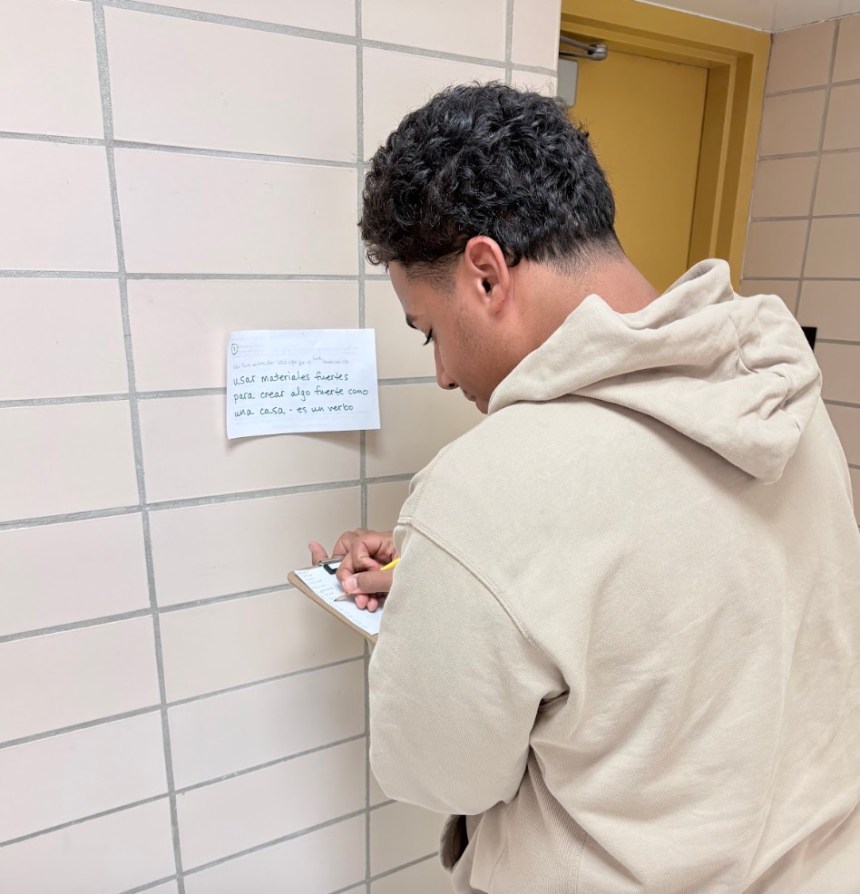
Mr. McPartland’s Spanish 4 class recently participated in a different kind of lesson when they headed into the hallway to practice our new vocabulary words.
Students walked up and down the hallway to read 15 different descriptions of vocabulary words that were written by their classmates.
“This activity focuses on a skill called circumlocution, which is the ability to work around a word you don’t remember how to say,” McPartland said.
At each stop on the walking tour was a clue, and students needed to match each passage to the correct vocabulary word from our new unit.
The lesson started with the class’ daily “Pregunta del Día,” which is a warm-up question in Spanish. After students answered it, McPartland explained how the hallway activity worked. Students grabbed clipboards, papers, and pencils and headed out into the hallway.
“It helped me understand the words better,” junior Evan Esposito said. “It made the lesson more fun and easier.”
When students finished going through all 15 passages, they went back into the classroom to check their answers. They talked as a class about which passages were confusing, which ones were easy, and why certain vocabulary words fit each situation.
“It felt like a scavenger hunt,” junior Colin Scibek said. “Honestly, it helped me remember the words a lot more.”
(Photo courtesy Adrian Vitale)
PERSONAL FINANCE WITH MRS. ISRAELITE
By Adrian Vitale – Social Media Editor
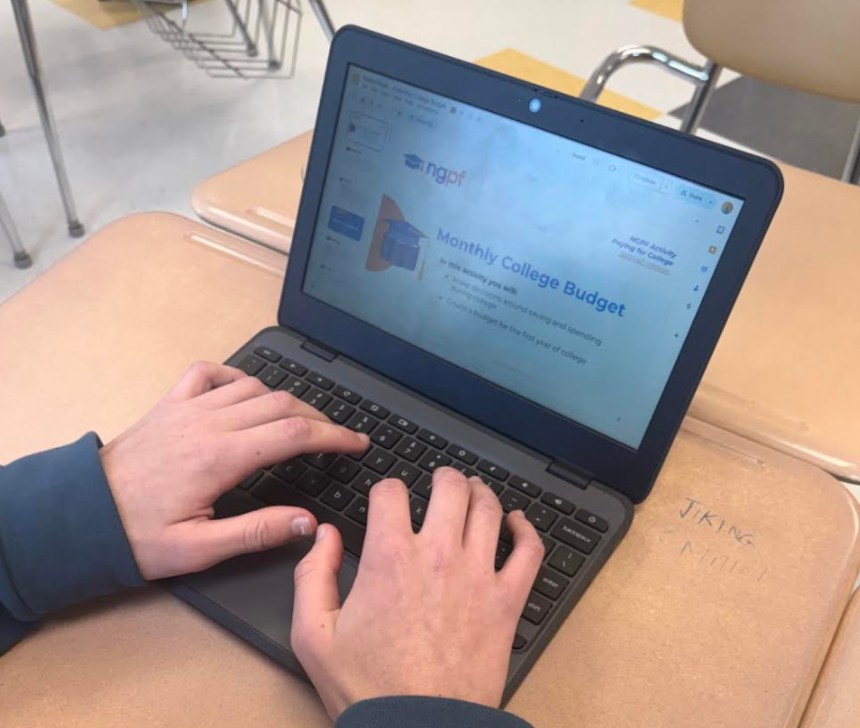
Mrs. Israelite’s Personal Finance class has been looking into options of paying for college and budgeting for it.
Students were assigned a Google Slideshow and a worksheet to make a monthly budget for college based on a decision they picked from the slideshow. The slideshow calculated how well students budgeted.
“I assigned the monthly college budget activity to help students see the budgeting choices and processes they might use to manage their finances in the future, as well as the opportunity costs of those choices,” Israelite said.
The goal of the assignment was to help students with some decisions they might make in the future.
“The lesson was valuable for me, as it taught me about the reality of budgeting for college, and gave me an insight into it,” sophomore Fiad Rahman said.
By doing this assignment, students learned about the reality of budgeting for college, and how to do so well.
“It was helpful for me as a person, and I will surely look back on this in the future,” sophomore Jackson Nichols said.
(Photo courtesy Ava Grippo)
AP HUMAN GEOGRAPHY WITH MR. ROUMELES
By Ava Grippo – Entertainment Editor
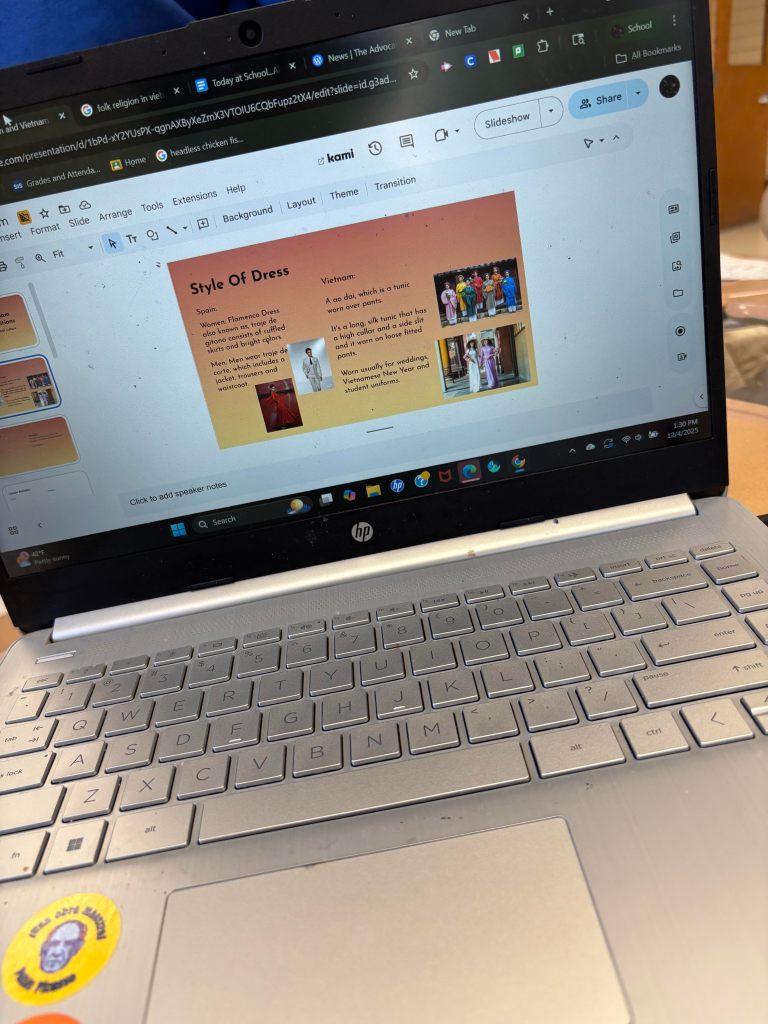
Mr Roumeles’s AP Human Geography class recently started a new assignment called The CCS Culture Project.
This project consists of students using their two assigned countries, one developed and the other developing, and creating a slide show describing the Indigenous traditions of each country, a one-pager about how global culture has affected them, and lastly, a project or ‘artifact’ that combines the two countries together.
Students will have 2-3 minutes to present their work.
“It is important for us, who live in a very global world, to understand that each point on the earth is a very unique space and by looking at these two different countries we start to realize that the earth is a very diverse place,” Roumeles said. “This project helps highlight that.”
Sophomore Sam Mayugba said the project has been fun and interesting.
“It’s cool to explore and research about the developed and developing countries,” Mayugba said. “I also really like the artifact idea of the project. I think it’s going to be nice seeing what everybody decides to come up with.”
Sophomore Allyson Arevalo plans on learning about many different aspect of her assigned countries.
“I hope after the project I have a good understanding of my developed and developing countries’ cultures and how other factors impacted their indigenous cultures,” Arevalo said. “I was thinking maybe combining traditional house structures together as one for my artifact.”
(Photo courtesy Tyler Lilly)
CIVICS WITH MR. LUI
By Tyler Lilly – Staff Reporter
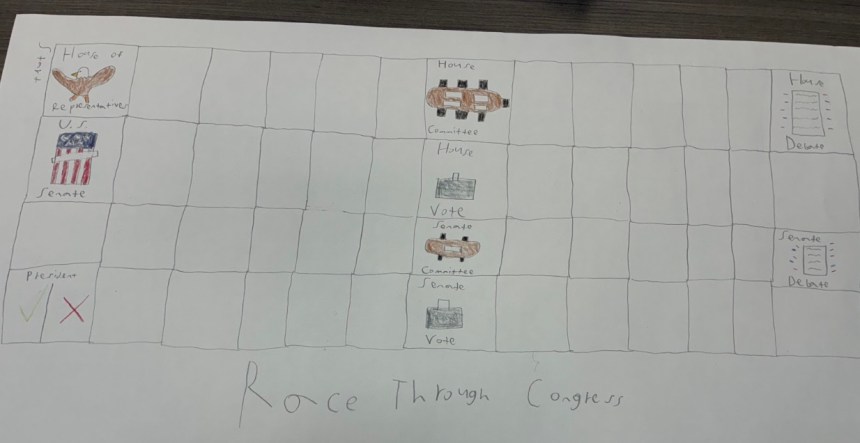
Students in Mr. Lui’s Civics class were tasked with creating a board game demonstrating the process of bills going through Congress.
The class had multiple days to make a board game that has a bill go through both the House and the Senate, and be signed by the President at the end. Students could use cards in their games as well as dice.
Another requirement for the project was to use 20 vocabulary words either on the board, cards, or directions.
“I did it the last couple years because it gives a lot of students a lot of choices as to how they want to display their knowledge of the process of how a bill becomes a law,” Lui said. “They can use the board game to show their creativity and a thing that teachers like doing is student choice, and they do a lot of choices on how they want to display their knowledge”.
After the games were finished, students took a day to test them to make sure they worked as intended, made changes, and then played them as a class the next day.
“My favorite part about the project with Lui is probably how we get to work on it with our friends and working with everyone else can help bring togetherness and make it easier,” junior Christopher Rivera said.
After the games were played, students filled out a reflection form asking whose game they played and what they liked about it.
“I enjoyed crafting the project and putting it all together,” junior Jocelyn Dimes said. “Creating the directions was very interesting and I liked the challenge of fitting the vocabulary words into it.”
(Photo courtesy Courtney Russo)
By Courtney Russo – Social Media Editor-In-Chief
Mrs. Bouchard’s Physics of the Universe class has been learning about force and collisions through a combination of different labs and assignments.
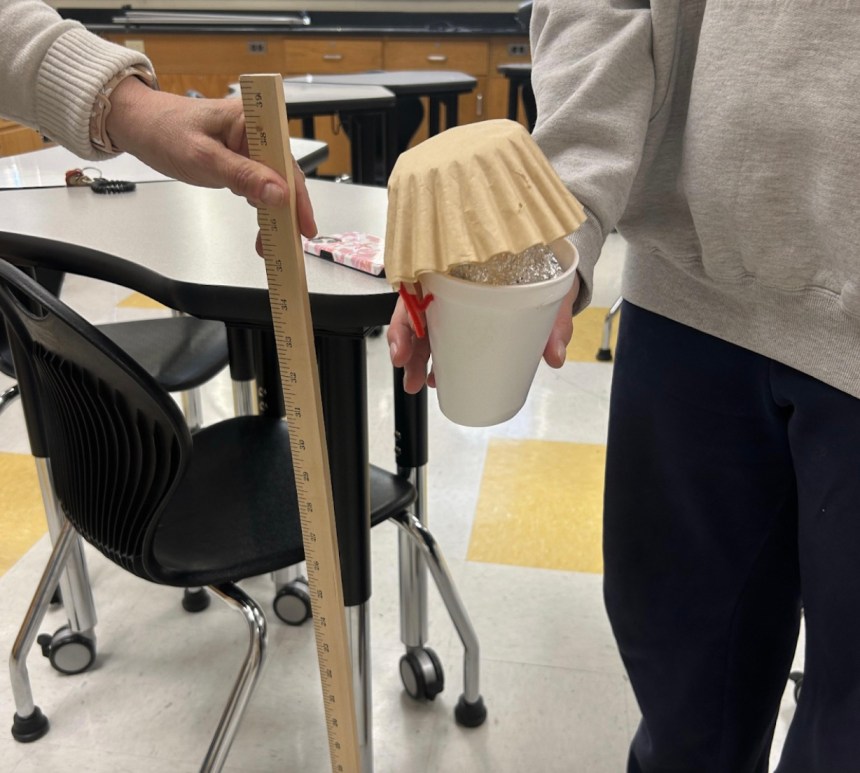
Students were given a certain amount of supplies and were asked to create a safety device for an egg.
“The overall assignment was to have physics students work in small, collaborative groups to design, build, test, and evaluate a safety device to protect a raw egg during a collision,” Bouchard said. “The device could protect and surround the egg itself, or it could be a landing pad.
Students followed a flow chart that showed them how the engineering process works to provide structure to their work.
“The most difficult part of the lab was having to test run and change different things to our design,” junior Lily Stankevich said. “But after dropping it from many heights, we realized the things we have to change.”
The ultimate goal of this assignment was for students to apply engineering principles and physics concepts to explain how collision safety devices work to protect humans during crashes. Students had to apply their understanding of how an impulse causes a change in momentum, and how adjusting the duration of a collision affects the force applied on the object during that collision.
“I enjoyed designing our protective layer with my group,” junior Ashna Punjabi said. “ It was good to see our design work successfully.”

(Photo courtesy Cameron Graf)
HUMAN ANATOMY WITH MS.DOOLAN
By Cameron Graf – Staff Reporter
Students in Ms. Doolan’s Human Anatomy class have recently been studying the brain and its functions.
Students were assigned a sheep brain dissection and had to label the parts of the brain. After the dissection, they discuss the functions and what each part of the brain is responsible for.
“This activity makes the anatomy feel real and hands-on for those who are interested in this in particular,” Doolan said.
The goal of this assignment was to stimulate an example or replica of the human brain and to get a general idea of what goes on in the brain.
“Learning this in Human Anatomy really helped me and my group members get a better representation of what goes on in the brain,” junior Cara Mikoliczyk said. “I also loved how it’s hands-on and we can touch the brain.”
This dissection and dissections similar to these are helpful for students who want a glimpse of the medical world.
“This whole unit has been one of my favorites considering I want to be a surgeon,” sophomore Kaylei Sistrunk said. “When we dissected and took apart the brain into different pieces it was fun and interactive.”
(Photo courtesy Matthew Witteman)
SPORTS MANAGEMENT WITH MR. BELER
By Matthew Witteman – Staff Reporter
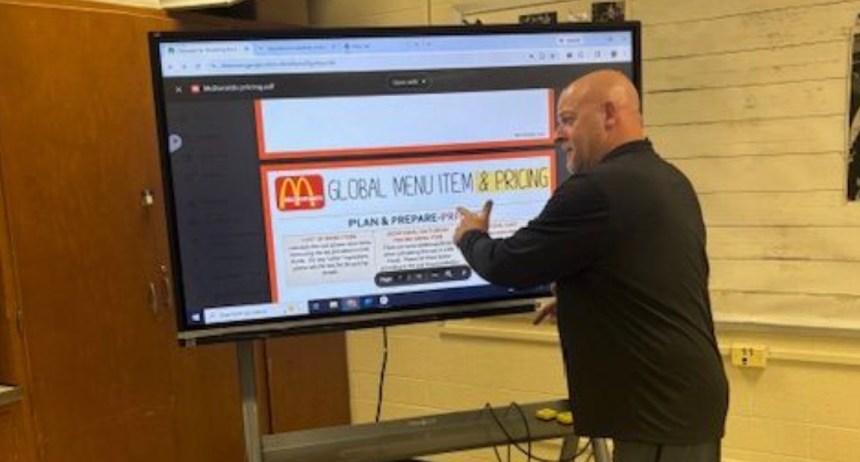
Mr. Beler’s Sports Management class has been exploring different career options that are available related to sports management and marketing.
Students were recently tasked with creating their own sports franchise and making a super fan for their franchise. Students get to see all that goes into making a franchise by going through all the ways they make money.
“Its very good for the students to learn that there’s so much more that goes into a franchise than just the team,” Beler said. “This project showed them all the ways the franchise makes money and markets themselves.”
Students enjoyed the assignment and said they were able to get a deeper understanding about all the elements that go into making a successful franchise.
“I thought the project was fun and I liked how I got to create my own team while seeing all the layers that go into making a franchise,” senior Nick Cosmas said.
This assignment allowed students to get creative with how they wanted to create their franchise. Students started at the base of the franchise and went through the whole process of making money for the franchise. They also learned why different foods sell better in certain areas and why they need to be on the menu.
“All the creative parts like making uniforms made it enjoyable,” senior Brian Gonzalez said.
(Photo courtesy Zach Hyatt)
ADVANCED CULINARY WITH MRS. RYAN
By Zach Hyatt – Staff Reporter
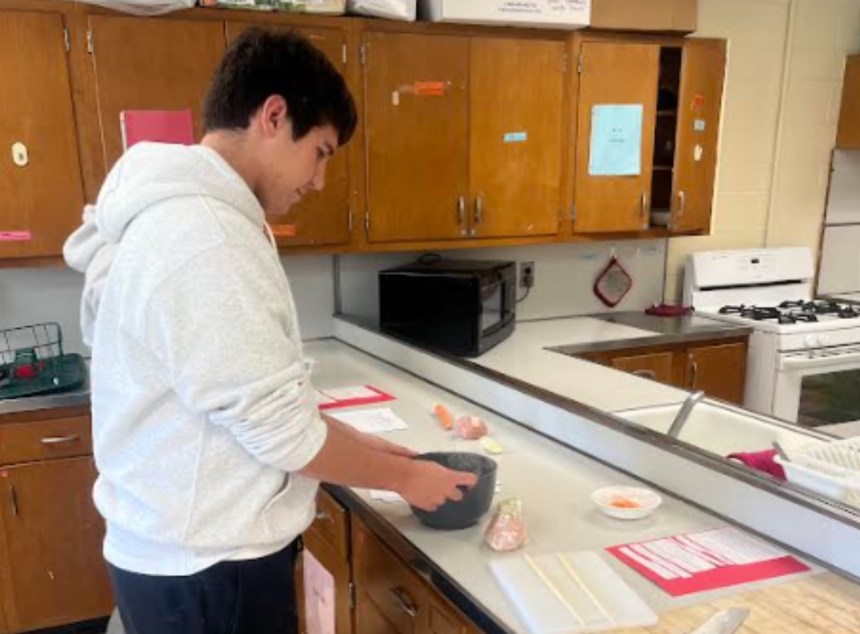
Mrs. Ryan’s Advanced Culinary class is starting to cook full meals for their final project.
Students had to pick a meal that included a protein, carb, and vegetable, but had to make the meal on a $3 budget.
“The final isn’t just about cooking, it’s about creativity,” Ryan said. “With just three dollars, I want to see how you transform something simple into a full meal with a carb, protein, and fruit or vegetable.”
The goal of the project was to show that students that they could design and prepare a own meal on a small budget. It tested their planning, their cooking skills, and how they made the most of limited resources.
“The $3 budget was hard at first but I actually ended up enjoying the challenge,” sophomore Vincenzo Mannino said. “It made me think out side the box about ingredients and I liked seeing how creative everyone got with such a small budget.”
The assignment helped students understand how to plan a meal all the way through and work with a limited amount of money. It also taught them how flavors taste together and how important preparation is when cooking.
“My favorite part of the assignment was getting to choose what I wanted to make and it was fun figuring out how to make something good with such little money,” sophomore Fiad Rahman said.

(Photo courtesy Madilynn Black)
IF YOU LOVE IT, TEACH IT WITH MRS. ANDERSON
By Madilynn Black – Social Media Editor-In-Chief
Mrs. Anderson’s If You Love It, Teach It course gives students an overview of all important aspects of being a teacher.
Students are currently learning how to incorporate all cultures into their school classrooms. They designed activities about different cultures and taught the lesson to the class.
“Our If You Love It, Teach It (IYLITI) class has been learning about culturally sustaining pedagogy, which is a teaching approach that values and builds on students’ cultures, languages, and identities so they can stay connected to who they are while they learn,” Ms. Anderson said. “To apply their learning, students worked in pairs to design and teach a lesson using both a culturally sustaining practice and one of the four co-teaching models we studied. They were free to choose any skill and any grade level, as long as their lesson meaningfully incorporated these strategies.”
This project introduced students to many new aspects of a lesson that they may have not known before.
“This was such a fun activity because I was able to get the lesson done in my own way and style to make it fun for everyone,” junior Maddie Nash said.
This project proved to be fun and enjoyable for all of the students in class.
“My favorite part about this activity had to be when we were able to do all the activities that the other groups set up,” junior Cara Mikoliczyk said. “It was a great way to learn while having fun and connecting with the whole class.”
Many students loved the creative aspect of the project, finding it to be one of their favorite parts of the class.
“My favorite part was seeing the students’ creativity,” Anderson said. “They came up with so many great ideas, and it even inspired me with new possibilities for my own classes and my own kids.”
(Photo courtesy Taylor Mola)
MODEL U.N. WITH MR. EVANKO
By Taylor Mola – Social Media Editor
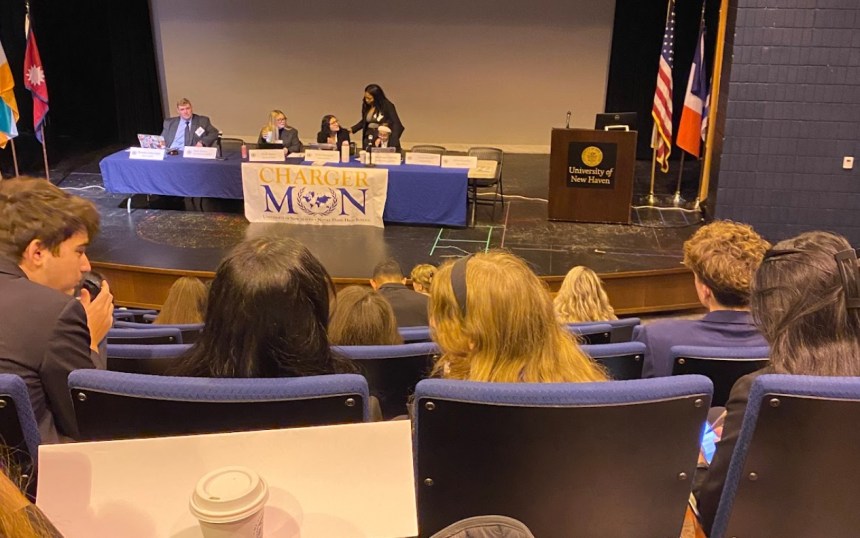
Mr. Evanko’s Model U.N. class recently worked on conference papers to propose at a Charger MUN Conference that they attended.
Students prepared papers on a country of their choice about that country’s thoughts on the war happening in Sudan.
“We attended the University of New Haven Charger MUN Conference because it fits in the middle of our course’s timeframe and gives students an opportunity to practice the research and debate skills that they need to complete the class,” Evanko said. “The ability to leave Law and debate students from other schools is invaluable.”
Students had to learn to collaborate with kids from all over New England to work together to try and come up with a solution paper.
“Being in the Security Council was really entertaining, and it was cool to have to collaborate with new people and come together to complete one task,” junior Chris Rivera said.
The goal in the end for this assignment was for students to take all of their research they have been collecting and use it to explain and argue their side at the debate. Students also had to use their knowledge they either known or learned to adjust their topic on the spot as the topic changed depending on what was said.
“I learned a lot for this when it came to the inner workings of it and how it is supposed to function, with a proper paper that is made and requires more than just yourself, but requires a team of collaborators, sponsors, and signatories,” senior Jaylen Rogers said. “Making clauses and resolutions requires fact and reasoning to work itself out to become part of a final resolution.”

(Photo courtesy Brady O’Neil)
HUMAN ANATOMY & PHYSIOLOGY WITH MS. DOOLAN
By Sebastian Beltran – Social Media Editor
Ms. Doolan’ Human Anatomy & Physiology class has recently been learning about the musculoskeletal system through assignments and a project.
Students were tasked with creating an anatomically accurate life-sized drawing of the skeleton where one side depicted the bones and the other side depicted the muscles.
“The main goal of having students create a life-sized musculoskeletal model is to get them engaged in learning about the anatomy of these two systems in a creative way,” Doolan said. “Each group has to choose a theme to make their poster about, and each class votes on the most creative for extra credit. These will be displayed in the hallway next week.”
To complete this project, students followed a detailed process in a checklist, which guided them so they could create a structured, accurate, and well-designed final model.
“Seeing the bones on one side and the muscles on the other helped me understand movement in a whole new way,” senior Brady O’Neil said.
This assignment helped students understand how the two systems are connected to each other and work together to produce movement for this project. Students actually saw how bones and muscles work together.
“I enjoyed designing our musculoskeletal poster with my group,” senior Gleidson De Souza said. “Drawing the skeleton life-size made me realize how complex the human body really is.”
(Photo courtesy Aleah James)
WORLD HISTORY WITH MR. ROUMELES
By Aleah James – Staff Reporter
Students in Mr. Roumeles’ World History class were recently given two Enlightenment thinkers and instructed to study their biographies, ideas, and historical impacts.
Students needed to gather enough information to write three full pages on each philosopher. Many students found enjoyment in the process of diving deeper into the Enlightenment era.
“The researching part was my favorite,” freshman Maddox Barrett said. “I was able to learn the significance of my figures and why their ideas still matter today.”
After completing the research papers, students were asked to compare one of their Enlightenment thinkers to a fictional character of their choice. This comparison encouraged students to make creative connections between modern TV and philosophies.
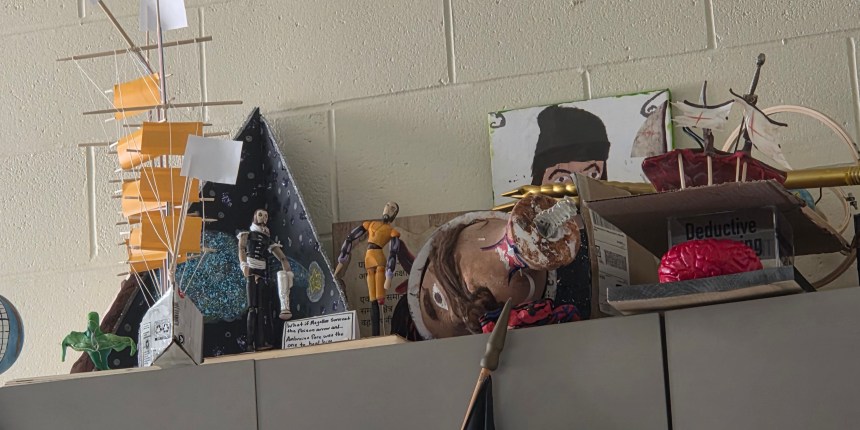
Characters from completely different worlds were compared alongside real historical legends, bringing surprising similarities.The project ended with the creation of an “ancient artifact” connecting both Enlightenment thinkers.
Students were allowed to use any materials they chose, resulting in a wide variety of creative approaches. Many students used 3D printers, cardboard, hot glue guns, paper, paint, and colored pencils to bring their artifacts to life.
This hands-on part of the project allowed students to tap into their artistic side while defending their interpretations. The goal was to prove how the artifact connected both thinkers and to present that argument directly to Roumeles.
“When students engage in a creative task, it forces them to interact with the information and research they want to do,” Roumeles said. “Their learning is expressed through that creative process.”
(Photo courtesy Matthew Sanchez)
SPANISH 3 WITH MR. RODRIGUEZ
By Matthew Sanchez – Social Media Editor
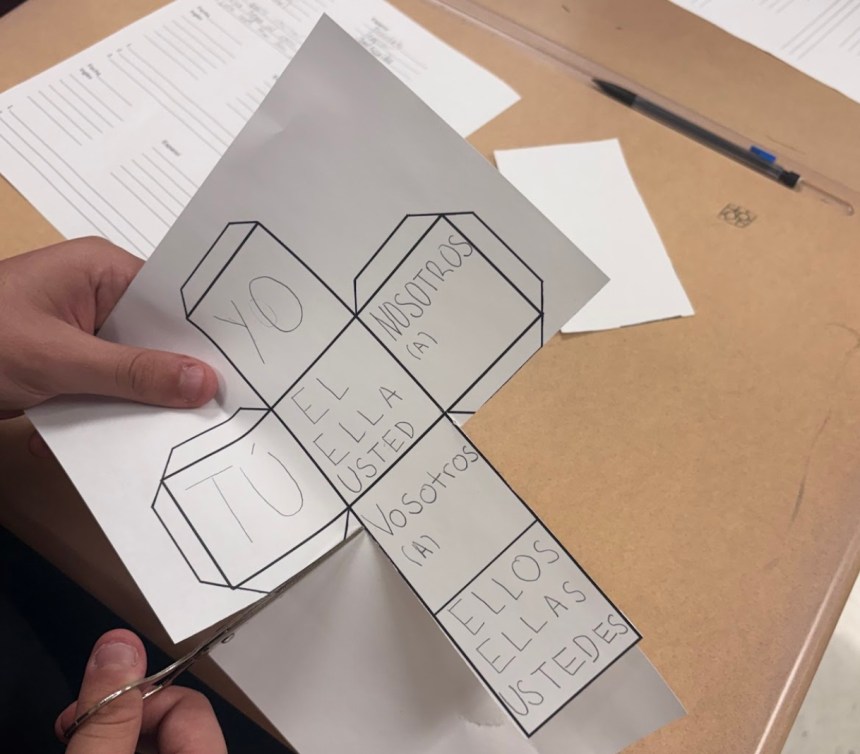
Spanish teacher Mr. Rodriguez recently had his class create dice with Spanish vocabulary words on them.
In the activity, students watched a video of a series completely in Spanish, and then wrote down five words in Spanish and translated them into English. They also created three sentences in Spanish describing what was happening in the show.
One of the dice in the main activity had Spanish subject pronouns. The other dice had six verbs with infinitive endings in ar, er, or ir.
“In the activity, the students had to roll the dice and conjugate the verbs using the imperfect tense,” Rodriguez said. “They did this because the dice are random and students can practice writing the verbs with the correct ending. When they finished conjugating, in their groups they had to create 10 sentences using the verbs, but also elaborating their sentences using words and phrases that trigger the use of the imperfect tense.”
Rodriguez worked with students if they had questions on the activity. He also highly encouraged students to work together in groups to further expand their proficiency in Spanish.
Sophomore Jackson Nichols says how the activity has helped him get better at Spanish.
“It helps me understand the proper conjugations for the imperfect tense,” Nichols said. “The dice activity helped me use the imperfect tense to show actions I’ve done in the past.”
The class said the dice game was creative way to learn and to have fun with their friends.
Sophomore Vincenzo Mannino said that Rodriguez has helped him get better at Spanish in many ways.
“Mr. Rodriguez helps me improve by teaching me new skills necessary to be able to properly communicate in Spanish,” Mannino said.
(Photo courtesy Connor Ryan)
ADVANCED JOURNALISM WITH MR. KULENYCH
By Connor Ryan – News Editor
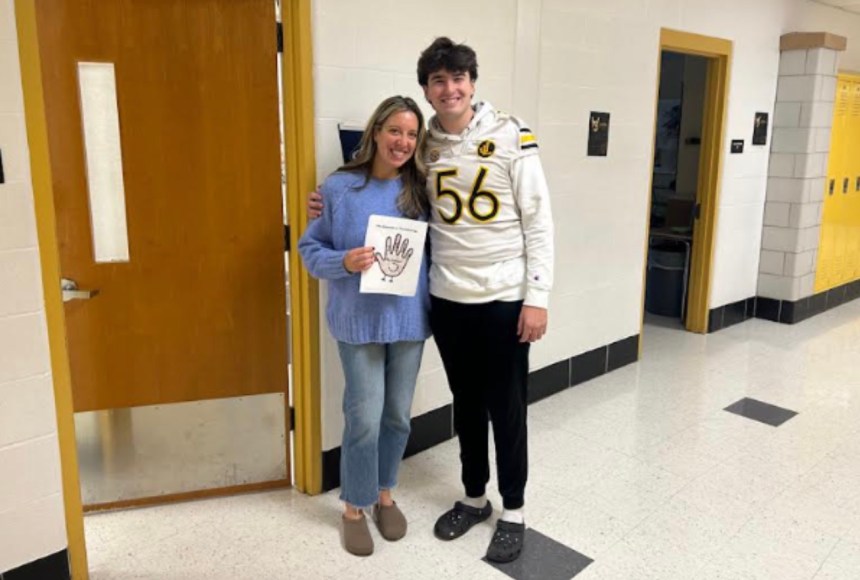
Mr. Kulenych’s Advanced Journalism class celebrated Thanksgiving last week by combining creativity and gratitude through a “Thankful Turkeys” activity.
For the assignment, students were instructed to color a turkey, choose a teacher in the building, and describe that teacher using five words. After completing their turkeys, students personally delivered them to the teachers, recording the reactions on video and taking photos with the teachers and their turkeys.
“Each year, we try to celebrate Thanksgiving with a variety of articles and videos,” Kulenych said. “This year, one of our editors, Fiorella Gargiulo, came up with the idea for the Thankful Turkeys and it ended up being an amazing way for students to show appreciation for teachers that have made a difference in their lives. The fact that so many different teachers were selected really showed the impact that so many adults have here and the teachers’ reactions made the video extra special.”
Students enjoyed being able to recognize teachers who have positively influenced them during the school year.
“I liked that we could pick any teacher in the building and really think about why they mattered to us,” sophomore Dylan Gaillard said. “It made the project feel more personal.”
Others appreciated how the assignment allowed them to spread positivity throughout the school.
“It was fun surprising teachers and seeing how happy it made them,” sophomore Logan Thomas said. “It was a cool way to say thank you and give back.”
The activity allowed students to practice journalism skills such as interviewing, filming, and photography while also promoting appreciation and community during the Thanksgiving season.
(Photo courtesy Shania Sanchez)
MARINE SCIENCE WITH MR. MORAZZINI
By Shania Sanchez – Staff Reporter
The Marine Science class at Jonathan Law is taught by Mr Morazzini, and it covers not just the basics of the ocean, but it also deep dives into topics like tides, waves, how animals adapt over time due to changes in the water, and even different currents in the ocean and their effect on marine life.
Students even get to go to Walnut Beach on block days to get first-hand experiences with finding different things that wash up at the beach and collect data that they get to accumulate at the end of the year.
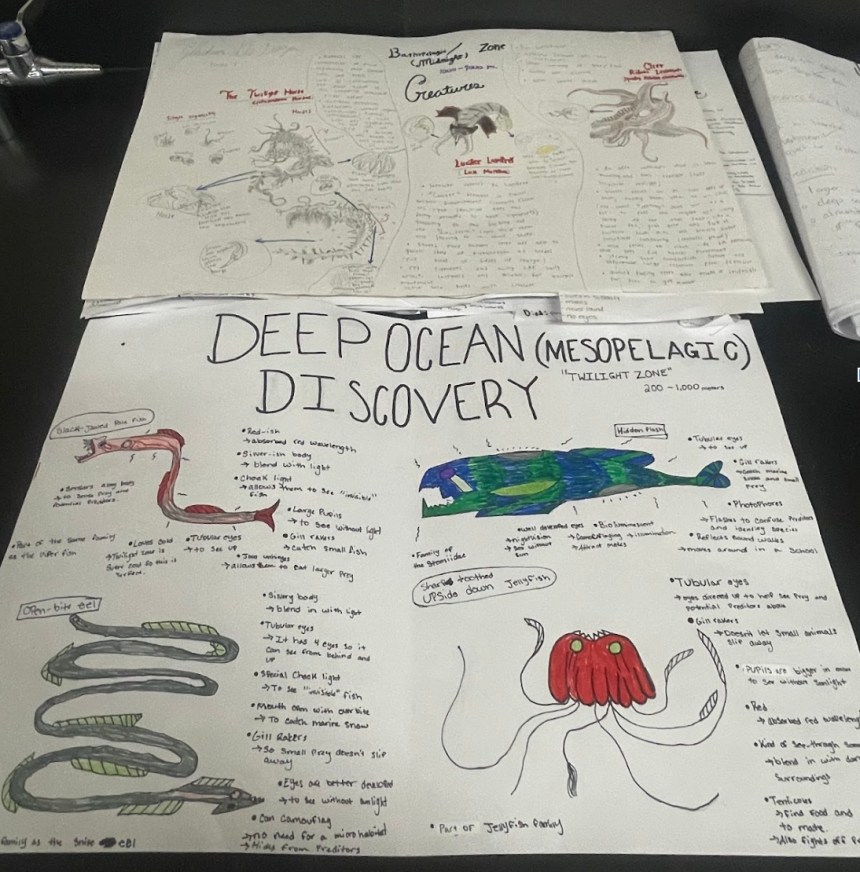
Students recently did a project that would test their creativity and just how far they can push their minds when it comes to making discoveries.
They had created new deep-sea creatures that would be inspired by the different ocean zones. The four zones are Sunlight (Epipelagic), Twilight (Mesopelagic), Midnight (Bathypelagic), Abyssal (Abyssopelagic), and Hadal (Trenches) zones. Each zone has its own depth, with Hadal being the deepest. The creature had to have accurate adaptations to its environment and has to look creative.
Students have to do their research to be able to do this, which made it a challenging yet fun assignment.
“The research I did helped me gain a lot of inspiration for my design, and it helped me figure out how to start my drawing,” junior Dylan Robinson said.
Morazzini has been doing this project for years now, and although they are all creative, there have been some that have definitely stuck with him even now.
“The Lucifer Lamprey is one I’m still having nightmares about – it lives a parasitic lifestyle and specifically targets only bioluminescent prey by latching on and piercing with a needle-like death spear between its sandworm-inspired jaws,” Morazzini said. “Scary stuff.”
Some of the more common adaptations students have made include extra-large or completely reduced eyes, bioluminescence, unique coloration, or transparent bodies, as well as specialized external sensory organs.
“This topic is cool because most of life’s secrets are hidden in the deep ocean, where sunlight never reaches,” Morazzini said. “The organisms down there are fascinating and so alien to us.”
Less than 5% of the ocean has been seen by the human eye. Taking this class makes it easier for students to understand what humans have seen in the ocean and what has been discovered.
“The class has definitely made me more curious about the ocean, and it has definitely made me research more weird sea animals,” junior Chase Bagwell said.
(Photo courtesy Brady O’Neil)
AP EUROPEAN HISTORY WITH MR. EVANKO
By Brady O’Neil – News Editor
Mr. Evanko’s AP European History class recently participated in a lesson about the French Revolution.
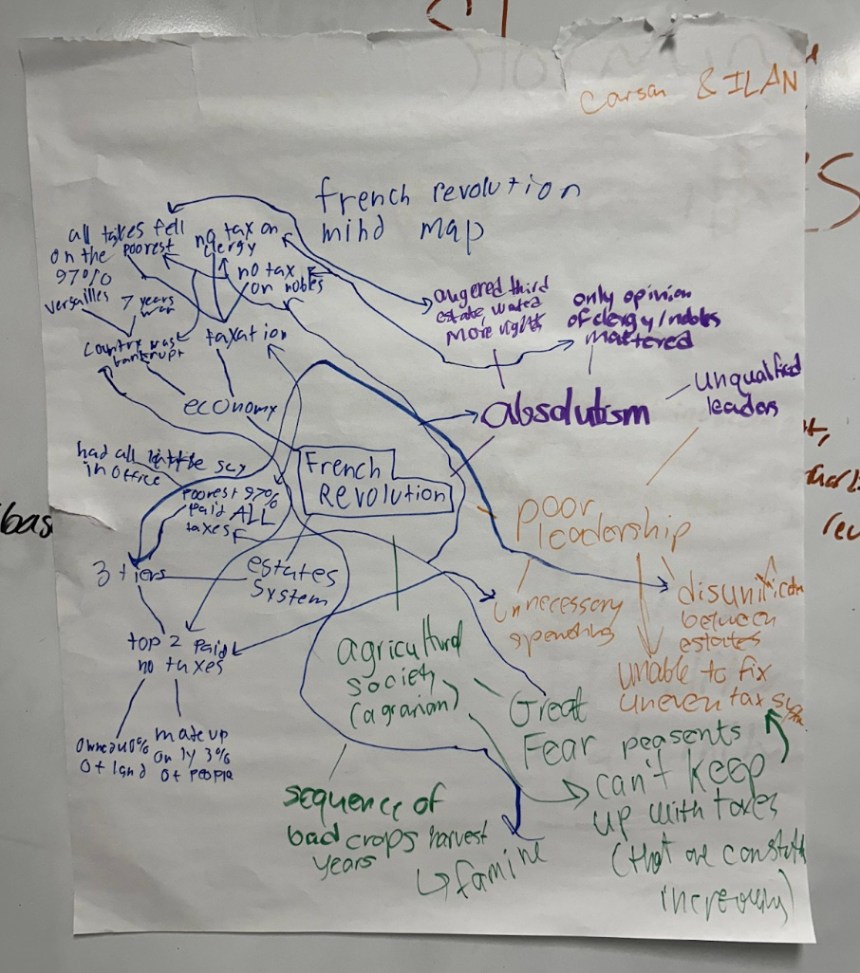
This activity involved students going around in groups and writing information about the Revolution on poster paper, then participating in a gallery walk to compare and contrast the groups’ notes. Students were successful in completing the assignment, and Evanko was pleased with the outcome.
“The lesson was designed to give students space to literally map out the complex causes of the French Revolution and to see the intersections between the different issues at the time,” Evanko said. “My takeaway is that students did well in this task and surprised me with the depth of the connections that they made.”
Evanko wasn’t the only person in the class who had some takeaways from the lesson. Many students genuinely enjoyed learning about the Revolution through this lesson.
“This lesson helped me learn a lot about the French Revolution,” senior Yeiden Nieves said. “I didn’t know too much about the Revolution, but getting to learn about why the estates revolted against the government was super interesting.”
This format of learning was so beneficial for the students that some want other aspects of European history to be taught this way in the future.
“I really enjoyed being able to see other groups’ work after working on my poster,” junior Vaughn Kraynak said. “If we could do this more often, I think it could help me with remembering different aspects of history, and just general information from our daily activities.”
(Photo courtesy Anwita Puttam)
ALGEBRA 2 WITH MS. LOCH
By Anwita Puttam – News Editor
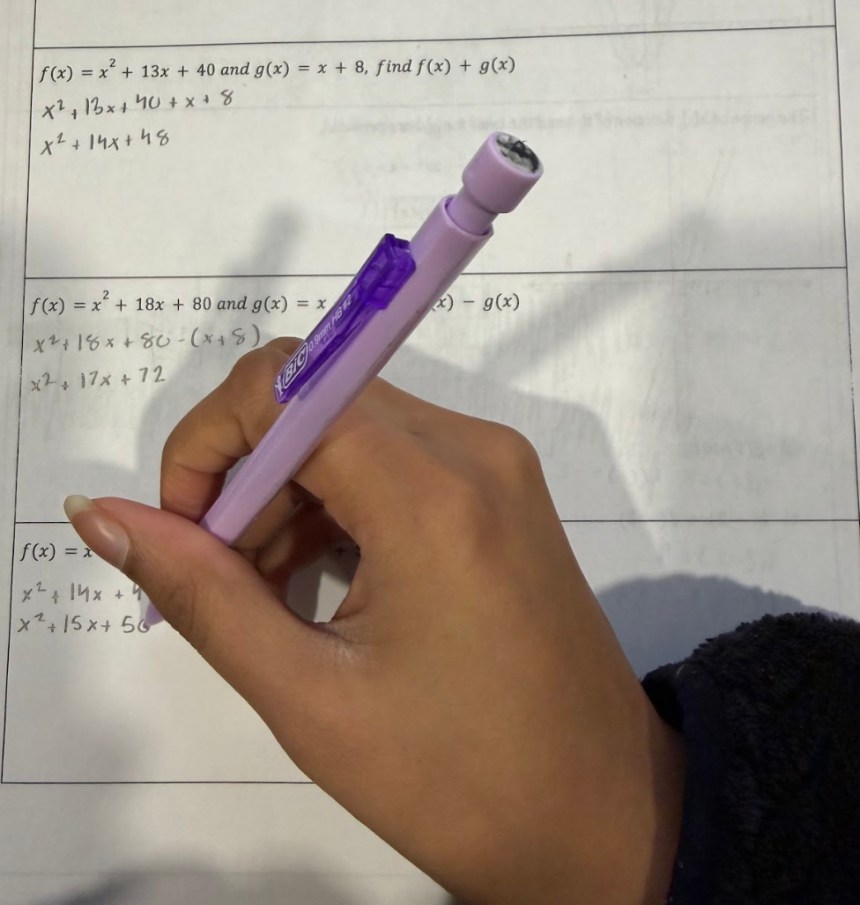
Ms. Loch’s Algebra 2 class recently completed a review packet covering Lessons 4.2, 4.3, and 4.4 of their current unit.
These lessons consist of a warm up for evaluating graphs, tables and functions, as well as a review for combining functions for tables, graphs and equations. They also reviewed function operations and solved equations concepts for homework.
“Our assessment is on 4.2- 4.4 on C day and this was one of our ways to prepare for your assessment,” Loch said
The goal of this assignment was to help the class feel and become prepared for their assessments in Algebra.
“This assignment was fairly easy,” sophomore Tenzin Gakhang said. “I was able to understand it well and got my work done fast.”
Some students easily completed the assignment, while others struggled a bit with understanding and solving the given concepts.
“I would say that I understood this assignment decentl.y” sophomore Sean Sula said “I had some issues in the beginning with the graphing, but I got the hang of it after some time.”
Loch helped the students understand the concepts and explained it to them in a way they would understand.
“When students are struggling, I remind them to go back to notes to look at a similar example, I may ask a question to hopefully clarifying and redirect their thinking process, and always offer our supports to students (extra help in Support Center, with me after school or common time, or even our peer tutoring with Math National Honor Society),” Loch said “ There are times I have changed my mind about homework and give a more skill based assignment of concepts in which students need to review.”
(Photo courtesy Kayla Markowitz)
AP/ECE ENVIRONMENTAL SCIENCE WITH MRS. BOUCHARD
By Kayla Markowitz – Editor-In-Chief
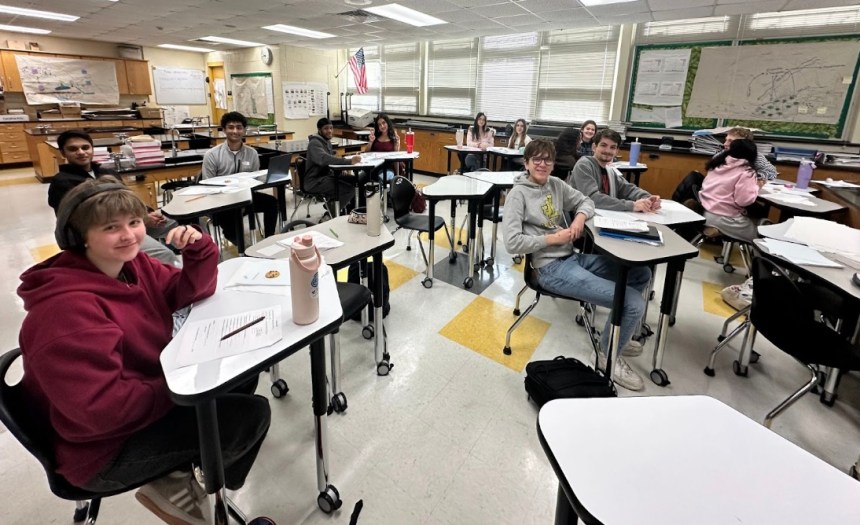
Mrs. Bouchard’s AP Environmental Science students recently got their pickaxes ready and spent their day as miners – mining for chocolate chips, that is.
Bouchard’s Mining Lab was designed to teach students about the impacts of mining and the resources that go into extracting ores that we use in our daily lives. Each pair of students had to extract as many chocolate chips from a cookie as possible.
“I learned a lot about how mining can affect the soil around ore, and how mining can negatively impact the environment if not done sustainably,” senior Aryan Sikhinam said.
The lab was a great way to allow students to explore the environmental effects of mining while doing a fun and interactive activity.
“The lab was really fun, and I also learned about the opportunity cost of mining,” senior Surya Gautham said. “All the processes like extraction and reclaiming were reflected in the cookie lab, and that helped me understand the environmental impacts.”
The lab gives students an opportunity to become aware of our indirect impact on the environment and understand what goes into the consumer goods people purchase.
“Most of what we use on a daily basis needs to be extracted from the earth by mining: fossil fuels, metal ores, gems, silicon dioxide, etc.,” Bouchard said. “All of these items are nonrenewable and are only present in a finite supply, and their extraction has many negative environmental impacts. Learning about the process of mining and its consequences can hopefully prompt people to find ways to reduce their consumption of these resources and find alternatives that have less of an impact.”
(Photo courtesy Harshitha Kothapalli)
AP LITERATURE & COMPOSITION WITH MRS. ROUMELES
By Harshitha Kothapalli – Editor-In-Chief
Mrs. Roumeles’ AP Literature and Composition class recently read the classic novel “Frankenstein” written by Mary Shelley.
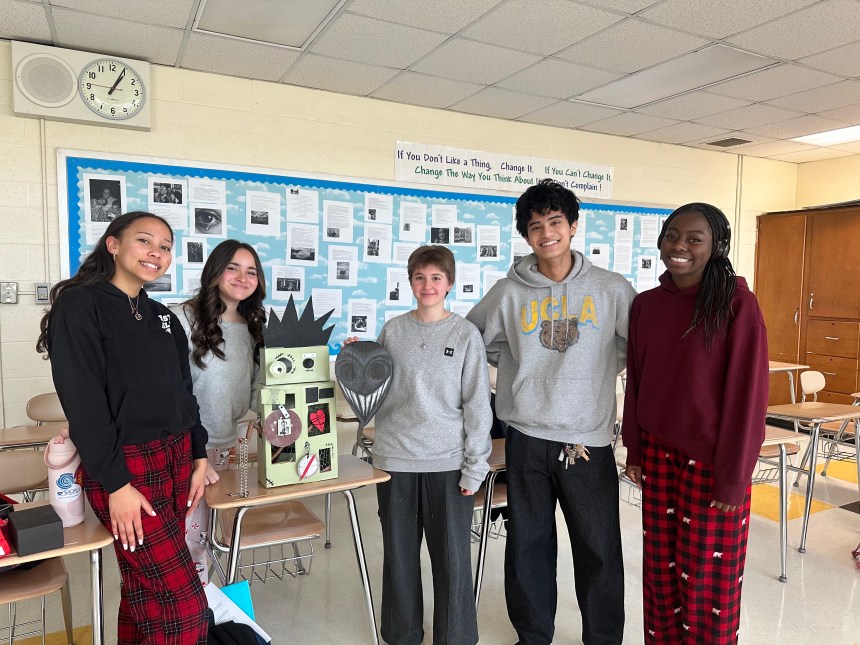
Students were tasked with multiple projects surrounding the book, including dissecting quotes that resonated the most with them, as well as creating a real-life model of the monster Frankenstein created.
Roumeles teaches this book every year to not only help students gain the necessary skills and knowledge for the AP test, but also for the intriguing discussion that comes along with the complex issues that arise.
“I choose to do Frankenstein for multiple reasons,” Roumeles said. “I love the book, it’s a classic, it’s a great example of Romantic literature, it taps into students’ knowledge and/or interest in the cultural idea of the Frankenstein monster, it has a wealth of great language and quotes, it provides very important lessons, and it’s absolutely relatable to the real world, especially in terms of societal issues.”
Senior Brady O’Neil also recognizes how the book delves into the depths of human ambition and consequence.
“’Frankenstein’ was able to open our eyes as readers to thought-provoking, complex ideas that raised critical questions about these ethical limits that we constantly push as a society,” O’Neil said.
This tragic tale forces readers to consider the responsibilities that come with power through writing that exemplifies the core principles of AP Literature.
“’Frankenstein’ helped me understand how different literary devices, like metaphors and imagery, can create a complex plot that has a deeper meaning that reflects human nature,” senior Kayla Markowitz said. “It also strengthened my ability to analyze character, literary devices, and themes in the novel, which will ultimately help me on the AP test.”
The language used throughout the novel is a testament to the period in which it was written, nearly 200 years ago.
“I hope students have an appreciation of the language,” Roumeles said. “Written in the 1800s, it’s very sophisticated and formal. I hope that students really take the time to consider our real-life ‘monsters’ and how society is responsible for creating those monsters. Responsibility is a huge component of the novel and an important fact of life to always be aware of and act upon. I hope they reflect on their moral compass.”
 The Advocate Online