
OPINION: Slight Changes To Lunch Procedures Would Benefit Students, Cafeteria Staff Alike
(Photo by Isabella Gecaj)
By Isabella Gecaj – Staff Reporter
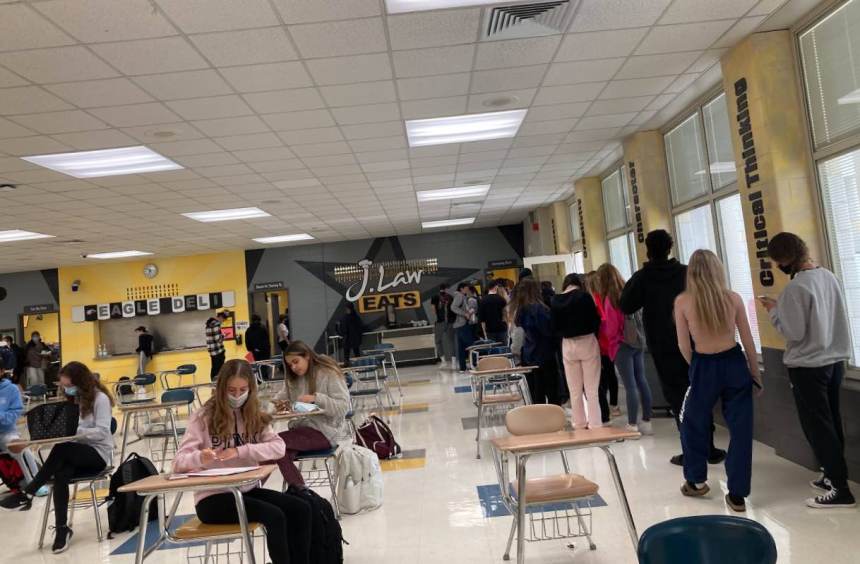
Jonathan Law High School has a 25-minute period for students to eat lunch. In this time students must leave their class and go to lunch from whatever area of the school they are in. Students primarily wait in two lines to buy food and then have the remaining time to eat lunch. Unfortunately, Law is unable to add simply time to the lunch period as it would affect the times of other classes and would be a districtwide decision.
That said, lunch periods can and should be made more efficient. It takes a long time to buy lunch and students are left with little to no time to eat. This problem has especially been an issue the past two two years, since lunch is free and more and more students are buying lunch rather than bringing lunch to school. While the cafeteria staff has done an amazing job adjusting to more students buying lunch, wait times are still an issue on some days. Students who are coming from upstairs or the other side of school have to wait anywhere from 10-20 minutes, which gives them 5-10 minutes to eat. For some, the bell rings as soon as they get their food and they are given a late pass so they can get time to eat. The lines are very crowded, all because students are worried about whether they will be able to eat lunch or not. The current process is inefficient and stressful for both students and the cafeteria staff who are rushing to hand out lunch. The students who are not given enough time to eat often leave undernourished or have to miss class time to finish lunch.
By making lunch more efficient, this problem can be fixed. The school district could possibly make a mobile app so students can pre-order their lunch beforehand. Lunches could be pre-made and boxed individually to follow COVID protocols. Creating an app will likely take some time, so in the meantime, paper forms or a Google Form could be used to pre-order a boxed lunch that students could pick up at the start of their lunch wave.
School lunch can also be made more efficient by adding an additional lunch wave or two, especially during block periods where there is time in between waves. This way lunch waves have less people, decreasing the line and helping the lunch workers so they do not have to rush as much with packing lunch. This would help since the last lunch wave finishes at 12:34 p.m. on block days, so there could be another one or two waves added. A third lunch line would also be helpful. The return of the Deli Line this week will hopefully shorten the other two lunch lines and make for a more efficient lunch-buying process.
These changes are important because a short lunch wave can negatively impact students’ physical and mental health. Eating too fast can result in a series of complications. With it taking 5-10 minutes to get lunch, students do not have enough time to properly digest their food. Even the full 25 minutes is not long enough, but at least it is more time than having 15 minutes to eat.
Students who rush to eat their lunch are more prone to headaches and stomach aches. Consuming food too fast can lead to irritable bowel syndrome, arthritis, abdominal pains, and heart diseases. In turn, students have a harder time functioning in class due to their increased stress levels. The rapid changes and inconsistency of the digestive system can lead to constipation or multiple trips to the bathroom. It can also interrupt class time and cause students to miss class time.
While this is not an everyday problem, current lunch procedures do affect many students on some days. Therefore, lunch can and should be made more efficient. Lunch is a time for students to destress, spend time with friends they do not normally see, and fill themselves with the proper nutrients. There are many ways this challenge can be handled. It will not be easy to instill and it will take time, but eventually a more efficient lunch period will benefit everyone.
(Some information courtesy Mrs. Attardo, thea-blast.org, edweek.org, kingcountry.ogov, goodtherapy.org, washington.edu, kqed.org, sutterhealth.org)
 The Advocate Online