
5 QUESTIONS WITH…Advanced Creative Writing Teacher Mr. Healy About The Class’ Upcoming Book
(Photo courtesy Mr. Healy)
By Ben Rossi – Staff Reporter
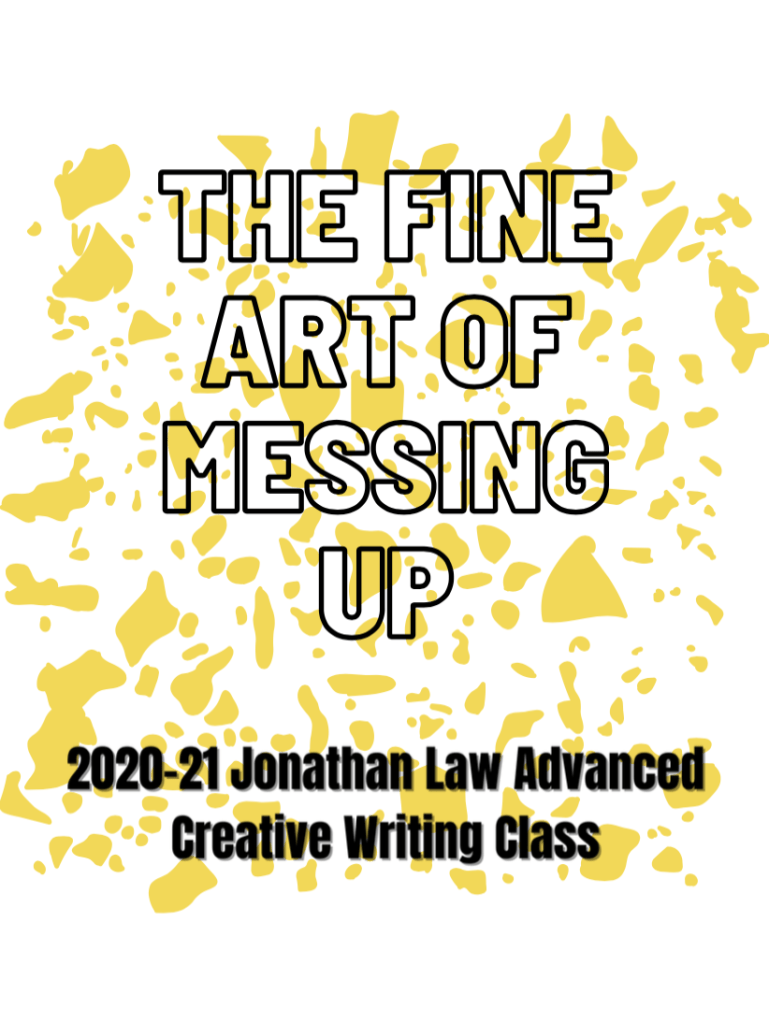
As the school year comes to an end, the Advanced Creative Writing class is finishing up its annual book. Due to COVID-19, many adjustments had to be made this year when creating the book which this this year is titled “The Fine Art Of Messing Up.” Advocate Staff Reporter Ben Rossi interviewed English teacher Mr. Healy about his class and the process of creating the book.
Ben Rossi: How has COVID-19 affected the publishing of the book?
Mr. Healy: Unfortunately, COVID threw a big wrench into our plans. Every year for the past three years we’ve published a physical copy of that year’s anthology. This year, when we tried to get in contact with our publisher, Lulu, we received no response. We kept trying but eventually we realized we had to look for alternative publishers. COVID also caused delays in the printing process for a lot of publishers, so between securing a new publisher, and dealing with the delays, we realized it wouldn’t be feasible to produce a print copy this year. But luckily we were able to produce a website this year that we’re super close to publishing, so I’m excited for that.
BR: How do you divide up the work among the class?
MH: Every year, each student is responsible for writing three short stories that will be put up for submission. Then the class and the authors themselves narrow down what they actually want in the book. We workshop and all of the stories as a class. Then we usually have some students handle compiling the artwork, some handle the marketing, and others handle the miscellaneous tasks that are part of the publishing process. Also the whole class works as a committee to pick the title, cover art design, format and layout, etc. It’s an interesting class because not many have one single goal they’re working towards, so not only do students have to be responsible for their own work, they have to be ready to contribute to the book project, or else it might not get published.
BR: What are some of the inspirations for your students’ stories?
MH: The authors would be better able to speak to that than me, but I can tell you my advice to them. Of course there’s the cliche “write what you know” idea, but even though it’s cliche, it works. I tell kids to write about what they’ve been through, things they think about, or things that interest them. That way they have a deeper understanding of the stories they’re telling, and they don’t have to do as much research or make stuff up. I also tell the kids to “steal like an artist.” Now I’m not advocating for plagiarism, but there’s really not any original stories anymore. Most artists take a good amount of what came before them and put their spin on it. So for example, if a kid likes Star Wars, they could write a cci-fi space epic. Or they could write about a son battling his father. Or a wily human/alien duo who pilot a ship to crazy places together. Obviously when you add those ideas together you get Star Wars, but when you take one and add your own creativity to it, you get your own, brand new story.
BR: Who comes up with the topic of the book?
MH: The class does as a group. I have them all think of title ideas and a reason why they think it should be chosen and then we vote. Since the book is a collection of unrelated stories, the title usually represents some overarching attitude the class has. Our first book, “Trust the Process,” was all about trusting in the writing process and following it through even if you were discouraged. “School Appropriate” was all about finding the line of what the kids could and couldn’t express, and what that means to them as artists. “Paper Prison” was about breaking free from the analytical writing required in most classes, and exploring one’s creative side. And this year, we have “The Fine Art of Messing Up,” which is all about this idea that we all mess up, and usually as a teen it can feel like you mess up a lot, so how do we take those mistakes and get something out of them? How do we learn from them?
BR: How long does the process of writing the book and getting it published usually take?
MH: It takes a while. They usually write about one story a month from October through January. With that comes lots of drafting, conferencing, peer reviews, and revising. Then starting in February we start to compile the book and tie up any loose ends. Now this is a loose timeline because creativity is messy and I’m always trying to corral the writers and keep people moving. We also have the marketing aspect of the class that is always hanging over our heads so that interrupts and distracts from actually writing the thing. Also around February we really focus on getting the artwork squared away. Then in March it’s all about doing the minuscule line edits that can be so tedious. I like to have the book sent to the publisher by April break, so that they can send me what’s called a proof, which is basically a physical copy of the book to look over and check for any issues, by late April/early May. And then once we approve the proof copy, we usually get our batch of books ordered, printed, and shipped by late May/early June.
 The Advocate Online