
EDITORIAL: TLC Quiet Rooms Have Been Beneficial For All Students, But Have Opportunity To Be Even Better
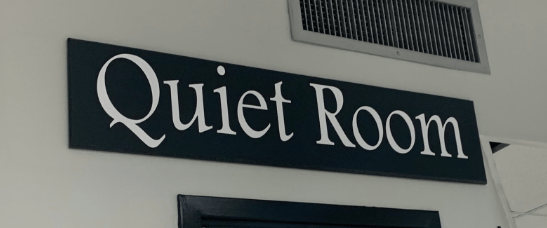
(Photo courtesy Sydney Simpson)
By Sydney Simpson – Staff Reporter
This year, Jonathan Law High School debuted a new and improved Teaching and Learning Commons, complete with couches, tables, a presentation room, and quiet and collaboration rooms. The TLC in general was created to act as a resource for students, specifically with the peaceful atmospheres of both the quiet rooms and the collaboration rooms. The quiet rooms are places where students can go to get work done in a quiet and productive space, and the collaboration rooms are places where students can go to concentrate on group projects, work together, and be creative and productive.
Both the quiet rooms and the collaboration rooms at Law have proved beneficial to the student body this year for many reasons, but there are also flaws hidden in their design. The pros of the quiet and collaboration rooms are that they are productive spaces for students to get work done, and they provide students with an escape from the crowded cafe during study halls. The cons, however, are that some students do not utilize the quiet and collaboration rooms for academic purposes, and the same students often use these rooms daily, not allowing for other students to get a chance to experience the benefits. Also, many students do not know the difference between the quiet rooms and the collaboration rooms, which can affect the experiences of other students trying to work.
The specialized rooms in the TLC are beneficial to students for many reasons. They are productive spaces and can help students focus on their work. They are closed off from the rest of the TLC, providing a less crowded and noisy place for students. These rooms allow kids to work diligently without getting distracted by their surroundings, and with the popularity of the TLC and the amount of students there each period, it is easy to get distracted by noise and by people passing through. Some students have trouble working in noisy atmospheres, and the quiet and collaboration rooms can help these students to focus. The rooms also supply the kids at Law with an alternative to a crowded cafeteria study hall. Law’s cafeteria can get extremely crowded, especially when there are four study classes in there at once.
The quiet rooms in the TLC give students another option by offering an escape from the often noisy cafeteria. Study hall is a time for students to utilize and to get work done, and it should be used to its full potential by all students. It can be hard for kids to utilize their study periods in loud, crowded places; the quiet and collaboration rooms provide secluded and productive areas for kids to do their work. Although there are not enough quiet rooms for every student to go during their study every day, students can rotate between staying in the cafeteria during study and going to the TLC to let other kids have a chance to utilize these rooms. With at least some students visiting the TLC each day, cafeteria study halls will become less crowded, letting the remaining students have a more productive, quiet atmosphere as well.
Although the quiet and collaboration rooms located in the TLC help Law students academically, there are some issues that still need to be addressed. First off, some students do not use these rooms for academic purposes, taking away the opportunity for students who are trying to utilize the quiet atmospheres to focus on school work. Many kids use these rooms to relax and take a break from their busy school days, which isn’t necessarily a bad thing, but there are many other places they could go to do this. For example, if coming from a cafeteria study, students can stay there to talk and socialize. They could also make a visit to the couches set up in the main area of the TLC, or the other cool new furniture that was installed. By doing this, other students could use the quiet rooms and the collaboration rooms more appropriately, for academic purposes rather than for socialization and Tik Tok dances. Secondly, the same students often use these rooms daily, not allowing for other kids to experience the benefits that the quiet and collaboration rooms have to offer. This could be fixed by having a sign-up sheet in the TLC for students who want to visit the rooms during their study periods. This way, quiet rooms can be previously reserved, and kids don’t have to rush to sign into their study and get to the TLC before all the rooms are taken. By only allowing kids to sign up for quiet rooms twice a letter cycle, it gives everyone an equal amount of time to use the quiet rooms if they want to.
The intended differences between the quiet rooms and the collaboration rooms at Law are not widely known by the student body. Most students use all four rooms in the same way when they are meant to be utilized for different things. The two quiet rooms are supposed to be places for students to go where they can get individual work done fast and efficiently. Kids can work in silence to increase productivity and to have less distractions. The two collaboration rooms are creative spaces where students can work together on assignments or group projects and still get work done efficiently because there are no outside distractions. These rooms should be filled with students exchanging ideas and helping each other through academic assignments. If more students at Law knew the differences between the quiet rooms and the collaboration rooms and used them correctly, productivity in both rooms would increase.
The quiet and collaboration rooms at Law have both benefits and issues associated with them. These issues are easily fixable, and by the end of the quarter, these rooms could be better utilized by the student body.
 The Advocate Online