
NEWS: Brainsgiving Unveils AP Psychology Students’ Learning In Enticing Way
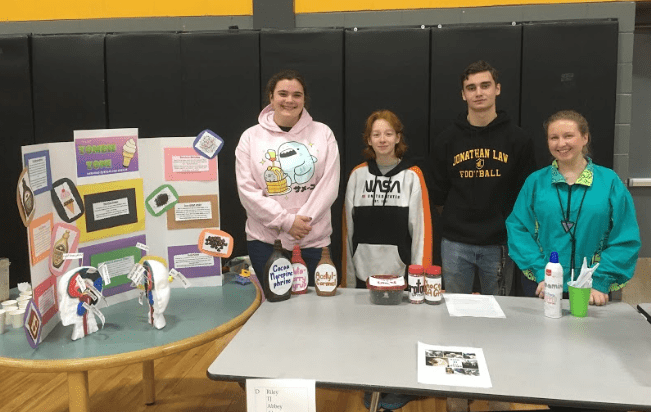
(Photo courtesy Mayur Somalinga)
By Mayur Somalinga – Staff Reporter
Jonathan Law’s AP Psychology classes, headed by Jonathan Law AP Psychology teachers Ms. Burns and Mr. Young, hosted their annual Brainsgiving event on November 27.
All AP Psychology students submitted projects that simulated a restaurant intended to serve zombies in a hypothetical post-apocalyptic world with a twist as all the items are related to aspects of the brain and the biological bases of behavior, as a whole, which is meant to further enforce the students’ learning and hopefully to encourage prospective students to take AP Psychology, as well.
The project specifically entails a menu of seven items, a three-dimensional model of the brain, and two items from the student’s menu for the rest of the student body and faculty, or in this case, the zombies, to taste.
“Brainsgiving is an opportunity for students to showcase the learning that they’ve done in Psychology, specifically the chapter on the biological bases of behavior,” Burns said. “So, it becomes a novel way to display the functions of the brain and the different parts of the brain to everyone else.”
While the criteria appear to be quite finite and constraining, the subtopic of the biological bases of behavior is in reality quite diverse, offering students a fair amount of topics to base their projects on.
Senior Neal DiBlase fended off the zombies alone with an especially captivating project.
“Mine was on the Endocrine System, and of course, much like everyone else, I had many food items and mine was centered around the idea of having these two cookies – the habanero cookies and the normal cookies,” DiBlase said. “Our habanero cookies are our spicy Norepinephrine cookies and our normal chocolate chip cookies are our sweet serotonin cookies and I had a little reaction test game that I set up and whoever hit it first got the normal good cookies and whoever hit it second got the habanero cookies, and that’s largely what it was centered around.”
A majority of students took on the task in cohorts to increase efficiency and distribute the work, however, the groups still had to work tirelessly and faced difficulties during the creation of their projects.
“The one thing that I would do differently would be to have more communication amongst my group and get their opinions as well as mine about the project,” senior AP Psychology student Briana Hernandez, said. “As well as asking previous AP Psychology students what their menu was like to get more food ideas.”
Even though the project was very rigorous, so much so that it was all done outside of class, it still offered an enriching experience for the students to get creative and collaborate with their counterparts from other AP Psychology classes that they usually wouldn’t get the chance to work with.
Junior AP Psychology student Luke Morris agreed with this evaluation.
“The combination of the creativity that goes into the menu, making the food with your friends, and the competition between each group is so much fun,” Morris said.
Brainsgiving is open to all students and faculty, and as such it receives an overwhelming turnout, especially since it is usually hosted on the day before Thanksgiving Break.
Among the plethora of tantalizing treats the visitors can try and the occasional game they can play, they are also encouraged to vote for the booth, identified by a letter, that they think is the best.
As much as Burns considers the voting aspect to be a perfect way to instill a feeling of interest in the spectators, especially since the group in first place is awarded five extra credit points, Burns simultaneously feels that the voting feature overly politicizes the event to the point where it strays off of its initial intent, which is to, again, educate students and staff about the brain and it’s interconnected systems.
“Next year, if every group submits a question or fact that they want somebody to find out about their booth and then we put it together as a treasure hunt or a scavenger hunt and then as kids come in they have to fill it out and fill out a form on Google [Forms] and they can be entered to win a gift card and then maybe I think they’d be more invested,” Burns said.
 The Advocate Online