
FEATURES: Cases Of Impostor Syndrome On The Rise
(Photo courtesy newsworthy.com)
By Rachna Vipparla – Staff Reporter
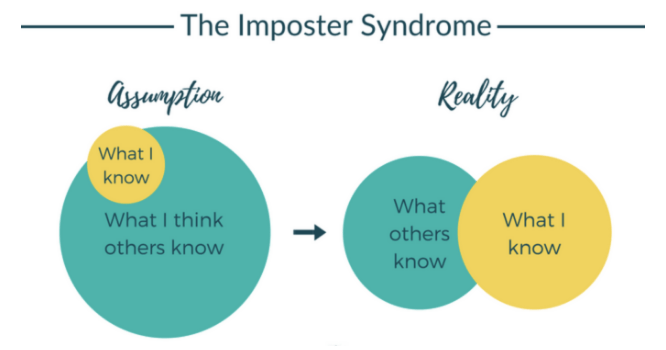
On the Kip Blog, which details people’s struggles with Imposter Syndrome, an anonymous poster writes, “I know that I first struggled with Imposter Syndrome in my first three years of college. I kept wondering how I got into Yale and what would happen if my classmates and professors found out that I wasn’t really as smart as everyone else. It led me to not speak in class, delay or avoid taking courses I wanted to take but thought I’d fail, and be less outgoing than I usually am. I still struggle with these issues sometimes, but I’ve learned how to cope and manage my confidence.” Impostor Syndrome the persistent inability to believe that one’s success is deserved or has been legitimately achieved as a result of one’s own efforts or skills.
This is just one of many real life examples of how people struggle with Impostor Syndrome.
As Megan Dalla-Camina, author of many best selling novels, said,” Impostor syndrome is a phenomenon in which people are unable to internalize their accomplishments.”
Impostor Syndrome is a psychological term referring to a pattern of behavior where people doubt their accomplishments and have a persistent, often internalized fear of being exposed as a fraud.
“It is basically a lack of self-confidence, anxiety, doubts about your thoughts, abilities, achievements and accomplishments, negative self-talk, feelings of inadequacy, dwelling on past mistakes and not feeling good enough,” said Karen Schneider, a physician who specializes in the brain.
Although Impostor Syndrome may seem common and insignificant, it often leads to severe anxiety, stress and depression.
Because the phenomenon is often so severe, it overlaps with many mental health disorders. This is why many people mistake Impostor Syndrome to be something else and diagnose themselves incorrectly.
“Despite external evidence of their competence, those experiencing impostor syndrome remain convinced that they are frauds, and do not deserve all they have achieved,” said Royse Roskowski, a researcher who has been looking into Impostor Syndrome for many years. ”Individuals with impostorism incorrectly attribute their success to luck, or as a result of deceiving others into thinking they are more intelligent than they perceive themselves to be.”
Some Celebrities that have experiences this syndrome include, Emma Watson, Michelle Obama, Tom Hanks, Mauro Ranallo, Sonia Sotomayor, Chuck Lorre, Tommy Cooper, Mike Cannon Brookes, and Maya Angelou.
Actress and Brown alumni, Emma Watson, said, ”When I was younger, I just did it. I just acted. It was just there. So now when I receive recognition for my acting, I feel incredibly uncomfortable. I tend to turn in on myself. I feel like an impostor. It was just something I did.”
The term “impostor” was introduced in 1978 in the article “The Impostor Phenomenon in High Achieving Women: Dynamics and Therapeutic Intervention” by Dr. Pauline R. Clance and Dr. Suzanne A. Imes. Clance and Imes defined impostor phenomenon as an individual experience of self-perceived intellectual phoniness (fraud).
The first scale designated to measure characteristics of impostor phenomenon was designed by Clance in 1985, called the Clance Impostor Phenomenon Scale (CIP). The scale can be utilized to determine if characteristics of fear are present, and to what extent.
The scale can has six key elements. These include: The impostor cycle, the need to be special or the best, characteristics of Superman/Superwoman, fear of failure, denial of ability and discounting praise and feeling fear and guilt about success.
In addition to this scale, there are five types of people who struggle with Impostor Syndrome: the perfectionist, the workaholic, the natural genius, the soloist, and the expert.
Esteemed Neurologist, Melody J. Welding said, ”Perfectionists set excessively high goals for themselves, and when they fail to reach a goal, they experience major self-doubt and worry about measuring up. Whether they realize it or not, this group can also be control freaks, feeling like if they want something done right, they have to do it themselves.”
Perfectionists are often accused of being a micromanager, having difficulty delegating, thinking they are not cut out for a job just because they mess up once, and always having to be one hundred percent perfect.
Impostor workaholics are actually addicted to the validation that comes from working, not to the work itself. They feel that they are below than the rest of their colleagues and struggle to work necessarily hard. They often stay at work longer than necessary, get stressed when they are not working, feel guilty while taking a break, sacrifice their hobbies to work, and feel like they do not deserve their title.
“The natural geniuses judge their competence based on ease and speed as opposed to their efforts,” said Dr. Valerie Young, an author and expert on Impostor Syndrome. “In other words, if they take a long time to master something, they feel shame.”
The natural geniuses set their internal bar impossibly high. But they do not only judge themselves based on ridiculous expectations; they also judge themselves based on getting things right on the first try.
They are often used to excelling at things on their first try, hold a perfect track record, are frequently referred to as the “smart one,” dislike having a mentor because they feel they should do it on their own, tumbled confidence by only one setback, and avoid challenges.
“Sufferers who feel as though asking for help reveals their phoniness are what Young calls Soloists,” Welding said. “It’s OK to be independent, but not to the extent that you refuse assistance so that you can prove your worth.”
Soloists feel as if they need to accomplish everything by themselves, and think of their accomplishments of a lesser value because they took someone else’s help.
“Experts measure their competence based on ‘what’ and ‘how much’ they know or can do,” Young said. ”Believing they will never know enough, they fear being exposed as inexperienced or unknowledgeable.”
They tend to shy away from applying to job postings, constantly seeking out trainings or certifications because they think they need to improve their skills in order to succeed, feel as if they do not know enough, and get shy when people call them an expert.
“Simply observing that thought as opposed to engaging it” can be helpful, says writer and physician, Dr. Ervin. “We can help teach people to let go and more critically question those thoughts. I encourage clients to ask ‘Does that thought help or hinder me?’”
To get past Impostor Syndrome, it is essential to ask questions such as, “What core beliefs do I hold about myself?”.
Evaluating and analyzing the actions/beliefs of the person enduring Impostor Syndrome allows them to get a better understanding of who they are in order to defeat the Impostor Phenomenon.
Impostor syndrome can last anywhere from a few weeks, to peoples entire lives. In severe cases, the syndrome prevents people from achieving their dreams and holds them back from future opportunities.
As famous American actress Meryl Streep said, “I have varying degrees of confidence and self-loathing…You can have a perfectly horrible day where you doubt your talent.”
Because Impostor Syndrome can take such a significant toll on people’s life, it is essential that everyone knows how to overcome it.
These methods include: Accept that your accomplishments come from somewhere, focus on providing value, keep a file of nice things people say to you, stop comparing yourself, keep a journal, talk to someone that you trust, realize that you deserve your success, do what you can and see your credentials for what it is.
“I use to have a sticky note in my desk that said “Just Do It” – then would beat myself up for not doing it and procrastinating,” Will Mitchell, a man with Impostor Syndrome said.
Apart from these techniques, it is essential to maintain a sense of self and understand that not everything will be perfect.
“Like most things – getting rid of this mindset is a habit. Every time you feel those feelings coming up – realize it’s genuinely a chemical-state, and you can change it,” Mitchell said.
Impostor Syndrome is also most common in women.
“If you’ve ever been to a women’s conference, a professional development course or a leadership event for women, you will have no doubt heard about the Impostor Syndrome,” said Camina.”Spoken about amongst women as one of the key reasons for their lack of confidence, other than the notion that, “I feel like a fraud,” it’s often not defined or clarified as to what it actually is and how to deal with it.”
Many psychologists are currently studying Impostor Syndrome in women, because they are trying to figure out why it is much more prevalent in women than in men.
“You get the promotion at work, and your inner narrative is that they must have been short on candidates,” said Camina. “Your business has a great win, and you tell yourself that it was sheer chance that the client found you (and they mustn’t have looked too far and wide).“
While many people struggle with this phenomenon, similar to the anonymous man from the Kip Blog. This is why researchers say it is essential that awareness of Impostor Syndrome is spread.
(Some information courtesy pyschologytoday.com, themuse.com, time.com, startupbros.com, scientificamerican.com, verywellmind.com)
 The Advocate Online