
FEATURES: Leagues Continue To Deal With Concussion Problems
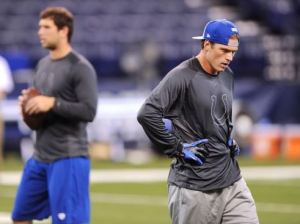
(Photo courtesy athleticbusiness.com)
By Nick Ferrara – Staff Reporter
Austin Collie started in the NFL by being a fourth round draft pick for the Indianapolis Colts in 2009. Collie is a wide receiver. Collie also played for the San Francisco 49ers, BC Lions, and the New England Patriots. Austin Collie attended Oak Ridge High School in California. His senior year, he recorded 60 receptions for a total of 978 yards and 18 touchdowns. Many awards came his way in high school; he was a PrepStar and SuperPrep All-American as well as being voted Northern California’s Most Valuable Player. After being scouted and recruited by Stanford, Arizona, Arizona State, Washington State, Oregon State, Colorado, and Utah, Collie signed with BYU. In 2004, Collie was named MWC Freshman of the Year. He was also named the MVP of the 2007 Las Vegas Bowl and all–MWC first–team receiver in 2008.
On November 7, 2010, things would change drastically for Austin Collie. A game against the Philadelphia Eagles; two defensive backs treated Austin Collie’s 6-foot, 205-pound body like a rag doll. It was two consecutive hits on both sides of his head by Quintin Mikell and Kurt Coleman; then silence. Collie laid on the turf frozen in unconsciousness. After 10 minutes inaudible and senseless, Collie was taken off the field by the medics.
For some football players, this would have been the end. Collie always wanted more football and always got up. The main issue was the concussions always kept coming. Bad hits came from the Eagles, The Steelers, The Jaguars, and more. Collie was soon known for being the king of concussions.
“A study of 2,500 retired NFL players found that those who had at least three concussions during their careers had triple the risk of clinical depression as those who had no concussions” Dr. Kevin Guskiewicz, research director of the University of North Carolina’s Center for the Study of Retired Athletes said. “Those who recalled one or two concussions were 1 1/2 times more likely to be diagnosed with depression.”
Austin Collie went from being a young, vibrant athlete for the Indianapolis Colts to out of the NFL in five years and done with football by the age of 30.
“I don’t enjoy people talking about me or tagging me to concussions,” Collie himself said in 2013 while training for an NFL comeback that never happened. “It doesn’t make me happy.”
Collie hated not being able to go back on the field. Making the decision to not play football again was one of the hardest decisions Collie had to make in his life. Collie was well aware of the science of it all and the science of his concussions. Collie studied this and relied on it heavily each time he decided to strap on his helmet and go back out on the field. Since Austin Collie decided to retire from football, he might as well pursue the science he studied so much as a football player: concussions. Collie spends most of his time at a facility in Provo, Utah that treats the very brain injury that wrecked his once-promising career with the Colts. Cognitive FX claims to be the most advanced concussion treatment center in the world.
“I’m fortunate to have found out early, in 1990, just two years after I retired, that I have neurological damage. I try to manage it. I know what can trigger headaches and try to avoid it” Hall of Fame Linebacker, Harry Carson said. “I have short term memory problems, so I make a special effort to remember people and names. I have to work harder, but it’s important.”
CFX offers world class treatment for people suffering from cognitive problems caused by injury, accident, or disease. CFX is the place to go when no other place has been able to provide the answers or solutions to your cognitive problems. In fact, CFX services have attracted professional athletes like Tom Brady and Austin Collie, who have enlisted fNCI and CFX services into their standard cognitive care regimen.
Ironically, Austin Collie, even out of retirement, can’t get away from concussions. At least now it’s of his own reconciliation. Instead of sustaining them, he’ll be researching and investigating them. Furthermore, educating athletes young and old, no matter the sport, about the injuries misconceptions. First on his agenda: Set the record straight on the impression that an athlete who suffers a concussion can’t rehabilitate. Many think time is the only medicine.
“Wrong,” Collie says. “Just because you had a head injury, people assume you’re going to keep deteriorating, that dementia is right around the corner. Not true. What we’re doing is taking a proactive approach. We’re identifying the weaknesses in the brain and making those strengths.”
Collie explains how the brain is like a muscle: it can be rehabilitated. If anyone is to know, it’s Austin Collie. He’s lived it, and felt it. After Collie’s frightening concussion in Philadelphia, he made his first stop in Utah at Cognitive FX after his first concussion. After that visit, Collie’s education began to grow and he never returned to the field without a full clearance from the doctors there. Dr. Alina Fong and Dr. Mark Allen are the ones who take care of him, a pair of leading concussion experts, along with a professional, well-trained crew. Ever since then, he’s been a regular patient, and even now undergoes regular check-ups.
During his time at the clinic, Collie was rehabbing his brain just like an injury he had in 2012 when he ruptured his patellar tendon his last season with the Colts. Both of these injuries followed the same ideas to heal themselves: rehabilitate and grow stronger from them. The brain is just like a muscle you injur. After healing his patellar tendon, he came back with the Patriots and caught 5 passes for 73 yards in two playoff games with the patriots in 2013. Which was the last season of his career in the NFL before the team electing to not bring him back to play.
“You are supposed to be tough. You are supposed to play through pain. You are not supposed to cry. We are taught that early on in the game as kids. Tough sport. Brutal sport. It’s like the gladiator” Hall of Fame Running Back Eric Dickerson said. “People want to see the big hits. They wind up on Sports Center. And as a player, you don’t want to admit you are injured.”
Collie spent one season with the BC Lions of the CFL. Attaining 43 catches for 439 yards and seven touchdowns. Collie soon realized after this season it was time for him to move on from the beautiful game he loved most, football.
Collie dug in at Cognitive FX and dove into case studies and research in an effort to learn more about the head trauma the NFL seemed to know very little about.
“For some people, one concussion is enough—they are slow to recover and they should give up the sport. But most athletes recover in 7 to 10 days.” Dr. Robert Cantu, Professor of Neurosurgery at Boston University Medical School and Co-Director of the Center for the Study of Traumatic Encephalopathy said.
Concussions are technical injuries and many people have different tolerance levels. Some are able to operate after multiple concussions, and others are unable to function after one bad one. Athletes need to know themselves and what they can handle in order to stay healthy. After one concussion, certain steps need to be taken in order to rehab that injury.
Cognitive FX has many advancements in their technology and research that makes them the most advanced concussion treatment center in the world. One advancement offered by the clinic: Instead of studying an injured brain with a simple MRI; Cognitive FX studies them with the use of an fNCI which stands for functional NeuroCognitive Image, a more powerful diagnostic assessment that picks up on more subtle impairments. The clinic claims an fNCI scan provides more information about brain function in 24 minutes of patient testing than 6-10 hours of traditional testing.
“I’ve always had an interest in medicine,” Collie said, “And hopefully that’s what my future holds.”
Athletes need to know themselves, and their limits. Many other professional athletes share Austin Collie’s story. The ability to know your body and know the steps to take once injured is something Austin Collie had a lot of time to practice. Concussions are serious injuries; but they can be rehabilitated if you allow them to.
(Some information courtesy athleticbusiness.com, burlingtoncountytime.com, bizjournals.com, indystar.com, wikipedia.org, headcasecompany.com, and stonephillipsreports.com)
 The Advocate Online