
FEATURES: “Hamilton” Shines Light On Hollywood’s Diversity Problem
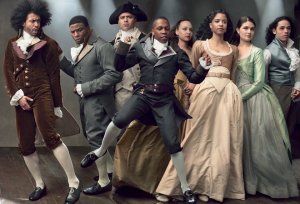
(Photo courtesy vogue.com)
By Tyler Chavez – Staff Reporter
In the heart of New York City’s Broadway stands the Richard Rodgers Theatre. Home of prominent shows such as “Guys and Dolls,” “How to Succeed in Business Without Really Trying,” and “Chicago,” the theatre holds the largest number of Tony Award winning musicals and plays with 10. Today, the theatre houses the Broadway show that has captivated the world: “Hamilton.”
“Hamilton” tells the story of founding father Alexander Hamilton. One of the lesser known founders of our country, the show uses a unique blend of hip-hop and rap to cover Hamilton’s life from his arrival in New York City to his death at the hands of a duel with Aaron Burr. But the music isn’t the only thing that has caused “Hamilton” to gain traction, the show has also become famous for its impressive cast of diversity. When the audience looks at the leads of the show, they are seeing a cast of non-white, biracial actors. The show’s creator, Lin-Manuel Miranda, is no stranger to diversity on Broadway. His previous show, “In the Heights”, was famous for the same reason as it was about a hispanic neighborhood in Washington Heights.
But the timing of “Hamilton” is also interesting. In another major entertainment industry, the past year’s Oscars awards ceremony was also under fire the exact opposite reason. For the second year in a row, all nominees for actor, actress, supporting actor, supporting actress, and director were all white, something that had not happened in decades. However, films featuring people of color such as “Straight Outta Compton”, “Concussion”, “Creed”, and “The Hateful Eight” were noticeably snubbed for major awards despite the critical and commercial success. People began to speak up as they were outraged at the lack of representation and diversity in the film industry. And then, there’s “Hamilton,” a show that is firm on its racial diversity, and has gained so much success because of it. The success of “Hamilton” and other racially diverse shows raises the argument as to how racial diversity can help Hollywood and why the film industry needs to progress and be more inclusive.
“It’s not diverse for diversity’s sake,” said Daveed Diggs, who plays both Marquis de Lafayette and Thomas Jefferson, “It’s that these are the actors who should play these parts, and it looks like America looks.”
Indeed, the cast of “Hamilton” displays a rainbow of cast members. For the first time that people can think of, founding fathers such as Aaron Burr, Thomas Jefferson, James Madison, Alexander Hamilton, and, first president George Washington, are being played by black, biracial, and Hispanic actors. Hamilton’s wife, Elizabeth Schuyler, is played by Asian-American actress Phillipa Soo. Ensemble members and King George are played by white actors, but the lead actors are all non-white, something that American media often does not see.
“Hamilton” is a story about America, and the most thing about it is…it’s told by such a diverse cast with such diverse styles of music,” said Renee Elise Goldsberry, the actress who plays Angelica Schuyler. “We have the opportunity to reclaim a history that some of us don’t necessarily think is our own.”
Renee’s quote truly resonates with many people of color who feel as if early American history is not “their” history since they were not included in the conversation and many were treated as property. They feel separated from the rest of American history. The juxtaposition of actors of color being the leads shows audience members that yes, this is a part of their history too. They are Americans and this is their American history. For the first time, they are being shown as fighters and leaders of the American Revolution.
Beyond that, children of color are also seeing people who look like them in the spotlight, something that is very rare. Growing up, the only time I heard last names like mine or heard Spanish like I did was when I watched a show like “Dora the Explorer”. There were very few Hispanic families or Hispanic children on my TV. And millions of black, Asian, and Hispanic children like me have felt the same thing. As we grew up, we saw so little traces of people like us. That shapes the way we look at the world. When all the models and stars you see on screen are white, it changes the way you look at yourself. You feel like an outsider and like a “token” when finally included. You almost never felt truly involved in the country that so frequently brags about how diverse it is.
The diversity of “Hamilton” has truly helped in its success, as the show has won a Grammy award, is among the top grossing Broadway shows of the past season, makes an average of $1.5 million a week, and is even expected to break the $1 billion mark before it leaves New York City. Celebrities and politicians, including President Obama, from all walks of stardom have gone to seen the show, praising it and spreading the word.
The success of “Hamilton” brings to attention something that has gained much traction in the past few years: diversity in media. Is there a correlation between diverse productions and success? According to a UCLA study conducted between 2012 and 2013, yes. Films with relatively diverse casts also saw the biggest global box office returns. On the television side, the 2014 Hollywood Diversity Report showed that TV shows with casts of 41 to 50% non white characters earned the highest revenue.
The proof is in the numbers; diverse TV shows and movies sell. People want to see more than just largely white casts. People of color want to see people who look like them in movies and shows. And when studios get it right, they’re making more money. And yet, the numbers are also showing that these same media outlets are not featuring enough representation and are under-representing people of color and women.
Even though nonwhite minorities represented 36% of the population in 2010 (and that number is expected to quickly ascend into the majority within the near future decades), they filled just 5.1% of lead roles in broadcast TV comedies and dramas. They also had only 10.5% of lead roles in film. The numbers get even worse when you learn that only 2.3% of films had casts with diversity percentages similar to the general population. The data is almost shocking. A country that frequently boasts on how much of a “melting pot” it is does not even remotely represent that on screen.
Women are being treated to a similar under-representation. According to the UCLA report mentioned earlier, in 2013, women only made up 25% of lead actors in film. Despite the obvious pool of talent to choose from Emma Watson to Jennifer Lawrence, women are given the short end of the stick. But if you notice, the names I mentioned are white women. Women of color are going to be given even less representation compared to their already underrepresented white co-workers. But there is some hope. TV shows with nonwhite, female leads such as “Jane the Virgin,” “How to Get Away with Murder,” and “Empire” are receiving critical and commercial success. The time are changing, but they are changing too slow compared to the general population.
The lack of diversity has stirred up quite a controversy in recent years. That controversy reached its tipping point this past year with the “Oscars So White” fiasco. People of color not being appreciated in the Academy Awards is nothing new, but 2015 was an especially bad. For the second year in a row, the nominees for actor, actress, supporting actor, and supporting actress were all white. That is not even including films such as “Straight Outta Compton”and “Creed” which were snubbed for directing and writing nominations (even though Sylvester Stallone, one of the few white actors in “Creed” picked up a nomination for best supporting actor), and “Salma” which was also snubbed in 2014 for multiple awards. This also does not include the fact that no Asian actress has won an award in 58 years, and no Latina in general has taken an award home in 54 years.
The anger about the lack of diversity led multiple prominent black film stars such as Spike Lee and Will and Jada Pinkett Smith to boycott the Oscars, calling for reform in the executive offices of film and TV studios. Host Chris Rock ripped the Academy in his opening monologue, referring to the Oscars as “the White People’s Choice Awards” among other jokes about the lack of diversity. He finished the show by proclaiming, “Black lives matter.”
Beyond the numbers showing the revenue and backlash from colored communities, diverse casts are something that many people want to see themselves. One of the biggest draws to “Hamilton” was that
If there was any doubt about it before, it is clear now to see that Hollywood and American media in general has a diversity problem. The fact that productions like “Hamilton” need to be put in the spotlight because it is so diverse says enough. In a perfect world, diverse casts would be the norm and would not need to be beacons of light.
And even though all the numbers show that diverse casts make more money, Hollywood continues to snail towards the finish line that is diversity. Which brings us back to “Hamilton”, the show that for so many people has sparked the conversation on diversity in media. As the Broadway hit edges closer to a national tour, the producers have already made it clear that they want to continue the theme of a diverse cast when the show hits the road, leading some to become angry as they saw it as an “anti-white” movement (even though the show’s creators have made it clear that diversity is a major aspect of the show, as it would be for a show like “In the Heights”).
As show creator Lin-Manuel Miranda Jr. and his cast continue to rake in revenue and awards (they just broke a record 16 Tony nominations), time will only tell if Hollywood and other media outlets will take note and move towards diversity. The future seems bright to many as the topic is finally getting recognition, and TV studios have also seen the benefit of diverse casting, but only time will tell if American media learns a lesson from “Hamilton” and embraces diversity.
(Some information courtesy of npr.org, huffingtonpost.com, thegeektwins.com, passionweiss.com, deadline.com, ew.com,.latimes.com)
 The Advocate Online