
ENTERTAINMENT: Benedict Cumberbatch Shines In “The Imitation Game”
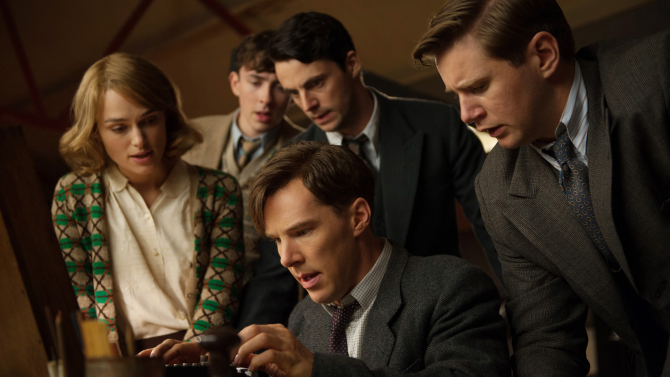
(Photo courtesy variety.com)
By Ian Hugo – Staff Reporter
“Sometimes it is the people who no one imagines anything of who do the things that no one can imagine.”
This is certainly not the case for Benedict Cumberbatch, star of Morten Tyldum’s “The Imitation Game.”
Cumberbatch, who has previously acted in big name pictures such as the BBC’s “Sherlock” in which he starred, “The Hobbit” films as Smaug and the Necromancer, and “Star Trek Into The Darkness” as Khan, portrays Alan Turing flawlessly.
“The Imitation Game,” based on Andrew Hodges’ book, “Alan Turing: The Enigma,” surrounds Alan Turing, a young British mathematician working for the British government during World War II as Britain attempted to crack Nazi Germany’s Enigma code, a seemingly impossible secret code used to communicate messages right under the Allies’ noses.
The film is a combination of flashbacks to Turing’s past as a child and as a codebreaker during the second World War and scenes in which we see Turing being investigated and questioned by the police in 1951.
Turing arrives at Bletchley Park, the site for the United Kingdom’s Government Code and Cypher School, in 1939 seeming awkward, humorless, and distant to his five fellow code-breakers including Hugh Alexander (portrayed by Matthew Goode), a man twice crowned chess champion of Britain.
Turing believes that a team will only slow him down, and with 159 million possibilities to try, time is certainly of the essence. The problem is, it would take 20 million years to try each and every possibility, and the team of six young geniuses from Britain only has 18 hours each day from when the first message is received at 6 am before the code resets at midnight and they must start from scratch.
Keira Knightley stars alongside Cumberbatch as Joan Clarke, a seemingly commonplace British woman who is in fact a mathematical genius. Clarke assists Turing and the rest of the code-breaking team in solving the Enigma code under the guise that she is doing clerical work at Bletchley.
Clarke also helps Turing hone his social skills and soon enough Turing begins to become accepted by his team and even tells a them a joke, something he was once criticized for not knowing the meaning of by Commander Denniston, head of GC&CS, in a rather touching scene in which Cumberbatch masterfully evokes the nervousness and diffidence of someone who is attempting to exit their shell and leaves everyone in the audience with a smile on their face.
Flashbacks to Turing’s childhood provide the audience with insight surrounding Turing’s childhood: his early experience with cryptography and personal information that could possibly explain why Turing is so withdrawn and unsociable as an adult.
The film follows Turing as he navigates his way through building the machine that broke the unbreakable code, forbidden relationships in both youth and adulthood, uncovering a Soviet spy in his midst, and the slow, painful torture Turing was subjected to at the end of his life cut short by the injustice of the British government.
Fans of the BBC’s crime-thriller “Sherlock” in which Cumberbatch stars will almost definitely be enchanted by this film. Cumberbatch plays Turing magnificently, and once again proves that although he may not be considered a genius in terms of IQ level like some of the characters he portrays (Fictional characters such as Sherlock Holmes and Khan Noonien Singh as well as actual geniuses that include Alan Turing and Julian Assange), Cumberbatch is a genius of film.
Rating: 4.5 out of 5 stars
 The Advocate Online