
OPINION: Ayn Rand’s Economic Predictions Are Coming True
 By Josh Weizel – Editorial Editor
“Atlas Shrugged,” by Ayn Rand, is set in a dystopian United States where the producers of society go on strike because the government has increased the number of regulations and enacted policies of regressive taxation. As a result of this, the economy collapses and the citizens go hungry. Some religious leaders believe that Rand presents an amoral individualist ideology, one where people look out for themselves instead of for those most in need. There are some that believe that Rand’s book has never been more important than it is now and that the prophecy is coming true.
Consider the following: Does the U.S. has a tax code that punishes job creators that produce the goods and services that society needs? Is there a tax code that is 17 % of GDP? How can jobs be created when the government punishes the very producers that create the very jobs that society needs? The truth is government bureaucrats cannot create jobs instead they can only destroy productiveness. Every dollar that is taken out of the private sector to support these government job programs is taken from the productive sector. Could the government allocate more competitive programs in health care than the private sector?
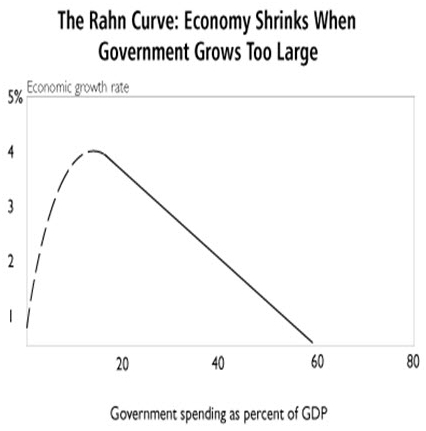
The evidence is overwhelming that this is not true. Economists James Gwartney, Randall Holcombe and Robert Lawson tested the impacts of government spending and the impact it has on economic growth in 23 Organization for Economic Cooperation and Development member countries (OECD). The differences in the domestic policies of these countries lead to different results. The data showed that wherever there was an increase in governmental spending and where government got bigger, the economic growth rate of the economy fell.
These are not just conservative talking points. These are just plain and simple facts and, according to the OECD study, the fact is that every 10 percent increase in government spending leads to a decrease in economic growth of about one percent. Sometimes facts are hard in politics because politicians don’t want to face the facts that ideologies of endless spending and printing and money does not work in a practical world. Facts are hard for politicians in both parties, including Democrats, who want to spend endless money on the welfare state, and Republicans, who want to spend endless amounts of money for militarism and nation building around the world.
Some people argue that cutting spending will lead to less economic growth, but that is just not true. In order to really cut government spending, the U.S. needs to change its overall ideology of government and realize that bureaucrats in government cannot solve the nation’s problems more effectively than individuals. In order to have a nation that creates jobs, the government needs to stop these regulations that prevent job creators from being productive.
Why is it that whenever there is one economic disaster caused by government regulations, government bureaucrats are always asking for additional interventions in the economy? This is a trend that Rand referenced in her book. Whenever there is economic disaster and shortages of food caused by government in “Atlas Shrugged” the government bureaucrats are always calling for more intervention. An example of this is the economic collapse and housing bubble in 2008 which were not caused by a so-called “prehistoric free market.” Those on the left would like to pretend that was the case, but the truth is the housing bubble was caused by the government encouraging loans to people who were not eligible for loans.
The people who favor more interventions and a crackdown of so-called corporate monopolies don’t realize that government control leads to whole new monopolies. Despite what progressives argue about the danger of corporate monopolies, there is not as much danger in corporate monopolies as there is in government monopolies. Milton Friedman, a conservative and libertarian economist, said it best when he said, “The great disadvantage of either government regulation or operation of monopoly is that it is exceedingly difficult to reverse.” Like it or not, the U.S. makes the most obscure and regressive regulations. The most obscure thing about the regulatory system is that almost any type of business activity requires a license. Did you know that in some states, a degree is needed to submit applications to certain business? Despite what progressives argue about government regulation helping the little guy against evil corporations, the facts are that government regulations have a huge effect on small business. People who have never owned a small business cannot comprehend the amount of paperwork and the cost of all of these the regulations.
The people who advocate for more government control of the economy make legitimate point that the poor and middle class cannot get by in the current system and that the U.S. needs to provide a level playing field to give people more opportunities. What these people fail to realize, though, is the excessive government spending and regulations and taxation hurt the most vulnerable. In order to cut regressive taxes, those in government need to walk away from that idea that collectivism is superior to the inherent worth of the individual. The U.S. cannot make the same mistakes that socialist countries like the Soviet Union once made. It is amazing how there are those who want to experiment with the ideas of socialism in the U.S. even though that type of system has continuously failed throughout history.
(Some information courtesy theheritagefoundation.com, finance.townhall.com, and usatoday.com)
(Photo courtesy whatamimissinghere.com)
 The Advocate Online